wayground logo

Free Printable Worksheets

Font size

S
M
L
XL
Worksheets

Ag Environmental Science WebXam Review #1

Total questions: 50

Worksheet time: 56mins

Name
Class
Date
1.

What is a material found on the surface of the earth consisting of rock, sand, clay, dead plants, and animal remains?

a)

silt

b)

soil

c)

bedrock

d)

loam

2.

What is the layer of soil just below the topsoil?

a)

soil

b)

subsoil

c)

topsoil

d)

terrace farming

3.
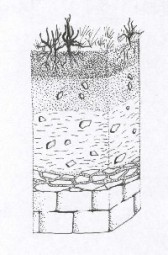
Which layer of soil are these roots growing in?
a)
subsoil
b)
topsoil
4.
What is the layer of soil that contains humus, leaf litter, and other organic matter?
a)
O - Organic
b)
A - Topsoil
c)
B - Subsoil
d)
R - Bedrock
5.
Which layer is the bottom of the soil profile?
a)
C - Partially Weathered Parent Material
b)
D - Separated rock
c)
R - Bedrock
d)
A - Topsoil
6.
Layers of soil are also known as:
a)
Soil Profiles
b)
Soil Horizons
c)
Soil sheets
d)
Soil cores
7.
Which of the following is NOT one of the three layers of soil?
a)
topsoil
b)
undersoil
c)
subsoil
d)
bedrock
8.
Ellen grabs a topsoil sample in her hand. She rolls it into a ball. The soil feels gritty and the ball falls apart. What part of the topsoil most likely made the topsoil feel gritty?
a)
clay
b)
sand
c)
silt
d)
humus
9.
The texture of soil depends mainly on
a)
the types of plants that grow in the soil.
b)
the size of the particles in the soil.
c)
the color of the soil.
d)
the number of worms in the soil.
10.

The O Horizon contains mostly..

a)

Organic Matter

b)

Rocks

c)

Boulders

d)

Houses

11.

Reorder the following soil layers from BOTTOM layer to TOP layer.

a)

Bedrock

b)

Parent Material

c)

Subsoil

d)

Topsoil

e)

Humus

1)
2)
3)
4)
5)
12.

What part of the soil is the A-horizon?

a)

subsoil

b)

bedrock

c)

topsoil

d)

rocks

13.

What is the process by which rock is broken down into smaller particles by exposure to the elements?

a)

Weathering

b)

Erosion

c)

Profiling

d)

Deconstructtion

14.

Which component makes up approximately 5% of soil?

a)

Air

b)

Water

c)

Minerals

d)

Organic Matter

15.

Which component of soil makes up about 45% of its composition?

a)

Air

b)

Water

c)

Minerals

d)

Organic Matter

16.

What is the size of sand in diameter?

a)

> 2mm

b)

2mm-0.05mm

c)

0.05mm-0.002mm

d)

<0.002mm

17.

What is the size of silt in diameter?

a)

> 2mm

b)

2mm-0.05mm

c)

0.05mm-0.002mm

d)

<0.002mm

18.

What is the size of clay in diameter?

a)

> 2mm

b)

2mm-0.05mm

c)

0.05mm-0.002mm

d)

<0.002mm

19.
In nature two species rarely occupy the same niche.  If a new species is introduced to an an ecosystem, what will occur between the new species and the native species?
a)
Predation
b)
Division of prey
c)
Competition
d)
Succession
20.
A __________ includes all living and non-living things in an environment. 
a)
population
b)
niche
c)
abitotic
d)
ecosystem
21.
_______ are consumers that eat only meat.
a)
Herbivore
b)
Omnivore
c)
Carnivore
22.
Which group do fungi, bacteria, and termites belong to?
a)
decomposers
b)
producers
c)
herbivores
d)
omnivores
23.
Which organism make their own food through the process of photosynthesis? 
a)
decomposer
b)
consumer
c)
herbivore
d)
producer 
24.
Field mice eat corn. Which would most likely happen if the field mouse population grew?
a)
There would be more corn to feed the field mice.
b)
There would be less corn due to the mice eating it.
c)
The habitat would get overpopulated because the mice woudl eat too much.
25.
If the population of prey increases, the population of predators will ________because of the availability of food.
a)
decrease
b)
stay the same
c)
increase
26.
How does energy enter an ecosystem? 
a)
sunlight
b)
soil 
c)
animals 
d)
invasive species 
27.
A lion, captures and eats other animals. What is he considered? 
a)
prey
b)
predator
c)
producer 
d)
healthy 
28.
How do consumers get their energy? 
a)
laying in the sun
b)
eating other organisms 
c)
providing food for other organisms
d)
surviving in an ecosystem 
29.
Remoras are small fish that swim close to or attach themselves to sharks.  Remoras eat small scraps left as the sharks feed and the sharks are unaffected. What kind of relationship is this?
a)
Competition
b)
Predation
c)
Mutualism
d)
Commensalism
30.
Clown fish live among anemones acting as a lure for the sea anemone’s prey. The clown fish gets protection and shelter from the anemone.  What type of relationship is this?
a)
parasitism
b)
commensalism
c)
mutualism
d)
predatation
31.
A series of changes that occur in an ecosystem after a disturbance
a)
secondary succession
b)
primary succession
c)
primary election
d)
secondary consumer
32.
When is a substance called a limiting nutrient?
a)
When the nutrient is scarce or cycles very slowly
b)
When the nutrient can only be used by limited organisms
c)
When the nutrient limits the speeds of surrounding molecules
d)
There is no such thing as a limiting nutrient
33.

Match the following terms to their description or definition.

a)

Herbivore

1.

An organism that only consumes plants,

b)

Omnivore

2.

An organism that consumes plants or animals

c)

Carnivore

3.

An organism that only consumes animals

d)

Detritivore

4.

An organism that consumes on dead organic material.

34.

Match the following terms to their description or definition.

a)

Autotroph

1.

Self feeder; an organism that makes its own food.

b)

Heterotroph

2.

Different feeder; an organism that must consume other organisms to survive

c)

Producer

3.

An organism that produces its own food.

d)

Consumer

4.

An organism that consumes food from other organsims

35.

An organism eats berries and fish. It is a...

a)

consumer (herbivore)

b)

producer

c)

decomposer

d)

consumer (omnivore)

36.

Which of the following is a heterotroph? Select all that apply.

a)

Bear

b)

Grass

c)

Mountain Lion

d)

Rabbit

37.
Conservation biology provides ways to preserve _____. 
a)
Threatened and endangered species
b)
Human comfort
c)
Captive populations
38.
What is a habitat? 
a)
The place or environment where a plant or animal grows most quickly. 
b)
The place or environment where a plant or animal natural or normally lives and grows. 
c)
The place or environment where a plant or animal are most numerous. 
39.
Which of these is not one of the two goals of almost every conservation plan? 
a)
To protect a species from harm
b)
To be as sustainable as possible
c)
To protect the species' habitat
40.
Which one of the following is not a possible consequence from enhanced global warming?
a)
lower sea levels
b)
methane escaping from melting permafrost
c)
extermination of species
d)
Greenland ice melting
41.

Which of the following principles is not valid to contribute to sustainability...

a)

Reduce our dependence on fossil fuels

b)

Reduce the destruction of nature

c)

Stopping using technology

d)

Buying only things we really need

42.

Non-biodegradable waste cannot be broken down by nature.

a)

True

b)

False

43.

Cutting down trees is always bad for the environment.

a)

True

b)

False

44.
The careful and responsible management of something that is entrusted ones care is called? 
a)
Stewardship 
b)
Environmental Science 
c)
Conservation  
d)
Restoration  
45.

The economy is the total of all activities for the purpose of...

a)

producing, marketing and selling goods and services in a country

b)

creating, designing and exploring goods and services in a country

c)

producing, distributing and consuming goods and services in a country

d)

producing, distributing and selling foods and services in a country

46.

Supply represents...

a)

how much of a product or service the market has to offer

b)

how much of a product that the customer wants to buy

c)

how many goods are available for purchase

d)

how much of a product or service that buyers want to sell

47.

Exports are...

a)

goods and services that are purchased from overseas businesses

b)

goods and services that are exported to overseas governments

c)

goods and services that are sold domestically to the household sector

d)

goods and services sold by local businesses to overseas consumers

48.

Capital is...

a)

the money or cash on hand that a business has at their disposal

b)

all the equipment used by human labour in the process of production

c)

all the equipment used when to create goods and services for the consumers

d)

the resources required to produce goods and services for consumers

49.

Goods are...

a)

goods are sold at supermarkets for consumption

b)

goods are intangible items that cannot be seen or touched

c)

goods are actions done by businesses for consumers

d)

goods are physical, tangible products that can be seen and touched

50.

A service is...

a)

are the products offered by businesses

b)

are companies that offer business to consumers

c)

are physical, tangible items that can be seen and touched

d)

the actions that are done by businesses for consumers