
 Worksheets
watershed review
Total questions: 15
Worksheet time: 8mins
Name
Class
Date
1.
Farmers can best reduce negative effects on the water quality of nearby streams and lakes by planting crops that —
a)
produce less oxygen
b)
produce less carbon dioxide
c)
need less fertilizer
d)
need less solar energy
2.

How do the industrial, agricultural, and residential activities of humans most likely affect the
groundwater in the area?
a)
The activities prevent most of the water from evaporating into the atmosphere.
b)
Pollutants from the activities percolate through the soil and enter the water table.
c)
The activities replace the groundwater used.
d)
All of the above
3.

The movement of colored water through the gravel best models —
a)
condensation of water vapor
b)
surface runoff of precipitation
c)
conservation of water
d)
pollution of groundwater
4.

The model shows an area near a lake. Community leaders are planning new laws to help
protect the lake from pollution. One proposed law will make it illegal to dump trash on the
shore of the lake, but the law still allows trash to be placed in the area labeled “Flow-through
wetland.”
Which statement about the proposed law is supported by the model?
a)
The proposed law will protect the lake because plant roots between the wetland and the lake will stop pollution from entering the lake.
b)
The proposed law will not protect the lake because groundwater will carry pollution from the wetland directly into the lake.
c)
The proposed law will not protect the lake because animals that live in or near the lake will add pollution to the lake.
d)
The proposed law will protect the lake because the high elevation of the water table will block pollution from entering the lake.
5.

How does the agricultural activity most likely affect the surface water of the area?
a)
Excess crop fertilizer is carried by runoff into the river, causing excess growth of water plants.
b)
Excess crop material accumulates on the riverbanks, slowing the movement of the river water
c)
Crops reduce erosion, increasing the amount of soil entering the river.
d)
Crops absorb pure water from soil, causing the remaining water to contain more salt.
6.

Pollution from human activity often ends up in lakes and oceans due to
watersheds. Which part of the diagram is most responsible for this movement?
Select the correct answer.
a)
Precipitation
b)
Condensation
c)
Runoff
d)
Evaporation
e)
Lake
7.

The picture below models runoff from a mine into local watersheds. The runoff will affect local watersheds in all of the following ways EXCEPT —
a)
by contaminating the lake with heavy metals.
b)
by increasing sediments in the stream.
c)
by increasing the number of animals that live in the lake or stream.
d)
by introducing acid rock drainage to the lake and stream.
8.
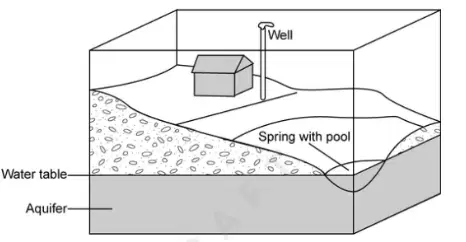
When an area is experiencing drought, humans may excessively pump groundwater out of
aquifers like this one. All of the following are effects of this excessive pumping EXCEPT —
a)
groundwater depleting.
b)
the water table rising.
c)
soil collapsing.
d)
water quality decreasing.
9.
Highly developed regions contain large amounts of fertilizers in their soil due to yard
maintenance. When these fertilizers are released from the soil, they enter local ponds, where
they deposit an unusually high amount of organic matter. This excessive organic matter leads
to massive algal blooms. What is the most likely result of the fertilizer entering the pond?
a)
An increase in light received by organisms that live below the water's surface
b)
An increase in the diversity of the organisms in pond
c)
A decrease in light received by organisms that live below the water's surface
d)
A decrease in the amount of soil and sediment at the bottom of the pond
10.
The volume of Earth's groundwater is estimated to be 50 times the volume of freshwater
found on Earth's surface. Sometimes, communities use up groundwater faster than the water
can renew itself. What effect does this have on these communities?
a)
Communities must dig deeper wells to reach a lower water table.
b)
Communities must stop using water until the groundwater is replenished.
c)
Communities have to relocate to areas with more groundwater.
d)
Communities are forced to use reclaimed water, only.
11.

The table shows the amount of water in a particular groundwater aquifer over ten years.
A new human community was built near the aquifer at some point in the last ten years. In
which year was the community most likely built?
a)
year 3
b)
year 5
c)
year 7
d)
year 9
12.
All of the following are reasons for protecting watersheds except—
a)
They provide drinking water.
b)
They promote pollution
c)
They sustain wild life
d)
They provide recreation
13.

A company known as Arten Industries is wanting to build a factory in the watershed that is
pictured.
The company wants to limit the ecological impact it has on surrounding areas. What would
be the worst location for the factory?
a)
At the top of the river.
b)
Away from the river.
c)
At the middle of the river.
d)
At the bottom of the river.
14.

As the map shows, there are multiple drainage basins in Texas.
Ft. Worth and Dallas are in the same drainage basin. What is the most likely reason that the
water in the Trinity River is dirtier in Houston than it is in Dallas?
a)
Ocean pollutants are entering the river.
b)
Pollutants are entering from other drainage basins.
c)
The river basin picks up more human pollutants.
d)
The water goes through a salt dome and get more polluted.
15.
John was changing the oil in his truck. He dumped the used oil around a fence post to keep
weeds from growing. John didn't know it, but he was hurting the environment because the oil
a)
rots the base of the fence post and attracts harmful insects
b)
goes deep into the ground and pollutes the groundwater
c)
kills weeds and they are an important part of the environment
d)
attracts more insects that will take over his yard
100 %

