
 Worksheets
Science Final 60-74
Total questions: 15
Worksheet time: 8mins
A student leaves her home and walks 300 m east to the library, 250 m
east to the bakery, and then 400 m west to the post office. What is her
total displacement?
A. 150 meters east
B. 350 meters west
C. 400 meters west
D. 950 meters east
Why can an object’s distance traveled and its displacement be different?
A. because distance depends on time, while displacement depends on
direction
B. because distance depends on direction, while displacement depends
on time
C. because distance includes magnitude, while displacement includes
magnitude and direction
D. because distance includes magnitude and direction, while
displacement includes magnitude
A student walks on a track which is 400 m around. To complete one lap,
the student begins at the starting line, walks all the way around the
field, and ends back at the starting line. If the student walks four laps in
1,800 s, what is the student’s total distance traveled and their
displacement?
A. Distance is 0 m and displacement is 1,600 m, because the student
returned to the starting point.
B. Distance is 1,600 m and displacement is 0 m, because the student
returned to the starting point.
C. Distance is 1,600 m and displacement is 3,200 m, because
displacement is twice the distance traveled.
D. Distance is 3,200 m and displacement is 1,600 m, because distance
traveled is twice the displacement.
A student walks around a track that is 100 m around. To complete one
lap, the student begins at the starting line, walks all the way around the
track, and ends up back at the starting line. If the student makes four
laps in 1,800 s, what is the total displacement of the student?
A. 0 m, because the student returned to the initial point of motion
B. 100 m, because the student went the total distance of the track
C. 400 m, because displacement and distance traveled are the same
D. 800 m, because displacement is twice the distance traveled
A student walks 5 meters north, then turns and walks 3 meters south.
What is the student’s displacement?
A. 0 meters, because the student returned to the starting point
B. 2 meters north, because the student turned around during travel
C. 5 meters north, because the magnitude of the student’s displacement
is equal to the initial distance traveled
D. 8 meters north, because the magnitude of the student’s displacement
is equal to the total distance traveled
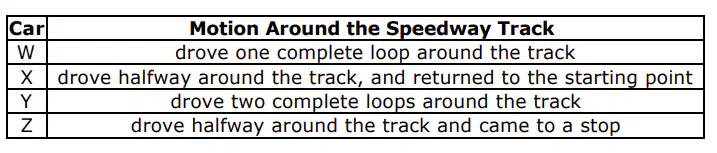
Four cars drove on a 2.5 km speedway track. The chart below describes
the motion for each car.
Which car had the greatest displacement?
A. Car W, because it went around the track once
B. Car X, because it traveled half the loop and returned to start
C. Car Y, because it went around the track twice
D. Car Z, because it did not return to the starting point
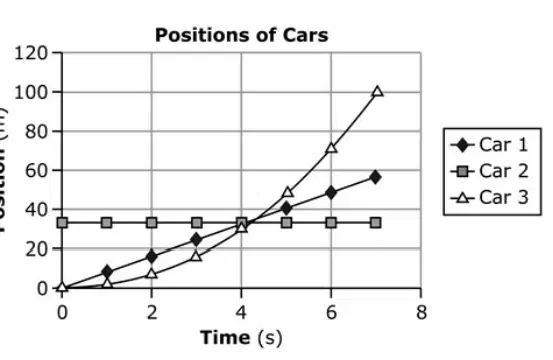
The graph below shows the positions of three cars over time.
Based on the graph, what is true about these cars?
A. Car 1 and 3 are moving, unlike Car 2.
B. Car 2 and 3 are increasing in speed, unlike Car 1.
C. They all have the same speed when t = 6 s.
D. They all have a negative acceleration.
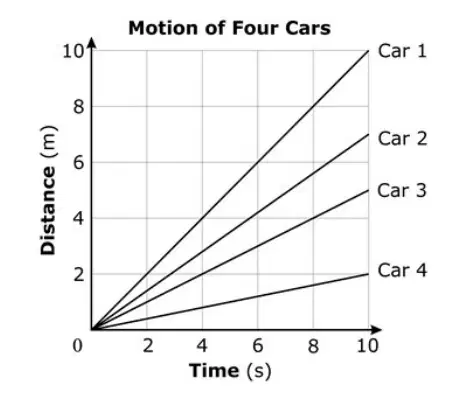
This graph shows the motion of four cars.
Which car has the greatest velocity?
A. Car 1
B. Car 2
C. Car 3
D. Car 4

The graph below shows the motion of four cars.
Based on the graph, which statement about all the cars is true?
A. They are moving at a constant speed.
B. They are changing their speed during travel.
C. They are slowing down.
D. They are stopped.
An 845.0-kg car travels north down a highway with a velocity of 22.0 m/s. A 1,325-kg truck is traveling behind it, in the same lane, with a velocity of 15.0 m/s. How does the truck’s momentum compare with the car’s momentum?
A. The momentum of the truck is greater than that of the car by 1.29 x
10 kg•m/s.
B. The momentum of the truck is greater than that of the car by 4.73 x
10 kg•m/s.
C. The momentum of the truck is less than that of the car by 69.0
kg•m/s.
D. The momentum of the truck is less than that of the car by 1.50
kg•m/s.
How does speed compare to the velocity of an object?
A. Speed has direction, while velocity does not.
B. Velocity has direction, while speed does not.
C. Both speed and velocity include the direction of an object.
D. Neither speed nor velocity include the direction of an object.
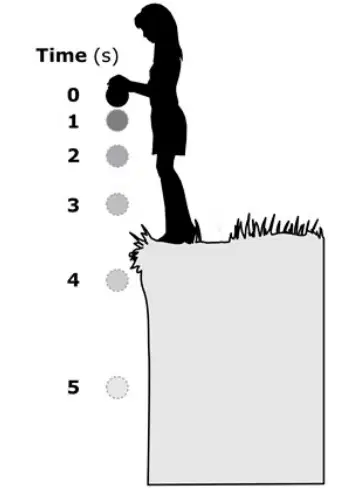
This diagram shows a ball being dropped from a cliff.
How does the acceleration of the ball compare from when time = 3 s to
when time = 4 s? (Ignore air resistance.)
A. The rate of acceleration for the ball is zero.
B. The rate of acceleration for the ball is halved.
C. The rate of acceleration for the ball is the same
D. The rate of acceleration for the ball is doubled.
2. How does the momentum of a car change when it goes from a velocity of
40 m/s eastward to a velocity of 80 m/s eastward?
A. It doubles.
B. It is halved.
C. It quadruples.
D. It remains constant.
This list describes the motion of a deer:
First, the deer moved north for 122 minutes, traveling 10,500 meters.
Next, the deer stopped and then remained stationary for 21 minutes.
Finally, the deer moved south for 27 minutes, traveling 7,500 meters.
What was the deer’s average velocity for the entire motion, measured in meters per
minute?
A. 0.01 meters per minute, south
B. 0.057 meters per minute, south
C. 17 meters per minute, north
D. 100 meters per minute, north
A car traveled 27 miles north, turned around, and then traveled 18 miles
south. What was the car’s average velocity if the whole trip took 1.5
hours?
A. 6 miles/hour, north
B. 6 miles/hour, south
C. 30 miles/hour, north
D. 30 miles/hour, south

