
 Worksheets
MC Copy of Unit 5 Lesson 1 Quiz: Natural Selection Explains How Populations Can Change- Moss
Total questions: 10
Worksheet time: 5mins
Name
Class
Date
1.
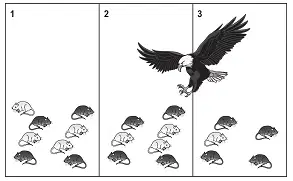
The picture shows the changes over time in a population of mice in the wild after an eagle has moved into its environment. The white and dark mice differ only in color.
Which statement is the most likely explanation for why the mouse population changed over time?
a)
A. The white mice are able to reproduce more successfully than the dark mice do.
b)
B. The eagle ate more dark mice than white mice because the dark mice taste better.
c)
C. The eagle ate more dark mice than white mice because it can see the dark mice more easily.
d)
D. The eagle ate more white mice than dark mice because it can see the white mice more easily.
2.
Scientists have been observing salamanders in an area over a long period of time and have recently discovered that there now may be multiple species of salamanders in the area. What method could they use to determine if speciation has occurred?
a)
A. Observe their habitats for similarities.
b)
B. Determine whether they have the same physical markings.
c)
C. Test to see if the salamanders consume the same food sources.
d)
D. Study their reproductive habits to see if they are able to mate with one another.
3.
In order for evolution to occur, which of these conditions must be met?
a)
A. Populations need to be willing to adapt to their environment.
b)
B. Genetic variation needs to exist in the traits of the population.
c)
C. All organisms in the population should have the same phenotype.
d)
D. The allele frequencies for each allele of a particular trait must be equal.
4.
Which of these describes a likely reason why a species would become extinct after a major environmental change?
a)
A. The environmental change means fewer predators are around.
b)
B. There are more homes for the species in the changed environment.
c)
C. The change in the environment opens new resources with less competition.
d)
D. There are not enough members of the species born with a trait necessary to survive in the new environment.
5.
Scientists are observing a population of insects living in a warm, dry climate over time. Which piece of evidence would not indicate evolution in the population has occurred?
a)
A. The phenotypes of the population remain the same.
b)
B. The distribution of traits in a population has shifted.
c)
C. The population is better adapted to survive in its environment.
d)
D. The allele frequency of a particular form of a gene has increased.
6.
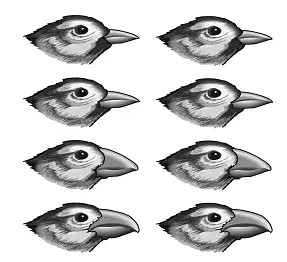
Charles Darwin studied the finches of the Galápagos Islands and found that their beaks vary in shape and size.
Darwin found that the finches that ate mostly insects had long, narrow beaks. Finches that ate mostly seeds had shorter, broad beaks to crush the seeds. Which statement best describes how natural selection resulted in the four types of finches shown?
a)
A. The residents of the Galápagos Islands selectively bred together finches having the traits that they wanted them to have.
b)
B. The narrow-beaked finches came first and evolved into the broad-beaked finches through a series of natural mutations.
c)
C. The broad-beaked finches wore down their beaks digging for insects and passed these narrower beaks on to their offspring.
d)
D. Over time, the finches that were born with beaks better suited to the available food supply in their habitats survived and reproduced.
7.

The picture shows an arctic fox.
The arctic fox is uniquely adapted to its environment with white fur for camouflage, a small nose and ears and warm coat to prevent heat loss and strong paws for running and hunting. Which statement best describes how the arctic fox population may have adapted to its environment over time?
a)
A. Foxes were bred to meet human needs for white fur.
b)
B. Foxes developed smaller ears and noses in response to their cold climate. They were able to survive and pass this trait on to their offspring.
c)
C. Foxes changed their fur to white to hide from predators and disguise themselves from their prey. They were able to survive and pass this trait on to their offspring.
d)
D. Variation existed in the traits of the fox population. Foxes with smaller ears and noses were able to stay warmer and were more likely to survive and reproduce to pass their genes on to offspring. Over time, the fox population showed a shift to smaller ears and noses.
8.
What is NOT an example of an adaptation, and how does the adaptation help the organism survive in a changing environment.
a)
California Coastal Salamanders look like poisonous newts
b)
Galapagos Finches that have larger beaks can survive droughts
c)
California Salamander in San Diego that has the skin of the Coastal Salamanders and the patterns of the inland Salamanders.
d)
Frogs from the Sonoran Desert in Mexico that squirt blood from their eyes.
9.

Two finches are shown.
Assume that each finch comes from a large population of similar finches in its particular environment. Imagine a drought in the environment of Finch 1 makes the small seeds they normally feed off of scarce. What is NOT how natural selection could cause the population of finches in the first group to evolve over time to resemble the population of Finch 2.
a)
The finch with the larger beak would be able to eat the larger harder seeds.
b)
The finch with the larger beak would be able to pull small worms out of trees.
c)
Having a larger beak would help them survive and then reproduce.
d)
Over time their offspring would have a larger beak.
10.
Suppose a population of crabs in a certain tidal ecosystem thrives. These male crabs have one large claw and one small claw, but variation exists in the size of the large claw. They wave the large claw to attract females to their burrow. Females are attracted to males with larger claws. Which crabs will NOT be likely to have more offspring in this environment and why?
a)
The crab with the small claw because it can hide from its predators to survive.
b)
The crab with the large claw because it allows the males to attract more females.
c)
The crab with the large claw because it has access to females that the other crabs don't.
d)
The crab with the large claw because it is more likely to reproduce.
100 %

