wayground logo

Free Printable Worksheets

Font size

S
M
L
XL
Worksheets

Unit 4: Energy and Unit 6: Simple Harmonic Motion

Total questions: 63

Worksheet time: 2hrs 24mins

Name
Class
Date
1.
Kinetic Energy is defined as
a)
Energy stored due to its location
b)
Energy of motion
c)
Energy stored in the bonds of molecules
d)
Heat energy
2.
You drop a 5 kg ball from a height of 2 m. Just before it reaches the ground, what type of energy does it have?
a)
Potential Energy
b)
Kinetic Energy
c)
Nuclear Energy
d)
Chemical Energy
3.

The unit for energy and work is

a)

J

b)

N

c)

m/s

d)

m/s/s

4.
A 5 kg ball is lifted 12 m above the ground. It's gravitational potential energy is
a)
60 J
b)
600 J
c)
17 J
d)
2.4 J
5.
The law of conservation states that
a)
every action has an equal and opposite reaction
b)
all matter has thermal energy
c)
energy cannot be created or destroyed, only changes form
d)
heat moves from an object of higher temperature to an object of lower temperature
6.
The ability to do work is called
a)
energy
b)
thermal
c)
kinetic
d)
potential
7.
Mechanical energy can be either potential or ________.
a)
Motion
b)
Kinetic
c)
Chemical
d)
Light
8.
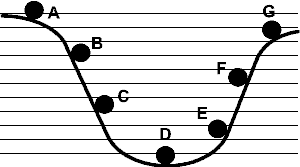
Which position has the most kinetic energy?
a)
A
b)
G
c)
D
d)
B
9.
Which position has the most potential energy?
a)
A
b)
G
c)
C
d)
D
10.
A pendulum is released from point C.  Which statement is correct as it  swings from C to A?
a)
The PE increases and KE decreases
b)
The KE increases and PE decreases.
c)
The PE is maximum at A.
d)
The KE is maximum at C and B.
11.
Which of the following is an example of a transformation of potential energy to kinetic energy?
a)
a truck slowing down
b)
a car climbing up a hill
c)
an airplane traveling at constant speed
d)
falling object
12.
How are work and energy related? 
a)
The work done by an external force acting on an object causes a change in the mechanical energy of the object.
b)
Work is the same thing as energy.  They are equal. 
c)
Energy is m*g*h, and work is 1/2*m*v2
13.
A 40 kg crate is picked up by a crane to a height of 50m. The crate falls. What is the velocity of the crate just before it hits the ground?
a)
2000 Joules
b)
19,600 Joules
c)
19,600 m/s
d)
31.3 m/s
14.
When my velocity triples, my kinetic energy increases by ______ times.
a)
9
b)
 3 
c)
1.5
d)
4.5
15.
When a 65 kg skydiver jumps from a plane, her speed steadily increases until air resistance provides a force that balances the force due to free fall.  How fast is the skydiver falling if her kinetic energy at the moment is 704000J?
a)
21661.53 m/s
b)
147.17 m/s
c)
22880.0 km/s
d)
10830.76 m/s
16.
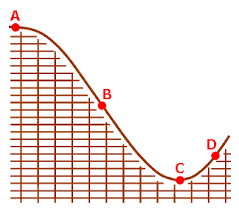
At which point(s) on the roller coaster is the gravitational potential energy at its maximum?
a)
A
b)
B
c)
C
d)
D
17.
At which point(s) on the roller coaster is the kinetic energy at its maximum?
a)
A
b)
B
c)
C
d)
D
18.
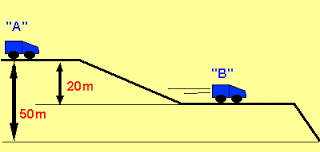
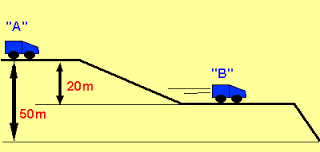
In diagram 2, if the mass of the car is 600 kg, what is the change in potential energy from point A to point B?
a)
411,600 J
b)
294,000
c)
176,400 J
d)
117,600 J
19.
In diagram 2, if the 600 kg cart is initially at rest, what is its velocity at point B?
a)
19.8 m/s
b)
15.0 m/s
c)
10.3 m/s
d)
3.8 m/s
20.

1. A ball has a 17 J of kinetic energy and its mechanical energy is 25 J. If the ball has a mass of 3.2 kg, what is its height above the ground?

a)

0.26 m

b)

0.52 m

c)

5.2 m

d)

25 m

21.
What is mechanical energy?
a)
It is what metal creates when heated.
b)
All potential and kinetic energy in a system.
c)
It is motion of all matter.
d)
Energy of momentum.
22.
What type of energy is in this picture?
a)
Kinetic
b)
Potential
c)
Chemical
d)
Sound
23.
Energy of motion is which type of energy?
a)
Potential
b)
Kinetic
c)
Sound
d)
Gravitational
24.
What force ultimately slows the roller coaster to a stop?
a)
Applied
b)
Normal
c)
Friction
d)
Magnetic
25.
On a roller coaster, where is maximum potential energy?
a)
At the bottom of a big hill
b)
When going around a corner
c)
When going upside down
d)
At the top of a big hill
26.
The total energy in an isolated system can be increased.
a)
True
b)
False
27.
A roller coaster car is poised at the top of the first hill on its track. What type of energy is the car's total energy stored as?
a)
Kinetic
b)
Thermal
c)
Potential
d)
Mechanical
28.
That same roller coaster car moves down the hill. Assuming that the track is frictionless, which option represents the transfer of energy?
a)
Potential to Kinetic
b)
Kinetic to Potential
c)
Mechanical to Thermal
d)
Mechanical to Potential
29.
If the roller coaster track is not frictionless, which option best represents the transfer of energy?
a)
Thermal to Kinetic and Potential
b)
Kinetic to Thermal and Potential
c)
Potential to Kinetic and Thermal
30.
A box with a mass of 20 kg is moving with a velocity of 3 m/s to the right. How much kinetic energy does it have?
a)
60 J
b)
75 J
c)
90 J
d)
180 J
31.
A spring with a spring constant of 3 N/m is compressed by 4 cm. How much potential energy is stored in the spring?
a)
0.0024 J
b)
0.024 J
c)
2.4 J
d)
24 J
32.
A 1 kg mass is placed against that same spring. When released, the spring imparts all of its energy to the mass. If the surface on which the mass rests is frictionless, what is the speed that the mass will move with?
a)
6.9 cm/s
b)
7.2 cm/s
c)
12.1 cm/s
d)
1.3 m/s
33.
A frictionless penduluum swings through its full range of motion at the surface of the Earth. At the lowest point of its motion, it is moving with a velocity of 2 m/s. How high above its lowest point will it rise?
a)
0.22 m
b)
0.38 m
c)
0.41 m
d)
0.56 m
34.
The total energy in an isolated system can be increased.
a)
True
b)
False
35.
A roller coaster car is poised at the top of the first hill on its track. What type of energy is the car's total energy stored as?
a)
Kinetic
b)
Thermal
c)
Potential
d)
Mechanical
36.
That same roller coaster car moves down the hill. Assuming that the track is frictionless, which option represents the transfer of energy?
a)
Potential to Kinetic
b)
Kinetic to Potential
c)
Mechanical to Thermal
d)
Mechanical to Potential
37.
If the roller coaster track is not frictionless, which option best represents the transfer of energy?
a)
Thermal to Kinetic and Potential
b)
Kinetic to Thermal and Potential
c)
Potential to Kinetic and Thermal
38.
A box with a mass of 20 kg is moving with a velocity of 3 m/s to the right. How much kinetic energy does it have?
a)
60 J
b)
75 J
c)
90 J
d)
180 J
39.
A spring with a spring constant of 3 N/m is compressed by 4 cm. How much potential energy is stored in the spring?
a)
0.0024 J
b)
0.024 J
c)
2.4 J
d)
24 J
40.
A 1 kg mass is placed against that same spring. When released, the spring imparts all of its energy to the mass. If the surface on which the mass rests is frictionless, what is the speed that the mass will move with?
a)
6.9 cm/s
b)
7.2 cm/s
c)
12.1 cm/s
d)
1.3 m/s
41.
A frictionless penduluum swings through its full range of motion at the surface of the Earth. At the lowest point of its motion, it is moving with a velocity of 2 m/s. How high above its lowest point will it rise?
a)
0.22 m
b)
0.38 m
c)
0.41 m
d)
0.56 m
42.

A 5 kg ball is lifted 12 m above the ground. The ball:

a)

gains elastic potential energy

b)

gains gravitational potential energy

c)

gains kinetic energy

d)

gains mechanical energy

43.

Which of the following objects has the most kinetic energy?

a)

A 20 kg toddler running at 5 m/s

b)

A 50 kg toddler running at 30 m/s

c)

A 90 kg toddler running at 30 m/s

d)

A 100 kg toddler running at 5 m/s

44.

When the speed of an object triples, what happens to its kinetic energy?

a)

3 times as much K

b)

9 times as much K

c)

1/3 as much K

d)

1/9 as much K

45.

The Work-Energy Theorem says:

a)

p = mv

b)

Ug = mgy

c)

Change E = W

d)

W = Fdcos angle

46.

A beat is dropped from the edge of a cliff. Which of the following graphs best represents the beat's kinetic energy KE as a function of time t?

a)
b)
c)
d)
47.

The system shown consists of two objects of unequal masses, M1 and M2, and pulley with negligible mass and friction. Which of the following is true about the changes in the gravitational potential energy and kinetic energy of the system soon after the objects are released from rest?

a)

ΔU = 0 and ΔK>0\Delta U\ =\ 0\ and\ \Delta K>0

b)

ΔU>0 and ΔK>0\Delta U>0\ and\ \Delta K>0

c)

ΔU<0 and ΔK>0\Delta U<0\ and\ \Delta K>0

d)

ΔU=0 and ΔK=0\Delta U=0\ and\ \Delta K=0

48.

When does the mass move at maximum velocity in a mass-spring system?

a)

At equilibrium

b)

At the farthest point from the equilibrium

c)

At its hightest point

d)

At its lowest point

49.

When does the mass move at 0 velocity in a mass-spring system?

a)

At equilibrium

b)

At the farthest point from the equilibrium

c)

At its hightest point

d)

At its lowest point

50.
A mass attached to a spring vibrates back and forth. At the equilibrium position, the
a)
acceleration reaches a maximum.
b)
velocity reaches a maximum.
c)
net force reaches a maximum.
d)
velocity reaches zero.
51.
A mass-spring system can oscillate with simple harmonic motion because a compressed or stretched spring has which kind of energy?
a)
kinetic
b)
mechanical
c)
gravitational potential
d)
elastic potential
52.
The angle between the string of a pendulum at its equilibrium position and at its maximum displacement is the pendulum’s
a)
period.
b)
frequency.
c)
vibration.
d)
amplitude.
53.
For a system in simple harmonic motion, which of the following is the time required to complete a cycle of motion?
a)
amplitude
b)
period
c)
frequency
d)
revolution
54.
How are frequency and period related in simple harmonic motion?
a)
They are directly related.
b)
They are inversely related.
c)
Their sum is constant.
d)
Both measure the number of cycles per unit of time.
55.
By what factor should the length of a simple pendulum be changed in order to triple the period of vibration?
a)
3
b)
6
c)
9
d)
27
56.
A certain pendulum with a 1.00 kg bob has a period of 3.50 s. What will happen to the period of the pendulum if the 1.00 kg bob is replaced by a bob with a mass of 2.00 kg?
a)
Increase
b)
Decrease
c)
Stays the same
d)
Need more information
57.
A pendulum's period is initially t.  Changes are made to the system so that the new period is 2t. What may have been changed?
a)
The length of the pendulum was increased by a factor of 2.
b)
The pendulum was moved to a planet with 2 times the mass of Earth.
c)
The length of the pendulum was increased by a factor of 4.
d)
The pendulum was moved to a planet with 4 times the  mass of earth.
58.
An object oscillating in simple harmonic motion has a time period T. The first graph shows how its displacement varies with time. Which of the subsequent graphs, A to D, show how the kinetic energy, Ek, of the object varies with time? 
a)
A
b)
B
c)
C
d)
D
59.
Pendulum "A" is on Jupiter Pendulum "B" is on the Moon.  The Moon has less gravity than  Jupiter the pendulums have the same mass and length.  Which Pendulum is moving faster?
a)
A
b)
B
c)
Same
60.
Convert from period to frequency.
4 sec = ______ Hz.
a)
0.25 Hz
b)
0.1 Hz
c)
2 Hz
d)
10 Hz.
61.

A spring with spring constant 16 N/m is compressed by 0.5 m. How much energy is stored in the spring?

a)

1 J

b)

0.25 J

c)

2 J

d)

16 J

62.

The equation for spring force is

a)

Fsp = mgh

b)

Fsp = 1/2kx2

c)

Fsp = Fd

d)

Fsp = -kx

63.

What equation is used to calculate elastic potential energy?

a)

Ep = m g h

b)

Ep = 1/2 k x2

c)

Ep = F / E d