wayground logo

Free Printable Worksheets

NEW

Font size

S
M
L
XL
Worksheets

Atomic Structure & Radiation

Total questions: 60

Worksheet time: 1hrs 20mins

Name
Class
Date
1.
Which subatomic particle has a positive (+) charge?
a)
Neutron
b)
Proton
c)
Electron
2.
True or False - Protons and Neutrons have about the same mass.
a)
True - They have about the same mass
b)
False - They do not have about the same mass
3.
Which subatomic particle has a negative (-) charge?
a)
Proton
b)
Electron
c)
Neutron
4.
Which subatomic particle has a neutral or no charge?
a)
Proton
b)
Electron
c)
Neutron
5.
Where is the nucleus located in an atom?
a)
Near the electron shells/levels
b)
Near the center of an atom
6.
Which two subatomic particles make up the nucleus of an atom?
a)
Protons and Electrons
b)
Neutrons and Electrons
c)
Electrons and Protons
d)
Protons and Neutrons
7.
Where are the Electrons found in the structure of an atom?
a)
In the nucleus
b)
In spaces around the nucleus
8.
The subatomic particles in green are...
a)
Protons
b)
Neutrons
c)
Electrons
9.
How many electron shells/levels does this atom have?
a)
1
b)
2
c)
3
d)
4
10.
How many electrons does this picture show?
a)
4
b)
5
c)
6
d)
3
11.
These will determine what element an atom is. 
a)
number of neutrons
b)
number of electrons
c)
number of atoms 
d)
number of protons 
12.
This is how you find the number of neutrons in an atom. 
a)
Subtract the atomic number from the atomic mass
b)
Subtract the atomic mass from the atomic number 
c)
Add the atomic mass to the atomic number 
d)
Divide the atomic mass by the atomic number 
13.
These are found in the nucleus and have a positive charge. 
a)
proton 
b)
electron 
c)
neutron 
d)
moron 
14.
These are found in the nucleus and have a neutral charge. 
a)
proton 
b)
electron 
c)
neutron 
d)
moron 
15.
These are found outside the nucleus and have a negative charge. 
a)
proton 
b)
electron 
c)
neutron 
d)
moron 
16.
An atom is the smallest piece of a(an) _____ you can get. 
a)
mixture 
b)
compound 
c)
molecule 
d)
element 
17.
The atomic mass is the number of _______ plus ________. 
a)
protons, electrons 
b)
protons, neutrons 
c)
electrons, neutrons 
d)
quarks, neutrons 
18.
This is an atom with a charge. 
a)
omni
b)
oni
c)
ion
d)
ouch-e
19.
You see an model of an atom with 5 protons and 4 electrons. What kind of atom is this? 
a)
positive ion 
b)
negative ion 
c)
neutral ion 
d)
strange ion
20.
These subatomic particles are taken or removed to form ions. 
a)
neutrons 
b)
protons 
c)
electrons 
d)
nimrons 
21.
This subatomic particle has almost no mass. 
a)
electrons
b)
protons 
c)
neutrons 
d)
sigrons 
22.
An atom is said to be neutral if it has the same # of electrons and ________. 
a)
thing-ons 
b)
electrons 
c)
neutrons 
d)
protons 
23.

The number of electrons in an atom is equal to ......

a)

the number of protons

b)

the number of neutrons

c)

the atomic mass

24.

Which particle is responsible for chemical reactions?

a)

proton

b)

electron

c)

neutron

d)

no charge

25.

If a neutron tries to buy a soda how much would it cost?

a)

3 for $5.00

b)

Sodas can't talk.

c)

$2.00

d)

no charge

26.
Alpha particles.....
a)
a) are positively charged.
b)
b) consist of two protons and four neutrons.
c)
c) can penetrate any thickness of matter
d)
d) All of the above 
27.
Radioactive materials have unstable...
a)
electrons
b)
protons
c)
nuclei
d)
neutrons
28.
The type of radioactive particle that can be stopped by a sheet of paper is the ____.
a)
alpha particle
b)
beta particle
c)
gamma ray
d)
positron
29.
Negatively charged particles emitted from a nucleus at a high speed are ____.  
a)
alpha particle
b)
gamma rays
c)
beta particles
d)
X rays
30.
Two atoms of the same element but with different mass numbers are called________
a)
electrons
b)
isotopes
c)
ions
d)
reaction partners
31.

Which type of nuclear radiation is being emitted here?

a)

Alpha

b)

beta

c)

gamma

d)

none

32.
Positively charged particles that consist of two protons and two neutrons are called
a)
alpha particles
b)
beta particles
c)
gamma rays
d)
neutron emissions
33.
In order of most to least penetrating radiation we have
a)
Alpha , Beta,  Gamma
b)
Beta , Gamma , Alpha
c)
Gamma, Beta, Alpha
d)
Gamma, Alpha, Beta
34.
The three types of nuclear radiation in order of increasing penetrating power are
a)
alpha, beta, gamma
b)
alpha, gamma, beta
c)
beta, alpha, gamma
d)
gamma, alpha, beta
35.
Name the most penetrating type of radiation.
a)
alpha
b)
beta
c)
gamma
d)
lambda
36.
_______________ is the process by which unstable atoms emit radiation until they become stable.
a)
Radiation
b)
Chemical Reaction
c)
Radioactive Decay
d)
Isotopes
37.

Which type of radiation releases an electron?

a)

Alpha radiation

b)

Beta radiation

c)

Gamma radiation

d)

Theta radiation

38.

What particle is released when an unstable isotope undergoes alpha radiation?

a)

a helium nucleus

b)

an electron

c)

a photon of light

d)

a neutron

39.
Which type(s) of radiation would be affected by a magnet?
a)
alpha only
b)
beta only
c)
alpha and beta
d)
gamma only
40.

What is radioactivity?

a)

A term that describes the forces that hold atomic nuclei together

b)

The movement of electrons around an atomic nucleus

c)

The application of heat energy to an atomic nucleus

d)

The emission of high-energy particles or waves from atoms
41.
What is Half-life?
a)
The amount of time it takes for some of the nuclei in a sample of the isotope to decay
b)
The amount of time it takes for half the electrons in a sample of the isotope to decay
c)
The amount of time it takes for half the nuclei in a sample of the isotope to decay
d)
the amount of time it takes to double the nuclei in a sample of the isotope to decay
42.
Barium-122 has a half-life of 2 minutes. A fresh sample weighing 80 g was obtained. If it takes 10 minutes to set up an experiment using barium-122, how much barium-122 will be left when the experiment begins?
a)
0.25g
b)
2.5g
c)
25g
d)
80g
43.
The half-life of strontium-90 is 25 years. How much strontium-90 will remain after 100 years if the initial amount is 4.0 g?
a)
3.0g
b)
0.25mg
c)
0.3g
d)
0.25g
44.
When nuclei decay, massive amounts of __________ is released.
a)
energy
b)
jello
c)
protons
d)
neutrons
45.
After 4 half-lives, 1g of a sample of Krypton-85 remains unchanged.  What was the original mass of the sample?
a)
16g
b)
32g
c)
0.0625g
d)
4g
46.
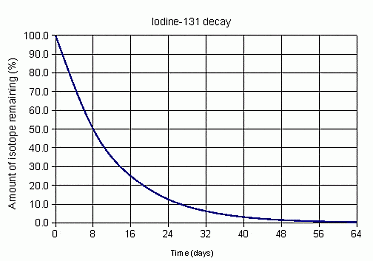
What is the half-life of iodine-131?
a)
32 days
b)
8 days
c)
16 days
d)
24 days
47.
What percent of carbon-14 would be left after 5730 years?
a)
100%
b)
75%
c)
50%
d)
25%
48.
What percent of carbon-14 would be left after 11,460 years?
a)
100%
b)
75%
c)
50%
d)
25%
49.
If one-fourth of the carbon-14 is remaining then how many half-lives have passed?
a)
1
b)
2
c)
3
d)
4
50.

The three main types of nuclear radiation are alpha, beta, and gamma. Which of the following lists these types of radiation from highest penetrating power to lowest penetrating power?

a)

alpha, gamma, beta

b)

beta, alpha, gamma

c)

beta, gamma, alpha

d)

gamma, beta, alpha

51.

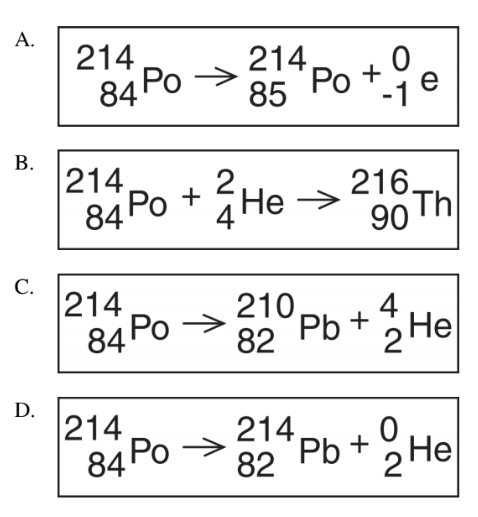
Which equation correctly represents the alpha decay of polonium-214?

a)

A

b)

B

c)

C

d)

D

52.

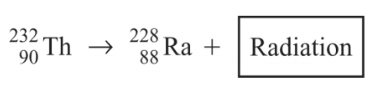
This equation shows the radioactive decay of thorium (Th). Which of the following particles is released in this reaction?

a)

alpha

b)

beta

c)

neutron

d)

gamma

53.
a)

alpha particle

b)

beta particle

c)

neutron

d)

proton

54.
After the nucleus of a radioactive element undergoes changes, the element can transform into ...
a)
  (a)  a different isotope of the same element.
b)
(b) an entirely different element.
c)
Both (a) and (b)
d)
Neither (a) nor (b)
55.
Alpha particles.....
a)
a) are positively charged.
b)
b) consist of two protons and four neutrons.
c)
c) can penetrate any thickness of matter
d)
d) All of the above 
56.
The process of nuclear change in an atom of radioactive material is called... 
a)
nuclear decay
b)
nuclear mass
c)
isotopes
d)
radon
57.
During beta decay, a nucleus .... 
a)
gives up two protons and two neutrons.
b)
  maintains the same number of protons and neutrons.
c)
  loses a proton and gains a neutron.
d)
gains a proton and loses a neutron. 
58.
When a nucleus undergoes nuclear decay by gamma rays, the atomic number of the element....
a)
remains the same
b)
  decreases by one.
c)
increases by one.
d)
increases by two.
59.
Radioactive materials have unstable...
a)
electrons
b)
protons
c)
nuclei
d)
neutrons
60.
The type of radioactive particle that can be stopped by a sheet of paper is the ____.
a)
alpha particle
b)
beta particle
c)
gamma ray
d)
uranium