
 Worksheets
12/16: Final Review Day 1
Total questions: 60
Worksheet time: 30mins
Name
Class
Date
1.
The widest part of an ellipse is called-
a)
the semimajor axis
b)
the minor axis
c)
the foci
d)
the major axis
2.
1 astronomical unit ( 1 AU) is equal to...
a)
the distance from the Earth to the Sun
b)
the distance from the Sun to Pluto
c)
the distance from the Earth to the Moon
d)
the distance light travels 1 year in the vacuum of space
3.
Which diagram shows a planet with the least eccentric orbit?
a)
Option 1
b)
Option 2
c)
Option 3
d)
Option 4
4.
The eccentricity formula of orbits is...
a)
change in value/ distance
b)
mass/volume
c)
distance between foci/ length of major axis
d)
length of minor/ length of major axis
5.
Which ellipse has the highest eccentricity
a)
Option 1
b)
Option 2
c)
Option 3
6.

Where is the planet moving faster
a)
Position A to B
b)
Position B to C
c)
Position H to I
d)
Position I to J
7.
Eccentricity can be between what two numbers if the object is in orbit?
a)
0-1
b)
0-0.1
c)
0-10
d)
0-2
8.

You discover a new planet in our solar system. You measure it's orbital period to be 200 years.
Where is this planet likely to be located based on this information?
a)
Located beyond Neptune
b)
Located between Jupiter and Neptune
c)
Closer to the Sun than Mercury
d)
Located between the Earth and Mars
9.
Kepler’s first law states that the orbits of all planets are elliptical.
Which of the following statements does not represent this law?
a)
Earth’s eccentricity is very low.
b)
The distance between both focal points of an orbiting planet is the same for any location along an ellipse.
c)
The orbit of every planet is the same.
d)
Comets have a very high eccentricity.
10.
Kepler’s second law relates to–
a)
the shape of each planet’s orbit.
b)
how the orbits of planets and comets differ.
c)
the rotation of planets about their axes.
d)
the area an orbit covers in a set amount of time.
11.
Kepler’s third law is known as the law of harmonies. What does it state?
a)
If you square the time it takes for a planet to orbit the Sun and divide this number by the cube of its distance from the Sun, you end up with the same number for all planets.
b)
All planetary orbits have low eccentricity.
c)
A planet covers the same area in its orbit in a set amount of time.
d)
None of the above
12.
Which description of eccentricity is correct?
a)
An eccentricity of zero is a line
b)
An eccentricity of zero is a circle
c)
An eccentricity of one is a circle
d)
An eccentricity of one is elliptical
13.

A scientist is examining the orbital path of two comets. Comet A has an orbital eccentricity of 0.70, while Comet B has an orbital eccentricity of 0.90.
What can the scientist conclude about the orbits of the two comets?
a)
Comet B’s orbit is less circular than Comet A’s orbit
b)
Both Comet A and B have similar orbital paths
c)
Comet B takes longer to complete an orbit than Comet A
d)
Comet A is closer to the Sun than Comet B
14.
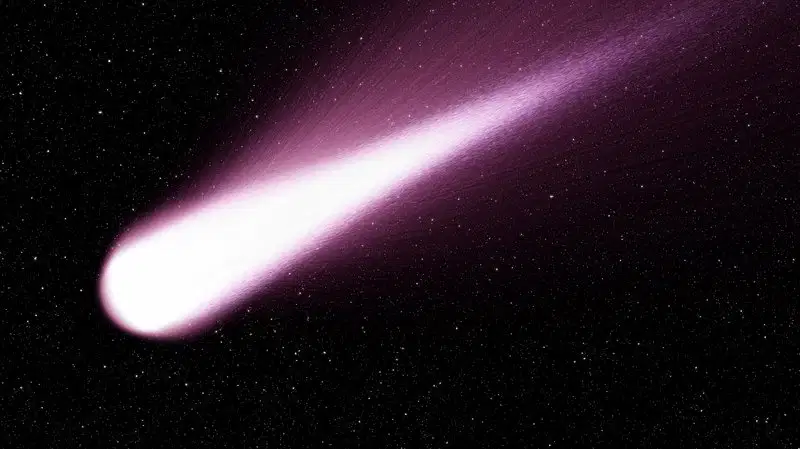
Kepler’s 2nd Law states that the area swept out by a planet’s motion will be the same regardless of where it is in its orbit.
A comet moves much faster when it is closer to the Sun than when it is further out from the Sun.
What is the primary cause in the change of the comet’s orbital velocity?
a)
Jupiter's gravitational field
b)
The sun's solar wind
c)
The sun's gravitational field
d)
Earth's magnetic field
15.

The Moon orbits the Earth as the Earth orbits the Sun. The Moon’s orbit is elliptical, and changes its distance from the Earth by around 10 % over the course of an orbit.
Any ellipse has two centers, which are called foci.
For the Moon’s orbit, what must exist at one of the two foci?
a)
Earth
b)
The Sun
c)
The Moon's center of gravity
d)
Mars
16.
What do we call a path followed by an object revolving around another object, cause by gravity?
a)
Orbit
b)
Path
c)
Route
d)
Trail
17.
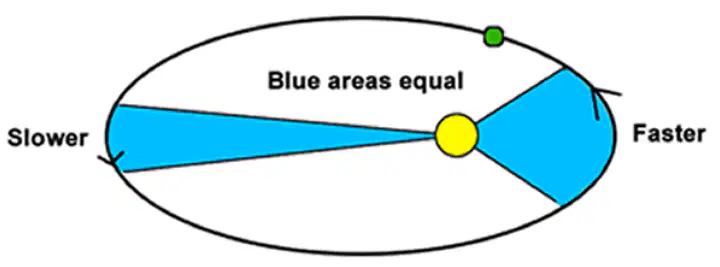
This diagram best illustrates which of the following laws?
a)
Keplers 2nd law
b)
Keplers 1st law
c)
Newtons 2nd law
d)
Newtons law of universal gravitation
18.
SOLVE:
P(before) = P(after)
2 kg x 4 mps = 1 kg x ___mps
a)
8
b)
0
c)
2
d)
10
e)
0.5
19.
Which of the following best describes "universal gravitation"
a)
Only large items experience gravity
b)
Gravity only happens if you are a planet
c)
Everything with mass is attracted to everything else with mass
d)
Like charges repel, opposite charges attract
20.
If your desk weighs 20 pounds on earth, if you moved the desk to Jupiter it would weigh...
a)
more
b)
less
c)
the same
21.

If both charges have the same sign, what happens to the electrical force compared to when the charges have opposite signs?
a)
Nothing
b)
The electrical force switches direction (attractive versus repulsive, or vice versa).
c)
The electrical force grows larger
d)
The electrical force shrinks
22.
According to Coulomb's law, the force between a pair of charged particles that are brought closer together
a)
decreases
b)
increases
c)
increases only if the charges are of the same sign.
d)
increases only if the charges are of opposite signs
23.
When dealing with electrical charges, like charges _______________
a)
attract each other
b)
repel each other
24.
What variable do "Newtons" represent
a)
Force
b)
Electrostatic charge
c)
Distance
d)
Mass
25.
If the distance between two planets is doubled, what happens to the force of gravity between the planets?
a)
stays the same
b)
reduced by 1/4
c)
reduced by half
d)
quadruples
26.
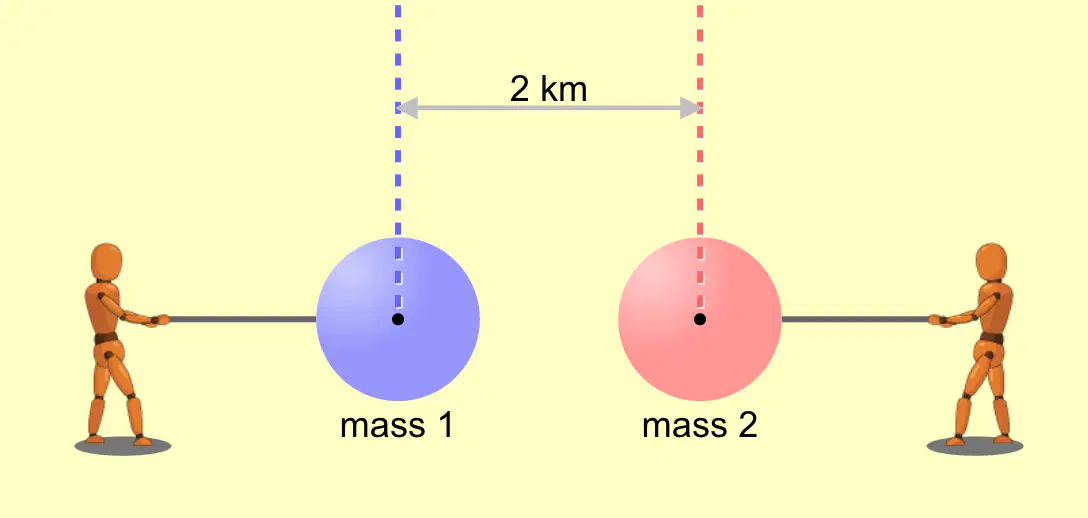
Which of the following change would result in a larger force of gravity?
a)
Decrease mass of object 1
b)
Increase the mass of object 2
c)
Decrease the mass of object 2
d)
Increase the distance between the two objects
27.
What variable is a Coulomb the unit for?
a)
Charge
b)
Force
c)
Mass
d)
Electric Current
28.
If your desk has as mass of 9 kilograms on earth, if you moved the desk to Jupiter, it's mass would be....
a)
more
b)
less
c)
the same
29.
The force of gravity....
a)
Acts on ALL OBJECTS with mass
b)
ONLY acts on objects with large mass
c)
ONLY acts on objects that are far apart from each other
d)
Only acts on very small objects
30.
The force of gravity always
a)
pulls objects together
b)
pushes objects away from each other
c)
can either cause objects to pull towards or push away from each other
31.

The force of gravity depends on two variables, __________________ and ________________
a)
mass of the objects, distance between the objects
b)
electrical charge of the objects, distance between the objects
c)
mass of the objects, electrical charge of the objects
32.
Electrical force depends on two variables, ___________________ and ______________
a)
mass of the objects, distance between the objects
b)
electrical charge of the objects, distance between the objects
c)
energy of the of the objects, mass of the objects
33.
Gravitational Force is based on the "Inverse Square Law"- based on this principle what would happen to the gravational force between two planets if you increased the distance between the planets
a)
stronger
b)
weaker
c)
it would remain the same
34.
What type of quantitity are momentum and velocity
a)
vector
b)
scalar
c)
numeric
d)
non- numeric
35.
The units of impulse are...
a)
N*S
b)
Newtons
c)
Meters
d)
M/S
e)
Kg*m/s
36.
When no _______________ forces act on a system, the momentum of the system will __________
a)
external, remain the same
b)
internal, remain the same
c)
external, decrease
37.
Two cars crash into each other and become completely stuck together
What kind of collision is this?
a)
Elastic
b)
Inelastic
c)
Both inelastic and elastic
d)
increased impulse
38.
If you cannot avoid being hit by a fast- moving object, you'll suffer a smaller contact force if you can extend that force over a...
a)
longer time
b)
shorter time
c)
both the same
39.
It is correct to say that impulse is equal to...
a)
momentum
b)
change in momentum
c)
force multiplied by the distance over which it acts
d)
velocity multiplied by time
40.
Which of Newton's laws of motion is a statement of the conservation of momentum?
a)
First
b)
Second
c)
Third
d)
All of the above
41.
A freight train rolls along a track with considerable momentum. If it rolls at the same speed but has twice as much mass, its momentum is
a)
zero
b)
twice as much as before
c)
unchanged
d)
half as much as before
42.
It is correct to say that impulse is equal to
a)
momentum
b)
change in momentum
c)
force multiplied by distance it acts
d)
velocity multiplied by time
43.
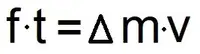
Here we can see the impulse equation. We should read this as:
a)
Impulse = change in momentum
b)
Momentum = change in impulse
c)
Force = Impulse
44.
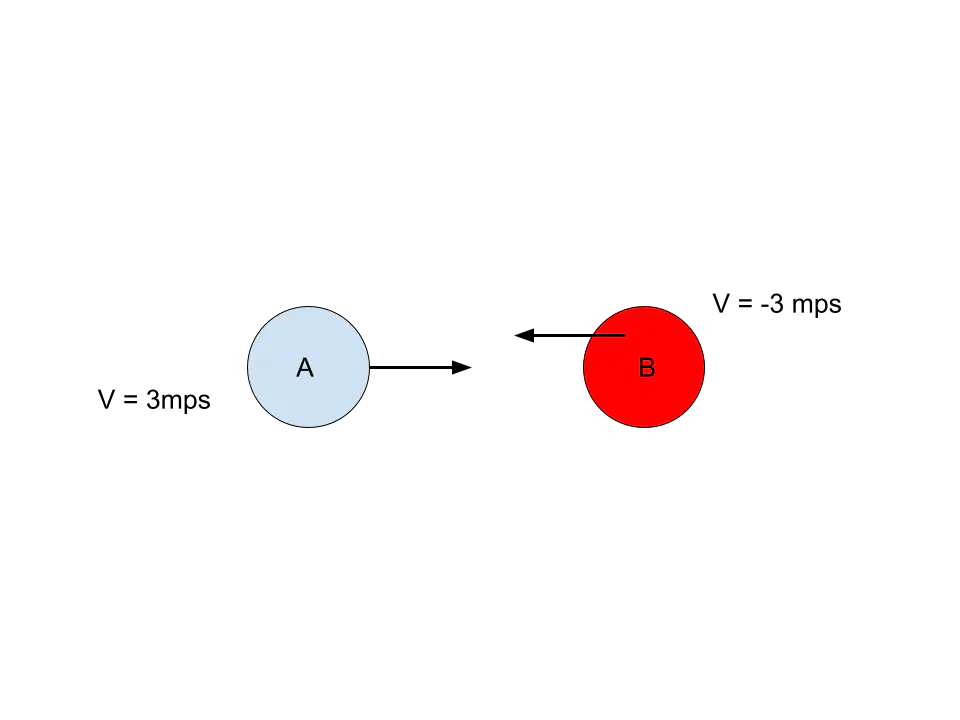
What will happen when these two balls INELASTICALLY COLLIDE with each other?
a)
They will move left
b)
They will move right
c)
They will bounce off and go opposite directions
d)
They will stick together and stop
45.
What does the principle of conservation of momentum state?
a)
The total momentum before and after a collision is the same
b)
The total momentum increases after a collision
c)
The total momentum decreases after a collision
d)
The total momentum before and after a collision is unrelated
46.
If a car's velocity doubles, what happens to its momentum?
a)
it doubles
b)
it remains the same
c)
it triples
d)
it quadruples
47.
The modern definition of momentum is–
a)
mass times velocity squared
b)
mass times velocity
c)
mass dividied by velocity
d)
mass cubed
48.
If the mass of an object doubles, then the acceleration is ______________ when the force is kept the same
a)
halved
b)
doubled
c)
kept the same
d)
tripled
49.
______________ is the rate at which velocity changes
a)
acceleration
b)
velocity
c)
gravity
d)
friction
e)
newton
50.
When there is a constant unbalanced force applied in the same direction as the motion, speed will _____________ and acceleration will _________
.
a)
increase, be positive
b)
increase, be negative
c)
increase, be zero
d)
decrease, be postive
e)
decrease, be negative
51.
According to Newton's first law- if a rocket is traveling in space "at full speed" and turns off its engines, what is going to happen?
a)
It will keep going in a straight line at the same speed forever
b)
It will keep going forward- but it will slow down eventually
c)
It will stop immediately
52.
True or False- The weight of an object is constant regardless of motion or location in the universe
a)
True
b)
False
53.
Newton's First Law is also referred to as the law of
a)
Friction
b)
Inertia
c)
Unbalanced Forces
d)
Newtons
54.
An object in motion tends to stay in motion unless an ___ force acts on it.
a)
unbalanced force
b)
balanced
55.
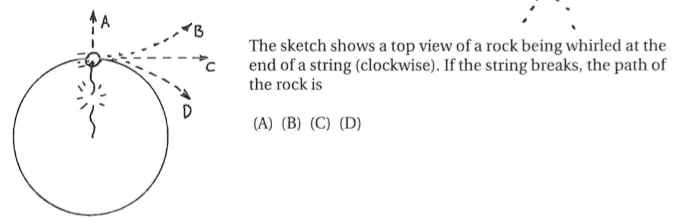
a)
A
b)
B
c)
C
d)
D
56.

Different materials, A, B, C, and D rest on a table, which item will resist being set into motion the most
a)
A
b)
B
c)
C
d)
D
57.
What is Newtons 1st law of motion?
a)
Force= Mass multiplied by acceleration
b)
An object at rest stays at rest unless acted on an unbalanced force. (inertia)
c)
For every action there is a equal and opposite re-action.
d)
Momentum is conserved in every collision
58.
What happens when unbalanced forces act on an object at rest?
a)
the object remains at rest
b)
the object begins moving in an unpredictable direction
c)
the object begins moving in the direction of the net force
d)
the object begins moving opposite to the direction of net force
59.

Which box has more acceleration
a)
Top
b)
Bottom
c)
Acceleration will be equal
60.
Which is an example of VELOCITY?
a)
A migrating bird headed south for the winter at 3 m/s
b)
A dog running at 3 m/s
c)
A deer sprinting at 4 m/s
d)
A person not moving at all
100 %

