
 Worksheets
IGCSE Ch. 11 TTO 2-3 Electric charge
Total questions: 61
Worksheet time: 1hrs 28mins
Name
Class
Date
1.
In a neutral atom, the number of electrons is equal to the number of _______.
a)
Neutrons
b)
Orbits
c)
Protons
d)
subatomic particles
2.
If two charges repel each other, the two charges must be
a)
Positive and neutral
b)
Positive and negative
c)
positive and neutral
d)
negative and negative
3.
An object becomes charged when the atoms in the object gain or lose
a)
electrons
b)
protons
c)
neutrons
d)
all of the above
4.
If you rub a glass rod with a piece of silk, the rod becomes positively charged. This means that
a)
friction destroyed electrons in the rod.
b)
the silk has become negatively charged.
c)
protons have moved to the rod.
d)
glass attracts more protons.
5.
If you bring a charged object near an electrically neutral surface without allowing the object to touch the surface, the charges in the surface are rearranged by
a)
friction.
b)
convection.
c)
induction.
d)
conduction.
6.
Objects that have opposite charges
a)
are attracted to each other, and the force between the objects pulls them together.
b)
are attracted to each other, and the force between the objects pushes them apart.
c)
are repelled by each other, and the force between the objects pulls them together.
d)
are repelled by each other, and the force between the objects pushes them apart.
7.
A region around a charged particle that can exert a force on another charged particle is called an
a)
electric pulse.
b)
electric charge.
c)
electric force.
d)
electric field.
8.
Charging by ____ occurs when electrons are transferred from one object to another by direct contact.
a)
reduction
b)
induction
c)
conduction
d)
friction
9.

When you pull a cotton sweater off your skin, electrons are transferred from the ___________________ (cotton, skin) to the __________________ (cotton, skin). As a result, your body acquires a ___________ (+ , -) charge and the cotton sweater acquires a ___________ (+ , -) charge.
a)
skin, cotton, +, -
b)
cotton, skin, +, -
c)
skin , cotton, -, +
d)
cotton, skin, -, +
10.
A negatively charged object is brought near a neutral, insulating object. What can be said about the charges on the neutral object?
a)
The object becomes polarized, so there is a force of attraction between them.
b)
The object remains neutral because it is an insulator and there is no force between them.
c)
A positive charge is induced on it and they attract.
d)
A negative charge is induced on it and they repel.
11.
During a lightning storm, your car is a reasonably good place to be. Why?
a)
The rubber tires insulate your car from the ground.
b)
Lightning only hits older VW vans.
c)
You are enclosed in a conductor so charge will go around you.
d)
Actually, a car is a really bad place to be because of all of the conductors around you.
12.
The closer the charges, the ___________ the force between them
a)
closer
b)
further
c)
stronger
d)
weaker
13.
Which part of the atom is positively charged?
a)
Proton
b)
Neutron
c)
Electron
14.
Two conductors come in contact with each other. One had a +100 charge and the other had a -50 charge. What is the charge on each after they touch?
a)
+50 and +50
b)
+25 and +25
c)
-25 and -25
d)
+50 and 0
15.
what is Lightning ?
a)
Magnetic spark Through Air
b)
Water flow through Air
c)
Electric spark through Air
d)
None of the above
16.
what is a Lightning conductor ?
a)
it is made of metal
b)
A pointy metal rod which sends all charge accumulated on the building to the ground.
c)
its one end is buried in the ground
d)
all of the above
17.
Top Part of the clouds Develops ________ and bottom part of the clouds develops ___________ during Thunderstorm and Lightning.
a)
Negative charge , Negative charge
b)
Positive charge, Negative charge
c)
Positive charge, Positive charge
d)
Kebab, Biryani
18.
What are the types of charges developed on the clouds during a Thunderstorm?
a)
Positive charges only
b)
Negative charges only
c)
Both Positive and Negative charges
d)
none of the Above
19.
A great conductor of energy is:
a)
wood
b)
plastic
c)
metal
d)
cloth
20.

What object would best complete this circuit?
a)
A battery
b)
a peice of yarn
c)
an insulator
d)
a conductor
21.
What is the difference between a conductor and an insulator?
a)
An insulator allows electricity to flow through it easily and a conductor does not
b)
A conductor allows electricity to flow through it easily and an insulator does not.
c)
An insulator is magnetic and a conductor is not
d)
A conductor is magnetic and an insulator is not
22.
The center of an atom is called the _____.
a)
neutron
b)
proton
c)
nucleus
d)
neutroid
23.
Which are contained in the nucleus?
a)
protons and electrons
b)
electrons and neutrons
c)
neutrons and nebulons
d)
protons and neutrons
24.
Which are free-floating on the outside of an atom?
a)
neutrons
b)
electrons
c)
protons
d)
photons
25.
Which part of an atom has a positive charge?
a)
proton
b)
neutron
c)
electron
d)
photon
26.
Which part of an atom has no charge?
a)
proton
b)
neutron
c)
electron
d)
nebuton
27.
What is it called when there is an excess of charges and the electricity does not flow?
a)
electric shock
b)
lightning
c)
starch electricity
d)
static electricity
28.
Which of the following is best to describe the main difference between an insulator and conductor?
a)
how easily they will carry a current
b)
a conductor will carry current with only a very small voltage while an insulator won't carry a current at all unless the voltage is extremely high
c)
conductors are made of metal but insulators are plastic
d)
An insulator will never let current flow while conductors always allow currents to flow
29.

Walking across a carpet is an example of charge being transferred by
a)
friction.
b)
induction.
c)
contact.
d)
static electricity
30.
The teacher rubbed two balloons with a piece of wool. What will happen when the balloons are brought near each other?
a)
The balloons will repel each other.
b)
The balloons will attract each other.
c)
The balloons will become positively (+) charged.
d)
The balloons will pop.
31.
What charge does a proton have?
a)
negative (-)
b)
positive (+)
c)
neutral or no charge (0)
32.
What charge does an electron have?
a)
negative (-)
b)
positive (+)
c)
neutral or no charge (0)
33.
If a substance has a higher number of electrons than protons on its surface, what type of charge does it have?
a)
A positive charge.
b)
A negative charge.
c)
A neutral charge
d)
No charge at all
34.
What happens when you touch a metal doorknob after rubbing your shoes on the carpet?
a)
The doorknob sends a burst of electric current into your body
b)
Millions of electrons go from your finger into the doorknob
c)
The doorknob sends millions of electrons into your finger
d)
our finger becomes negatively charged
35.
What makes a charged balloon stick to the wall?
a)
Protons transferred to the balloon when it was rubbed on metal.
b)
Extra electrons on the surface of the balloon push away electrons in the wall, leaving a positively charged area.
c)
The rubber in the balloon has a magnetic field that pulls on the wood in the wall.
d)
Electricity in the balloon creates a magnetic field that attracts the metal in the wall.
36.
If two objects with static charge are attracted, what do you know about them?
a)
They are both positively charged.
b)
They are both negatively charged.
c)
One is positively charged and one is negatively charged, but you won't be able to tell which is which.
d)
One is positively charged and one is negatively charged, and you can tell which is which by looking at them.
37.

Rubbing a balloon on hair is an example of static charge build up created by....
a)
conduction
b)
friction
c)
induction
d)
hairduction
38.
Static electricity is:
a)
electricity flowing in a wire
b)
the buildup of electric charges on an object
c)
when protons move between objects
39.
What is the process of connecting an object to Earth with a conductor called?
a)
charging
b)
draining
c)
grounding
d)
induction
40.

Lightning is _____.
a)
a buildup of neutrons
b)
harmless
c)
a high-voltage electric current
d)
a large discharge of static electricity
41.

The charge of an electron is:
a)
Positive.
b)
Negative.
c)
Electrons have no charge
42.
Lightning is an example of _________.
a)
static electricity
b)
current electricity
c)
watts
d)
voltage
43.

Protons are located in the nucleus of the atom.
A proton has _______________.
A proton has _______________.
a)
No charge
b)
A negative charge
c)
A positive charge
44.

Which of these is the proton?
a)
A
b)
B
c)
C
45.

Which of these is the electron?
a)
A
b)
B
c)
C
46.
In static electricity,charges
a)
flow continuously
b)
flow intermittently
c)
build up in an atom
d)
build up on an object
47.

What causes static electricity?
a)
only an object losing electrons
b)
only an object gaining electrons
c)
when positive and negative charges balance
d)
when positive and negative charges are not balanced
48.
If an element has 6 protons, 7 neutrons, and 6 electrons, what type of charge does the element have?
a)
positive
b)
negative
c)
neutral
d)
imaginary
49.

The field lines for these charges must be?
a)
+, +
b)
+, -
c)
_ , _
50.

The field lines shown must?
a)
attract
b)
repel
c)
ionize
d)
polarized
51.

Objects with like charges repel and unlike charges attract. The girl's hair and the comb have-
a)
unlike charges
b)
like charges
c)
neutral charges
d)
no charges
52.
Electric energy is produced by the movement of ___________.
a)
protons
b)
neutrons
c)
nucleus
d)
electrons
53.
Which term refers to the flow of electrical charges?
a)
conductance
b)
resistance
c)
current
d)
energy
54.
The electric field surrounding a positively charged object is
a)
Away from the charge
b)
Toward the charge
55.
How do electric field lines represent the magnitude of an electric field?
a)
Length of the line
b)
With arrows
c)
Density of lines
d)
Width of lines
56.
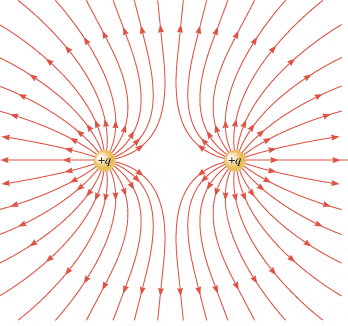
What option best describes this field?
a)
A strong electric field generated by two positive charges. They would attract each other.
b)
A strong electric field generated by two positive charges. They would repel each other.
c)
A weak electric field generated by two opposite charges. They would attract each other.
d)
A weak electric field generated by two positive charges. They would repel each other.
57.

What option best describes this field?
a)
A weak electric field generated by two positive charges. They would attract each other.
b)
A strong electric field generated by two opposite charges. They would repel each other.
c)
A strong electric field generated by two opposite charges. They would attract each other.
d)
A weak electric field generated by two positive charges. They would repel each other.
58.

QA and QB are two charges creating an electric field. Based on the electric field lines, we can conclude
a)
QA and QB are both positive
b)
QA and QB are both negative
c)
QA is positive and QB is negative
d)
QA is negative and QB is positive
59.

Consider the electric field lines shown in the diagram below. From the diagram, it is apparent that object A is ____ and object B is ____.
a)
+,+
b)
+,-
c)
-,+
d)
-,-
60.
How do electric field lines represent the magnitude of an electric field?
a)
Length of the line
b)
With arrows
c)
Density of lines
d)
Width of lines
61.
The flow of electrons through a wire or any conductor is called_____.
a)
current
b)
a circuit
c)
flood
100 %

