wayground logo

Free Printable Worksheets

NEW

Font size

S
M
L
XL
Worksheets

Sound Review

Total questions: 56

Worksheet time: 1hrs 9mins

Name
Class
Date
1.
Which device measures sound waves?
a)
Oscilloscope
b)
Stethoscope 
c)
Radio
d)
I don't know
2.
Sound travels FASTEST through which of these materials?
a)
Air
b)
Empty space
c)
Metal
d)
Water
3.
Sound is caused by? 
a)
force
b)
vibrations
c)
instruments
4.
Measure of how high or low a sound is
a)
amplitude
b)
compression
c)
speed of sound
d)
pitch
5.
Why is sound able to travel faster through a solid than a gas?
a)
Gas molecules are packed tightly.
b)
Sound does not travel faster through a solid than a gas.
c)
Solid molecules are packed tightly.
d)
Gas molecules move slowly.
6.
An object that does not vibrate cannot produce
a)
sound
b)
light
c)
heat
d)
electricity
7.
What is volume?
a)
how high or low a sound is
b)
the loudness or softness of a sound
c)
the number of vibrations per second
d)
vibrations
8.
Amplitude is used to measure what?
a)
Pitch
b)
Volume
c)
Sound
d)
Echoes
9.
A sound with a low frequency and low amplitude would be....
a)
Loud with a high pitch
b)
Loud with a low pitch
c)
Quiet with a high pitch
d)
Quiet with a low pitch
10.
We measure pitch in....
a)
Volume
b)
Decibles
c)
Amplitude
d)
Frequency
11.
How LOUD or quiet a sound is...
a)
Pitch
b)
Fequency
c)
Volume
d)
Echo
12.
Energy that you can hear? 
a)
Sound
b)
Light 
c)
Heat 
d)
pitch
13.
We measure sound in...
a)
Decimals
b)
Decibles
c)
Frequency 
d)
Amplitude
14.
There's a great big beautiful
a)
tomorrow
b)
taco
c)
Train
d)
Tiki Room
15.
If you want to change the pitch of a sound, you have to change the ___
a)
frequency
b)
amplitude
c)
speed
d)
volume
16.
What happens when you increase the amplitude of a sound?
a)
it makes the sound louder
b)
it makes the sound travel faster
c)
it increases the wavelength of the sound
d)
it increases the frequency of the sound
17.
This is the unit used to measure the volume of a sound. 
a)
Decibel
b)
Medium
c)
Vibration
d)
Oscilloscope
18.
True or False: Can sound travel through a vacuum (space).
a)
True
b)
False
19.
True or False: Sound travels better through solids than through liquids
a)
True 
b)
False
20.
What is a pitch?
a)
highness or lowness of a sound
b)
the intensity of a vibration
c)
the amplitude of the sound wave
d)
volume of sound
21.
Sound waves move more quickly through _________________ matter
a)
dense
b)
light
22.
Why is sound able to travel faster through a solid than a gas?
a)
Gas molecules are packed tightly.
b)
Sound does not travel faster through a solid than a gas.
c)
Solid molecules are packed tightly.
d)
Gas molecules move slowly.
23.
Sound is caused by? 
a)
force
b)
vibrations
c)
instruments
24.
You and your father inspect an empty house with the hopes of buying it. You walk through the rooms talking to one another, and you notice that your voices and footsteps are echoing in the big, empty house. What causes the echo?
a)
sound waves reflecting off smooth, flat surfaces throughout the house
b)
sound waves moving around the large rooms
c)
sound waves moving slowly through air
d)
sound waves refracting around corners in the empty rooms
25.
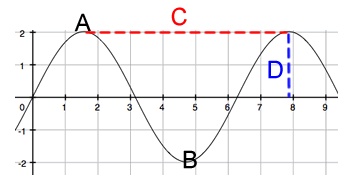
If distance C on the diagram increased, what would happen to the pitch? 
a)
The pitch would be louder. 
b)
The pitch would be softer. 
c)
The pitch would be higher. 
d)
The pitch would be lower. 
26.
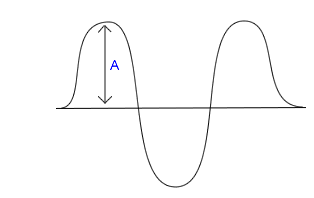
If the distance represented by the letter A were increased, how would it change the way the sound was heard?
a)
The sound would be higher. 
b)
The sound would be lower. 
c)
The sound would be softer. 
d)
The sound would be louder. 
27.
______ is how high or low a sound is; depends on the frequency.
a)
pitch
b)
frequency
c)
sound
d)
medium
28.
A soft, low pitch sound would have which of the following....
a)
low frequency 
high amplitude 
b)
high frequency 
high amplitude 
c)
low frequency 
low wavelength  
d)
low frequency
low amplitude 
29.
When comparing the two waves that are shown, how would Wave A (green wave) differ than Wave B (black wave)?
a)
Wave A and B have the same amplitude, but wave B (black) has a lower pitch.
b)
Wave A and B have the same amplitude, but Wave A has a lower pitch. 
c)
Wave A and B have the same pitch, but Wave A is a softer sound. 
d)
Wave A and B have the same pitch, but Wave B is a softer sound. 
30.
After the train passed, the pitch of the train whistle became lower. This change in sound would be represented by what change in the diagram above? 
a)
The distance represented by C would increase. 
b)
The distance represented by C would decrease. 
c)
The distance represented by D would increase. 
d)
The distance represented by D would decrease. 
31.
If I increase the energy of a wave, what will happen to the pitch? 
a)
stays the same
b)
increases
(higher pitch)
c)
decreases
(lower pitch)
d)
goes up but levels off
32.
A soft, high pitch sound would have which of the following....
a)
low frequency 
high amplitude
b)
low frequency 
low wavelength 
c)
high frequency 
low amplitude
d)
high frequency 
high amplitude 
33.
______ is how loud or soft a sound is; depends on the amplitude.
a)
pitch
b)
frequency
c)
loudness
d)
medium
34.
What best describes the doppler effect?
a)
An apparent change in frequency of a wave due to the relative motion between a wave source and an observer
b)
When sound changes pitch
c)
When light changes color
d)
An apparent change in the amplitude of a wave due to the relative motion between a wave source and an observer.
35.
When an ambulance move TOWARD you it sounds ________ pitched. 
a)
high
b)
low
c)
medium
36.

The number of crests or troughs that pass by over a certain amount of time

a)

Frequency

b)

sound

c)

amplitude

d)

volume

37.

The distance between one crest or trough to the next

a)

volume

b)

acoustics

c)

sound

d)

wavelength

38.

The distance between the resting point and a crest or trough

a)

acoustics

b)

pitch

c)

amplitude

d)

volume

39.

What is a tool that makes sounds louder called?

a)

pitch

b)

wavelength

c)

outer ear

d)

amplifier

40.
Sound cannot travel through which of the following?
a)
empty space
b)
gas
c)
liquid
d)
solid
41.
How can you make the pitch of a sound higher?
a)
Turn up the volume
b)
increase the vibration
c)
Shorten the string
d)
hit the string harder
42.
What does 1 represent?
a)
trough
b)
crest
c)
amplitude
d)
wavelength 
43.
What does 2 represent?
a)
amplitude
b)
wavelength 
c)
trough
d)
crest
44.

What affects the pitch of a stringed instrument?

a)

The thickness of the string, tension on the string, length of the string

b)

The shape of the instrument.

c)

The shape of the hole.

d)

How the strings are plucked.

45.

What happens when a rubber band on a cup is plucked?

a)

The cup changes shape.

b)

The rubber band always breaks.

c)

The cup will vibrate back and forth.

d)

The rubber band will vibrate back and forth.

46.

The farther away you are from the source of sound the softer the volume and the less clear the sound is.

a)

True

b)

False

47.

What is the loudness of softness of a sound?

a)

volume

b)

pitch

c)

vibrations

d)

energy

48.

What do you call how high or low a sound is?

a)

Volume

b)

Pitch

c)

Vibrations

d)

Sound

49.

If you blow into these two whistles, the shorter one will produce a sound that is

a)

higher

b)

lower

c)

softer

d)

louder

50.

The material through which waves travel...

a)

speed

b)

motion

c)

bounce

d)

matter

51.

Loudness of sound is measured in ...............

a)

decibels

b)

feet

c)

degree

52.
The speed of a sound wave depends on
a)
the frequency
b)
the medium
c)
both air temperature and medium
d)
the air temperature
53.
A note is played on a guitar.  Next, a lower note is played on the guitar.  Which of these statements describes the lower note?
a)
Both notes vibrated at the same speed.
b)
The second note vibrated slower.
c)
The second note vibrates at a higher frequency.
d)
The second note vibrated faster.
54.
Which is a tool that is used in medicine to view internal organs and pregnancy.
a)
radar
b)
doppler
c)
ultrasound
d)
sonar
55.
Sound waves move more quickly through _________________ matter
a)
dense
b)
light
56.
If the distance represented by the letter A were increased, how would it change the way the sound was heard?
a)
The sound would be higher. 
b)
The sound would be lower. 
c)
The sound would be softer. 
d)
The sound would be louder.