Worksheets
Newton's Laws & Forces Review
Total questions: 60
Worksheet time: 2hrs 29mins
Newton's 3rd Law states that for ever action there is an equal and opposite ________.
reaction
satisfaction
fraction
transaction
If a 10 kilogram object accelerates suddenly at 15 m/s2, how much force was applied to the object?
150 Newtons
15 Newtons
150 kilograms
100 kilograms
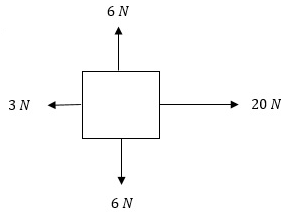
What is the NET FORCE of this diagram?
17 N, right
17 N, left
23 N, right
12 N, up
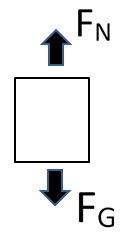
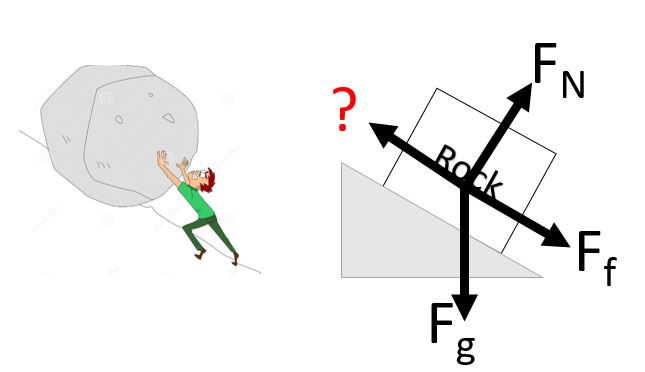
Which of the following is true about this free-body diagram?
the forces are are balanced
the object is free-falling
the object is moving upward
the forces are unbalanced
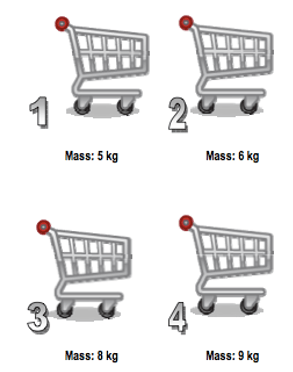


What is inertia?
the force that opposes motion
the force of attraction between 2 objects
an object's tendency to stay in its state of motion
a change in an object's speed and/or direction
What is the net force on an object?
the sum of all the forces on an object
the negative forces on an object
the positive forces on an object
the balanced forces on an object

Why does an 18-wheeler truck have more inertia than a bicycle?
it has more mass
it has more volume
it is not as aerodynamic
It has more space
When two equal forces act in opposite directions on an object, they are called ______________________.
frictional forces
balanced forces
centripetal force
gravitational force
Which of the following is the best example of Newton's First Law of Motion?
Jessica's body flies forward after she hits the brakes
Jessica drives a car
Jessica is at a road crossing
Jessica is sleeping
Newton’s law states that for every action, there is an ________ reaction.
unequal and opposite
equal and similar
stronger and opposite
equal and opposite

When a small car pushes a big truck, the truck applies an equal and opposite force on the car.
False
True

If the person is pushing backwards with the paddle, why do they move forward?
The person will actually move backwards, they need to paddle the other way
The water pushes back with an equal and opposite force
The person is pushing harder than the water
The water pushes back with a greater force than the person

If a person pushes down on a trampoline, why do they move back up into the air?
The trampoline pushes back with a greater force than the person
The trampoline pushes back with less force than the person
The trampoline pushes back with an equal and opposite force as the person
A student kicks a soccer ball. According to Newton's 3rd law, what is the "reaction" in this situation
The soccer ball flies off into the air
You can hear the soccer ball being kicked
The soccer ball exerts a force back on the student's foot
Other students chase after the soccer ball

A student drops a basketball onto the floor. According to Newton's 3rd law, why does the ball bounce?
The student dropped the ball
The earth pulls the ball down
The ball presses down on the floor
The floor presses up on the ball

The moon orbits the Earth. What forces act on the Moon?
Air resistance
Normal Force
Tension Force
Gravity Force
Applied Force
The moon orbits the Earth. How do the forces on the moon and earth compare?
The moon experiences a greater force than the earth
The moon experiences a lesser force than the earth
The forces on the moon and earth are equal in strength
You stand on the ground holding a snowball in the palm of your hand. Which below identifies a third law pair of forces in this situation?
The snowball pushes down on your hand and your hand pushes up on the snowball.
The earth pulls the snowball down, and your hand pushes up to oppose gravity.
The earth pulls you down, and the ground pushes you back up to oppose gravity.
You push down on the ground while standing on it, and the ground pushes back up on you.
A 7.50 N force is applied to a 1.25kg object to accelerate it rightwards across a friction-free surface. Determine the acceleration of the object.
If a 10 kg ball is pushed with a 5 N force, what will the ball's acceleration be?
A 72-kg skydiver is falling from 10 000 feet. After reaching terminal velocity, the skydiver opens his parachute. Shortly thereafter, there is an an instant in time in which the skydiver encounters an air resistance force of 1180 Newtons. Determine the acceleration of the skydiver at this instant. (round to 1 decimal place)
A 921-kg sports car is moving rightward with a speed of 29.0 m/s. The driver suddenly slams on the brakes and the car skids to a stop over the course of 3.20 seconds with the wheels locked. Determine the average resistive force acting upon the car. (round to whole number)
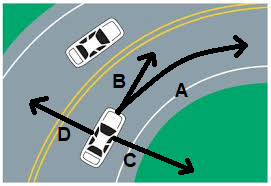
A car is rounding a bend as shown in the diagram. Which arrow correctly shows the direction of the car's velocity?
A
B
C
D

Which Vector represents the acceleration of the ball?
A
B
C
D

CIRCULAR MOTION CONCEPTS: An object moves in a perfect circle on the end of a string. If the string breaks, which letter represents the direction in the object would move in at that instant?
A
B
C
D
directed outward
tension
directed toward the center of the arena
9.8 N
.38
1.23
.55
1.66 N
9.8?
Force triples
Force divides by 3
Force divides by 9
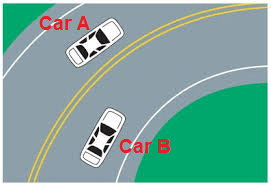
If car A and car B are both traveling at the same speed, which will require a higher centripetal force?
Car A
Car B
They have the same centripetal force

The diagram shows the top view of a 65-kilogram student at point A on an amusement park ride. The ride spins the student in a horizontal circle of radius 2.5 m meters, at a constant speed of 8.6 meters per second. The floor is lowered and the student remains against the wall without falling to the floor. What is the Fc on the student?


The combined mass of a race car and its driver is 600 kg. Travelling at constant speed, the car completes one lap around a circular track of radius 160 m in total time of 36 s. What is the magnitude of the centripetal acceleration of the car?
0.17 m s-2
4.9 m s-2
78 m s-2
100 m s-2

The diagram shows a stone tied to the end of a length of string and is whirled round in a horizontal circle . What provides the centripetal force on the stone?
The weight of the string.
The friction in the string.
The tension in the string.
The air resistance from the surroundings.
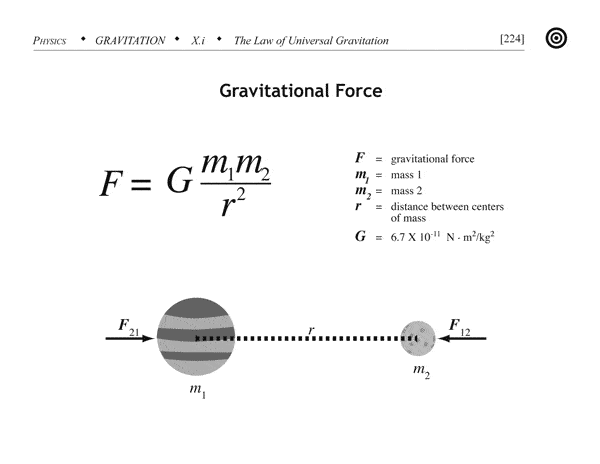
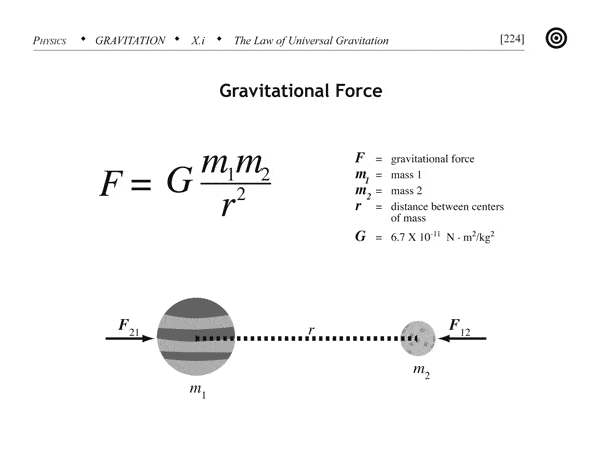
If I double the mass of one object, but don't change anything else... What happens to the gravitational force between two objects?
Doubles
Quadruples
Cut in Half
4x Smaller
What happens to Gravitational force if I triple both of the masses but don't change their distance?
triples
a third as big
9x bigger
9x smaller
Two asteroids exert a gravitational force, F, on each other. Some time later, the asteroids are now 9 times as far from each other as before. Which of the following represents the gravitational force at this distance?
F/3
F/9
F/81
F/4.5
When do gravitational forces exist between two objects?
They only exist between microscopic objects.
They are always present between any two objects.
Gravitational forces only act on objects falling on Earth.
They only exist for objects in space.

Calculate the gravitational force between a 15-kg chinchilla and a 65-kg dog which are separated by 0.30 m.
Fg = 3.7*10-8 N
Fg = 1.3*1012 N
Fg = 1.1*105 N
Fg = 7.2*10-7 N
What would the gravitational force be between the Sun and Mars if they were 2.3*1011 m apart? The masses for the Sun and Jupiter are 1.99*1030 kg and 6.42*1023kg, respectively.
Fg = 3.8*1015 N
Fg = 2.8*10-42 N
Fg = 1.6*1021 N
Fg = 4.6*10-75 N
Which of the following changes would increase the gravitational force between two objects?
Increase G
Increase the mass
Increase r
Decrease G
What is the gravitational force between a 140 kg tree and a 798 kg Lotus Elise Sprint that are 15 m away?
6.6*10-7 N
4.8*104 N
3.3*10-8 N
7.4*1012 N