
 Worksheets
7th Grade Review (Quizizz)
Total questions: 80
Worksheet time: 40mins
Name
Class
Date
1.
Which scientist stated that all animals are made of cells?
a)
Theodor Schwann
b)
Zacharias Janssen
c)
Matthias Schleiden
d)
RudolfVirchow
2.
Which scientist was the first to describe "cells" after looking at a cork under a microscope?
a)
Robert Hooke
b)
Anton van Leeuwenhoek
c)
Zacharias Janssen
3.
_____________________ created the first compound microscope which was composed of 2 lenses, one at each end of a tube and that resembled a kaleidoscope.
a)
Hooke
b)
Leeuwenhoek
c)
Janssen
d)
Smith
4.
Which scientist stated that all cells must come from preexisting cells?
a)
Theodor Schwann
b)
Zacharias Janssen
c)
Matthias Schleiden
d)
Rudolf Virchow
5.
____________________ created a high powered simple microscope and used it to look at his teeth scrapings and pond water, and see tiny organisms.
a)
Robert Hooke
b)
Anton van Leeuwenhoek
c)
Zacharias Janssen
6.
Which scientist stated that all plants are made of cells?
a)
Theodor Schwann
b)
Zacharias Janssen
c)
Matthias Schleiden
d)
RudolfVirchow
7.
The cell is the basic unit of structure and ______________________ in living things
a)
function
b)
composition
c)
chemistry
d)
development
8.
The invention of the ________________________________ made it possible for people to discover and learn about cells.
a)
telescope
b)
kaleidoscope
c)
microscope
d)
mirrorscope
9.
Which of the following statements below make up the three parts of cell theory? (Select ALL that apply)
a)
All living things are made of cells.
b)
Cells are the basic unit of structure and function in living things.
c)
All cells come from pre-existing cells.
d)
Living things respond to stimuli.
e)
All cells always die eventually.
10.
Which three thing are living organisms?
a)
Bacteria
b)
Plants
c)
Animals
d)
Rocks
e)
Water
11.
Which three thing are nonliving organisms?
a)
Rocks
b)
Water
c)
Oxygen
d)
Bacteria
e)
Plants
12.
___________________ used a compound, light microscope to discover that corks are made of "cells".
a)
Robert Hooke
b)
Anton van Leeuwenhoek
c)
Zacharias Janssen
13.
_____________________ created a compound microscope (with his son) that consisted of a tube and two lenses.
a)
Robert Hooke
b)
Anton van Leeuwenhoek
c)
Zacharias Janssen
14.
____________________ created a simple microscope that could magnify up to 266X and used it to look at his teeth scrapings.
a)
Robert Hooke
b)
Anton van Leeuwenhoek
c)
Zacharias Janssen
15.
How do you calculate total magnification (what is the formula) ?
a)
Multiply the powers of two objective lenses.
b)
Multiply the powers of the eyepiece & the objective lens.
c)
Add the powers of the eyepiece and the objective lens.
16.
If the eyepiece has a magnification of 10x and an objective lens has a magnification of 40x, what is the total magnification?
a)
4x
b)
40x
c)
400x
17.
The flat bottom support of the microscope is the _______________.
a)
stage
b)
base
c)
eyepiece
18.
The lens that we look through is called the ___________________________.
a)
vio lens
b)
ocular lens
c)
objective lens
19.
The hollow cylinder that supports the eyepiece is the ____________.
a)
bodytube
b)
diaphragm
c)
nosepiece
20.
The piece that rotates the objective lenses is called the ___________________.
a)
diaphragm
b)
nosepiece
c)
bodytube
21.
The flat platform on which the slide is placed is the _____________.
a)
base
b)
diaphragm
c)
stage
22.
The disk under the stage which has various-sized holes to change the amount of light passing upward through the microscope specimen is the _______________.
a)
stageclips
b)
diaphragm
c)
objective lenses
23.
The lenses located directly above the stage are called _________________.
a)
vio lenses
b)
ocular lenses
c)
objective lenses
24.
___________________ hold the slides in place while you view them.
a)
stageclips
b)
diaphragm
c)
0bjective lenses
25.
Rectangular glass plate used to view samples of water or other materials is a_________.
a)
stage
b)
slide
c)
cover slip
26.
The largest focusing knob which is to be used only on low power or is the _____.
a)
coarse adjustment knob
b)
objective adjustment knob
c)
fine adjustment knob
27.
Microscopes are carried by holding the _________ and _________.
a)
stage & base
b)
arm & stage
c)
arm & base
28.
Small glass or plastic piece that is used to cover a water drop on a slide is a___________.
a)
stage
b)
slide
c)
cover slip
29.
The smallest focusing knob which can be used with all objective lenses is the____.
a)
focus adjustment knob
b)
objective adjustment knob
c)
fine adjustment knob
30.
The lenses in a light microscope magnifies an object by bending the light rays. What type of lens is this?
a)
convex
b)
ocular
c)
concave
31.
To switch from low power to high power, turn the ______________.
a)
A. course adjustment knob
b)
B. fine adjustment knob
c)
C. nose piece
32.
A
a)
Eyepiece
b)
Arm
c)
Base
d)
Body Tube
e)
Coarse adjustment knob
33.
B
a)
Coarse adjustment knob
b)
Arm
c)
Base
d)
Body Tube
e)
Diaphragm
34.
C
a)
Body Tube
b)
Arm
c)
Base
d)
Coarse adjustment knob
e)
Diaphragm
35.
D
a)
Fine adjustment knob
b)
Arm
c)
Base
d)
Body Tube
e)
Coarse adjustment knob
36.
E
a)
Nosepiece
b)
Arm
c)
Base
d)
Body Tube
e)
Coarse adjustment knob
37.
F
a)
Low power objective lens (10x)
b)
Arm
c)
Base
d)
Body Tube
e)
Coarse adjustment knob
38.
G
a)
Arm
b)
Base
c)
Body Tube
d)
Coarse adjustment knob
e)
Diaphragm
39.
H
a)
High power objective lens (40x)
b)
Arm
c)
Base
d)
Body Tube
e)
Coarse adjustment knob
40.
I
a)
Stage
b)
Arm
c)
Base
d)
Body Tube
e)
Coarse adjustment knob
41.
J
a)
Stage Clips
b)
Arm
c)
Base
d)
Body Tube
e)
Coarse adjustment knob
42.
K
a)
Diaphragm
b)
Arm
c)
Base
d)
Body Tube
e)
Coarse adjustment knob
43.
L
a)
Base
b)
Arm
c)
Body Tube
d)
Coarse adjustment knob
e)
Diaphragm
44.
M
a)
Light source
b)
Arm
c)
Base
d)
Body Tube
e)
Coarse adjustment knob
45.
N
a)
Scanning power objective lens (4x)
b)
Arm
c)
Base
d)
Body Tube
e)
Coarse adjustment knob
46.
Which level are the groups least specific?
a)
Kingdom
b)
Family
c)
Species
d)
Phylum
47.
Which level are the groups the most specific?
a)
Kingdom
b)
Family
c)
Species
d)
Phylum
48.
What is the order of taxonomic levels from Most inclusive to most specific?
a)
SFDKCOPG
b)
DKPCOFGS
c)
DKPFGSCO
d)
DKCOPFSG
49.
The scientific names of organisms are a combination of which two levels?
a)
Class and Family
b)
Genus and Species
c)
Domain and Kingdom
d)
Kingdom and Phylum
50.
Members of this kingdom are multicellular and autotrophic!
a)
Plantae
b)
Animalia
c)
Protista
d)
Fungi
51.
Members of this kingdom are mostly unicellular and don't seem to fit in any other kingdom.
a)
Plantae
b)
Animalia
c)
Protista
d)
Fungi
52.
Members of this kingdom are multicellular, decomposers, and reproduce asexually through spores. These are often confused for being plants.
a)
Plantae
b)
Animalia
c)
Protista
d)
Fungi
53.
Members of this kingdom are multicellular, heterotrophic, and Eukaryotic. This kingdom includes both vertebrates and invertebrates.
a)
Plantae
b)
Animalia
c)
Protista
d)
Fungi
54.
The science of classifying and naming organisms is called...
a)
biology
b)
taxonomy
c)
grouping
d)
scientific names
55.
Which tool is used by taxonomists to identify unknown organisms...
a)
dichotomous key
b)
binomial nomenclature
c)
scientific name
d)
binomial key
56.
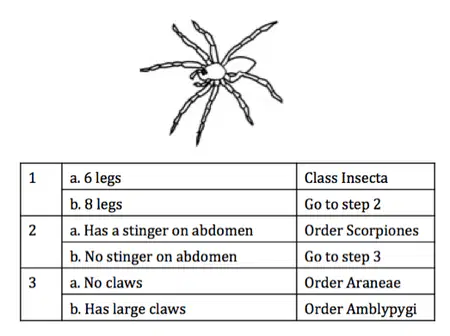
An illustration and a dichotomous key are given. What is the correct classification for this organism?
a)
Class Insecta
b)
Order Amblypygi
c)
Order Araneae
d)
Order Scorpiones
57.
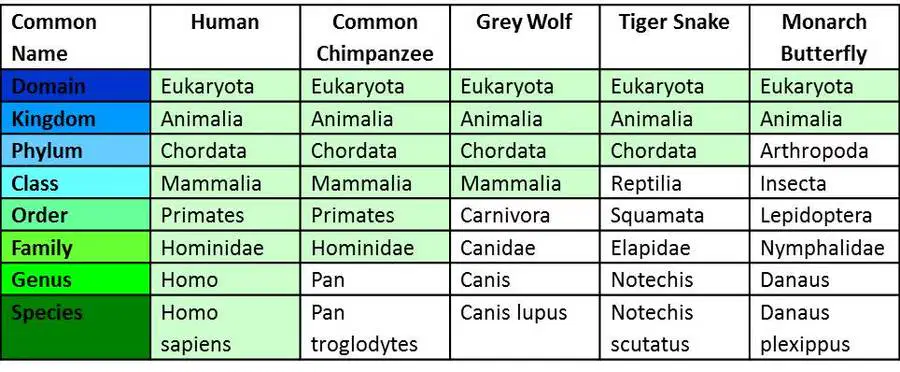
Which organism in the table is least closely related to the chimpanzee?
a)
human
b)
grey wolf
c)
tiger snake
d)
monarch butterfly
58.
What are the domains of life?
a)
Prokaryotes and Eukaryotes
b)
Kingdom, Phylum, Class, Order, Family, Genus, and Species
c)
Archaebacteria, Eubacteria, Plants, Animals, Fungi, and Protista
d)
Bacteria, Archaea, and Eukarya
59.
What are the kingdoms of life?
a)
Prokaryotes and Eukaryotes
b)
Kingdom, Phylum, Class, Order, Family, Genus, and Species
c)
Archaebacteria, Eubacteria, Plants, Animals, Fungi, and Protista
d)
Bacteria, Archaea, and Eukarya
60.
Chordata, Echinodermata, Cnidaria, Mollusca, and Porifera are examples of...
a)
Plant phyla
b)
Fungi phyla
c)
Animal phyla
d)
Protist phyla
61.
Angiosperm, Fern, and moss are examples of ...
a)
Plant phyla
b)
Fungi phyla
c)
Animal phyla
d)
Protist phyla
62.
Heterotrophic organisms obtain energy by...
a)
Eating other organisms
b)
Photosynthesis
c)
Autotrophism
d)
Converting electrical energy to chemical energy.
63.
Autotrophic organisms obtain energy by...
a)
Eating other organisms
b)
Photosynthesis
c)
Heterotrophism
d)
Converting electrical energy to chemical energy.
64.
An organism made up of only one cell...
a)
Unicellular organism
b)
Multicellular organism
c)
Eukaryote
d)
Prokaryote
65.
An organism made up of more than one cell...
a)
Unicellular organism
b)
Multicellular organism
c)
Eukaryote
d)
Prokaryote
66.
An organism made up of more than one cell...
a)
Unicellular organism
b)
Multicellular organism
c)
Eukaryote
d)
Prokaryote
67.
An organism made up of cells without a nucleus and without membrane bound organelles.
a)
Unicellular organism
b)
Multicellular organism
c)
Eukaryote
d)
Prokaryote
68.
An organism made up of cells that include a nucleus and a membrane bound organelles.
a)
Unicellular organism
b)
Multicellular organism
c)
Eukaryote
d)
Prokaryote
69.
Which domain includes unicellular organisms found in extreme environments?
a)
Archaea
b)
Bacteria
c)
Eukarya
70.
Which domain includes unicellular organisms found in everyday locations?
a)
Archaea
b)
Bacteria
c)
Eukarya
71.
Which domain includes both unicellular and multicellular organisms?
a)
Archaea
b)
Bacteria
c)
Eukarya
72.
A starfish is of which domain and kingdom?
a)
Eukarya, Protista
b)
Eukarya, Animalia
c)
Eukarya, Plantae
d)
Eukarya, Fungi
73.
A mushroom is of which domain and kingdom?
a)
Eukarya, Protista
b)
Eukarya, Animalia
c)
Eukarya, Plantae
d)
Eukarya, Fungi
74.
An apple tree is of which domain and kingdom?
a)
Eukarya, Protista
b)
Eukarya, Animalia
c)
Eukarya, Plantae
d)
Eukarya, Fungi
75.
Carolus Linnaeus is known as the father of...
a)
18 children
b)
modern taxonomy
c)
microscopy
d)
genetics
76.

Use the dichotomous Key to identify organism A
a)
Class Bivalvia
b)
Class Gastropoda
c)
Phylum Annelida
d)
Order Octopoda
e)
Order Teuthida
77.

Use the dichotomous Key to identify organism B
a)
Class Bivalvia
b)
Class Gastropoda
c)
Phylum Annelida
d)
Order Octopoda
e)
Order Teuthida
78.

Use the dichotomous Key to identify organism E
a)
Class Bivalvia
b)
Class Gastropoda
c)
Phylum Annelida
d)
Order Octopoda
e)
Order Teuthida
79.
A skeleton found inside an organism.
a)
Endoskeleton
b)
Exoskeleton
80.
A skeleton or shell covering the outside or an organism.
a)
Endoskeleton
b)
Exoskeleton
100 %

