
 Worksheets
AP Biology Unit 7 Test Review
Total questions: 45
Worksheet time: 43mins
Why are advantageous traits more likely to be passed onto offspring?
Because they are more likely to survive and reproduce.
Because they come from dominant alleles.
Because they come from recessive alleles.
Because the organism knew it needed that trait, survives, and passes it on.
Mutations are a change in what?
DNA
tRNA
protein
rRNA
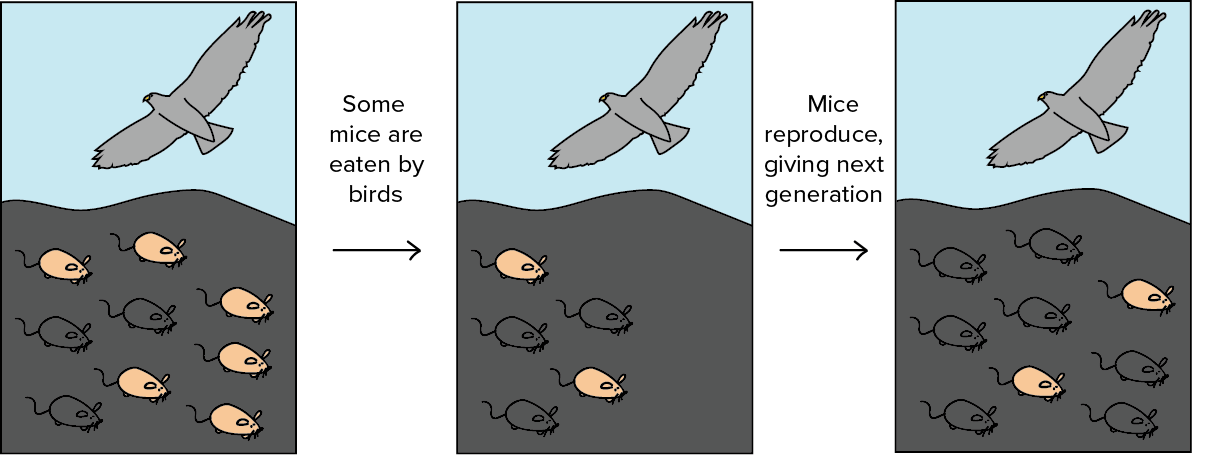

Where do adaptations come from?
The individual organism decides to adapt
Mutations that give an organism an advantage in its environment
Genetic recombination during meiosis
Both mutations and genetic recombination are sources of adaptation
"Organisms that are better adapted to the environment survive to pass traits to their offspring" is the definition of
Natural Selection
Evolution
Selective Breeding
Artificial Selection
Which best describes the role of mutations in natural selection?
Mutations help an organism to better survive in their environment
An organism may acquire a helpful mutation by interacting with the environment
A mutation may result in a beneficial trait that makes an organism more likely to survive and reproduce
Organisms with certain traits are more likely to win competitions for mutations

All rabbits of the same species living in a particular area would be an example of a(n)
population
species
community
ecosystem
The more genetic variation a population has,
the more likely it is for some individuals to
evolve
migrate
survive
mutate
Mutations are important because they bring about
death of the organism in which they develop
genetic variation needed for a population to evolve
benefits for the individual, not for the population
changes in genotype, but not phenotype


Why is competition important for natural selection?
It shows which variations are more successful, allowing the organisms with those variations to survive.
It causes organisms, regardless of which traits they have, to die out, reducing the population size.
It causes organisms to get stronger due to having to outcompete other species.
Competition is not important for natural selection.
Darwin observed many finch species on the Galapagos Islands. To explain these observations, he
proposed that each species evolved from the same common ancestor, which was a finch species
that migrated to the islands from the mainland. What additional evidence did Darwin use to support
his explanation?
The finch populations were very numerous, and different species often bred with one another.
The finch species lived in different habitats on different islands, which isolated them from one another.
The finch species were distributed evenly among all of the islands, but did not interbreed.
The beaks of the finches were identical, allowing them to eat the same foods on any of the islands.
A population of rabbits grows rapidly from one year to the next. Then one year, a disease strikes approximately one fourth of the adult rabbits. The disease remains with the population in the years that follow.
As explained by Darwin’s theory, which of these conditions allows the rabbit population to evolve by natural selection?
The disease affects adult and juvenile rabbits equally.
The disease reduces the ability of the rabbits to reproduce.
Some rabbits are resistant to the disease, and they pass the resistance to their offspring.
No rabbits are resistant to the disease, and all die when the disease strikes them.
Which of the following is a situation that could cause evolutionary change that is NOT due to natural selection?
A volcano erupts and kills many individuals in a population.
A mutation produces sea stars that are less visible to predators.
An insecticide is sprayed in a community to combat mosquitoes.
Cattle are treated with antibiotics to prevent the spread of infections.
What is the movement of genes into or out of a population
(Can cause a population to evolve)
Genetic Drift
Hydrosphere
Open and close systems
Gene Flow
Do individuals evolve?
individuals evolve only if they are male
Individuals don't evolve but populations do
Individuals don't evolve because they cant fly
we do
Founder effect: Each new population has a distinct gene pool from the original population resulting in changes in allele frequency which reduces ____
Genetic variation
Genetic valuation
Genetic drift
Genetic Decorum
A phylogeny explains
Genealogical relationship
morphological relationship

Which of the following species is extinct?
J
A
B
C

arachnids and insects?

Does the perch have jaws
yes
no

Which organisms from this cladogram are more closely related Perch and Pigeon OR Salamander and Pigeon?
Perch and Pigeon
Salamander and Pigeon

A gene pool is
all of the alleles in an individual
all of the alleles in a population
a body of water filled with fish
all of the bases in one strand of DNA
Most causes of speciation are relatively slow in that they may take many generations to see changes, with the exception of...
polyploidy
reinforcement
colonization
natural selection

There three types of natural selection events, 1- directional selection, 2- disruptive selection and
unique selection
multiple allelism
stabilizing selection
conditioning selection
What does the biological species concept use as the primary criterion for determining species boundaries?
geographic isolation
niche differences
gene flow
morphological similarity
_________________ show clear changes in an organism over time, the environment organisms lived in, the time period the organism lived in, and where the organism lived.
DNA
Vestigial structures
Fossils
Homologous structures

What type of evidence are shown in the picture above?
Fossils
Embryology
Homologous Structures
Vestigial Structures

Because whales have a pelvis and femurs, it shows whales are descended from an ancestor that was able to _____________________.
walk
sing
swim
polka
Which of the following is an example of evolution by natural selection?
A giraffe increasing its neck length by stretching to reach the top of a tree
A human increasing the size of their muscles as a result of training
An increase in the number of drug resistant bacteria in a population

What can cause variation to be passed on to offspring?
Less well-adapted individuals cannot reproduce
Most well-adapted individuals can reproduce
Reproduction involves passing on genes

The graphs below show the changes in crab color at one beach.
Which of the following is most likely to have caused the change in the distribution?
A new predator arrived that preferred dark-tan crabs.
A new predator arrived that preferred light-tan crabs.
A change in beach color made medium-tan crabs the least visible to predators.
A change in beach color made medium-tan crabs the most visible to predators.

Directional Selection
Stabilizing Selection
Disruptive Selection

A population of African swallowtail butterflies exhibit different patterns and tails. Which traits are not favored and may eventually die out?
One extreme trait
Both extreme traits
The medium/average trait


What is evolution?
study of living things
change over time
study of non-living things


