
 Worksheets
EHM Unit VIII_Middle Ages Practice Test
Total questions: 44
Worksheet time: 33mins
(a) codified Roman law and had a major impact on western law.
(a) gave a speech during a crisis in the (b) Empire, and inspired her doubtful husband to resist the invasion.
(a) fell in 1453 to the (b) Empire. It's name was changed to Istanbul.
(a) expanded the Byzantine Empire to its largest size, but after him the empire (b)
(a) united the (b) by converting to (c) and having a strong relationship with the Pope at (d) .
(a) won the Battle of (b) in 732 C.E. and stopped the (c) advance into Western Europe.
(a) was the first ruler of a confederation of Germanic states called the (b) Empire .
Scandinavian invaders called (a) came from the modern countries of Norway, Sweden and (b)
Vikings influenced modern culture through language and (a)
The (a) (Bubonic Plague) that ravaged Europe from 1347-1351 C.E. resulted in the loss of (b) the population of Europe. This caused feudalism to (c) .
The Black Death spread from (a) to (b) via fleas on rats.
Some Byzantine Emperors used (a) as bodyguards.
Arrange from the oldest (left) to the most recent (right)
Fall of the Western Roman Empire
Clovis unites the Franks
The Battle of Tours
The Black Death
Fall of Constantinople

Match the event and the "so what?"
Fall of Rome
Rise of the Germanic Franks and Feudalism
Battle of Tours
Islam doesn't spread to Western Europe
Great Schism
Christianity divided between Roman Catholic / Eastern Orthodox
Mehmet the Conqueror buys a big honkin' cannon
Constantinople falls to the Ottomans
Battle of Kulikovo
Moscow 1, Mongols 0
Arrange the labels in chronological order, left (oldest) to right (most recent).

Match the Event and the Outcome
Black Death
1346-1352 C.E.
Half of Europe's population wiped out
Battle of Tours 732 C.E.
Muslims stopped before reaching Western Europe
Battle of Kulikovo 1380 C.E.
Moscow stops the Mongols
Fall of Constantinople 1453 C.E.
Ottomans conquer the Byzantines
"Deus Vult!"
1095 C.E.
Pope Urban II's famous crusade speech
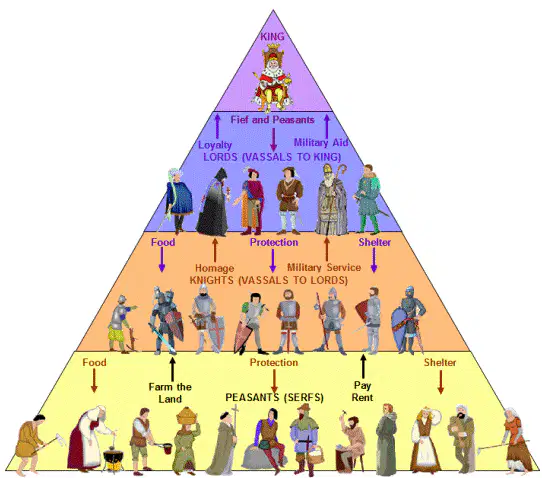
(a) declined because of the (b) , the Black Death, the Magna Carta and the invention of the longbow!
The King's power was limited by this document, signed by King John in 1215 C.E. This was a major political reason for the decline of feudalism.
The Treaty of Quesadilla
The Edict of Milan
The Magna Carta
The Code of Hammurabi
Match the terms and descriptions of things that led to the decline of feudalism.
Magna Carta
1215 C.E.
Limited the power of the King
The Crusades
1095-1291 C.E.
Drew manpower from Europe to the Holy Land
The Black Death
1346-1352 C.E.
Destroyed over 50% of peasant workforce
English Longbow
1415 C.E.
Nullified armor advantage of feudal knights
Rise of the Merchant Class, 13th-14th centuries
Noble - Peasant relationship undermined--better economic options

The event that ushered in the age of feudalism was the (a) in 473 C.E.

The (a) was Spain's campaign to drive the (b) (North African Muslims) off the Iberian Peninsula.
Ivan the Great
United Northern Russia
Clovis
United the Germanic Franks
Charlemagne
Emperor of the Holy Roman Empire
Charles Martel
Stopped Muslim advance into Western Europe
Marco Polo
European traveler who met Kublai Khan, GK's grandson
King Richard I of England, also known as Richard the Lionheart, led the...
First Crusade.
Second Crusade.
Third Crusade.
The city of Jerusalem is important to what three major religions?
Buddhism, Hinduism, and Islam
Islam, Christianity, and Hinduism
Islam, Christianity, and Judaism

This is the vast grassland that stretches across Northern Asia
Siberia
Steppe
Tibetan Plateau
Ethiopian Highlands
Around 1200 CE, this person unified the Mongol Empire
Kublai Khan
Genghis Khan
Confucius
Marco Polo
Eventually the Mongols would divided their empire into four regions or _______________
Sects
Divisions
Khanates
Territories
________________ was allegedly the most famous European to viists China during years of Mongolian rule.
Columbus
Marco Polo
John Wayne
Tom Brady
As a byproduct of the increased interregional connections they caused, the Mongols were probably responsible for this
the Hundred Years War
the Norman Conquest of 1066
Global Warming
the Black Death

This capital of the Abbasid Empire was destroyed by the Mongols in 1258
Baghdad
Samarkand
Damascus
Kiev
The term "Tsar" or Czar" comes from what latin term meaning emperor?
(a)

Caesar
The first Russian ruler to adopt the title czar, meaning "caesar" was:
Peter the Great
Ivan the Terrible
Michael Romanov
Anastasia Romanov
Ivan the Terrible's cruelty was aimed mainly at:
serfs
priests
nobles
merchants

