
 Worksheets
energetics and kinetics
Total questions: 54
Worksheet time: 33mins
Which reaction is endothermic?
acid neutralising alkali causing a temperature increase
adding magnesium to hydrochloric acid
calcium carbonate decomposing when heated combustion of fossil fuels
Which statements about exothermic and endothermic reactions are correct?
During an exothermic reaction, heat is given out
The temperature of an endothermic reaction goes up because heat is taken in
Burning methane in the air is an exothermic reaction
Which is an endothermic process?
Burning hydrogen
Distilling petroleum
Reacting potassium with water
Using petrol in a motor car engine
Which fuel does not produce carbon dioxide when it burns?
Coal
Hydrogen
Methane
Statement 1 Hydrogen is used as a fuel.
Statement 2 When hydrogen burns in the air to form water, heat energy is produced.
Which is correct?
Both statements are correct and statement 2 explains statement 1
Both statements are correct but statement 2 does not explain statement 1
C Statement 1 is correct but statement 2 is incorrect
Some white anhydrous copper(II) sulfate powder is put into a beaker of water and stirred. What would show that the process was exothermic?
A blue solution is formed
The beaker feels cooler
The beaker feels warmer
Which of the following is true about the formation of bonds between molecules?
Energy is given off when bonds are formed between molecules.
Energy is absorbed by the molecule when bonds are formed.
Energy is neither given off nor absorbed when bonds are formed.
Which of the following statement is true about the breaking of bonds between molecules?
To break a bond between molecules, energy must be released by the molecule
To break a bond between molecules, no energy is needed.
To break a bond between molecules, energy must be absorbed by the molecule.

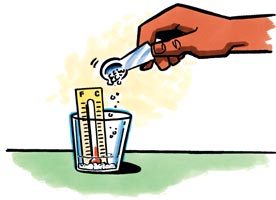
The initial temperature was measured to be 20oC and the final temperature was 10oC. The reaction was
exothermic
endothermic
The initial temperature was measured to be 20oC and the final temperature was 45oC. The reaction was
exothermic
endothermic

What type of reaction is this?
Exothermic
Endothermic
Energy Producing
No way to tell

The graph above is from which type of reaction?
Endothermic reaction
Exothermic reaction
When we investigate the rate of reaction we are looking at the...
amount of product formed
speed of reaction
concentration of reacting particles
combining reactants with products
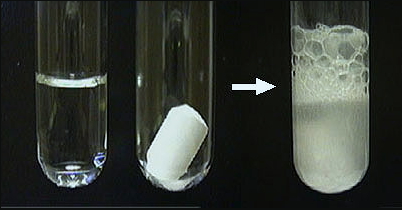
How could we make this reaction happen more quickly?
Decrease the concentration of the acid
crush the chalk to increase the surface area
Put the test tube in an ice bath
What does the M after a concentration value stand for?
meters
music
Molarity
moles
The major theory of reaction rate is called
Collision theory
Crash theory
Newton's laws
Thermodynamics
When surface area is decreased the rate of reaction...
Decreases, because there are LESS possible sites for correct collisions
Increases, because there are LESS possible sites for correct collisions
Decreases, because there are MORE possible sites for correct collisions
Increases, because there are MORE possible sites for correct collisions
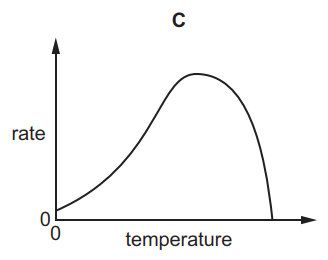
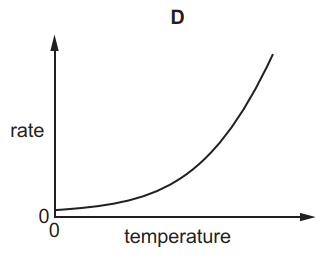
Which graph shows the effect of increasing temperature on the rate of reaction of calcium carbonate with dilute hydrochloric acid?
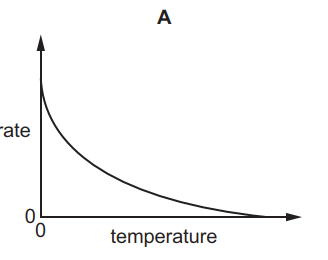
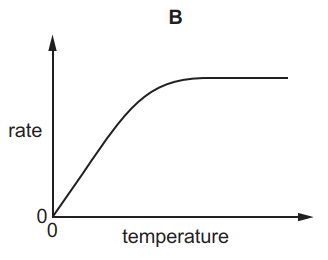
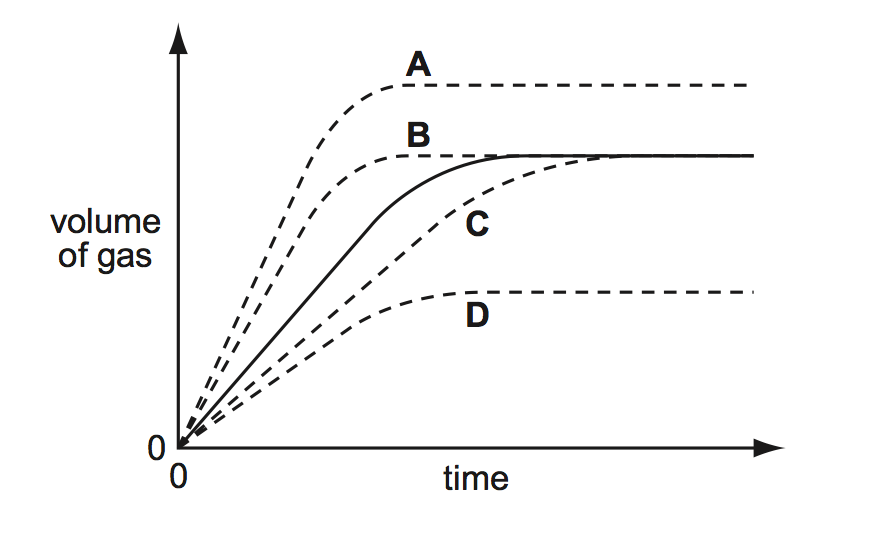
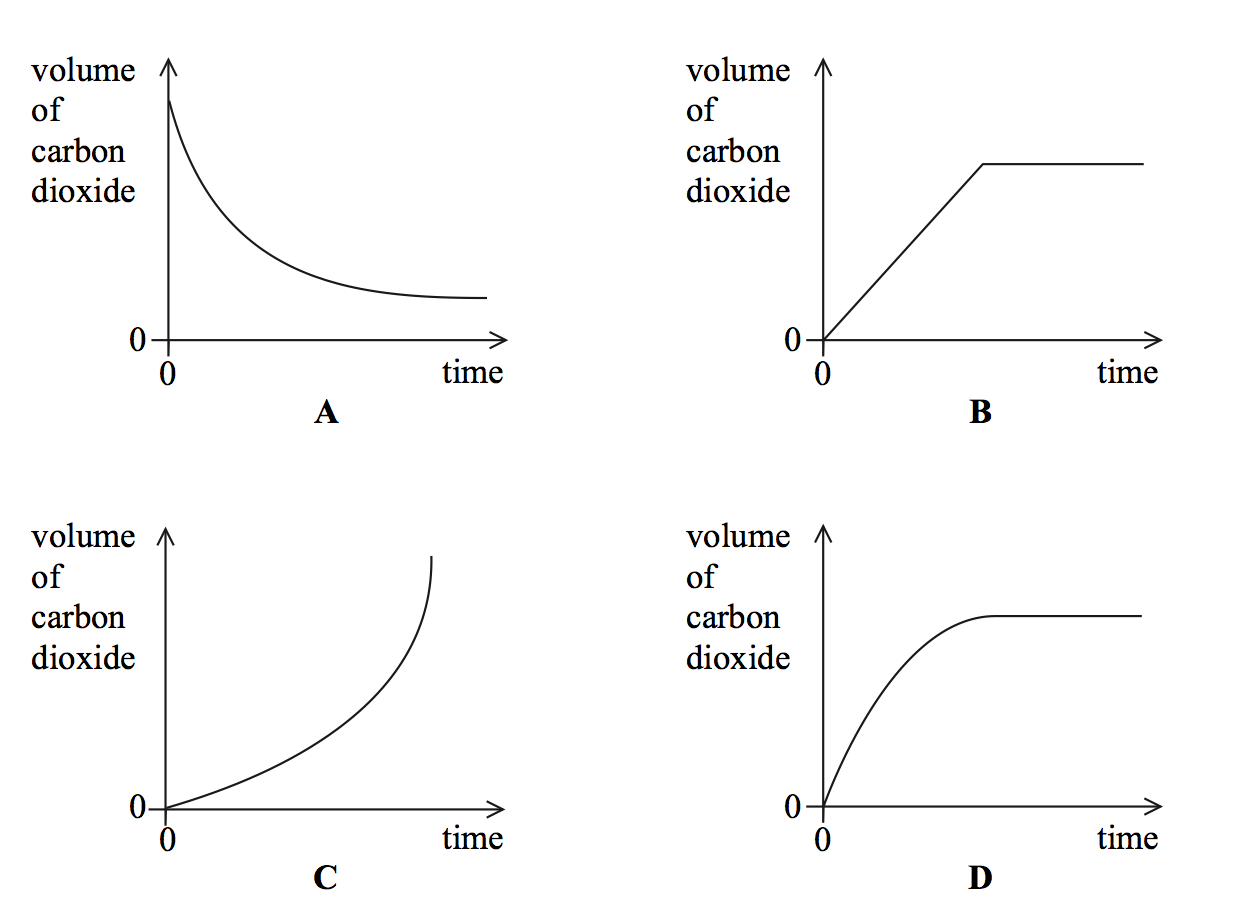
Which graph shows the correct results?


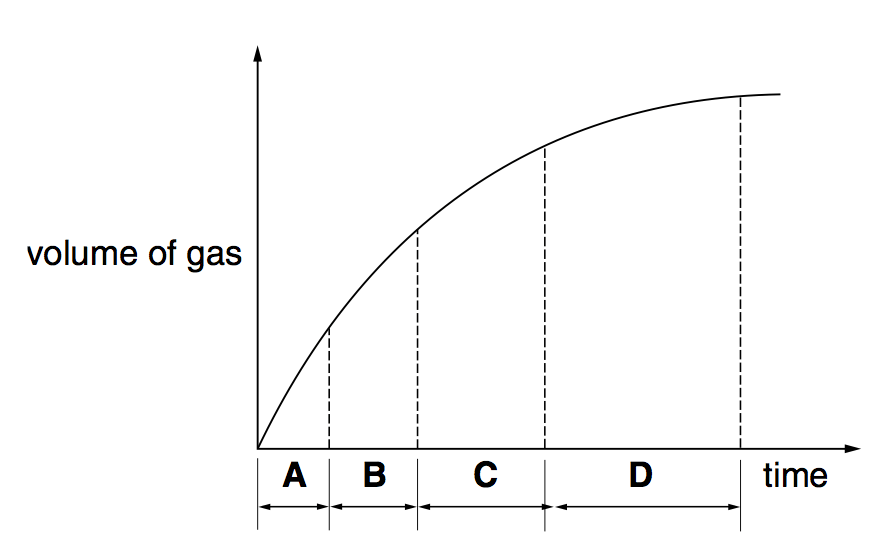
A student reacted a carbonate with an acid and measured the volume of carbon dioxide gas at regular intervals. Between which two times was the reaction fastest?
0-2 minutes
2-4 minutes
4-6 minutes
8-10 minutes
List four factors that affects the rate of a reaction
temperature
concentration
surface area
volume
catalysts

Which colour on the graph would represent the solution with the higher temperature?
Red
Blue
None
Both
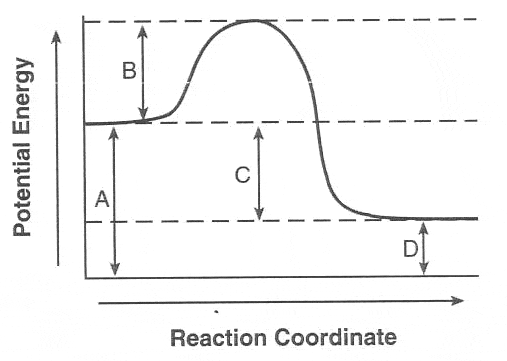
Endothermic
Exothermic
Physical
Chain


Which group of particles shows that increasing surface area increases collisions among particles?
Left side
Right side
Cannot be determined by either picture

From the data given, calculate the average rate at which A disappears over the time interval from 20 s to 40 s.
Average Rate = −ΔtΔ[A]

Calculate the average rate of the appearance of B over the time interval from 0 to 40 s.
Which of the following is not a correct statement about the effect of a catalyst?
Provides an alternative route to the products
Lowers the energy which molecules need for successful collisions
Provides energy so that more molecules have successful collisions
Reactant molecules form weak bonds on active sites

You were asked to find the instantaneous rate of the reaction at 60 seconds in terms of g/s carbon dioxide produced. calculate using the points (20,0.14) (100,0.35). Pick the correct answer
2.3 x 10¯³g/s
2.625 x 10¯³g/s
2.625 x 10¯³kg/s
2.3 x 10¯³kg/s
Hydrogen and Iodine gas react to form hydrogen iodide, as shown in the equation H2 + I2 → 2HI. Suppose you are given a time interval from t1=10 sec and t2=20 sec where the change in H2 concentration from 0.210 mol/L to 0.185 mol/L. Calculate the average reaction rate in that period.
(a)
What quantity is defined by the rate of decomposition of a reactant at a specific time?
Specific rate constant
Rate order
Instantaneous rate
Catalyst
The term that describes the change in the concentration of a reactant divided by the change in time of the reaction is the ______________.
Rate constant
Average reaction rate
Activated complex
Chemical reaction
Catalyst helps to
increase the amount of product obtained
to lower the activation energy
provide an alternative reaction route
decrease the frequency of collision
What is collision theory?
Molecules must collide in the correct orientation with enough energy to bond.
Molecules need enough energy to collide and react.
Atoms constantly collide and react.
The minimum energy needed for atoms to react

