
 Worksheets
Astronomy Units 1-5
Total questions: 500
Worksheet time: 9hrs 33mins
What is an astronomical unit (A.U.)?
the time it takes light to travel one year
the distance between the Earth and the Moon
the distance between the Earth and the Sun
the distance between the Earth and the Neptune
Why do we use light years and astronomical units to measure distances in space?
Scientists want to sound smart.
Hubble discovered these units and wanted to use them.
Space is too small to use km, it wouldn't make sense.
Space is too big, vast, enormous to use traditional units, like miles.
Which of the following scenarios would be appropriate to use light years?
From the sun to Earth
from Earth to Neptune
from the Milky Way to its closest galaxy
Asteroid Belt to the Kuiper Belt
Which of the following scenarios would we use Light Years to determine, not Astronomical Units (AU)?
distance from Mercury to Saturn
distance from Sun to Neptune
distance from Earth to Sun
distance from Asteroid Belt to the Betelgeuse Star
Which of the following is CLOSEST to planet Earth:
Jupiter
Andromeda Galaxy
Earth's moon
the Sun
Light year is a unit of _?_.
time
distance
brightness
heat

Why create a new unit for distance?
Kilometers or miles were too small.
Kilometers or miles were too big.
They could not agree whether to use kilometers or miles.

Which is a longer distance: a parsec or a light year
parsec
light-year
They are equal distances. Parsec is Latin for light-year.
A.U. (astronomical units) are used to measure distances between _?_.
stars
planets
galaxies
solar systems
Light years are used to measure distances between _?_.
stars
planets
galaxies
solar systems
The distance that light can travel in a year is called....
A light second
A light minute
A light month
A light year
This geometrically derived unit equals about 3.26 light years
Astronomical Unit
Light year
Parsec
Light second
_____________ would be the best to use to measure the distance between galaxies
Astronomical units
Light seconds
Light years
Parsecs
_______________ would be the best unit to use to measure the distance between the asteroid belt and Pluto
Astronomical units
Light seconds
Light years
Parsecs
_______________ would be the best unit to use to measure the distance between the our sun and Proxima Centauri (our nearest star neighbor).
Astronomical units
Light seconds
Light years
What's wrong with Han Solo's claim of making "the Kessel Run in less than 12 parsecs"
Even the Millennium Falcon can't travel that fast
He should have used 'astronomical units'
Parsec is a measure of distance, not time
He should have used 'light seconds'
An object at the other end of the universe is billions of ___________ away.
AUs
Light seconds
Light minutes
Light years
Which distance is larger: 1 astronomical unit or 1 light-year?
1 AU
1 LY
If an object is 7.4 light years away from Earth, what does this tell you?
It would take 7.4 minutes for the light to get to Earth.
Traveling at the speed of light it takes 7.4 yrs to get to the earth.
The object is very close to Earth.
It would take 7.4 seconds for the light to get to earth.

What units would you use to measure the diameter of a planet?
Light Years
Astronomical Units
Kilometers
Centimeters
The distance light can travel in one year is ______________
15,000 kilometers
1 light-year
15 Astronomical Units
6,000 miles
Which unit of measure would be used to measure the distance from our solar system to the center of the MIlky Way?
ft
ly
AU
km
Arrange the following distances in order from smallest to largest.
Kilometer
Light-year
Yard
Astronomical unit
Yard, Astronomical unit, light year, Kilometer
Yard, light year, Kilometer, Astronomical unit
Yard, Kilometer, Astronomical unit, light year
A light year is the ______________ light travels in a ____________. It is used to measure _____________ in space.
Distance, Year, Distances
Year, Distance, Distances
Distance, Distance, Year
Which two objects in space are located farthest apart?
Earth and Mars
Earth and the sun
Earth and the moon
the Milky Way galaxy and the Andromeda galaxy
Space exploration has advanced our knowledge of the universe. Which space journey would take the longest?
a journey from Earth to the sun
a journey from Earth to the moon
a journey from Earth to a star in the constellation Centaurus
a journey from Earth to the farthest planet in our solar system, Neptune

Which object is closest to Earth?
Barnard’s Star
Planet Neptune
Andromeda galaxy
Triangulum galaxy
The galaxy we are a part of is called:
Milky Way
Andromeda
Whirlpool
Sombrero

The unit used to measure distances between objects like stars or galaxies is
kilometers
miles
light years
astronomical units

Proxima Centauri is the closest star to Earth after the Sun and is located 4.3 light years away from Earth. How long does it take light from Proxima Centauri to reach Earth?
1 year
4.3 years
43 years
10 trillion years
Which unit is best to measure the distance to Neptune?
a red shift
The Astronomical Unit
a light-year
a parsec

What is the time taken for the light to travel between the Sun and Earth?
2 minutes
4 minutes
8 minutes
12 minutes
If an object is 7.4 light years away from Earth, what does this tell you?
It would take 7.4 minutes for the light to get to Earth.
Traveling at the speed of light it takes 7.4 yrs to get to the earth.
The object is very close to Earth.
It would take 7.4 seconds for the light to get to earth.


What is parallax?
the average distance between a celestial object and Earth
the angle formed by Earth and two celestial bodies located in different directions from Earth
the apparent difference in the position of an object when viewed at the same time each year
the apparent difference in the position of an object when viewed from different lines of sight
Which of the following best describes the difference between two different units of distance in space?
An AU is useful for measuring distances within the solar system; a light-year is useful for measuring distances beyond the solar system.
An AU is calculated by dividing kilometers by 150 million; a light-year is calculated by determining how long it takes an object to travel 150 million AUs.
An AU is useful for measuring objects fewer than 300 light-years from Earth; a parsec is useful for measuring objects more than 300 light-years from Earth.
An AU equals the distance between Earth and the Sun; a parsec equals the angle between an object’s apparent positions when viewed from two different locations.
Your friend argues that all the stars in a typical constellation are approximately the same distance from Earth. Is your friend correct?
Yes. All the stars in a typical constellation are approximately the same distance from Earth.
No. The stars in a constellation fall within the same patch of sky on the celestial sphere, but some stars are typically much closer to Earth than others.
No. The stars in a constellation fall within the same patch of sky on the celestial sphere, but brighter stars are always much closer to Earth than dimmer stars.
No. The stars in a constellation fall within the same patch of sky on the celestial sphere, but only equally bright stars are the same distance from Earth.
An astronomical unit is equivalent to
150,000 miles
150,000 kilometers
150 million miles
150 million kilometers
What is necessary to calculate a star's distance from Earth?
the parallax angle
the position of the star observes twice, six months apart
the distance between the two points of observation
all of the above
What is the distance of Andromeda Galaxy measured from the Earth?
1.7 million light years
2.2 million light years
28 million light years
Which of the following will show the smallest parallax shift?
the Moon
the planet Jupiter
the Sun
Alpha Centauri, the nearest star
the star 51 Pegasi, about 50 lightyears away
How many Lightyears are in a Parsec?
3.26
1
150 million
30.1

The orbit of the Earth around the sun (diameter of 2 AU) is used as the ...
parsec
baseline
parallax
Dave runs a 400 m race with a speed of 4 meters per second. What time will it take him to finish the race?
400 minutes
100 minutes
100 seconds
.25 seconds

If a man runs at a speed of 70 meters per second, and has a time of 30 seconds. Calculate the distance he ran.
2100 m
0.233 m
2.33 m
300m
Joanna drives for 400 km at an average speed of 80 km per hour. How long was her journey?
Joanna's journey was 5hrs long
Joanna's journey was 10hrs long
Joanna's journey was 20hrs long
Joanna's journey was 15hrs long
How do you calculate speed? (rate)
divide the time by the distance (time/distance)
Divide the distance by the time (distance/time)
multiply the distance by the time (distance x time)
multiply the speed by the time (speed x time)
How do you calculate distance?
Divide the speed by the time (speed/time)
Multiply the rate of speed by the time (rate x time)
divide the rate by the distance
What are the underlined words?
Mike can run 50 miles per hour. If he ran for 3 hours, how far would he get?
Distance
Rate of Speed
Time
What are the underlined words?
Mike can run 50 miles per hour. If he ran for 3 hours, how far would he get?
Distance
Rate of Speed
Time
If distance = rate * time, which of the following must also be true?
Rate = distance * time
Time = distance ÷ Rate
Distance = rate ÷ Rate
Time = rate ÷ Distance
Which of the following steps is important in solving distance, rate, and time problems?
Working quickly.
Doing the whole problem in your head.
Drawing diagrams.
Memorizing the average speeds of different trains.
If a puppy runs across a park at a speed of 15 meters per second. The puppy has a time of 5 seconds. How far did the puppy run?
75 m
30 m
45 m
105 m
You know you have a "rate" when you see which keyword?
through
under
per
via
What is the speed of light?
1 000 000 km/h
359 892 560 m / s
299 792 458 m / s
It is impossible to calculate the speed

The Milky Way measures ____ light years in length.
26,000
1 million
1000
100 thousand

In comparison to other stars in the sky, the Sun appears brighter because it is–
Bigger
Smaller
Nearer
Further


As the _________ of a star increases, luminosity increases.
size
distance
age
composition
The luminosity of a star describes its ______________.
brightness
temperature
age
color

Which star would have the highest luminosty?

Based on the graph a star of whoich color most likely has the lowest luminosity?

Which celestial body above is most likely to have the highest surface temperature?
A
B
C
D
Which of the following stellar spectral classes has the highest surface temperature?
O
A
F
K

Is the star marked X belong to the main sequence stars?
True
False

Which pair is most likely to have stars with approximately equal radii?
A
B
C
D
It is impossible to compare stellar radii using a H–R diagram.
What kind of star has the longest lifespan?
A very massive star, like a blue giant
An average sized star, like our Sun
A star with low mass, like a red dwarf
Which of the following give off infrared radiation?
people
light bulbs
stars
a heated / glowing stovetop burner

Which star has the greatest luminosity?

Which star shines brightest as seen from Earth?
Based on the graph a star of whoich color most likely has the lowest luminosity?
Which star would have the highest luminosty?

Which star is going to have the highest temperature?


Stars are made of mostly which two gases?
Hydrogen and Helium
Hydrogen and Oxygen
Hydrogen and Nitrogen
Hydrogen and Carbon
Stars give off heat and light in a process called ___________.
nuclear fusion
supernova
luminosity
spectroscopy
In the process of nuclear fusion, hydrogen atoms combine to form ___________ atoms.
helium
carbon
nitrogen
oxygen
Billions of stars are held together in groups called __________.
galaxies
solar systems
planets
comets
Our Sun is part of which galaxy?
Milky Way
Andromeda
Sombrero
Whirlpool
The luminosity of a star describes its ______________.
brightness
temperature
age
color
As the _________ of a star increases, luminosity increases.
size
distance
age
composition
What color are the coolest stars?
red
blue
white
orange
What color are the hottest stars?
blue
red
white
yellow
The types of gases that make up a star is also known as the star's _______________.
composition
temperature
size
luminosity
Describe the difference between luminosity and magnitude.
Luminosity measures energy, magnitude measures brightness
Luminosity measures brightness, magnitude measures energy
Luminosity measures distance, magnitude measures time
Luminosity measures time, magnitude measures distance
Stars that are further away...
Will be more blueshifted
Will display less parallax
Will always appear dimmer
Will have a greater magnitude

very large star of high luminosity and low surface temperature, thought to be in a late stage of evolution when no hydrogen remains in the core to fuel nuclear fusion.
nuclear fusion
main sequence star
core collapse
red giant

extremely large red giant star with a minimum of 15 solar masses. The best known red supergiant is Betelgeuse, with a luminosity about 10,000 times that of the Sun.
super redgiant
main sequence star
supernova
neutron star
the intrinsic brightness of a celestial object
mass
gravity
luminosity
stars
Which star has a surface temperature most similar to the surface temperature of Alpha Centauri?
Polaris
Betelgeuse
Procyon B
Sirius
Which star is hotter, but less luminous, than Polaris?
Deneb
Aldebaran
Sirius
Pollux
Which two stars are most similar in luminosity?
Betelgeuse and Barnard's Star
Procyon B and Proxima Centauri
Polaris and the Sun
Alpha Centauri and Sirius
Compared the the Sun, the star Betelgeuse is
less luminous and warmer
less luminous and cooler
more luminous and warmer
more luminous and cooler
Which of the following are characteristic of the surface temperature and luminosity of some white dwarf stars?
Surface Temperature: 5,000 K Luminosity: 100
Surface Temperature: 5,000 K Luminosity: 0.001
Surface Temperature: 10,000 K Luminosity: 100
Surface Temperature: 10,000 K Luminosity: 0.001
Which star is more massive than our Sun but has a lower surface temperature?
40 Eridani B
Sirius
Aldebaran
Barnard's Star
For other stars in our galaxy that go through a similar life cycle to our Sun, which star is currently in the late stage of its life cycle?
Alpha Centauri
Procyon B
Bernard's Star
Polaris
Shows the relationship between luminosity and temperature in a star.
HR (Hertzsprung - Russell) Diagram
Color vs. Brightness chart
Temperature vs. Luminosity chart
Stellar life cycle chart
Shows the relationship between luminosity and temperature in a star.
HR (Hertzsprung - Russell) Diagram
Color vs. Brightness chart
Temperature vs. Luminosity chart
Stellar life cycle chart
Apparent Magnitude
the brightness of a star as seen from Earth have at a distance of 32.6 light-years from Earth Luminosity The actual brightness of a star
the brightness that a star would have at a distance of 32.6 light-years from Earth
the location on the H-R diagram where most stars lie
the brightness of a star as seen from Earth
A star in a galaxy has a surface temperature of 8,000 K and a luminosity of 10. Identify the stage and color of this star.
Super Giant and White
Main Sequence and Red
White Dwarf and White
Main Sequence and White
Compared to our Sun, the star Betelgeuse is
smaller, hotter, and less luminous
smaller, cooler, and more luminous
larger, hotter, and less luminous
larger, cooler, and more luminous

Which star color indicates the hottest star surface temperature?
Blue
White
Yellow
Red
Which might change, depending on the distance to a star?
absolute magnitude
apparent magnitude
compostion
luminosity

Which star on the graph has the greatest apparent magnitude?
Polaris
Proxima Centauri
Sirius
the Sun
The brightness of a star as seen from earth
Apparent magnitude
Awesome magnitude
Absolute magnitude
Amazing magnitude
As the frequency of a wave increases, how does the wavelength change?
increases
decreases
It does not change.
There is not enough information to answer this question.
Which of the following types of electromagnetic radiation travels the slowest?
Gamma Rays
Radio Waves
Visible Light
They all travel at the same speed.
Which of the following is the speed of light when traveling through space?
3 x 10⁸ m/s
300, 000 km/s
3 x 10⁵ km/s
All of these answers are correct.
A wave has a frequency of 50Hz and a wavelength of 10m. How fast is the wave traveling?
50 m/s
5 m/s
500 m/s
5000 m/s
A wave has a wavelength of 10 m and a speed of 340 m/s. What is its frequency?
34 Hz
3400 Hz
34 m
3400 m
What is the wavelength of an electromagnetic wave with a frequency of 3.76 x 10¹⁴ Hz?
1.25 x 10⁶ meters
3 x 10⁸ meters
1.13 x 10²³ meters
7.98 x 10⁻⁷ meters
How would you write 137840000 in scientific notation?
1.3784 x 10⁸
13.784 x 10⁷
1.3784 x 10⁻⁸
13.784 x 10⁻⁷
Write 7.89 x 10⁻⁴ in standard notation.
.0000789
7890000
.000789
78900
In minutes, how long does it take light to reach Earth from the Sun?
100
8
1
80
What is the speed of light in kilometers per second?
3 x 10⁸
3000
3 x 10¹¹
300,000
If the plane of the Milky Way Galaxy is about 100,000 light years across, how long would it take for light to travel from one end of the galaxy to the other?
100 years
1000 years
100,000 years
1 million years
The fastest spacecraft made by humans so far is the Parker Solar Probe, which has reached a speed of 430,000 miles per hour. At this speed, how long would it take for the spacecraft to go from one end of the Milky Way Galaxy to the other if the plane of the galaxy is 100,000 light years across?
100,000 years
over 150 million years
15 years
1 year
The fastest spacecraft to ever carry humans was the Apollo 10 vehicle. It reached a speed of about 25,000 miles per hour. At this speed, how long would it take people to get to Proxima Centauri, which is about 4 light years away?
235 years
39, 193, 333 years
107, 379 years
940,640,000 years
If Mars is about 70 million miles away from Earth and you sent a laser pulse there, how long would it take the photons to reach the surface of the planet?
6 minutes
5 months
2 minutes
3 days
Saturn is about 1.42 x 1014 cm away from the Sun. How long would it take for my favorite song playing on the radio right now to reach my alien buddy on Saturn?
about an hour
a few minutes
they can hear it right now
it will take years
Polaris is about 323 light years away from Earth. How many days would it take for light from the North Star to reach us?
118 million
118,000
118
18
When light passes through a prism, each wavelength bends a different amount so that we can see the different colors at different wavelengths. This is called...
resolution
reflection
refraction
interference
Which type of spectrum is a rainbow with black lines where specific wavelengths are missing?
continuous
emission
absorption
Which type of spectrum is mostly dark with only colored lines at specific wavelengths where light is emitted?
continuous
emission
absorption
When the wavelengths of an observed astronomical object appear to be longer than they really are, we say that the object's light has been...
redshifted
blueshifted
When an object's light has been redshifted, it must be...
moving away from us
moving towards us
Most objects in the universe are...
moving away from us
moving towards us
are not moving compared to us
The light from most galaxies appears to be...
blueshifted
redshifted
The farther away the galaxy, the more its light has been redshifted. This means that the farther away a galaxy is from us, the __________ it is moving away.
faster
slower
When we look out into the universe, most astronomical objects are moving away from us and the farther away they are, the faster they are moving. This tells us that the universe is...
getting smaller (contracting)
getting larger (expanding)
What is the highest point on a wave called?
Crest
Trough
Wavelength
Frequency
What is the lowest point on a wave called?
Crest
Trough
Wavelength
Frequency
What is the distance between two adjacent crests or troughs on a wave called?
Crest
Trough
Wavelength
Frequency
What is the number of waves that pass a point in a given time period called?
Crest
Trough
Wavelength
Frequency
What speed do electromagnetic waves travel at?
30 kilometers per second
3 meters per second
300 meters per second
300,000 kilometers per second
EM Waves are everywhere?
True
False
Which EM wave has the longest wavelength?
Visible Light
Gamma Rays
Radio Waves
Microwaves
What waves are used to transmit signals to radio and tv stations?
UV rays
Infrared Waves
X-rays
Radio Waves
This EM Wave is often used in medical imaging.
Microwaves
X-Rays
Gamma rays
Infrared waves
This EM Wave is responsible for the warmth you feel.
UV Rays
Microwaves
Gamma Rays
Infrared Waves
This EM Wave has the shortest wavelength, highest frequencies, and highest energy.
Gamma Ray
Visible Light
Microwaves
UV Rays
Prolonged exposure to this EM Wave can damage human tissue.
Gamma Rays
Microwaves
X-Rays
Radio Waves
Which EM wave does NOT damage living tissue?
X-Rays
Gamma Rays
Ultraviolet Rays
Radio Waves
This is the electromagnetic radiation that can be detected by your eyes.
Radio Waves
Visible Light
UV Rays
X-Rays
Which color on the visible spectrum has the shortest wavelength?
Yellow
White
Red
Violet
Which color on the visible spectrum has the longest wavelength?
Yellow
White
Red
Violet
This EM Wave can be used for cell phones and to cook food quickly.
Frequency
Microwaves
UV Rays
Infrared Waves
Which of the following below list the EM Waves in order from the longest wavelength to shortest wavelength?
Radio, Infrared, Microwaves
Radio, UV Rays, Microwaves
Radio, Microwaves, Infrared
Radio, X-Rays, Microwaves
If a EM Wave has a long wavelength, it has what kind of energy?
low energy
high energy
medium energy
no energy
If a EM Wave has a long wavelength, it has what kind of frequency?
no frequency
high frequency
medium frequency
low frequency
The portion of the electromagnetic spectrum that humans can see is called:
radio waves
visible light
gamma rays
x-rays
Which has a longer wavelength?
infrared
ultraviolet
Which is can be felt as "heat"?
gamma rays
infrared
x-ray
blue light

Which of the following types of EMR is used to send a signal from a TV remote control device to change the channel on a TV?
radio waves
microwaves
infrared
X-ray
All electromagnetic waves travel through space at the same speed.
True
False
The electromagnetic spectrum from long wavelength to short.
gamma, xray, ultraviolet, visible light, infrared, microwaves, radio
radio, visible, microwaves, infrared, ultraviolet,x ray, gamma
radio, microwave, infrared, visible, ultraviolet, xray, gamma
gamma,radio, microwave,infrared, visible, ultraviolet, xray

On this diagram of a wave, which end shows the SHORTEST wavelength?
Left
Right
Middle
Which type of radiation causes sunburns?
Xrays
Ultraviolet
visible light
gamma rays
This type of radiation can help heat up food and can be found in cellphones
microwaves
UV
Infrared
gamma
What is TRUE about Gamma Ray Waves? (choose two)
used for treating certain types of cancer
are very safe
can be very dangerous
used for cooking food
What is TRUE about Infrared Waves? (choose two)
used for treating certain types of cancer
used for our tv remotes
have very high energy
used for thermal (heat) imaging
Which type of wave can detect broken bones?
radio waves
gamma ray waves
x-ray waves
visible light waves
Waves that can be the size of a skyscraper.
Radio
Visible
Ultra violet
x rays
Waves that can kill bacteria on hospital equipment.
Radio
Visible
Ultra violet
x rays
Waves that can kill cancer cells.
Radio
Visible
Gamma
x rays
As white light travels through a prism
All the colors of the rainbow are seen
Only red and purple are seen
White light is absorbed
White light is refracted
Colors of white light low frequency to high
red, orange, yellow, green, blue, indigo, violet
violet, indigo, blue, green, yellow, orange, red.
indigo, blue, red, orange, yellow, green, violet
red, yellow, orange,green,blue,indigo,violet
As wavelength gets longer...
Frequency increases
Frequency decreases
As wavelength gets smaller..
Frequency and energy increases
Frequency and energy decreases
Which of the following options best compares and contrasts electromagnetic radiation?
Each type of electromagnetic radiation has different frequencies but each have similar energy.
Each type of electromagnetic radiation has a different wavelengths but have similar frequencies.
Each type of electromagnetic radiation travels at the same speed but have different wavelengths.
Each type of electromagnetic radiation travels at different speeds but have different wavelengths.
The full range of frequencies of electromagnetic radiation is called
visible light.
radio waves.
the electromagnetic spectrum.
invisible radiation.
Electromagnetic waves vary in
the speed they travel in a vacuum.
wavelength and frequency.
the way they reflect.
the orientation of their electric and magnetic fields.
Which type of radiation causes sunburns?
Xrays
Ultraviolet
visible light
gamma rays
What is TRUE about Gamma Ray Waves? (choose two)
used for treating certain types of cancer
are very safe
can be very dangerous
used for cooking food
What is TRUE about Infrared Waves? (choose two)
used for treating certain types of cancer
used for our tv remotes
have very high energy
used for thermal (heat) imaging

Which wave has a greater frequency?
A
B


Calculate the wavelength of light that has a frequency of 5.2 x 10¹²/s.
5.8 x 10 -5 m
5.8 x 10 -7 m
5.19 x 10 14 m
1.56 x 10 23 m

A microwave oven emits radiation at a wavelength of 0.00500 m. What is the frequency of this radiation?
6.67 x 10⁻⁷ Hz
2.00 Hz
1.50 x 10⁶ Hz
6.00 x 10¹⁰ Hz

If an AM radio station broadcasts at
9.95 x 10⁵ Hz, what is the wavelength of this radiation?
6.59 x 10⁻²⁸ m
1.01 x 10⁻⁶ m
3.32 x 10⁻³ m
302 m

When you go out in the sunshine, ultraviolet light rays may give you a tan or a sunburn. What is the wavelength of this light if it has a frequency of
7.74 X 10¹⁴ Hz?
3.88 x 10⁻⁷ m
3.26 x 10⁻² m
2.58 x 10⁶ m
2.32 x 10²³ m

IRAS, the Infrared Astronomy Satellite launched by NASA in 1983, had a detector that measured infrared or heat radiation from different regions of space. What is the frequency of infrared light that has a wavelength of
1.10 X 10⁻⁶ m?
3.67 x 10⁻¹⁵ Hz
3.67 x 10⁻³ Hz
2.73 x 10² Hz
2.73 x 10¹⁴ Hz

A particular light source gives off light waves with a measured wavelength of
2.0 x 10⁻⁷ m. What is the frequency of the light source?
6.67 x 10⁻¹⁵ Hz
6.0 x 10¹¹ Hz
1.5 x 10¹⁵ Hz
not enough information to answer

What does a wave carry from place to place?
energy
matter
people
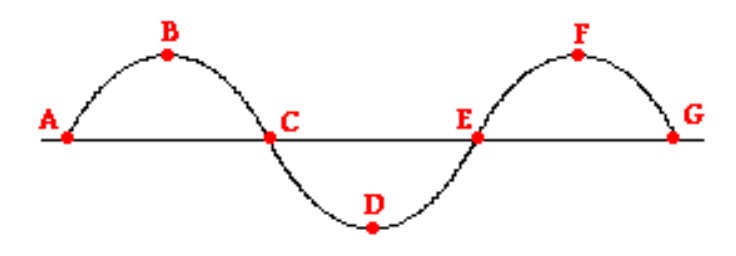
The highest point on a transverse wave is the
compression
crest
rest position
trough
The lowest point on a transverse wave is the
compression
crest
rest position
trough
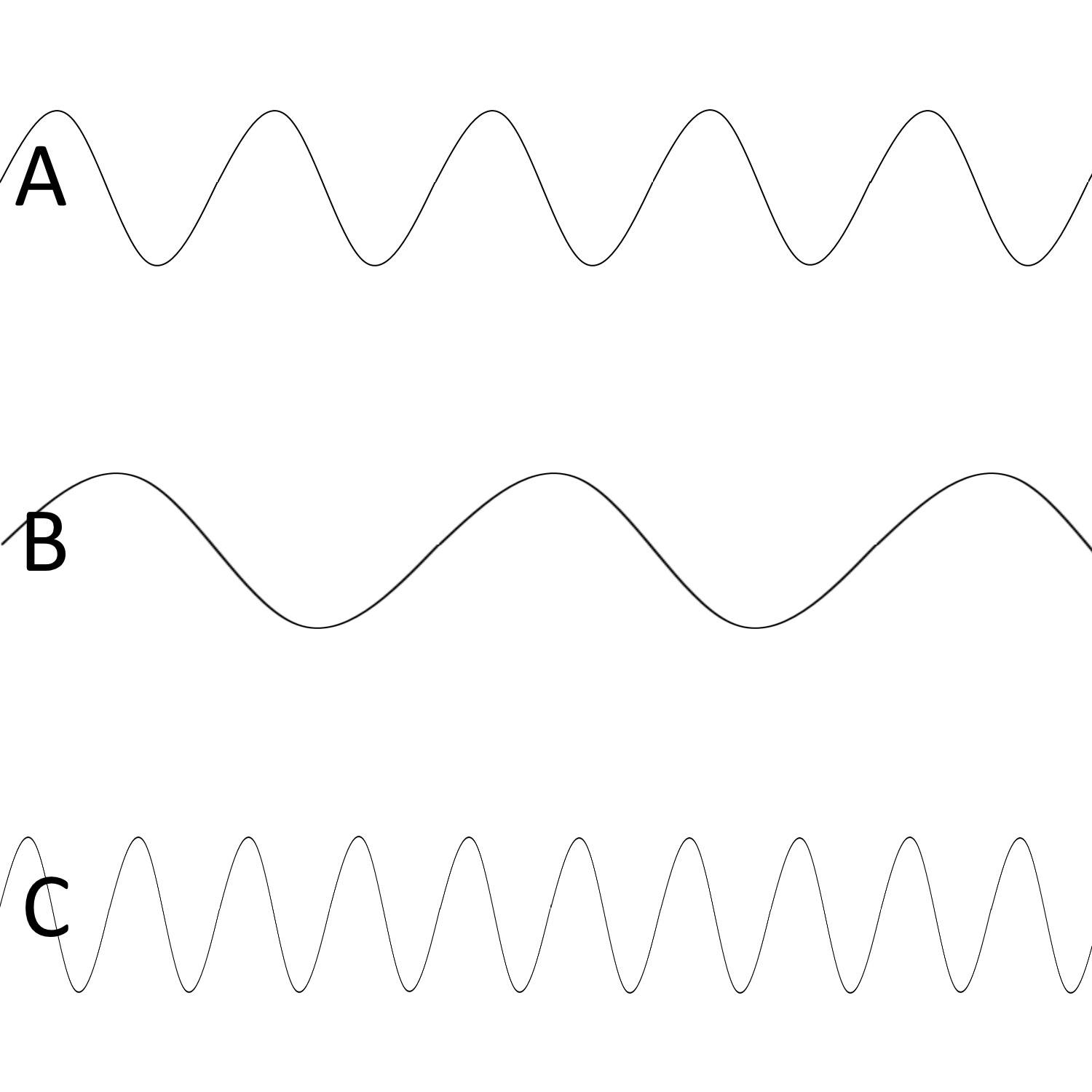
The number of waves that pass somewhere in a second is:
amplitude
frequency
wavelength
Unit used to measure the frequency of wavelengths.
Amplitude
Hertz
Joule
Engergy
Wavelength= .5m
Frequency= 150 hertz
Wavelength= 1.2 m
Frequency= 210 hertz
Wavelength= 3.0 m
Frequency= 120 hertz
Wavelength= __________
Frequency= 600 hertz
Wavelength= 1.2 m
Frequency= 210 hertz

Which wave has the most energy?
Wave 1
Wave 2
Wave 3
Wave 4

Identify B
Wavelength
Crest
Amplitude
Trough
Find the frequency of an electromagnetic wave with a wavelength 2.75 × 10⁻⁸ m.
1.10 Hz
1.09 × 10¹⁶ Hz
9.17 × 10¹⁵ Hz
9.17 × 10¹⁶ Hz
What is the variable c used for?
frequency
wavelength
Energy
speed of light
What is the variable λ used for?
frequency
wavelength
Energy
speed of light

When bombarded with light, lithium emits a light with a frequency of 4.29 x 10¹⁴ Hz. Calculate the wavelength and use the chart to predict the color.
blue
green
yellow
red
Which wave has a greater frequency?
A
B
How are frequency and wavelength related?
As frequency increases, wavelength gets shorter
As frequency increases, wavelength gets longer
As frequency increases, wavelength gets lower
As frequency increases, wavelength gets higher
Six waves go past a fixed point in two seconds. What is the frequency of the wave?
3
6 Hz
3 Hz
2


Find the frequency of an electromagnetic wave with a wavelength 2.75 × 10⁻⁸ m.
1.10 Hz
1.09 × 10¹⁶ Hz
9.17 × 10¹⁵ Hz
9.17 × 10¹⁶ Hz
Which of the following electromagnetic waves travels the fastest?
gamma rays
radio waves
ultraviolet waves
they all travel the same speed

The relationship between wavelength and frequency is c=fλ. Calculate the wavelength of light that has a frequency of 5.2 x 10¹² Hz. The speed of of light is 3.0x 10⁸ m/s.
5.8 x 10 -5 m
5.8 x 10 -7 m
5.19 x 10 14 m
1.56 x 10 23 m
Solve this problems using the equation: c = fλ If an AM radio station broadcasts at 9.95 x 10⁵ Hz, what is the wavelength of this radiation?
6.59 x 10⁻²⁸ m
1.01 x 10⁻⁶ m
3.32 x 10⁻³ m
302 m
What is the variable ƒ used for?
frequency
wavelength
Energy
speed of light
The frequency of light is 7.14 x 10¹⁴ Hz. What is the wavelength?
3.00 x 10⁸ m
4.20 x 10⁻⁷ m
2.25 x 10²³ m
3.90 x 10⁻⁹ m
What is the frequency of ultraviolet light with a wavelength of 1.24 x 10⁻⁷ m?
2.42 x 10¹⁵ Hz
8.22 x 10⁻³⁴ Hz
3.00 x 10⁸ Hz
1.04 x 10¹³ Hz
What is the frequency of infrared light with a wavelength of 1.05 x 10⁻⁶ m?
6.96 x 10-40 Hz
2.86 x 10¹⁴ Hz
9.62 x 10⁻¹³ Hz
2.55 x 10⁻¹⁹ Hz
A violet spectral line of an element has a wavelength of 4.2 x 10⁻⁷ m. What is the frequency of the violet light?
3.00 x 10⁸ Hz
6.63 x 10⁻³⁴ Hz
7.14 x 10¹⁴ Hz
1.04 x 10⁻¹³ Hz
Electromagnetic waves vary in
the speed they travel in a vacuum
wavelength and frequency
the way they reflect
the orientation of their electric and magnetic fields
To calculate the frequency of an electromagnetic wave, you need to know the speed of the wave and its
wavelength
refraction
intensity
amplitude
Infrared rays have a shorter wavelength than
Ultraviolet ray
X-rays
gamma rays
radio waves

Which wave has a longer wavelength?
wave C
wave D

Which wave has a greater frequency?
wave B
wave C
How would you write 0.0005 in scientific notation?
50 x 10-5
5 x 10⁻⁴
5 x 10³
.5 x 103
Which of the following numbers is written in scientific notation?
20.35 x 10⁴
.2035 x 104
2035 4
2.035 x10⁴
Express the following in scientific notation:
.000457
457 x 106
457 x 10-6
4.57 x10⁴
4.57 x 10⁻⁴
Convert to scientific notation:
520,000,000
52 x 107
5.2 x 10⁻⁷
5.2 x 10⁸
0.52 x 10⁹
If the exponent is a positive number the original number was...
a really big number.
a really small number.
If the exponent is a negative number the original number was...
a really large number.
a really small number.
Convert this number into scientific notation:
0.068
6.9 x 10⁶
6.8 x 10⁻⁹
6.8 x 10⁻²
None of the above
Convert this number into scientific notation:
950,000
9.5 x 10⁵
9.5 x 10⁻⁹
9.5 x 10²
None of the above
Which value is the greatest?
5.0 x 10⁻⁹
5.0 x 10⁻⁴
5.0 x 10⁶
5.0 x 10⁸
Which number is the least in value?
5.0 x 10⁻⁹
5.0 x 10⁻⁴
5.0 x 10⁶
5.0 x 10⁸
The ____________ refers to an imaginary sphere of heavenly objects that seems to center on the observer.
Constellation
Celestial Sphere
North Pole
South Pole
The apparent shifting of nearby objects with respect to distant ones as the position of the observer changes is called:
Peristalsis
Ex-Lax
Periscope
Parallax
The first person to use a telescope to study the sky was __________.
Ptolemy
Kepler
Galileo
Aristotle
The two most famous believers of the geocentric model of the universe were:
Orville and Wilbur Wright
Kepler and Tycho Brahe
Copernicus and Galileo
Aristotle and Ptolemy
What did Galileo discover about the surface of the moon when he saw it through his telescope?
It had craters and mountains
It was smooth
It was all water
It was made of cheese
Kepler's 1st Law of Planetary Motion states that each planet's path around the Sun is in the shape of a/an:
Ellipse
Ecliptic
Circle
Rhombus
Ptolemy hypothesized that planets travel in circular orbits centered around the Earth. He called these circular orbits __________.
Ellipses
Epicenters
Epicycles
Epic Cycles
While observing the planet Venus through his telescope, Galileo observed that it changed size and shape over a period of months. What conclusion did this help him come to?
The Earth is round
The Sun goes around the Earth
Venus goes around the Sun
Venus has four moons
Geocentric models place the _______ at the center of the universe?
Sun
Moon
Earth
Stars
________________ developed three laws of planetary motion.
Tycho Brahe
Aristotle
Johannes Kepler
Galileo Galilei
Copernicus theorized that the stars do not actually move across the sky each night. That is an illusion created by what?
Parallax
The Zodiac
The Sun revolving around the Earth
The rotation of the earth
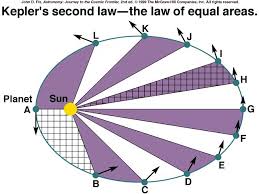
The second law of planetary motion has to do with the changing speeds of planets. As a planet gets closer to the sun it _________, and as it gets further away from the sun it _____________.
Speeds up, maintains constant speed
Speeds up, slows down
Slows down, speeds up
Slows down, maintains constant speed
What is the name for the group of constellations the Sun passes through on its apparent path along the ecliptic?
Galaxies
The Zodiac
Jupiter
The Ecliptic
Kepler’s third law of planetary motion implied that __________ holds the planets near the Sun.
Gravity
The Force
Magnets
Inertia
Which wave has a greater frequency?
A
B
Calculate the wavelength of light that has a frequency of 5.2 x 10¹²/s.
5.8 x 10 -5 m
5.8 x 10 -7 m
5.19 x 10 14 m
1.56 x 10 23 m
A microwave oven emits radiation at a wavelength of 0.00500 m. What is the frequency of this radiation?
6.67 x 10⁻⁷ Hz
2.00 Hz
1.50 x 10⁶ Hz
6.00 x 10¹⁰ Hz
If an AM radio station broadcasts at
9.95 x 10⁵ Hz, what is the wavelength of this radiation?
6.59 x 10⁻²⁸ m
1.01 x 10⁻⁶ m
3.32 x 10⁻³ m
302 m
When you go out in the sunshine, ultraviolet light rays may give you a tan or a sunburn. What is the wavelength of this light if it has a frequency of
7.74 X 10¹⁴ Hz?
3.88 x 10⁻⁷ m
3.26 x 10⁻² m
2.58 x 10⁶ m
2.32 x 10²³ m
IRAS, the Infrared Astronomy Satellite launched by NASA in 1983, had a detector that measured infrared or heat radiation from different regions of space. What is the frequency of infrared light that has a wavelength of
1.10 X 10⁻⁶ m?
3.67 x 10⁻¹⁵ Hz
3.67 x 10⁻³ Hz
2.73 x 10² Hz
2.73 x 10¹⁴ Hz
A particular light source gives off light waves with a measured wavelength of
2.0 x 10⁻⁷ m. What is the frequency of the light source?
6.67 x 10⁻¹⁵ Hz
6.0 x 10¹¹ Hz
1.5 x 10¹⁵ Hz
not enough information to answer
What does a wave carry from place to place?
energy
matter
people
The highest point on a transverse wave is the
compression
crest
rest position
trough
The lowest point on a transverse wave is the
compression
crest
rest position
trough
The number of waves that pass somewhere in a second is:
amplitude
frequency
wavelength
Unit used to measure the frequency of wavelengths.
Amplitude
Hertz
Joule
Engergy
Wavelength= .5m
Frequency= 150 hertz
Wavelength= 1.2 m
Frequency= 210 hertz
Wavelength= 3.0 m
Frequency= 120 hertz
Wavelength= __________
Frequency= 600 hertz
Wavelength= 1.2 m
Frequency= 210 hertz
Which wave has the most energy?
Wave 1
Wave 2
Wave 3
Wave 4
Identify B
Wavelength
Crest
Amplitude
Trough
Find the frequency of an electromagnetic wave with a wavelength 2.75 × 10⁻⁸ m.
1.10 Hz
1.09 × 10¹⁶ Hz
9.17 × 10¹⁵ Hz
9.17 × 10¹⁶ Hz
What is the variable c used for?
frequency
wavelength
Energy
speed of light
What is the variable λ used for?
frequency
wavelength
Energy
speed of light
When bombarded with light, lithium emits a light with a frequency of 4.29 x 10¹⁴ Hz. Calculate the wavelength and use the chart to predict the color.
blue
green
yellow
red
Which wave has a greater frequency?
A
B
How are frequency and wavelength related?
As frequency increases, wavelength gets shorter
As frequency increases, wavelength gets longer
As frequency increases, wavelength gets lower
As frequency increases, wavelength gets higher
Six waves go past a fixed point in two seconds. What is the frequency of the wave?
3
6 Hz
3 Hz
2
Find the frequency of an electromagnetic wave with a wavelength 2.75 × 10⁻⁸ m.
1.10 Hz
1.09 × 10¹⁶ Hz
9.17 × 10¹⁵ Hz
9.17 × 10¹⁶ Hz
Which of the following electromagnetic waves travels the fastest?
gamma rays
radio waves
ultraviolet waves
they all travel the same speed
The relationship between wavelength and frequency is c=fλ. Calculate the wavelength of light that has a frequency of 5.2 x 10¹² Hz. The speed of of light is 3.0x 10⁸ m/s.
5.8 x 10 -5 m
5.8 x 10 -7 m
5.19 x 10 14 m
1.56 x 10 23 m
Solve this problems using the equation: c = fλ If an AM radio station broadcasts at 9.95 x 10⁵ Hz, what is the wavelength of this radiation?
6.59 x 10⁻²⁸ m
1.01 x 10⁻⁶ m
3.32 x 10⁻³ m
302 m
What is the variable ƒ used for?
frequency
wavelength
Energy
speed of light
The frequency of light is 7.14 x 10¹⁴ Hz. What is the wavelength?
3.00 x 10⁸ m
4.20 x 10⁻⁷ m
2.25 x 10²³ m
3.90 x 10⁻⁹ m
What is the frequency of ultraviolet light with a wavelength of 1.24 x 10⁻⁷ m?
2.42 x 10¹⁵ Hz
8.22 x 10⁻³⁴ Hz
3.00 x 10⁸ Hz
1.04 x 10¹³ Hz
What is the frequency of infrared light with a wavelength of 1.05 x 10⁻⁶ m?
6.96 x 10-40 Hz
2.86 x 10¹⁴ Hz
9.62 x 10⁻¹³ Hz
2.55 x 10⁻¹⁹ Hz
A violet spectral line of an element has a wavelength of 4.2 x 10⁻⁷ m. What is the frequency of the violet light?
3.00 x 10⁸ Hz
6.63 x 10⁻³⁴ Hz
7.14 x 10¹⁴ Hz
1.04 x 10⁻¹³ Hz
Electromagnetic waves vary in
the speed they travel in a vacuum
wavelength and frequency
the way they reflect
the orientation of their electric and magnetic fields
To calculate the frequency of an electromagnetic wave, you need to know the speed of the wave and its
wavelength
refraction
intensity
amplitude
Infrared rays have a shorter wavelength than
Ultraviolet ray
X-rays
gamma rays
radio waves
Which wave has a longer wavelength?
wave C
wave D
Which wave has a greater frequency?
wave B
wave C
How would you write 0.0005 in scientific notation?
50 x 10-5
5 x 10⁻⁴
5 x 10³
.5 x 103
Which of the following numbers is written in scientific notation?
20.35 x 10⁴
.2035 x 104
2035 4
2.035 x10⁴
Express the following in scientific notation:
.000457
457 x 106
457 x 10-6
4.57 x10⁴
4.57 x 10⁻⁴
Convert to scientific notation:
520,000,000
52 x 107
5.2 x 10⁻⁷
5.2 x 10⁸
0.52 x 10⁹
If the exponent is a positive number the original number was...
a really big number.
a really small number.
If the exponent is a negative number the original number was...
a really large number.
a really small number.
Convert this number into scientific notation:
0.068
6.9 x 10⁶
6.8 x 10⁻⁹
6.8 x 10⁻²
None of the above
Convert this number into scientific notation:
950,000
9.5 x 10⁵
9.5 x 10⁻⁹
9.5 x 10²
None of the above
Which value is the greatest?
5.0 x 10⁻⁹
5.0 x 10⁻⁴
5.0 x 10⁶
5.0 x 10⁸
Which number is the least in value?
5.0 x 10⁻⁹
5.0 x 10⁻⁴
5.0 x 10⁶
5.0 x 10⁸
The brightness of a star as seen from earth
Apparent magnitude
Awesome magnitude
Absolute magnitude
Amazing magnitude
Brightness determined by DISTANCE from the earth
Amazing magnitude
Absolute magnitude
Apparent magnitude
Awesome magnitude
Why can the apparent magnitude be inaccurate?
It doesn't exist
It may not be brighter compared to another star but instead just closer
It only shows the brightness of stars too far away for humans to detect
the scale is messed up
In comparison to other stars in the sky, the Sun appears brighter because it is–
Bigger
Smaller
Nearer
Further

Alpha Centauri A is a star that is larger than the Sun, yet it appears much less bright. Which of the following is the best explanation for this?
The difference in brightness is due to the distance of the Sun and Alpha Centauri A from Earth
The smaller a star the brighter it appears
The older the star the brighter it appears
The larger the star always appears to be brighter


Put the stars in order from hottest to coolest.
Blue, White, Yellow, Orange, Red
Red, Orange, Yellow, White, Blue
Red, Orange, Yellow, Blue, White
Red, Yellow, Orange, White, Blue

Which star is the least bright?
B
A
C
D

Which star appears the least bright from Earth?
B
A
C
D

Order the stars from brightest to dimmest based on ABSOLUTE brightness.
A, B C, D
D, C, B, A
D, C, A, B
A, D, C, B

Which star is the brightest based on APPARENT magnitude?
Sun
Sirius
Vega
Polaris
Which choice below has the stars correctly ordered from dimmest to brightest, based on absolute brightness?
Sun, Polaris, Betelgeuse
Sirius, Vega, Sun
Vega, Sirius, Sun
Betelgeuse, Sun, Vega

What is the brightness of Rigel as seen from Earth?
-1.46
-8.1
0.12
0.85
Which star is the brightest?
Sirius
Alderban
Rigel
Sun

When sunlight is split by a prism or diffraction grating it appears to emit a ___ spectra.
absorption
dark-line
continuous
bright-line

Upon closer examination, sunlight (and all stars) actually emit ___ spectra.
bright-line (or emission)
absorption (or dark-line)
continuous
multiple

The analysis of the way matter emits and absorbs radiation is called ___.
astronomy
chemistry
spectroscopy
atomic theory

Spectroscopy can be used to study
the atmosphere of Mars.
the age of stars.
spectroscopes.
the Moon.

Spectroscopy can also be used to study
galaxies.
the surface of Mercury.
stellar composition.
UFO's.

___ or "bright-line" spectra can be used to study the elemental composition of stars.
Absorption
Dark
Continuous
Continuous

When electrons of an element reach an "excited" state, ___ lines are produced.
dark
emission (bright)
continuous
invisible

A ___ is used in astronomy to break down light like a prism.
telescope
spectroscope
stethoscope
microscope

Each element on the periodic table can be identified by its
classification as a solid, liquid or gas.
location on the table.
ability to react to form compounds.
unique spectral "fingerprint."

Emission spectra emitted by an element (or compound) will produce ___ through a spectroscope.
bright lines
a continuous rainbow
dark lines
white light

The spectroscope is a powerful tool used by astronomers to infer the nature of matter.
True
False

Excited hydrogen gas forms a series of distinct bright spectral lines called absorption lines.
True
False

When an electron changes state it produces a proton.
True
False

By passing starlight light through a ___the light is spread out into its component colors.
spectrograph or spectrometer
telescope
prism or diffraction grating
mirror

After hydrogen is ___ - which is made up of two protons, two neutrons & two electrons.
helium
beryllium
lithium
oxygen

___ produces many emission lines in the red-wavelengths & is used in lights.
Neon
Argon
Hydrogen
helium

A spectroscope may be connected to a ___ to record an object's spectra.
telescope
CCD (charged coupled device)
spectrometer
spectrograph

A ___ can be used in place of a prism in a spectroscope & is inexpensive.
plastic prism
diffraction grating
CCD
lens

If an object like a star is moving away from Earth, the spectral lines are observed to be
smaller or thinner & red-shifted.
smaller or thinner & blue-shifted.
wider or broader & blue-shifted.
wider or broader & red-shifted.

Spectral lines that are observed to be narrower & blue-shifted indicates that an object is
moving away from Earth.
showing transverse motion.
moving towards Earth.
showing radial motion.
When sunlight is split by a prism or diffraction grating it appears to emit a ___ spectrum.
absorption
emission
continuous
Upon closer examination, sunlight (and all stars) actually emit ___ spectra.
bright-line (or emission)
absorption (or dark-line)
continuous
multiple
The analysis of the way matter emits and absorbs radiation is called ___.
astronomy
chemistry
spectroscopy
atomic theory
Spectroscopy can be used to study
the atmosphere of Mars.
the age of stars.
spectroscopes.
the Moon.
Spectroscopy can be used to study...
galaxies.
the surface of Mercury.
stellar composition.
UFOs.
___ or "bright-line" spectra can be used to study the elemental composition of hot gas clouds.
Absorption
Emission
Continuous
When electrons of an element reach an "excited" state, ___ lines are produced.
dark
emission (bright)
continuous
invisible
A ___ is used in astronomy to break down light like a prism.
telescope
spectroscope
stethoscope
microscope
Each element on the periodic table can be identified by its
classification as a solid, liquid or gas.
location on the table.
ability to react to form compounds.
unique spectral "fingerprint."
Emission spectra emitted by an element (or compound) will produce ___ through a spectroscope.
bright lines
a continuous rainbow
dark lines
white light
The spectroscope is a powerful tool used by astronomers to infer the nature of matter.
True
False
Excited hydrogen gas forms a series of distinct bright spectral lines called absorption lines.
True
False
When an electron changes state it produces a proton.
True
False
By passing starlight through a ___the light is spread out into its component colors.
telescope
prism
mirror

wavelength
speed
amplitude
intensity


Why are emission spectra of elements called "atomic fingerprints"?
They are all the same
They are all unique
They are all similar
They all contain colored light

According to the Bohr model of the atom, the single electron of a hydrogen atom circles the nucleus
in specific, allowed orbits
in one fixed orbit at all times
at any of an infinite number of distances, depending on its energy
counterclockwise

An emission spectrum is produced when an electron moves from one energy level
into the nucleus
to a higher energy level
to another position in the same sublevel
to a lower energy level

If an electron moves from n=4 to n=2 it ____
absorbs energy
releases energy

Based on the picture, choose the best description of how wavelength and frequency are related
As wavelength increases, frequency increases
As frequency increases, wavelength decreases
As frequency increases, wavelength remains the same
Frequency and wavelength mean the same thing
Each element on the periodic table can be identified by its
classification as a solid, liquid or gas.
location on the table.
ability to react to form compounds.
unique spectral "fingerprint."
A ___ is used in astronomy to break down light like a prism.
telescope
spectroscope
stethoscope
microscope

What is the unknown spectrum?
beryllium
copper
manganese
strontium


Which element(s) is/are in Unknown W?
Cadmium, Potassium, and Helium
Hydrogen, Potassium, and Lithium
Cadmium and Sodium
Only Sodium

What kind of spectrum is this?
absorption spectrum
continuous spectrum
emission spectrum

The unknown emission spectrum belongs to the element...
Hydrogen
Mercury
Neon
Sodium

The unknown emission spectrum belongs to the element...
Hydrogen
Mercury
Neon
Helium
When an electron falls down in energy level, it releases:
heat
speed
juice
light
True or False: All light has the same energy.
True
False
A big transition will produce more _______ than a small transition.
heat
energy
red
Emission spectra can tell us the ________ of a substance.
color
components
state
light
Which of the following colors has the longest wavelength?
blue/violet
green
yellow
red

Which element(s) is/are found in the star's spectra below?
Hydrogen only
Hydrogen & Helium
Calcium only
Hydrogen & Calcium
What happens when you shine a light through a prism?
The prism absorbs the light
The amount of light is low density
There is a continuous spectrum of light
There is no light that shines through
How do scientists know what stars are made of?
The Doppler Effect
Emission and Absorption Lines
Radio Waves
The Electromagnetic Spectrum

Emission spectra come from
Dense gases
Hot, low density gases
Cold, low density gases
All of the above

A sample of gas is analyzed, producing the spectrograph in the image. Identify which element the sample is mostly made-up of?
Hydrogen
Helium
Neon
Mercury

When we compare the star spectrum with the gas spectrum in this picture what does it tell us
the Sun has Helium
the Sun only has Helium
Helium is made from the fusion process
Sun does not have Helium

When we compare the star spectrum with the gas spectrum in this picture what does it tell us
the Sun has Hydrogen
the Sun only has Hydrogen
Helium is made from the fusion process
Sun does not have Hydrogen
The types of gases that make up a star is also known as the star's _______________.
composition
temperature
size
luminosity

Look carefully at the picture. It shows an electron in the excited state on the left, and the electron returning to its ground state on the right. When the electron return to the ground state it emits a_______________________.
blast of cold air
electrostatic charge
proton
photon (light)

The picture shows an atom in the ground state absorbing energy and the electron jumps to the excited state. Which state has higher energy?
Ground State
Excited State

Each element produces its own pattern of emission spectra lines because each element has its own distinct
Speed of light
Electron configuration
Number of neutrons
None of these

How is white light able to separate through a prism?
the light is being absorbed
the light is being refracted
the light is being reflected

reflection
refraction

High-mass stars burn hotter & brighter because they have more _______ at their cores.
fusion
fuel
energy
pressure


The hottest stars have surface temperatures up to 54,000 oF (30,000 K) and are
red/orange in color.
blue/violet in color.
generally just too hot to observe with a telescope.
about the same size as our Sun.

The three stars that make up the "belt" in the constellation Orion are
yellow stars like our Sun (or Sol ).
all going to blow up as supernovae very soon.
all very hot blue giant stars.
called Mintaka & Bellatrix.

Examples of very hot blue/violet stars include
the Sun (or Sol ) and Alpha Centauri A.
Mintaka, Rigel & Sirius.
Betelgeuse & Mira.
Alpha Centauri B & Proxima Centauri.

Yellow or "medium" hot stars like our Sun & Alpha Centauri A have surface temperatures around
1 million degrees Fahrenheit.
10,000 degrees Celsius.
1 million degrees Celsius.
10,000 degrees Fahrenheit.

Relatively "cool" stars (5000 oF surface temps) are generally
red in the visible light spectrum.
going to blow up pretty soon.
yellow in the visible light spectrum.
not found very often in our galaxy.

Basically the ____ index of stars allow astronomers to determine stellar surface temperatures.
Doppler
color
spectral
radial

Stellar classification is the classification of stars based on their ____ characteristics.
spectral
color
stellar
size

EM radiation from a star is analyzed by splitting it with a
prism.
charged coupled device (CCD).
telescope.
diffraction grating.

A star's spectrum exhibits the rainbow of colors interspersed with
bright-line emissions.
absorption lines.
a continuous spectrum.
Fraunhofer lines.

Stars are classified based on spectral type & temperature with "O-type" stars
the coolest.
classified as the most dangerous.
somewhere in the middle temperature-wise.
the hottest.

Spectral classification of stars based on temps. are O, B, A F, G, K, M (hottest to coolest).
True
False

"M-type" stars are classified as the coolest and make up the majority of stars in the galaxy.
True
False

Our Sun (or Sol ) and Alpha Centauri A are classified as "K-type" stars.
True
False

Two of the brightest stars in the night sky are the red supergiant Betelgeuse and blue giant
Bellatrix in the constellation Centaurus.
Arcturus in the constellation of Orion.
Rigel in the constellation of Orion.
Mintaka in the constellation Centaurus.

Parallax is used by astronomers to determine "nearby" stellar distance to within
about 330 light years.
100 parsecs.
about 330 parsecs.
100 light years.

Astronomers use luminosity, distance and ___ to indirectly measure star radius.
size
temperature
weight
gravitational pull

Stars (like Mira ) that are 10-100 times the size of our Sun are called
white dwarfs.
red giants.
red supergiants.
white supergiants

Stars (like Betelgeuse ) which are 100-1000 times the Sun's radius are classified as
way too hot to get close to.
supernova stars.
giants.
supergiants.

Stars that are comparable to our Sun in size or smaller are classified as ____ stars.
average
dwarf
yellow
blue dwarf

Earth-size stars that are very hot (like Sirius B ) are classified as
too small to actually be a star.
white dwarfs
re dwarfs
blue dwarfs
If the plane of the Milky Way Galaxy is about 100,000 light years across, how long would it take a spacecraft moving at 430,000 miles per hour to get from one end to the other?
15 years
1500 years
150,000 years
150 million years
If a star is 356 light years from Earth, how long would it take radio waves emitted from that star to reach us?
35 hours
3.56 seconds
356 minutes
356 years
If Jupiter's orbit has a 5 AU long radius, what is its distance from the Sun in meters?
7.48×10¹¹
7.48
748
7.48×10⁵
If you sent a mission to Mars and the spacecraft could travel at 25,000 miles per hour, about how long would it take to get there if Mars is 70 million miles away?
2.8 hours
28 hours
280 hours
2800 hours
If Saturn is 1.42×10¹⁴ centimeters from the Sun, how long would it take for ultraviolet light from the Sun to reach Saturn?
1.3 minutes
13 minutes
1.3 days
13 days

