
 Worksheets
Life Science Pre-Test
Total questions: 65
Worksheet time: 1hrs 7mins
Protista
What is an organism that makes food through photosynthesis
autotroph
heterotroph
True or False: The arrows in a food chain and food web will always point towards the organism that is doing the eating.
True
False

The flow of energy moves in a circle through a food chain. The energy moves from the grass to the grasshopper. Next, the transfer of energy passes from the snake to the hawk. Finally, the fungi help by breaking down the hawk when it dies, and returns the energy to the grass. Where does the energy that is transferred through this chain originate?
Fungi
Grass
Grasshopper
Sun

Examine the energy pyramid shown above. Suppose that your teacher hands you a clump of grass and a rabbit. You are told to place them on the correct level of the energy pyramid. On which levels would you place the grass and the rabbit?
Grass on level B, Rabbit on level A
Grass on level D, rabbit on level E
Grass on level E, rabbit on level D
Grass on level A, rabbit on level B

In the ecological/energy pyramid, organism A represents a
carnivore
decomposer
herbivore
producer
Beginning with the producer, which represents the correct order in a typical food chain?
mountain lion-fox-rabbit-grass
grass-fox-rabbit-mountain lion
grass-rabbit-fox-mountain lion
rabbit-fox-mountain lion-grass
In the pyramid, only about 10 percent of the __________ available within one trophic level is transferred to organisms at the next trophic level.
energy
heat
mass
matter

Based on the energy pyramid seen here, which group of organisms is the primary consumer?
predator fish
birds and mammals
insects and zooplankton
phytoplankton and bacteria
Clownfish have evolved resistance to the deadly stings of sea anemones. The sea anemone provides protection for the clownfish from predators and leaves the uneaten remains of its prey for the clownfish to finish off. Meanwhile the clownfish helps attract prey to the sea anemone with its bright colors.
The relationship between clownfish and sea anemones is a form of symbiosis called
commensalism
mutualism
parasitism
competition

The remora has a front dorsal fin that acts like a suction cup. It uses this fin to attach to whales, sharks, or rays and eat the scraps their hosts leave behind. What type of relationship is this? Defend your choice.
It is a mutualistic relationship because both animals benefit; neither animal is harmed.
It is a symbiotic relationship because the remora benefits by eating the larger animals' scraps.
It is an example of commensalism because the remora benefits from the food scraps while the shark, in this case, is neither helped or harmed.
The key word is host. The shark is the host; the remora is a parasite. This is a parasitic relationship.
Ecosystems are made up of living and non-living components. What is a single living thing called?
organism
community
ecosystem
population
What is the correct order of ecological organization from smallest to largest?
organism, community, population, ecosystem, biosphere, biome
organism, population, community, ecosystem, biome, biosphere
biosphere, biome, ecosystem, population, community, organism
community, organism, ecosystem, population, biosphere, biome
8) The greatest biodiversity on earth is found in the __________ biome.
taiga
savanna
tropical rainforest
temperate forest
The MAIN difference between a rain forest and a desert is the
number of seasons.
number of decomposers
amount of land occupied
amount of precipitation
Biomes that are found near the equator or near mountains ranges and have high relative humidity and lots of rain are called
deserts
rainforests
deciduous forest
temperate forests
In which biome would you MOST LIKELY find permafrost?
tundra
desert
savanna
mountain
Which biome do you live in?
Savanna
Tundra
Temperate Deciduous Forest
Taiga

In the punnett square below, what belongs in the missing square
The genotype for a yellow plant is...

In the punnett square, what is the probability for white fur?
In peas, the allele for green pods (G) is dominant to yellow (g). What percent of the offspring will have green coats in a Homozygous recessive x Heterozygous cross
100%
75%
50%
25%
0%
In peas, the allele for green pods (G) is dominant to yellow (g). What percent of the offspring will have green coats in a Homozygous dominant x Heterozygous cross
100%
75%
50%
25%
0%
In peas, the allele for green pods (G) is dominant to yellow (g). What percent of the offspring will have green coats in a Heterozygous x Heterozygous cross
100%
75%
50%
25%
0%
In peas, the allele for green pods (G) is dominant to yellow (g). What percent of the offspring will be purebred dominant green coats in a Heterozygous x Heterozygous cross
100%
75%
50%
25%
0%
In peas, the allele for green pods (G) is dominant to yellow (g). What percent of the offspring will be purebred yellow coats in a Heterozygous x Heterozygous cross
100%
75%
50%
25%
0%
In peas, the allele for green pods (G) is dominant to yellow (g). What percent of the offspring will be hybrid for green coats in a Heterozygous x Heterozygous cross
100%
75%
50%
25%
0%
In peas, the allele for green pods (G) is dominant to yellow (g). What percent of the offspring will have yellow coats in a Homozygous dominant x Heterozygous cross
100%
75%
50%
25%
0%
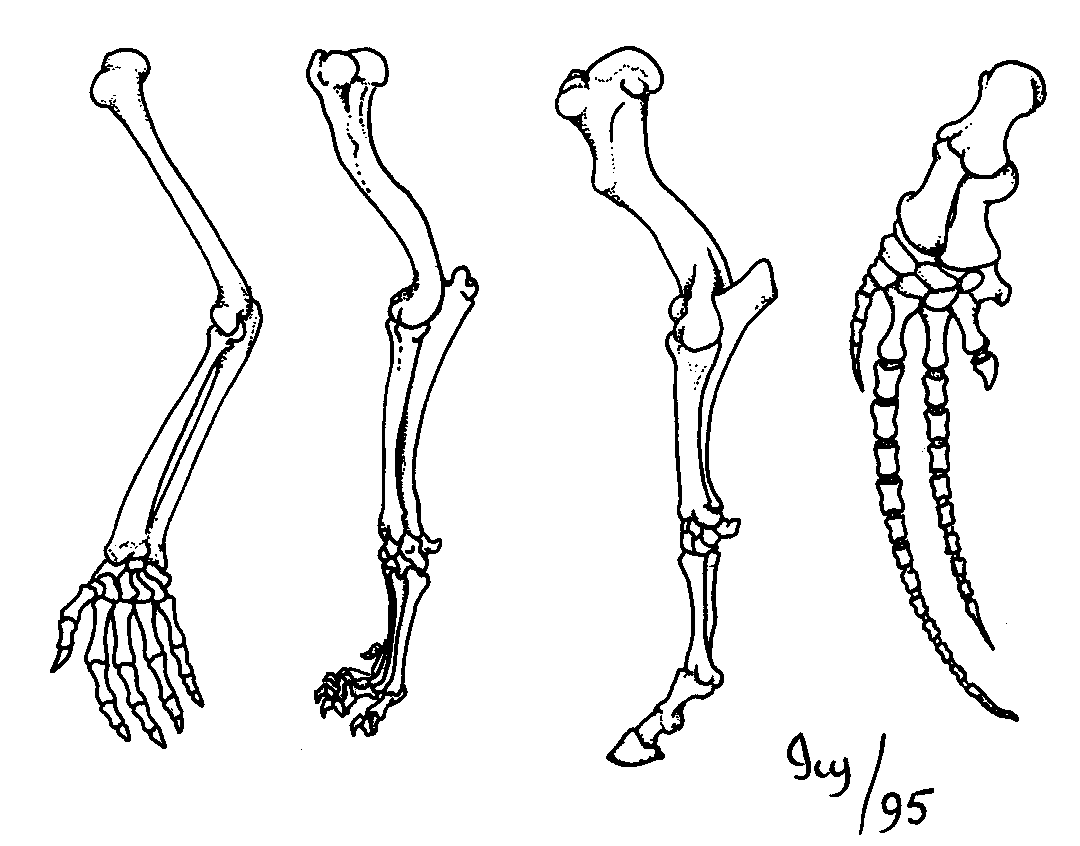
Generations of a species that are farther apart from each other look the most different.
This cell is irregularly shaped, has many small vacuoles, but does not have a cell wall or chloroplasts
Prokaryotic Cell
Plant Cell
Animal Cell
Bacteria Cell
This type of cell is usually larger than the others, is geometric in shape, and has a cell wall and chloroplasts
Prokaryotic Cell
Animal Cell
Plant Cell
Fungi Cell
These cells have cell walls
Plant cell
Animal Cell
Bacteria Cell
Fungi Cell
Where is the DNA of a Eukaryotic Cell
The Cytoplasm
The Nucleus
The Cell Membrane
The lysosome

