wayground logo

Free Printable Worksheets

NEW

Font size

S
M
L
XL
Worksheets

Respiratory System Review

Total questions: 51

Worksheet time: 46mins
Name
Class
Date
1.
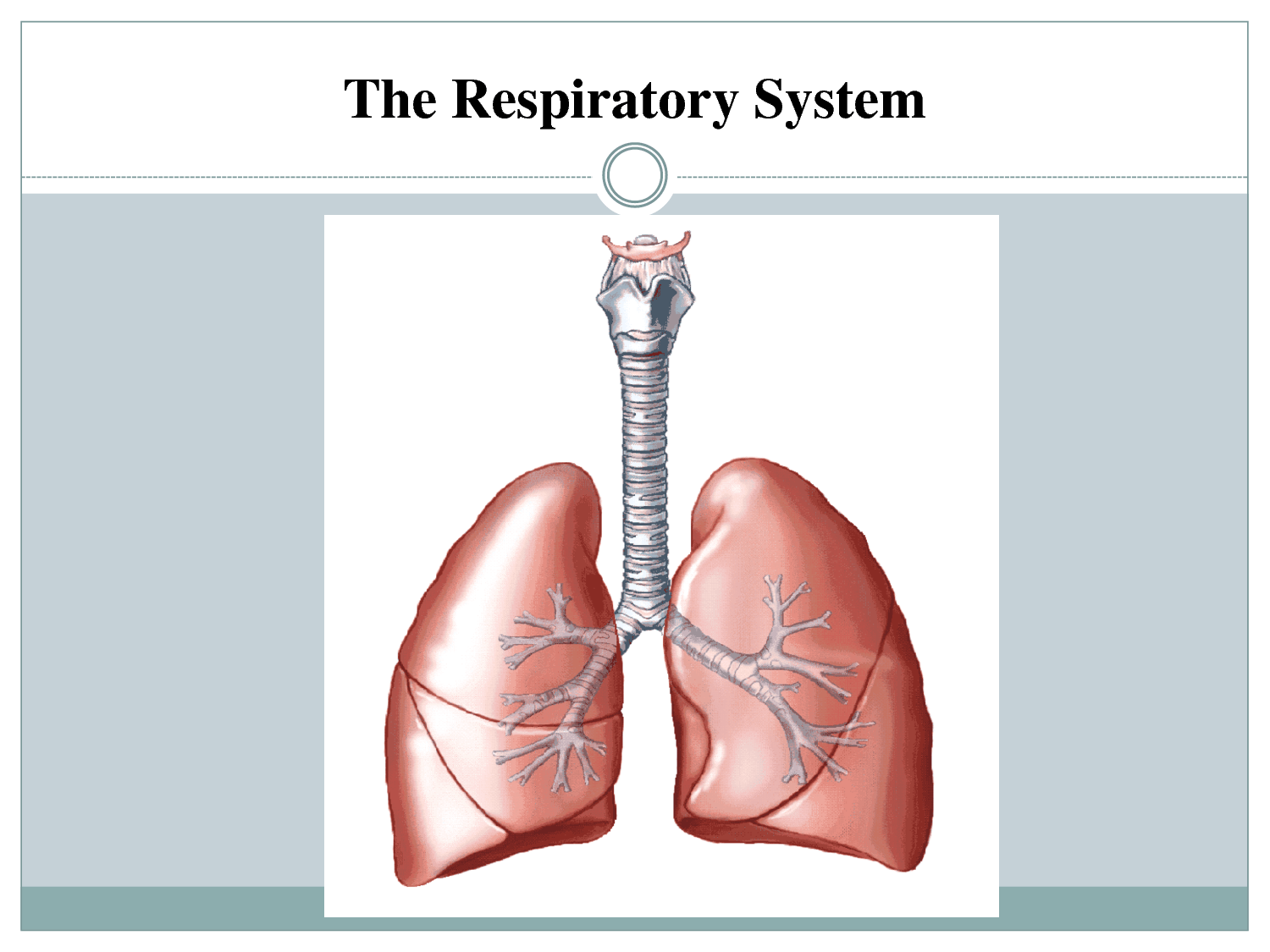
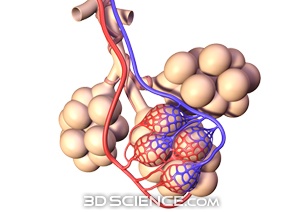
The air sacs that are covered with capillaries where gas exchange takes place
a)
bronchi
b)
lungs
c)
oxygen
d)
alveoli
2.

Flap of tissue that covers the opening to the windpipe during swallowing

a)

Pharynx

b)

Trachea

c)

Epiglottis

3.
What is the main function of the respiratory system?
a)
to provide oxygen and remove carbon dioxide from the body
b)
to bring oxygen to the body
c)
to break down food and absorb nutrients
d)
to remove oxygen from the body and deliver carbon dioxide
4.
Given the following structures:
1. larynx
2. nasal cavity
3. pharynx
4. trachea
Which of the following is the correct order that air would flow during inhalation. 
a)
1,2,3,4
b)
2,3,1,4
c)
2,1,3,4
d)
4,2,3,1 
5.
Which body function is made possible by the fibrous bands stretched across the larynx?
a)
swallowing
b)
breathing
c)
diffusion
d)
speech
6.
A chamber behind the nose and mouth that leads to the trachea
a)
pharynx
b)
trachea
c)
epiglottis
d)
larynx
7.

What is the site of gas exchange?

a)

alveoli

b)

nose

c)

lung

d)

bronchi

8.

A cavity within a bone or other tissue, especially one in the bones of the face or skull connecting with the nasal cavities.

a)

Sinus

b)

Nose

c)

Pharynx

d)

Larynx

9.

The process of diffusing oxygen from the blood, into the interstitial fluid and into the cells.

a)

inspiration

b)

expiration

c)

internal respiration

d)

external respiration

10.

The process of exchanging oxygen and carbon dioxide in the lungs.

a)

inspiration

b)

expiration

c)

internal respiration

d)

external respiration

11.

The only externally visible part of the respiratory system

a)

Eyes

b)

Nose

c)

Pharynx

d)

Larynx

12.

The division of the trachea forms

a)

nose

b)

main bronchi

c)

lungs

d)

alveoli

13.

The opening between vocal cords

a)

glottis

b)

epiglottis

14.

Olfactory receptors are located in the mucosa of the nose. What are these receptors used for?

a)

sight

b)

smell

c)

touch

d)

taste

15.

Which part of the Respiratory System plays a major role in speech?

a)

nose

b)

pharynx

c)

larynx

d)

trachea

16.
What is another name for the windpipe?
a)
Lungs
b)
Trachea
c)
Larynx
d)
Esophagus
17.

A small flap of tissue that covers the trachea when swallowing is called the

a)

bronchi

b)

larynx

c)

pharynx

d)

epiglottis

18.

When you exhale, the diaphragm

a)

moves upwards

b)

moves downwards

c)

flattens

d)

none of the above

19.

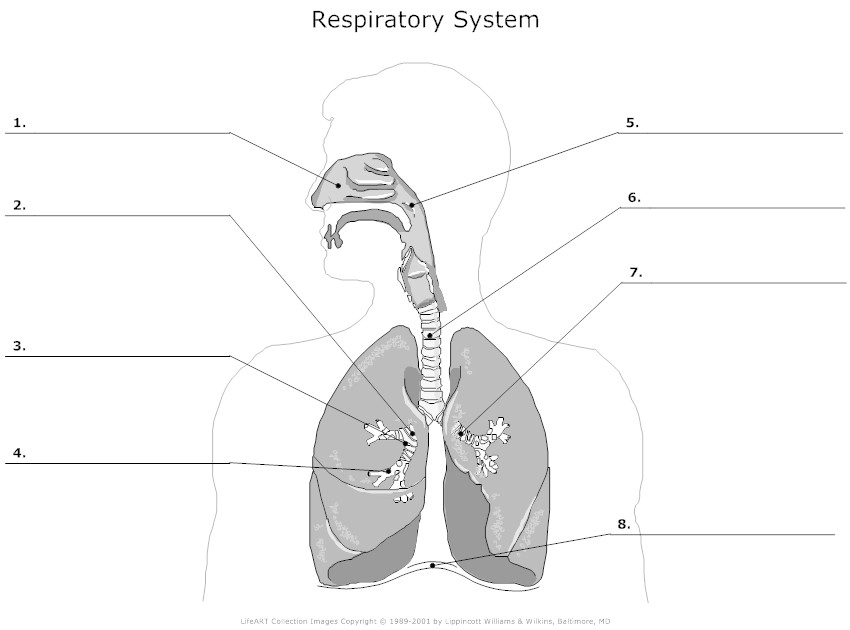
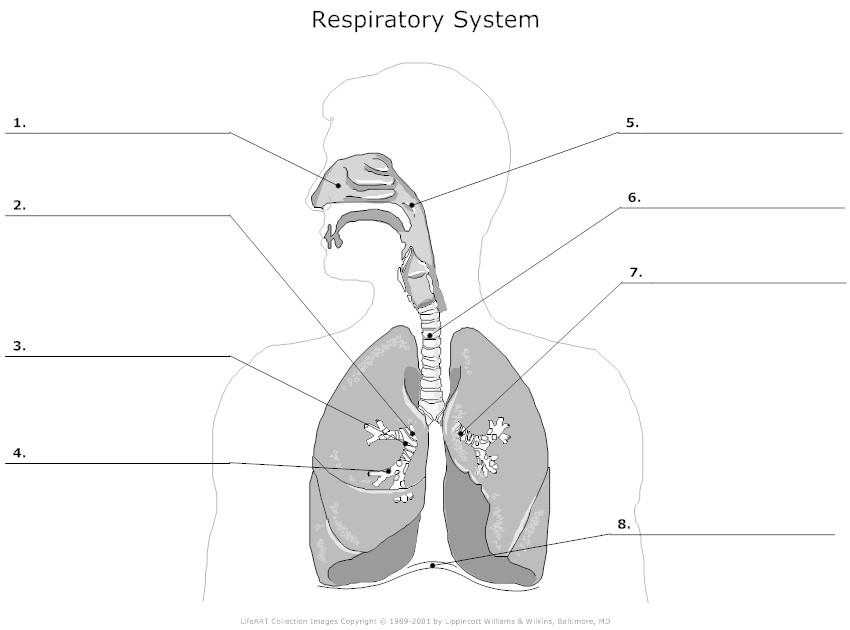
What is labeled at E?

a)

bronchi

b)

trachea

c)

pharynx

d)

none of the above

20.
The Bronchi branch out into many different smaller tubes which take oxygen to the alveoli. What are these tiny tubes called?
a)
Trachea
b)
Larynx
c)
Pharynx
d)
Bronchioles
21.
Name the organ label # 6. 
a)
alveoli 
b)
bronchi 
c)
trachea 
d)
lungs 
22.
Name the structure labeled 8 
a)
lungs 
b)
trachea 
c)
diaphragm 
d)
alveoli 
23.

NUMBER 2:

a)

Pharynx

b)

Bronchi

c)

Alveoli

d)

Lungs

24.

When air is pushed OUT of the lungs, what is the correct order for the tubes it passes through?

a)

bronchiole -> bronchi -> trachea -> nose

b)

bronchi -> bronchiole -> trachea -> nose

c)

trachea-> bronchi -> bronchiole-> nose

25.

What keeps your bronchi and bronchiole tubes open?

a)

cartilage rings

b)

ligament squares

c)

ciliated cells

d)

muscle

26.
What is the primary function of mucus and cilia in the nostrils?
a)
Sound production
b)
Filtration
c)
Temperature Control
d)
Respiration
27.
Where are the sinuses located?
a)
In the front lobe of the brain
b)
In the skull surrounding the nasal cavity
c)
Inside the nares
d)
Under the cheek bones
28.
What structure is a passageway for both food and air?
a)
Pharynx
b)
Bronchus
c)
Trachea
d)
Larynx
29.
In the process of breathing, during what stage does the movement of the diaphragm enlarge the thoracic cavity?
a)
Internal respiration
b)
External respiration
c)
Inspiration
d)
Experation
30.
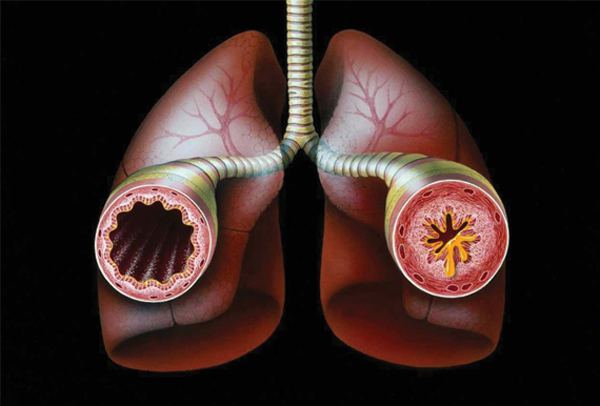
Barbara has asthma and uses an inhaler when she starts to wheeze. The purpose of the device is to:
a)
Dissolve mucus
b)
Contract blood vessels
c)
Liquefy secretions in the lungs
d)
Enlarge the brochioles
31.
MOST respiratory disorders are causes by:
a)
Infection
b)
Lack of exercise
c)
Heredity
d)
Poor circulation
32.
What statement is true about lung cancer?
a)
The prognosis is good.
b)
Treatment includes hormone therapy and blood transfusions.
c)
IT is the leading cause of cancer death in men and women.
d)
Second hand smoke rarely contributes to the development of lung cancer.
33.

Which of the following happens when you exhale?

a)

chest cavity expands

b)

your lumgs become smaller

c)

your chest cavity becomes smaller

d)

your lungs take in and give off oxygen

34.
The process by which oxygen and carbon dioxide are exchanged between cells, the blood, and air in the lungs is called
a)
emphysema
b)
cellular respiration
c)
systemic circulation
d)
respiration
35.
known as the voice box
a)
windpipe
b)
larynx
c)
pharynx
d)
epiglottis
36.
cleans, moistens, and warms the air
a)
trachea
b)
larynx
c)
nasal passage
d)
windpipe
37.
What is breathed out from our mouth and nose?
a)
carbon dioxide
b)
oxygen
c)
nitrogen
d)
helium
38.
a dome shaped sheet of muscle, the _________, separates the chest from the abdomen
a)
diaphragm
b)
epiglottis
c)
alveoli
d)
bronchial tubes
39.

The membrane or sac that encloses each lung is a ____.


a)

pleura

b)

perithoracic membrane

c)

visceral membrane

d)

pneumocardial sac

40.

A respiratory disorder caused by a sensitivity to an allergen is ____.

a)

asthma

b)

bronchitis

c)

chronic obstructive pulmonary disease

d)

emphysema

41.

A noninfectious, chronic respiratory condition that occurs when the walls of the alveoli deteriorate and lose their elasticity is ____.

a)

asthma

b)

emphysema

c)

chronic obstructive pulmonary disease

d)

pleurisy

42.

The correct term for a nosebleed is ____.

a)

rhinitis

b)

epistaxis

c)

pleurisy

d)

sinusitis

43.

Divides the nose into two hollow spaces called nasal cavities.

a)

nasal cavities

b)

sinuses

c)

bronchioles

d)

nasal septum

44.
The lower respiratory tract includes?
a)
alveoli, squamous, epithelial cells, and pharynx
b)
 capillaries, alveoli, nose, pharynx
c)
oropharynx, bronchioles, lungs
d)
trachea, bronchi, bronchioles, lungs, alveoli
45.
Given the following structures:
1. alveoli
2. bronchi
3. bronchioles
Which of the following is the correct order in which air would flow after inhalation? 
a)
1,2,3
b)
2,1,3
c)
2,3,1
d)
3,2,1
46.
What is the volume that remains in the lungs even after a forceful exhale
a)
expiratory reserve
b)
residual volume
c)
inspiratory reserve
d)
total lung capacity
47.
What muscles are used in breathing in and breathing out?
a)
diaphragm and intercostals
b)
diaphragm and lungs
c)
lungs and ribs
d)
lungs and diaphragm
48.
What is the volume of one breath called?
a)
minute ventilation
b)
inspiratory capacity
c)
tidal volume
d)
vital capacity
49.
The amount of air you can force out after a normal breath out
a)
Expiratory Reserve
b)
Functional Residual Capacity
c)
Vital Capacity
d)
Inspiratory Capacity
50.
The amount of air you can still inhale after a normal breath in
a)
Vital Capacity
b)
Inspiratory Reserve
c)
Functional Residual Capacity
d)
Inspiratory Capacity
51.
A disorder of the lungs called ____ causes the bronchi to become restricted (get smaller) so air can't get to the lungs.
a)
asthma 
b)
cold
c)
influenza 
d)
bronchitis