
 Worksheets
Kinetics
Total questions: 45
Worksheet time: 27mins

Which letter corresponds with the potential energy of the reactants?
(a)
Which letter corresponds with the potential energy of the products?
(a)
Which letter corresponds with the activation energy?
(a)
Which letter corresponds with the ΔH ?
(a)
Which letter corresponds with the energy of the activated complex?
(a)
2NOCl (g) ↔ 2NO (g) + Cl2 (g)
How does the reaction shift if [NOCl] is increased?
Forward/Right
Reverse/Left
2NOCl (g) ↔ 2NO (g) + Cl2 (g)
How does the reaction shift if [NO] is decreased?
Forward/Right
Reverse/Left
2NOCl (g) ↔ 2NO (g) + Cl2 (g)
How does the reaction shift if [Cl2] is increased?
Forward/Right
Reverse/Left
2NOCl (g) ↔ 2NO (g) + Cl2 (g)
How does the reaction shift if pressure is increased?
Forward/Right
Reverse/Left
2CH4 (g) ↔ C2H2 (g) + 3H2 (g) + Δ
Given the reaction above, which way would the reaction shift if the temperature is decreased?
Forward/Right
Reverse/Left
2CH4 (g) ↔ C2H2 (g) + 3H2 (g) + Δ
Given the reaction above, which way would the reaction shift if the pressure is decreased?
Forward/Right
Reverse/Left
Which of the following will increase the number of effective collisions during a chemical reaction?
Adding a catalyst
Increasing the surface area
Decreasing the temperature
Increasing the reactant concentration
What is required for a chemical reaction to occur
Molecules must collide
Collisions must have enough energy
Collisions must have the correct orientation
Which factors decrease the rate of a reaction?
Adding a catalyst
Decreasing the temperature
Increasing the surface area
Decreasing the concentration of the reactants
Which of the following affects the rate of a reaction?
Temperature
Concentration
Color
Pressure
The rate of a reaction is how (a) the reaction is.
Which will have a higher surface area?
A whole seltzer tablet
A seltzer tablet cut in half
A seltzer tablet cut into quarters
A seltzer tablet ground into powder
How does a catalyst increase the rate of a chemical reaction?
Increases the activation energy
Decreases the activation energy
Increases the energy of the particles
Decreases the energy of the particles.
Which of the following are not true for chemical equilibrium?
The reaction comes to a stop.
The forward and reverse reactions happen at the same rate.
There is no observable change in the reaction.
The concentration of all chemicals will be equal.
Which way will the equilibrium shift for an increase pressure for the following reaction?
CCl4 (g) ↔ C(s) + 2Cl2 (g)
Forward/Right
Reverse/Left
____ states that chemical equilibrium will shift in a way that reduces the stress placed upon the system.
1st Law of Thermodynamics
Le Chatelier's Principle
2nd Law of Thermodynamics
Newton's Law of Motion
If an endothermic reaction has reached equilibrium, increasing the temperature will:
Favor the forward reaction
Favor the reverse reaction
Favor both the forward and reverse reaction
Have no effect on the equilibrium
Which will cause an equilibrium to shift to relieve stress?
Increasing Temperature
Decreasing the concentration of a product
Increasing the concentration of a reactant
Increasing the pressure of gas
According to collision theory, particles must:
Collide with correct orientation
Be kept under immense pressure
Collide everywhere
Be above their melting points
The rate of a reaction depends upon:
The concentration of the reactants
The temperature of the reaction
Whether a catalyst is used
The nature of the reactants
All of the above

Which letter shows the activation energy in the graph?
A
B
C
D
A catalyst is a substance
That increases the rate of reaction and is changed during the reaction
That increases the rate of reaction and increases the amount of mass(es) formed in the reaction.
That has no effect on the rate of reaction.
That increases the rate of reaction but is not used up in the reaction.
Which one of the following statements about catalysts is true?
Catalysts increase the temperature of a chemical reaction.
Catalysts increase the energy required for a reaction to take place.
Catalysts are chemically unchanged at the end of a reaction.
All catalysts are solid.
What effect will decreasing the temperature have on the rate of a chemical reaction?
Decrease the rate of reaction
Increase the rate of reaction
There will be no effect on the rate of reaction
The reaction will stop.
Why does the rate of reaction increase when powdered calcium carbonate is used instead of lumps of marble chips.
There is an increase in temperature of the particles.
There is an increase in the concentration of the reactants.
Powdered calcium carbonate acts as a catalyst.
There is an increase in surface area of the calcium carbonate.
If we increase the concentration of a reactant, what happens to the collisions between particles?
There are the same number of collisions, but they have more energy.
There are fewer collisions.
There are the same number of collisions, but they have less energy.
There are more collisions.
By increasing the temperature of a chemical reaction, what happens to the collisions between particles?
There are fewer collisions taking place.
There are more collisions and the particles have more energy.
There are the same number of collisions and the particles have more energy.
There are more collisions, but the particles have less energy.
Which set of conditions will increase the rate of chemical reaction?
Decreased temperature and decreased concentration of reactants.
Decreased temperature and increased concentration of reactants.
Increased temperature and decreased concentration of reactants.
Increased temperature and increased concentration of reactants.
The particles of reactants must collide in order for a reaction to take place. The fewer the collisions, the slower the rate of reaction.
Which one of the following will increase the rate of reaction?
Decreasing the pressure of gaseous reactants.
Decreasing the concentration of solutions taking part in the reaction.
Breaking a solid reactant into many small pieces.
Lowering the temperature of the reactants?
Which of the following statements about catalysts is TRUE?
I. A catalyst will increase the concentration of the reactants.
II. A catalyst reduces the energy needed for a reaction to take place.
III. A catalyst will increase the number of collisions between the reactants.
IV. A catalyst increases the energy needed for a reaction to take place.
I only
II only
II and III only
I, II, and IV only
Consider the following factors
I Reactant particles collide
II Sufficient kinetic energy is present
III A favorable geometry exists
IV Catalysts are present
Which combination of the above factors is required for successful collisions?
I only
II and III only
I, II, and III only
I, II, III, and IV only
Which one of the following reactions will start with the highest rate?
5 g of limestone powder in 100 mL of 0.1 M HCl at 45°C
5 g of limestone chips in 100 mL of 0.1 M HCl at 25°C
5 g of limestone chips in 100 mL of 0.1 M HCl at 45°C
5 g of limestone powder in 100 mL of 0.1 M HCl at 25°C
In a reaction between two gases, which one of the following factors will not affect the rate of reaction?
The volume of the container that the gas is in
The temperature of the gases
The color of the gases
The pressure of the gases
What effect does doubling the concentration of one of the reactants have on the rate of reaction?
It decreases the rate of reaction
The rate of reaction is halved
It increases the rate of reaction
It has no effect
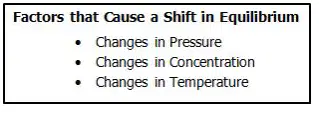
The information in the figure represents which principle?
Pauli Exclusion Principle
Le Chatelier's Principle
Aufbau Principle
Avogadro's Principle
What principle states that when a system in chemical equilibrium experiences a disturbance, it will shift in equilibrium composition in a way that tends to counteract this change?
Hund's Rule
Law of Conservation of Mass
Le Chatelier's Principle
Heisenberg's Uncertainty Principle
N2 (g) +3H2 (g)↔ 2NH3 (g) + Δ
Assume the reaction is at equilibrium. Which of the following would shift the equilibrium to the left?
A decrease in pressure
A decrease in temperature
A decrease in the amount of NH3
An increase in the amount of N2
2SO2 (g) + O2 (g) ↔ 2SO3 (g) + Δ
Adding SO2 (g) will:
Shift equilibrium right
Shift equilibrium left
Increase the rate of the reaction
Have no change
2SO2 (g) + O2 (g) ↔ 2SO3 (g) + Δ
Increasing pressure will:
Shift equilibrium right
Shift equilibrium left
Increase the rate of the reaction
Have no change
2SO2 (g) + O2 (g) ↔ 2SO3 (g) + Δ
Increasing temperature will:
Shift equilibrium right
Shift equilibrium left
Increase the rate of the reaction
Have no change

