
 Worksheets
Gas Law Review
Total questions: 41
Worksheet time: 6mins
If a hairspray can is heated, what can be expected of the pressure of the gas inside the can?
The pressure will increase
The pressure will decrease
The pressure will remain constant
The pressure will equalize
What is the pressure of a car tire that had an initial pressure of 1.8 atm but was heated from 38°C to 123°C?
0.9 atm
2.1 atm
1.6 atm
3.4 atm
Absolute zero is
0 K
where there is no molecular movement
the coldest temperature possible
all of these
Pressure is
defined as the mass that an object exerts when at rest.
not a measurable in gases.
defined as the number of moles of substance divided by the mass of the substance.
created by the force of the gas particles impacting the walls of the container.

Elastic collision means no ______ energy is lost when molecules collide.
potential
light
nuclear
kinetic
What describes the motion of a Gas Molecule?
Molecules are far apart
Move in constant, random motion
It will travel in a straight path
All of the above
Gas molecules are very small and ________ from one another.
very far
closed
very thin
big
A student measures the pressure and volume of an empty water bottle to be 1.4 atm and 2.3 L. She then decreases the pressure to 0.65 atm. What is the new volume?
2.1 L
5.0 L
8.2 L
3.9 L
A sample of a gas is at 265 K and a pressure of 0.900 atm. Calculate the final temperature when the pressure is 0.32 atm.
94.22 K
745.31 K
76.32 K

A gas that has a pressure of 2 atm and a volume of 10 L. What would be the new volume if the pressure was changed to 4 atm?
2 L
4 L
8 L
5 L
All of the following are temperature units except ______
atm
Kelvin
Celsius
Farenheit
Temperature units used in Chemistry are _________
C
kPa
F
K
V1/T1 = V2/T2
P1/T1 = P2/T2
V1/T1 = V2/T2
P1/T1 = P2/T2
V1 P1 = V2P2
As temperature of a gas increases, the average kinetic energy of it molecules
increases
decreases
remains the same
At constant pressure, a sample of gas is heated , the average kinetic energy of its molecules...
decreases, and the volume of the gas increases
decreases, and the volume of the gas decreases
increases, and the volume of the gas decreased
increases, and the volume of the gas increases
A sample of a gas is contained in a closed, rigid container. According to the kinetic molecular theory, what occurs when the gas inside the cylinder is heated?
the number of gas molecules increases
The number of collisions between gas molecules per unit time decreases
The volume of the gas decreases
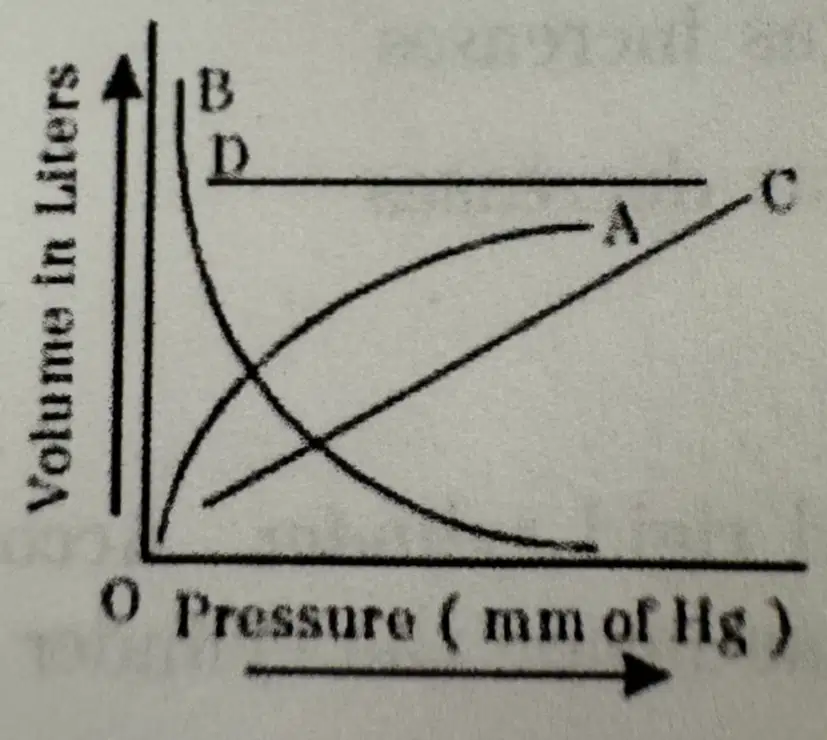
At constant temperature, which line best shows the relationship between the volume of an ideal gas and its pressure?
A
B
C
D
You forgot to bring your basketball inside after playing a game with your friends. When the sun when down, the temperature dropped & it got cold outside. What do you think happened to the volume of the ball?
Increase
Decrease

Which graph shows the pressure-temperature relationship expected for an ideal gas?
A
B
C
D

At constant pressure, which graph shows the correct relationship between the volume of a gas and its absolute temperature?
A
B
C
D
You go camping & roast marshmallows over a campfire. What happens to the volume of the air bubbles inside the marshmallows?
Increases
Decreases

