
 Worksheets
7th grade final exam study guide
Total questions: 58
Worksheet time: 29mins
Name
Class
Date
1.
Are there different kinds of scientific investigations?
a)
True
b)
False
2.
1) Which one is not Steps of the Scientific Method:
a)
Observation
b)
Question
c)
Experiment
d)
Interview
3.
2) Why do scientists repeat experiments done by other scientists?
a)
To verify results makes data more valid
b)
To challenge themseleves
c)
To show that there is no other way
d)
To have fun
4.
3) The amount of kinetic energy in an object is determined by its _________.
a)
speed and volume
b)
mass and volume
c)
volume and accelerator
d)
speed and mass
5.
4) This type of energy is caused by motion.
a)
potiential
b)
Mechanical
c)
Kinetic
d)
Gravitational
6.
5)The faster an object moves, the greater its ____________ energy is.
a)
Mechanical
b)
Chemical
c)
Kinetic
d)
None of the above
7.
6) An object’s potential energy will increase with ____________.
a)
speed and mass
b)
speed and height
c)
height and mass
d)
speed, height and mass
8.
7) What types of energy doesn't come from the sun?
a)
Visible light
b)
Ultraviolet light
c)
Heat
d)
Gamma
9.
8) What type of energy is not found in the electromagnetic spectrum?
a)
Gamma
b)
radio wave
c)
microwave
d)
sound wave
10.
9) Which part of the spectrum can we see?
a)
Visible light
b)
Gamma
c)
Microwave
d)
None of the above
11.
10) List the colors in the visible spectrum in order from the longest to shortest wavelength. What can we use to Remember the order of the colors?
a)
Red, orange, yellow, green, blue, indigo, violet
b)
Orange, yellow, green, blue, indigo, violet
c)
Red, yellow, orange, green, blue, indigo, violet
d)
Orange, red, yellow green, blue, indigo, violet
12.
15) What does a wave carry from place to place?
a)
Vabration
b)
Energy
c)
Water
d)
Air
13.
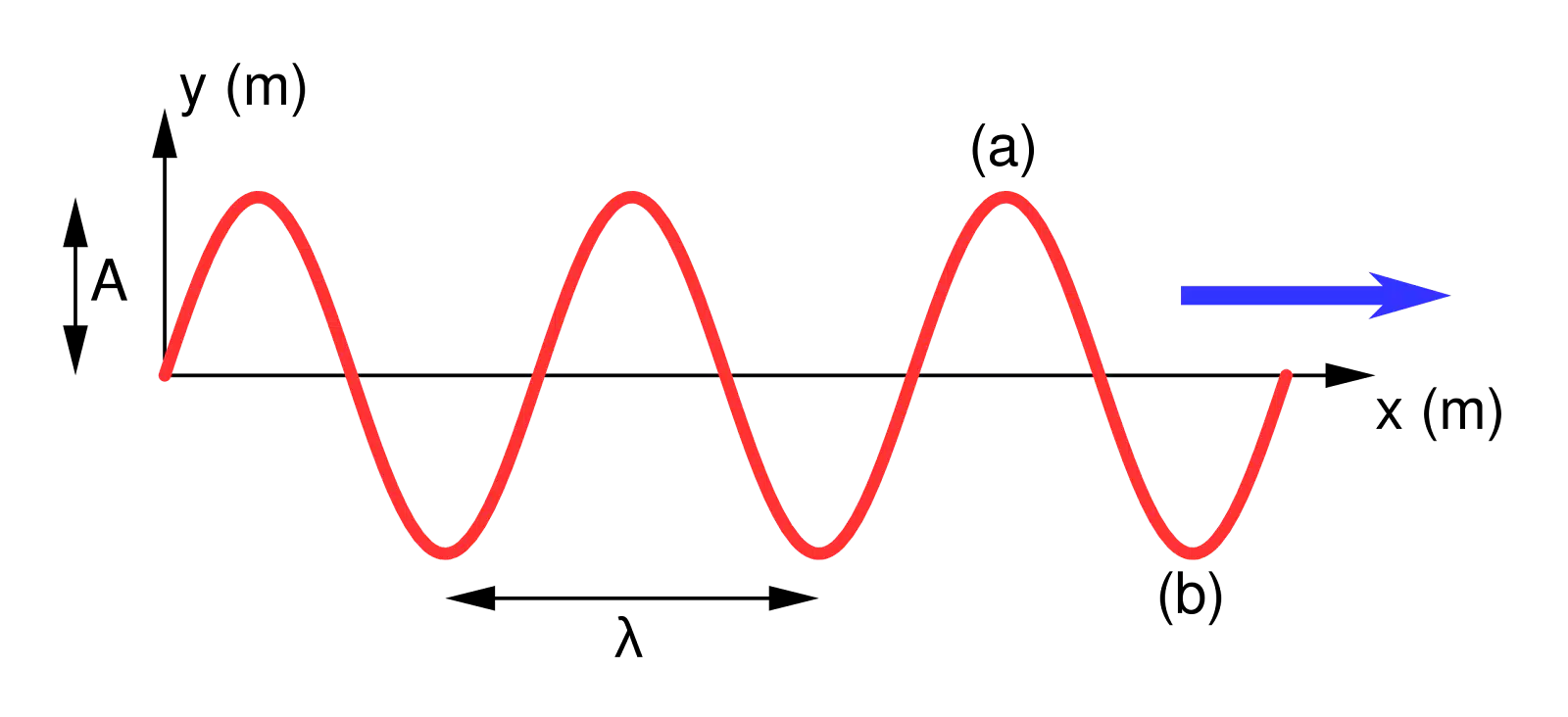
16) The highest point on a transverse wave is ?
a)
Crest
b)
Through
c)
amplitude
d)
wavelength
14.

17) The lowest point on a transverse wave is
a)
Trough
b)
Wavelength
c)
Crest
d)
Amplitude
15.
18) What is the formula for the speed of a wave?
a)
Speed= Wavelength x Amplitude
b)
Speed= Wavelength/Frequency
c)
Speed= Frequency x Amplitude
d)
Speed= Wavelength x Frequency
16.
19) Suppose you knew the speed and frequency of a wave. What property of the wave would you be able to calculate? What would that formula look like?
a)
Wavelength= Speed/ Amplitude
b)
Wavelength= Amplitude x Frequency
c)
Wavelength= Amplitude/ Frequency
d)
Wavelength= Speed/ Frequency
17.
20) What are the three main types of waves?
a)
Transverse, longitudinal and surface
b)
Transverse, surface, and light
c)
Longitudinal, surface, and water
d)
Transverse, water, light
18.
21) Wave often cause by
a)
Vibration
b)
Sound
c)
Energy
d)
Water
19.
22) What property of waves makes the types of waves in the spectrum different?
a)
Frequency
b)
Wavelength
c)
Amplitude
d)
None of the above
20.
23) List of types of wave interactions.
a)
Reflection, Refraction, Diffraction
b)
Reflection, Absorption , Transparent
c)
Refraction, Diffraction, Absorption
d)
Absorption, Transfer, Transparent
21.
24) What does the Law of Reflection state? Angle of incidence=angle of reflection
a)
Angle of incidence = angle of reflection
b)
Angle of incidence= angle of refrection
c)
Angle of incidence= 0
d)
None of the above
22.
25) Which type of wave interaction explains why objects look different under water? Why does this occur?
a)
Refection
b)
Refraction
c)
Reflection
d)
Diffraction
23.
26) Sound waves travel as ______________ waves.
a)
Surface
b)
Transvers
c)
longitudinal
d)
Diffraction
24.
27) How do most power plants generate electricity?
a)
Mechanical energy from wind, steam, water
b)
Chemical energy from turbine, generator
c)
Mechanical energy from sun
25.
28) Describe the relationship between speed of waves and the type of medium (material) they pass through.
a)
Waves move fastest through liquid
b)
Wave move fastest through solids (except light), slowest through gases. Light moves fastest through a vacuum
c)
Wave move fastest through solids (even light)
26.
29) Why is there a delay in the time someone sees lightning and the time they hear thunder?
a)
Sound travels faster than light
b)
Light travels faster than sound
c)
Sound is louder than light
d)
None of the above
27.
30) Sound waves travel as ______________ waves.
a)
transverse
b)
Surface
c)
longitudinal
d)
all of the above
28.
31) The amount of energy a sound wave carries per second through a unit of area is its ______________.
a)
Mass
b)
Density
c)
Intensity
d)
None of the above
29.
32) Loudness of waves is measured in ______________.
a)
Hertz
b)
Volume
c)
Decibels
d)
pitch
30.
33) The atmosphere is composed mainly of __________.
a)
Oxygen
b)
carbon dioxide
c)
Nitrogen
d)
Oxygen and carbon dioxide
31.
34) Which gas is released into the atmosphere by plants as they photosynthesize?
a)
Carbon dioxide
b)
Oxygen
c)
carbohydrate
d)
all of the above
32.
35) Which gas is removed from the atmosphere by green plants?
a)
Carbohydrate
b)
Oxygen
c)
Carbon dioxide
d)
None of the above
33.
36) Atmospheric pressure __________ with __________ altitude.
a)
Decreases with increased
b)
Increased with Decreases
c)
all of the above
d)
None of the above
34.
37) The density of our atmosphere __________ with an increase in altitude.
a)
Decreases
b)
Increases
c)
Decreases and Increase
35.
38) The space shuttle orbits in this layer.
a)
Stratosphere
b)
Mexosphere
c)
Thermosphere
d)
Exosphere
36.
39) The ozone layer is found in this atmosphere layer.
a)
Troposphere
b)
Mexosphere
c)
Thermosphere
d)
Stratosphere
37.
40) Earth’s magnetic field traps harmful particles from the Sun, concentrating them into belts of radiation called __________.
a)
Van Allen
b)
Aurora
c)
Magnetic belts
d)
None of the above
38.
41) Wind is created when _____.
a)
Warm air moves into replace cold air
b)
Moving up and down warm air
c)
Moving up and down cold air
d)
Cool air moves in to replace warm air
39.
42) Describes a sea breeze
a)
Cool air from the ocean blows onto land
b)
Cool air from the land blows onto ocean
c)
Warm air form ocean blows onto land
d)
Warm air goes up from land blows onto ocean
40.
43) Tornadoes and hurricanes are large areas of ____ pressure.
a)
High
b)
Medium
c)
Low
d)
No pressure
41.
44) List the layers of the Earth from inside the Earth to the surface.
a)
Crust , mantle, outer core, inner core
b)
Crust, outer core, mantle, inner core
c)
Inner core, outer core, mantle , crust
42.
45) Where are convection currents within the Earth?
a)
In the inner core
b)
In the outer core
c)
Lithosphere
d)
Mantle
43.
46) What property of matter caused the Earth to form in layers?
a)
Mass of different earth materials
b)
Color of different earth materials
c)
Volume of different earth materials
d)
Density of different earth materials
44.
47) What is the difference between minerals and rocks?
a)
Rocks have different types minerals don't have
b)
Rocks are composed of 2 or more minerals
c)
Minerals are composed of 2 or more different type of rocks
d)
Minerals are organic compound
45.
48) How do rock types become other rock types?
a)
Weathering and erosion
b)
Heating and cooling
c)
Heat and pressure
d)
all of the above
46.
49) What is the Law/ Principle of Superposition and how does it help geologists determine the age of rock layers?
a)
rock layers, the oldest layer will be found at the bottom and the youngest at the top
b)
Color of the rock layers, the darkest on will be found at top and lightest at the bottom
c)
Hard layers of rock at the bottom and soft one at the top
d)
all of the above
47.
50) What causes the Earth’s plates to move?
a)
Conduction currents in the inner core
b)
Convection currents in the outer core
c)
Conduction currents in the mantle create force of the movement of plates
d)
Convection currents in the mantle create forces that move the plates
48.
51) What are faults?
a)
A fracture in the Earth's mantel
b)
plates in the Earth's surface
c)
landforms
d)
Fracture in the earth's curst where movement happens
49.
51) Which seismic wave is the first to reach a seismic station?
a)
P wave
b)
S wave
c)
Love wave
d)
surface wave
50.
52) Which type of seismic wave can move through solid layers of the earth but not through the liquid outer core?
a)
P wave
b)
S wave
c)
Love wave
d)
all of the above
51.
53) How many seismic stations are required to determine the epicenter of an earthquake?
a)
2
b)
1
c)
0
d)
3
52.
54 ) What instrument is used to measure seismic waves?
a)
remote sensors
b)
GPS
c)
GIS
d)
Seismograph
53.
55) The type of plate boundary where seafloor spread can create
a)
Transforms
b)
Convergen
c)
Divergent
d)
Mid ocean ridge divergent
54.
56) Where the upper solid mantle meets the crust
a)
asthenosphere
b)
mesosphere
c)
outer core
d)
lithosphere
55.
57) The large plates move across the surface of the Earth by what process?
a)
Convection
b)
Conduction
c)
Radiation
d)
Gravity
56.
58) A wave with a large wavelength will have a ______ frequency and _____ energy
a)
low - high
b)
high - high
c)
Low-Low
d)
Low- nothing
57.
59) Which has the LONGEST wavelength and, therefore, the lowest frequency/energy
a)
X ray wave
b)
Gamma
c)
light
d)
Radio Waves
58.
60) Which color has the least amount of energy?
a)
Blue
b)
Yellow
c)
Orange
d)
Red
100 %

