
 Worksheets
Physical Science 1st Semester Benchmark 23-24
Total questions: 55
Worksheet time: 28mins
Name
Class
Date
1.
When you finish working with chemicals, biological specimens, and other lab substances, always
a)
treat your hands with skin lotion
b)
wipe your hands on a towel
c)
wash your hands thoroughly with soap and water
d)
wipe your hands on your clothes
2.
Hot glass looks the same as cold glass
a)
True
b)
False
3.
If you do not understand a direction or part of a lab procedure, you should
a)
figure it out as you do the lab
b)
ask the instructor before proceeding
c)
try several methods until something works
d)
skip it and go on to the next part
4.
Chipped or cracked glassware is okay to use.
a)
True
b)
False
5.
Select the correct abbreviation for milliliter
a)
mL
b)
mm
6.
Select the correct abbreviation for centimeter
a)
cg
b)
cm
7.

Convert 2000 mg = _______ g
a)
2
b)
2,000,000
8.

Convert 104 km = _______ m
a)
104,000
b)
0.104
9.
A car moves around a wide turn going 45 mi/hr the whole time. The car has a constant _____.
a)
speed
b)
velocity
c)
direction
10.
The velocity of an object must include both a __________ and a ___________.
a)
speed, direction
b)
acceleration, speed
c)
positive, negative
11.
Motion is a change in _____.
a)
time
b)
speed
c)
position
12.
3 m/s North is an example of a(n)
a)
speed
b)
velocity
c)
time
13.
A car slowing down as it is approaching a red traffic light has a _______________ acceleration; when the light turns green, the car’s acceleration is _______________.
a)
positive, negative
b)
negative, positive
14.
If you ride your bicycle down a straight road for 500 m then turn around and ride back to your starting point, your distance is _____ your displacement.
a)
greater than
b)
equal to
c)
less than
15.
The speed you read on a speedometer is ____
a)
instantaneous speed
b)
constant speed
c)
velocity
16.
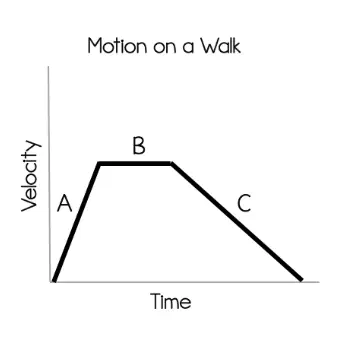
In this velocity vs. time graph, the person at point A:
a)
has zero acceleration
b)
has positive acceleration
c)
has negative acceleration
17.
An indicator that orients you when describing motion is called the ___________ .
a)
reference point
b)
speed
c)
point of motion
18.
A horizontal (flat) line on a velocity vs. time graph shows ____ acceleration.
a)
positive
b)
changing
c)
zero
19.
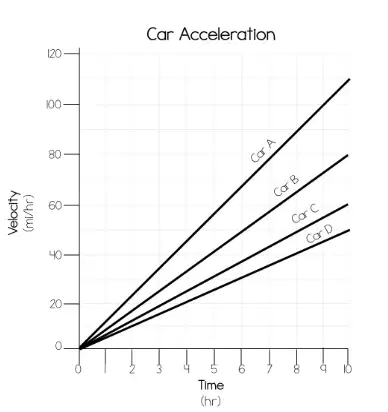
The graph represents the change in velocity of four cars over a period of 10 hours. Which line represents the car with the greatest acceleration?
a)
A
b)
B
c)
C
d)
D
20.
Find the acceleration of a car that goes from 32 m/s to 96 m/s in 8.0 s.
a = Δv/t
a)
8.0 m/s2
b)
12 m/s2
c)
4.0 m/s2
21.
A car travels a distance of 98 meters in 10 seconds. What is the average speed of the car?
s = d/t
a)
4.9 m/s
b)
9.8 m/s
c)
98 m/s
22.
A skateboarder is traveling 12 m/s down a hill. The skateboarder crashed and slid to a stop in 2.0 seconds. What was the rider’s acceleration?
a)
6 m/s
b)
-6 m/s2
c)
0.17 m/s2
d)
-0.17 m/s2
23.
A cross-country runner runs 10 km in 40 minutes. What is his average speed?
s=d/t
a)
30 km/min
b)
4 km/min
c)
0.25 km/min
24.
What is true about a car with constant velocity?
a)
it has a positive acceleration
b)
it has a negative acceleration
c)
it has zero acceleration
25.
Carl and Juan are playing catch. Carl throws a fastball to Juan and it hurts Juan’s hand. Why is this the case?
a)
Greater the mass, greater the acceleration
b)
Greater the acceleration, greater the force
c)
Greater the acceleration, the less the force
26.
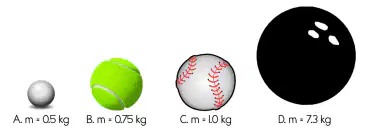
If the same force is applied to each of the balls pictured below, which one will have the LEAST acceleration?
a)
A. Golf ball
b)
D. Bowling ball
27.
Calculate the force on an object that has a mass of 10 kg and an acceleration of 4 m/s2
F=ma
a)
14 N
b)
40 N
c)
2.5 N
28.
A group of students is playing tug-of-war. The students on both sides of the rope are pulling with equal force so that the rope is not moving. This is an example of
a)
balanced forces
b)
un-balanced forces
c)
acceleration
29.
Which two quantities are measured in the same units?
a)
velocity and acceleration
b)
weight and force
c)
mass and weight
30.
A man weighing 800 N is standing on a chair. In order to support the man, what FORCE is the chair exerting?
a)
800 N up
b)
800 N down
31.
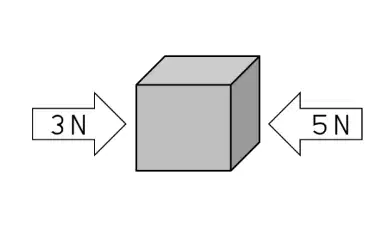
What is the NET FORCE on the block?
a)
8 N left
b)
2 N left
c)
2 N right
32.
If a 53 kg boulder falls off a cliff, what is the force with which it will hit the ground?
F=ma
a)
519.4 N
b)
53 N
33.
Which of the following items has the most inertia?
a)
A pencil
b)
A water bottle
c)
Coach A
34.
Which of the laws of motion states, “To every action there is an equal but opposite reaction”?
a)
1st
b)
2nd
c)
3rd
35.
What is the weight (in Newtons) of a person with a mass of 95 kg?
F=ma
a)
95 N
b)
104.8 N
c)
931 N
36.
According to Newton’s laws, for any object, the greater the force that's applied to it, the greater its____ will be.
a)
acceleration
b)
inertia
c)
size
37.
A student drops a feather and rock at the same time from Mrs. Taylor’s window. If air resistance wasn’t a factor, what should she observe?
a)
The rock falls slower than the feather.
b)
The rock falls faster than the feather.
c)
The rock and feather fall at the same rate.
38.
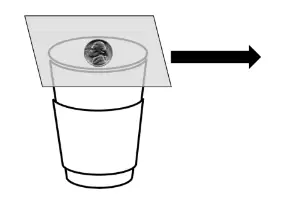
In the picture, if the card were quickly pulled off the cup like the arrow suggests, what property would explain why the coin falls into the cup rather than moving with the card?
a)
friction
b)
force
c)
inertia
39.
An object has 16 N of force being applied to the right, 16 N of force being applied to the left, and 4 N of force being applied downward. What is the net force on the object?
a)
36 N
b)
4 N downward
c)
16 N to the left
40.
If a bicyclist has a mass of 70 kg and a velocity of 25 m/s, what is the momentum of the bicyclist?
p=mv
a)
1750 kg*m/s
b)
2.8 kg*m/s
c)
0.35 kg*m/s
41.
The sum of kinetic energy and potential energy within a system is called
a)
thermal energy
b)
electrical energy
c)
mechanical energy
42.
Which of the following is not a type of potential energy?
a)
chemical
b)
elastic
c)
gravitational
d)
kinetic
43.
Where would a roller coaster have the greatest potential energy?
a)
at the top of a hill
b)
halfway up the hill
c)
at the bottom of the hill
44.
When an object (like a ball) falls, some of its ___________ energy changes to___________ energy, due to the law of conservation of energy.
a)
kinetic, potential
b)
potential, kinetic
45.
If a toy helicopter is moving at 12 m/s, how much energy does the 3 kg toy have?
KE=1/2mv2
a)
54 J
b)
216 J
46.
How much energy does a 50 kg rock have if it is sitting on the edge of a 15 m cliff?
GPE=ham
a)
750 J
b)
7350 J
47.
A small child weighs 60 N. If mommy left him sitting on top of the stairs, which are 10 m high, how much energy does the child have?
GPE=ham
a)
600 J
b)
5880 J
48.
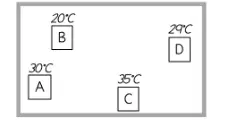
The diagram shows four locations in a temperature field. The temperature of each location is given in degrees Celsius. Heat energy will normally flow from:
a)
A to D
b)
B to C
c)
C to B
d)
D to A
49.
A constant force of 2.0 N is used to push a box 4.0 m across the floor. How much work is done?
W=Fd
a)
2 J
b)
8 J
c)
78.4 J
50.
A material that resists/limits the flow of heat by conduction, convection, and radiation is a(n) ____.
a)
insulator
b)
conductor
51.
Temperature measures the average ____ of the particles in a material.
a)
kinetic energy
b)
mechanical energy
52.
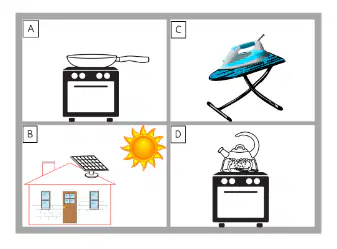
Thermal energy is transferred to the solar panel in picture B by
a)
conduction
b)
convection
c)
radiation
53.
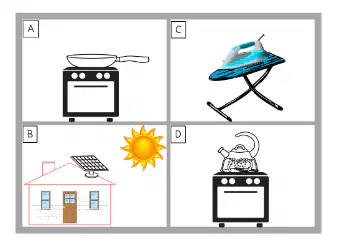
Which picture shows thermal energy transfer by convection?
a)
A
b)
B
c)
C
d)
D
54.
What energy change do a toaster, a hairdryer, and an iron all have in common?
a)
They convert electrical energy to thermal energy.
b)
They convert mechanical energy to electrical energy.
55.
A piece of zinc was lying outside and had a temperature of 26 ° C. Later that day the sun came out and the temperature increased to 36 ° C. If the piece of zinc is only 0.15 kg, find the thermal energy. Note: Zinc has a specific heat of 380 J/kg/°C
Q=mc(change of)T
a)
1482 J
b)
570 J
100 %

