
NEW
Font size
 Worksheets
Unit 9 Review
Total questions: 20
Worksheet time: 10mins
What type of natural selection favors average individuals in a population?
directional
disruptive
stabilizing
divergent
Which of the following pairs of terms are NOT related?
analogous structures - butterfly and birds wings
evolution - natural selection
vestigial structure - eyes in blind fish
adaptive radiation - convergent evolution
Fish and whales are not closely related. Their structural similarities appear to be the result of
adaptive radiation.
convergent evolution.
divergent evolution.
punctuated equilibrium.
Which of the following is a true statement about evolution?
Individuals evolve more slowly than populations.
Individuals evolve more slowly than populations.
Individuals evolve by changing the gene pool.
Populations evolve; individuals don't.
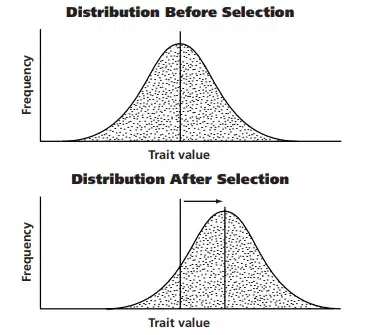
Which pattern of natural selection is illustrated in the picture?
disruptive selection
stabilizing selection
directional selection
random selection
Which of the following provides for instant reproductive isolation?
polyploidy
geographic barriers such as rivers and mountains
climate changes
behavior changes in females of the species
Which type of adaptation develops quickly in bacteria that are antibiotic resistant?
structural adaptation
physical adaptation
physiological adaptation
phenotypic adaptation
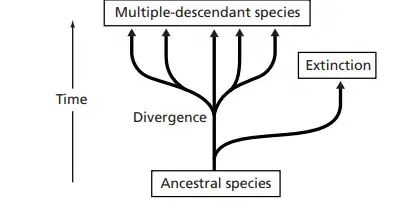
The pattern of evolution shown in the picture indicates
convergent evolution
divergent evolution
stabilizing selection
geographic isolation
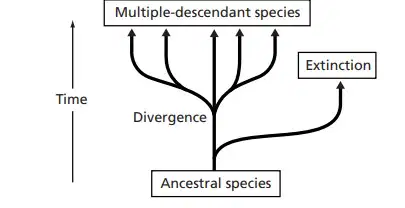
The pattern of evolution pictured most closely resembles that of
Galapagos finches.
bats and birds.
whales and sharks.
turtles and frogs.
In forming his theory of evolution, Darwin most lacked an adequate understanding of
geology.
heredity.
anatomy.
geography.
An inherited trait that helps an individual survive and reproduce in a particular environment is
an adaptation.
a survival trait.
a genetic trait.
natural variation.
A human arm and a bat wing are each made up of similar number and arrangement of bones. This similarity is evidence that humans and bats
evolved at the same time.
have the same parents.
have an ancestor in common.
once shared the same habitat.
After studying plant and animal life in South America and the Galapagos Islands, Darwin proposed that
Galapagos species had descended from South American species.
South American species had descended from Galapagos species.
Galapagos species and South American species are unrelated.
Galapagos species and South American species descended from European species.
Darwin was influenced by Malthus's ideas about
inheritance.
populations.
the fossil record.
natural history.
Which of the following is a form of biochemical evidence that can be used to study evolution?
speciation.
intermediate forms.
homologous structures.
DNA similarities.
Which of the following was a weakness in Darwin's ideas about evolution?
lack of evidence for evolution
lack of a mechanism for evolution
lack of a mechanism for inheritance of traits.
lack of recognition of the importance of variation.
Modern evolutionary theory has incorporated most of Darwin's ideas except
Darwin's laws of heredity.
Darwin's theory of natural selection.
Darwin's idea that species evolve gradually.
Darwin's predictions of intermediate forms.
Like modern plants, early photosynthetic organisms used light as the energy source for synthesizing sugar. Based on this fact, what substance had to be available to these organisms in the environment of early Earth?
nitrogen
ATP
oxygen
carbon dioxide
In the evolution of eukaryotes, cells that contained mitochondria-like organelles had and advantage because they
could make use of photosynthesis.
could make use of more available energy.
had more DNA.
were protected from bacterial invasion.
All evolution is driven by
genetic mutations.
sexual selection.
competition.
sexual reproduction.

