wayground logo

Free Printable Worksheets

Font size

S
M
L
XL
Worksheets

Algebra 1 EOC Review

Total questions: 159

Worksheet time: 8hrs 43mins

Name
Class
Date
1.

Solve the equation: 4x - 5x + 9 = 5x - 9

a)

x=3

b)

x=-3

c)

x=-9

d)

x=9

2.

3=2(x4)11-3=2\left(-x-4\right)-11  

a)

6-6  

b)

7-7  

c)

8-8  

d)

9-9  

3.
0.75 + 2(a - 0.5) = 3a - 0.4
a)
0.15
b)
5
c)
1.5
d)
3.75
4.

x+5 = 3\left|x+5\right|\ =\ -3  

a)

2 or 8-2\ or\ -8  

b)

no solution

c)

00  

5.

Solve:
34a3=9\left|\frac{3}{4}a-3\right|=9  

a)

{16, 8}\left\{16,\ -8\right\}  

b)

{16, 16}\left\{16,\ -16\right\}  

c)

{8, 8}\left\{-8,\ 8\right\}  

d)

no solution

6.

Solve for x

|3x| = 9

Don't forget to choose two answers!

a)

3

b)

-3

c)

9

d)

27

e)

-27

7.

SOLVE Y=MX+B FOR X

a)

x=ymbx=y-m-b  

b)

x=ymbx=\frac{y-m}{b}  

c)

x=ybmx=\frac{y-b}{m}  

d)

x=ymbx=ymb  

8.
Solve:
C = 2πr, for r
a)

C2π=r\frac{C}{2\pi}=r  

b)
C + 2π = r
c)
C - 2π = r
d)
2πC = r
9.

Given V=lwh, solve for l.Given\ V=lwh,\ solve\ for\ l.  

a)

l=Vwhl=\frac{Vw}{h}  

b)

l=Vwhl=\frac{V}{wh}  

c)

l=Vhwl=\frac{Vh}{w}  

d)

l=whVl=\frac{wh}{V}  

10.

Solve the following Compound Inequality 3x9 or 5+x<63x\ge9\ or\ 5+x<6

a)

x<1 or x3x<1\ or\ x\le3

b)


x<1 or x3x<1\ or\ x\ge3

c)

x<1 or x3x<1\ or\ x\ge-3

d)

x<1 or x3x<1\ or\ x\le-3

11.

Does the following graph match the compound inequality

x<1 or x3x<1\ or\ x\ge3  

a)

True

b)

False

12.

Solve the following "and" Compound Inequality

27<7x13<8-27<7x-13<8  

a)

x>2 and x<3x>-2\ and\ x<3  

b)

x<2 and x<3x<-2\ and\ x<3  

c)

x>2 and x>3x>-2\ and\ x>3  

d)

x>2 and x<3x>2\ and\ x<3  

13.
Solve:  -3 ≤ 2x - 1 ≤ 5
a)
-1 ≤ x ≤ 3
b)
-1 < x < 3
c)
1 < x < 3
d)
1 ≤ x ≤ 3
14.

Solve this

3x+4193x+4\le19  

a)

x = 5

b)

  x >5x\ >5  

c)

x5x\le5  

15.

Now lets put it all together! Distribute, combine and solve!!

3(23x)<33-3\left(2-3x\right)<-33  


a)

x<3x<3  

b)

x>3x>-3  

c)

x<3x<-3  

16.
solve 5( 6 + 3r) + 7 ≥ 127
a)
r ≤ 6
b)
r ≥ 6
c)
r ≤ -6
d)
r ≥ -6
17.

Solve the inequality

a)

x ≥ -7

b)

x ≤ -7

c)

x ≤ -15

d)

x ≥ -15

18.

Solve:

5x + 4 = 5x − 3

a)

x = 4

b)

x = -3

c)

infinitely many solutions

d)

no solutions

19.

Solve:

3(x − 2) = 3x − 6

a)

x = 6

b)

x = -6

c)

infinitely many solutions

d)

no solutions

20.
Discrete or Continuous?
a)
Discrete
b)
Continuous
21.
For the function {(0,1), (1,-3), (2,-4), (-4,1)}, write the domain and range.
a)
D: {1, -3, -4,}
R: {0, 1, 2, -4}
b)
D: {-4, 0, 1, 2}
R:{-4, -3, 1}
c)
D: {0, 1, 2, 3, 4}
R:{1, -3, -4}
d)
D: {0, 1, 2, -4}
R: {1, -3, -4, 1}
22.

Is this graph continuous or discrete?

a)

Continuous

b)

Discrete

23.

Raji joins a gym that requires a start up fee of $40 and a monthly fee of $10. The equation that models this situation is y = 10x + 40, where y is the cost over time and x is the number of months. Does this situation have a continuous or discrete domain?

a)

Continuous

b)

Discrete

24.

Speedy Boat Rental charges a $15 deposit fee plus $2 for each hour of use to rent a paddle boat. This is represented by the equation c = 2h + 15, where c is the total cost and h is the number of hours. Does this situation have a continuous or discrete domain?

a)

Continuous

b)

Discrete

25.
What is the range of the graph?
Remember: Range is y! 
a)
1 ≤ x ≤ 5
b)
1 < x < 5
c)
1 ≤ y ≤ 5
d)
1 < y < 5
26.
What is the domain of the graph?
Remember:   Domain is the "x" values from left to right
a)
-7 ≤ x < 5
b)
-3 ≤ x < 1
c)
-3 ≤ y < 1
d)
-7 ≤ y < 5
27.

Which of the following points is the y-intercept of the graph?

a)

(0, 3)

b)

(0, -3)

c)

(-1.5, 0)

d)

(3, 0)

28.

Which of the following points is the highest maximum (absolute maximum) on the graph?

a)

(-5, 1)

b)

(0, 3)

c)

(4, 1)

d)

(-3, -2)

29.

How many minimums does this graph have?

a)

5

b)

3

c)

2

d)

4

30.

Where could we say this graph is increasing?

a)

It is increasing from -3 to 0

b)

It is increasing from 0 to 2

c)

It is increasing from 2 to 4

d)

It is increasing from 4 to infinity

e)

It is increasing at the point (0, 3)

31.
What is the end behavior as x → +∞, f(x)→ ?
a)
-∞
b)
32.
Over what interval is this function decreasing?
a)
−∞ ≤ x ≤ 2
b)
2 ≤ x ≤ ∞
33.
What is x if
f(x) = -2?
a)
4
b)
0
c)
3
d)
8
34.
Given h(x) = 5 - 9x, find h(8). 
a)
h(8) = -360
b)
h(8) = -67
35.
What is x if
f(x) = -2?
a)
4
b)
0
c)
3
d)
8
36.
Write the equation of the line.
a)
y= -1x-3
b)
y= -3x-1
c)
y=-1/3x-1
d)
y= -3x-3
37.
Which is the graph of y= -x + 2? 
a)
A
b)
B
c)
C
d)
D
38.

Write an equation of the line

a)

y=23x2y=-\frac{2}{3}x-2

b)

y=23x2y=\frac{2}{3}x-2

c)

y=23x +2y=-\frac{2}{3}x\ +2

d)

y=23x+2y=\frac{2}{3}x+2

39.

The equations of three lines are given. Identify which lines are parallel.

a)

Line A is Parallel to Line B

b)

Line A is Parallel to Line C

c)

Line B is Parallel to Line C

d)

No Lines are Parallel

40.

Write an equation in slope-intercept form for the line parallel to

y = 5x – 2

that passes through the point (8, –2).

a)

y=5x+32y=5x+32

b)

y=5x42y=5x-42

c)

y=15x25y=-\frac{1}{5}x-\frac{2}{5}

d)

y=15x2y=-\frac{1}{5}x-2

41.

 Write an equation of the line that passes through (2, 5) and is perpendicular to 

y = 14x12\frac{1}{4}x-12  

a)

y=4x+3y=-4x+3  

b)

y=4x+13y=-4x+13  

c)

y=4x13y=-4x-13  

d)

y=4x3y=-4x-3  

42.

Determine which of the lines, if any, are perpendicular.

a)

a  ba\ \perp\ b

b)

 b  c\ b\ \perp\ c

c)

 a  c\ a\ \perp\ c

d)

ab  and  cba\perp b\ \ and\ \ c\perp b

43.

Convert to slope-intercept form:

y + 9 = 3(x - 1)

a)

y = 3x + 12

b)

y = 3x - 12

c)

y = 3x - 6

d)

y = 3x + 6

44.

What is the equation of a line that is parallel to

y=8x2y=8x-2  and passes through the point (1, 3)\left(-1,\ -3\right)

a)

y=8x5y=8x-5  

b)

y=18x258y=-\frac{1}{8}x-\frac{25}{8}  

c)

y=8x+5y=8x+5  

d)

y=8x+23y=8x+23  

45.

What is the equation of the graph?

a)

y = -2

b)

y = 2

c)

x = -2

d)

x = 2

46.

Write the equation in point-slope form of the line that passes through the given point and has the given slope:

(-2, -1); m= -3

a)

y + 1 = -3(x - 2)

b)

y + 1 = -3(x + 2)

c)

y - 1 = 3(x - 1)

d)

y + 2 = -3(x + 1)

47.

A line has a slope of -6 and passes through the point (-2,3). Write the equation for the line in Slope-Intercept form.

a)

y = -6x - 16

b)

y = -6x - 20

c)

y = -6x + 16

d)

y = -6x - 9

e)

y = -6x - 15

48.
Which equation matches the table?
a)
y = 3x + 9
b)
y = x + 9 
c)
y = x + 3
d)
y = 12x - 3
49.
Given the table, write the equation in the slope-intercept form.
a)
y = 1/3x + 6
b)
y = 3x + 6
c)
y = 2x + 6
d)
y = 1/2x + 6
50.

What is the solution to the systems of equations shown in the graph?

a)

1 Solution x=-1/2

b)

1 Solution y=-1/2

c)

Many Solutions

d)

No Solution

51.

Match the following graphs to the systems of equations

a)
1.

y=23x+1y=\frac{2}{3}x+1  

y=23x2y=\frac{2}{3}x-2  

b)
2.

y=x+7y=-x+7   y=2x+1y=2x+1  

c)
3.

y=2x+4y=-2x+4   y=2x+4y=-2x+4   

52.

Which of the following graphs would fit the system of equations?

y=2x4y=2x-4  

y=12x+1y=-\frac{1}{2}x+1  

a)
b)
c)
53.

What are the solutions to the system of equations below?


7x5y=387x-5y=38  
2x+10y=122x+10y=-12  

a)

x = 4 and y = -2

b)

x = 4 and y = 2

c)

x = -4 and y = 2

d)

x = -4 and y = -2

54.
Solve the system of equations.
y = 4x+1
3x + 2y = 13
a)
(1, 5)
b)
(5, 1)
c)
(0.25, 2)
d)
55.
Determine if (4, 1) is a solution for the system of equations.
y = -x + 5
y = 2x - 7
a)
yes
b)
no
56.

Solve the system of inequalities by graphing.

a)
b)
c)
d)
57.

Solve the system of inequalities by graphing.

a)
b)
c)
d)
58.

Solve the system of inequalities by graphing. 8x +4y10 and 3x6y>128x\ +4y\ge10\ and\ 3x-6y>12  

a)
b)
c)
d)
59.
Given the system, determine a solution.
a)
No solution
b)
Infinite solutions
c)
(-5, 5)
d)
(5, -5)
60.
Which point below is NOT part of the solution set?
a)
(0, 0)
b)
(-10, -10)
c)
(-1, 5)
d)
(5, 20)
61.
Select the graph for y ≥ -3.
a)
A
b)
B
c)
C
d)
D
62.
a)
y < -3/4x - 2 
b)
y > -3/4x - 2 
c)
y ≤ -3/4x - 2 
d)
y ≥ -3/4x - 2 
63.
Select the graph for 5x+ y ≤  -1 .
a)
A
b)
B
c)
C
d)
D
64.
(6x2)(-3x5)
a)
18x7
b)
-18x7
c)
18x7
d)
3x7
65.
Simplify the expression in exponential form:
1340
a)
0
b)
134
c)
1
66.
Simplify (2x4y7)3
a)
6x7y10
b)
6xy32
c)
8x12y21
d)
8x7y10
67.
Evaluate the expression using the quotient rule.
a)
214 z13
b)
22/z7
c)
214/ z7
d)
2z7
68.

Simplify: 12x5y42x9y\frac{12x^5y^4}{2x^9y}  

a)

6x4y36x^{-4}y^3  

b)

6y3x4\frac{6y^3}{x^4}  

c)

12y32x4\frac{12y^3}{2x^4}  

d)

6x4y3\frac{6x^{-4}}{y^3}  

69.

What is the initial value in y=4(2)x

a)

4

b)

2

c)

x

70.

What is the common ratio for the function f(x) = 25 (4)x

a)

25

b)

4

71.

Is the function linear or exponential?

a)

linear

b)

exponential

72.

Match each table with the correct "a" value.

a)
1.

3

b)
2.

5

c)
3.

2

d)
4.

1/3

73.

What is the equation that models the data in the table?

Use the formula: y=a(b)x

a)

y = 3(3)x

b)

y=13(3)xy=\frac{1}{3}\left(3\right)^x  

c)

y=(13)xy=\left(\frac{1}{3}\right)^x  

d)

y = 3x

74.

What is the equation that models the data in the table?

a)

y=2xy=2^x  

b)

y=2(2)xy=2\left(2\right)^x  

c)

y=4(2)xy=4\left(2\right)^x  

d)

y=2(4)xy=2\left(4\right)^x  

75.

Select the functions that are exponential growth.

a)

y=2(3)xy=-2\left(3\right)^x

b)

f(x)=3(1.09)xf\left(x\right)=3\left(1.09\right)^x

c)

f(x)=4(13)xf\left(x\right)=4\left(\frac{1}{3}\right)^x

d)

y=0.5(32)xy=0.5\left(\frac{3}{2}\right)^x

76.
Classify the model as Exponential GROWTH or DECAY.
A=1200(.85)6
a)
Growth
b)
Decay
77.
Which of the following functions shows an initial amount of $15 and an increase of 35% each year?
a)
y = 15(35)x
b)
y = 15(1.35)x
c)
y = 15(0.35)x
d)
y = 35(1.15)x
78.
Is this exponential growth or decay?
a)
Growth
b)
Decay
79.

Suppose a culture of bacteria begins with 5000 cells and dies by 30% each year. Write an equation that represents this situation.

a)

y=5000(0.7)x

b)

y=30(5000)x

c)

y=5000(1.3)x

d)

y=5000xx

80.
What is the range of this graph?
a)
y = 6
b)
(0, -4)
c)
y > -6
d)
y < -6
81.
Riley invested $1,000 in savings bonds. If the bonds earn 6.75% interest compounded semi-annually,how much interest will Riley earn in 15 years?
a)
$1,584.62                   the train station
b)
$1,651.39                   the movie theater
c)
$1,706.86                   the art museum
d)
$1,893.45                   the bakery
82.
Kennedy won $3,000 from a radio contest. If she puts this money in a bank account that earns 2.9% interest compounded quarterly, how much interest will she earn in 10 years?
a)
$915.59                Rome
b)
$933.28             Sydney
c)
$979.81               Dublin
d)
$1,005.09              Paris
83.

Which equation best represents the graph above?

a)

f(x)=5(.5)x

b)

f(x)=10(.25)x

c)

f(x)=10(5)x

d)

f(x)=10(.75)x

84.

Which statement describes the end behavior of the function above?

a)

As x, y+As\ x\longrightarrow-\infty,\ y\longrightarrow+\infty as x+, yas\ x\longrightarrow+\infty,\ y\longrightarrow-\infty  

b)

As x, y0As\ x\longrightarrow-\infty,\ y\longrightarrow0 as x+, yas\ x\longrightarrow+\infty,\ y\longrightarrow-\infty  

c)

As x, y0As\ x\longrightarrow-\infty,\ y\longrightarrow0 as x+, y5as\ x\longrightarrow+\infty,\ y\longrightarrow-5  

d)

As x, y+As\ x\longrightarrow-\infty,\ y\longrightarrow+\infty

as x+, y0as\ x\longrightarrow+\infty,\ y\longrightarrow0  

85.

Which statement describes the end behavior of the function above?

a)

As x, y+As\ x\longrightarrow-\infty,\ y\longrightarrow+\infty as x+, yas\ x\longrightarrow+\infty,\ y\longrightarrow-\infty  

b)

As x, y+As\ x\longrightarrow-\infty,\ y\longrightarrow+\infty

as x+, y+as\ x\longrightarrow+\infty,\ y\longrightarrow+\infty  

c)

As x, y+As\ x\longrightarrow-\infty,\ y\longrightarrow+\infty

as x+, y3as\ x\longrightarrow+\infty,\ y\longrightarrow3  

d)

As x, y+As\ x\longrightarrow-\infty,\ y\longrightarrow+\infty

as x+, y0as\ x\longrightarrow+\infty,\ y\longrightarrow0  

86.

What is the asymptote of y = 2x - 3

a)

y = 0

b)

y = -3

c)

x = 0

d)

x = -3

87.

Classify the following polynomial according to its terms:

4x2 + 5x -7

a)

Monomial

b)

Binomial

c)

Trinomial

d)

Polynomial

88.

Classify the following polynomial according to its terms:

5x11

a)

Monomial

b)

Binomial

c)

Trinomial

d)

Polynomial

89.

Determine the degree of the following polynomial:

x4 - 9x + 1

a)

1

b)

4

c)

5

d)

-9

90.

Determine the degree of the following polynomial:

-7xy3z2

a)

1

b)

3

c)

2

d)

6

91.

Add the following polynomials:


(x3 + 6x - 5) + (-6x2 + 4x + 3)

a)

x3 - 6x2 +10x - 8

b)

x3 - 6x2 +10x + 2

c)

x3 - 6x2 +10x - 2

d)

x3 + 4x - 2

92.

Subtract the following polynomials:


(6x2 + 10x - 9) - (4x2 - 13)

a)

2x2 + 10x - 22

b)

10x2 + 10x - 22

c)

2x2 + 10x - 4

d)

2x2 + 10x + 4

93.

Multiply the following polynomial by the monomial:


3x(4x2 - x - 3)

a)

12x2 - 3x - 9

b)

7x3 - 3x2 - 6x

c)

12x3 - 3x2 - 9x

d)

12x3 - 3x2 - 6

94.

What is the perimeter of the rectangle?

a)

x²+8x-5

b)

2x²+16x-10

c)

2x²+10x-8

d)

6x-2

95.
(x +2)(x + 3)
a)
x2 + 5x + 6
b)
x2 + x + 6
c)
x2 + 5x + 5
d)
x2 + 6x + 6
96.
(5x+2)(x2-3x+6)
a)
5x3 - 17x2 +24x +12
b)
5x3 + 17x2 - 24x +12
c)
5x3 - 13x2 + 24x +12
d)
5x3 +13x2 - 24x - 12
97.
(4x+1)(5x−2)
a)
20x2 + 3x − 2
b)
20x2 − 11x + 5
c)
20x2 − 18x + 2
d)
20x2 − 3x − 2
98.
Find the product:
(2x+3)2
a)
2x+3+2x+3
b)
4x2+12x+9
c)
4x2+9
d)
16x2+9
99.
What is the area for the given rectangle:
a)
6x3 - 9x2 + 10x - 15
b)
6x2 + 1x - 15
c)
6x2 + 4x + 4
d)
6x3 + 1x2 - 15x
100.
A pool has a length of x - 5 and a width of x + 3. What is the area of the pool?
a)
x2 - 2x - 15
b)
x2 - 8x + 15
c)
x2 + 2x - 15
d)
x2 + 8x + 15
101.
What is the GCF? 5x2+20x
a)
5
b)
x
c)
5x
d)
20x
102.
Factor Completely: x2-17x+72
a)
(x-9)(x+8)
b)
(x-9)(x-8)
c)
x(x-3)
d)
(x+9)(x+8)
103.
Factor Completely: x4-9x2
a)
x2(x+3)(x-3)
b)
(x2+3x)(x2-3x)
c)
(x2+9)(x-3)(x+3)
d)
x2(x2-9)
104.
Factor Completely: 14p2-24p-8
a)
(5p+3)(p-4)
b)
(3p-2)(p+10)
c)
2(7p-2)(p+2)
d)
2(7p+2)(p-2)
105.

What method should you use to factor the polynomial?

5n³-10n²+3n-6

a)

Factor by Grouping

b)

Factor out the GCF

c)

Difference of Squares

d)

Master Product

106.
Which is another way of correctly expressing
 (x  - 3)(x - 3)?
a)
(x2 - 32)
b)
(x2 - 3)
c)
(x + 3)(x - 3)
d)
(x - 3)2
107.
Factor:
x2 - 9
a)
(x + 3)(x - 3)
b)
(x + 3)2
c)
(x - 3)2
d)
(x+3)(x+3)
108.
a)
5p- 16p
b)
5p + 4
c)
5p - 4
d)
5p + 4p
109.
Divide the polynomial by the monomial.
a)
2x8-8x2-28x
b)
2x8-2x2-7x
c)
8x7-8x-28x
d)
2x-2x -7
110.
Divide the polynomial by the monomial.
a)
15x9 - 8x3
b)
3x6 - 8x3
c)
-5x12
d)
3x6 - 40x3
111.

652-\sqrt{6}\cdot5\sqrt{2}  

a)

512-5\sqrt{12}  

b)

535\sqrt{3}  

c)

52-5\sqrt{2}  

d)

103-10\sqrt{3}  

112.

22746\frac{2\sqrt{27}}{4\sqrt{6}}  

a)

18212\frac{18\sqrt{2}}{12}  

b)

324\frac{3\sqrt{2}}{4}  

c)

3326\frac{3\sqrt{3}}{2\sqrt{6}}  

d)

6346\frac{6\sqrt{3}}{4\sqrt{6}}  

113.

6 1256\ \sqrt[]{125}   Simplify.

114.

A rectangle has a length of 3 53\ \sqrt[]{5} and a width of 4 44\ \sqrt[]{4} . Find the area of the rectangle as a simplified radical expression.

115.

When did the ball reach its maximum height? Choose the key feature and the answer.

a)

y-intercept, 3 secs

b)

x-value of the vertex, 4 secs

c)

y-value of the vertex, 5 secs

d)

y-intercept, 0 secs

116.

What was the height of the ball at 1 second?

a)

3 feet

b)

4 feet

c)

5 feet

117.

What was the maximum height of the water? Choose the key feature and the answer.

a)

y-intercept, 0 feet

b)

x-value of the vertex, 2 feet

c)

y-value of the vertex 10 feet

d)

x-intercept. 3.85 feet

118.

How do I find the y-value of the vertex for a quadratic function?

a)

factor

b)

x = -b / 2a gives you the y-value of the vertex

c)

find x = -b / 2a and then plug in for x and solve for y.

d)

find -b / 2a and then plug in for y and solve for x.

119.

Identify the form of the equation

f(x) =3(x+7)24f\left(x\right)\ =3\left(x+7\right)^2-4

a)

Standard Form

b)

Factored Form

c)

Vertex Form

120.

Identify the form of the equation

f(x) =(2x1)(x+2)f\left(x\right)\ =\left(2x-1\right)\left(x+2\right)

a)

Standard Form

b)

Factored Form

c)

Vertex Form

121.

Given the equation for this parabola:

y=(x4)23y=-\left(x-4\right)^2-3  ,

does this parabola have a maximum or minimum value?

a)

Maximum

b)

Minimum

122.

Determine the vertex from the following equation: 3(x4)2+1-3\left(x-4\right)^2+1  

a)

Vertex: (4,1)

b)

Vertex: (-4, -1)

c)

Vertex: (4, -1)

d)

Vertex: (-4, 1)

123.

Find the axis of symmetry for the following equation.

y=x210x+7y=-x^2-10x+7   x = (a)  

124.

Find the vertex, AOS, and y-intercept for the following equation.

y=4x2+20x22y=-4x^2+20x-22   Choose all below that apply.

a)

Vertex:  (52, 3)\left(\frac{5}{2},\ 3\right)  

b)

Vertex:  (52, 97)\left(-\frac{5}{2},\ -97\right)  

c)

AOS:  x = 52x\ =\ \frac{5}{2}  

d)

AOS:  x = 52x\ =\ -\frac{5}{2}  

e)

y-intercept:  (0, 3)\left(0,\ 3\right)  

125.

Match the following equations with their equivalent forms.

a)

standard form

y=x2+16x+64

1.

factored/vertex form

y=(x+8)2

b)

standard form

y=2x2-4x-2

2.

vertex form

y=2(x-1)2-4

c)

standard form

y=-x2+18x-75

3.

vertex form

y=-(x-9)2+6

d)

standard form

y=-3x2+12x-10

4.

not factorable (prime)

126.

What are the x-intercepts of y= (2x + 5)(5x - 2)?

a)

(-5/2, 0)

(-2/5,0)

b)

( -5/2, 0)

(2/5, 0)

c)

(5/2, 0)

(2/5, 0)

d)

(5/2, 0)

(-2/5, 0)

127.

b2+8b33=0b^2+8b-33=0 Solve by factoring. 

a)

{8,33}\left\{8,-33\right\}  

b)

{3,11}\left\{3,-11\right\}  

c)

{3,11}\left\{3,11\right\}  

d)

{11,3}\left\{-11,-3\right\}  

128.

Convert x2 - 9x + 20 = 0 to factored form and solve.

a)

(x-10)(x+2)=0; x = -2, 10

b)

(x+4)(x+5)=0; x = -5, -4

c)

(x-4)(x-5)=0; x = 4, 5

d)

Not factorable

129.
Solve
a2 + 2a - 24 = 0
a)
a = -6, 4
b)
a = 6, -4
c)
a = 12, -2
d)
a = 8, -3
130.
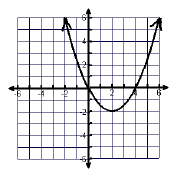
Determine the values of
a, b, and c for
the quadratic equation: 
4x2 – 8x = 3
a)
a = 4, b = -8, c = 3
b)
a = 4, b =-8, c =-3
c)
a = 4, b = 8, c = 3
d)
a = 4, b = 8, c = -3
131.
What are the zeros?
a)
x= 0 and x= -4
b)
x= 0 and x= 4
c)
y= 0
d)
x= 2
132.
Find the zeros of the equation: 
(x+10)(x-2) = 0
a)
10 and 2
b)
-2 and 10
c)
-10 and 2
d)
-2 and -10
133.

Solve the following quadratics equation by completing the square...


x2 + 4x + 1 = 0

a)

x = -2 ± √3

b)

x = -3 ± √2

c)

x = 2 ± √3

d)

x = 2 ± √2

134.

Solve the following quadratics equation by completing the square...


x2 - 6x + 2 = 0

a)

x = -3 ± √7

b)

x = 3 ± √7

c)

x = 7 ± √3

d)

x = -7 ± √3

135.

What is the vertex of the parabola?

y = 3(x + 5)2 - 4

a)
(5, -4)
b)
(-5, -4)
c)
(-15, -4)
d)
(15, -4)
136.
An object in launched directly upward at 64 feet per second (ft/s) from a platform 80 feet high. Its height is represented by the equation 
s(t) = –16t2 + 64t + 80.
What will be the object's maximum height? 
a)
2 ft
b)
80 ft
c)
144 ft
d)
64 ft
137.

A lizard is jumping across the water in search of food. The equation h = -12t2 + 6t models the lizard's height in feet above the water t seconds after he jumps. How long after jumping is he back on the water?

a)

0.1 seconds

b)

0.25 seconds

c)

0.50 seconds

d)

0.75 seconds

e)

1 second

138.

The function f(t) = -5t2+20t + 60 models the approximate height of an object t seconds after it is launched. How many seconds does it take the object to hit the ground?

a)

4 seconds

b)

-2 seconds

c)

6 seconds

d)

9 seconds

139.
If a toy rocket is launched vertically upward from ground level with an initial velocity of 128 feet per second, then its height h after t seconds is given by the equation
h(t) = -16t2 +128t  
When will the object reach its maximum height?
a)
4 ft
b)
0 seconds
c)
0 ft
d)
4 seconds
140.
If I want to find out when an object hits the ground, I should _________.
a)
Use x = (-b/2a) as my answer.
b)
Set my equation = 0 and solve.
c)
Replace x with 0 and evaluate.
d)
Find the y-coordinate of the vertex.
141.
When I want to find the maximum or minimum height of an object, I should_____.
a)
Set the equation = 0 and solve.
b)
Use x = (-b/2a) as my answer.
c)
Substitute x = 0 into the equation.
d)
Find the y-coordinate for the vertex.
142.
If I want to see the initial height of an object, I should _____________.
a)
Substitute x = 0 into the equation and evaluate.
b)
Use x = (-b /2a) as my answer.
c)
Find the y-coordinate of the vertex. 
d)
Set my equation = 0 and solve.
143.

What is the range?

a)

{5, 10, 15}

b)

{(5,2), (5,4), (10,6), (15,8)}

c)

{2, 4, 6, 8}

d)

{5, 2, 4, 10, 15}

144.

What is the domain?

a)

{0, 1, 2, 15}

b)

(0, 1, 2, 3}

c)

{3, 7, 11, 15}

d)

{3, 7, 11, 3}

145.

What is the Range of this linear function?

a)

-6 ≤ y ≤ 6

b)

0 ≤ y ≤ 6

c)

1 ≤ y ≤ 6

d)

4 ≤ y ≤ 3

146.

What is the Domain?

a)

-3 < x ≤ 3

b)

-4 ≤ x < 5

c)

-4 ≤ y ≤ 5

d)

-3 < y ≤ 3

147.
Which parent function matches the graph?
a)
f(x) = x
b)
f(x)= x2
c)
f(x) = |x|
d)
f(x) = abx
148.
Which parent function matches the graph?
a)
y = |x|
b)
y = ∛(x)
c)
y = x2
d)
y = a⋅bx
149.

What does the h term tell you in vertex form?

f(x)=xh+kf\left(x\right)=\left|x-h\right|+k

a)

left or right, the same direction as the sign

b)

left or right, opposite sign & x-value of the vertex.

c)

axis of symmetry, x-value of the vertex

150.

What does the k term tell you?

f(x)=xh+kf\left(x\right)=\left|x-h\right|+k

a)

up.

b)

down.

c)

up/down, y-value in the vertex

d)

nothing

151.

Describe the transformations below: (x+1)24\left(x+1\right)^2-4  

a)

left: 1, up: 4

b)

left: 1, down: 4

c)

right: 1, up: 4

d)

right: 4, up: 1

152.

Which function defines the graph?

a)

f(x) = |x - 4| + 3

b)

f(x) = |x - 3| + 4

c)

f(x) = |-x + 4| + 3

d)

f(x) = |x + 4| + 3

153.

Describe the translation of the function as it relates to the graph of f(x) = x2.f\left(x\right)\ =\ x^2.  

k(x)=(x+9)2k\left(x\right)=-\left(x+9\right)^2    

a)

Reflected across the x-axis, Translated left 9 units

b)

Reflected across the x-axis, Translated right 9 units

154.
What are the transformations of this functions compared to the parent function?
a)
Shifted down 2
b)
Shifted up 2
c)
Shifted left 2
d)
Shifted right 2
155.
Is this a function?
a)
Function
b)
Not a Function
156.
a)
Function
b)
Not a Function
157.
Is this table a function or not a function? 
a)
Function
b)
Not a Function
158.
Is this graph a function or not a function? 
a)
Function 
b)
Not a Function
159.
Is this graph a function or not a function? 
a)
Function
b)
Not a Function