wayground logo

Free Printable Worksheets

Font size

S
M
L
XL
Worksheets

Final Exam Review IM1 Semester 1

Total questions: 156

Worksheet time: 10hrs 57mins

Name
Class
Date
1.
-5x = 25
a)
x = 20
b)
x = -20
c)
x = -5
d)
x = 5
2.
19  + a  =  -50
a)
a = -950
b)
a =  -69
c)
a = -31
d)
a = -50/19
3.
m - 8 = -5 
a)
m = 13
b)
m = -13
c)
m = 3
d)
m = -3
4.
How would you solve this equation: 9x = 153 ? 
a)
multiply both sides by 9
b)
divide both sides by 9
c)
add 9 to both sides
d)
subtract 9 from both sides
5.
x + 12 = 20
a)
x = 32
b)
x = -32
c)
x = 8
d)
x = -8
6.
a)
x = 20
b)
x = 7
c)
x = 10
d)
x = 3
7.
Which equation has a = 5 as the solution?
a)
a + 15 = 10
b)
2a = 5
c)
2a = 10
d)
a - 15 = 10
8.
a)
k = 152
b)
k = 176
c)
k = 5
d)
k = 27
9.
144 = 12k
a)
k = 156
b)
k = 0.08333333
c)
k = 12
d)
k = 132
10.
x - 62 = 123
How should you show your work to solve the equation?
a)
Add 62 to each side. 
b)
Subtract 62 from each side.
c)
Multiply each side by 62.
d)
Add 123 to each side.
11.
9 + 3r = 10
a)
r = 2/3
b)
r = 1/3
c)
r = -1/3
d)
r = 4
12.
8 -3w = -13
a)
w = 7
b)
w = -13/5
c)
w = 13/5
d)
w = -7
13.
 -5t + 9 = 24
a)
t = -3
b)
t = 3
c)
t = 33/5
d)
t = -33/5
14.
Solve  3x - 7 = 32
a)
x= 13
b)
x= -13
c)
x= 12
d)
x= -12
15.
5(y - 3) + 2y = 27
a)
y = 3
b)
y = 42/15
c)
y = 30/7
d)
y = 6
16.
4x - 9x + 3 = -32
a)
x = -35/13
b)
x = 7
c)
x = -7
d)
x = -29/5
17.
17 = 3(x-5) + 5
a)
x = 9
b)
x = 8
c)
x = 17/3
d)
x = -9
18.
What is the first step to solve this equation:
11 - 3x = 44
a)

Add 3 to both sides

b)

Add -11 to both sides

c)

Add 11 to both sides

d)

Divide 3 on both sides.

19.
The steps in solving 5b - 6 = 24 are: 
a)
Add 6 to both sides and divide both sides by 5
b)
Add 6 to both sides and multiply both sides by 5
c)
Subtract 6 from both sides then multiply both sides by 5
d)
Subtract 6 from both sides then divide both sides by 5
20.
a)
x = 55
b)
x = 60
c)
x = 17.5
d)
x = 45
21.
Solve the inequality.
x + 5 ≤ 13
a)
x ≥ 8
b)
x ≥ 18
c)
x ≤ 8 
d)
x ≤ 18 
22.
Solve the inequality
c - 7 > 8
a)
c < 15
b)
c > 15
c)
c < - 15
d)
c >, = 15
23.
When graphing an inequality, you use an open dot when you use which symbols?
a)
<, >
b)
≤, ≥ 
24.
Will my dot be colored in?
5 ≥ x
a)
Yes
b)
No
25.
This graph represents which inequality?
a)
x > 1
b)
1 ≥ x
c)
x is greater than or equal to 1
d)
x is less than or equal to 1
26.
At least tells you to use which inequality symbol?
a)
 <
b)
 >
c)
 ≤
d)
 ≥
27.
Which represents the word sentence as an inequality?
A number n is at least 17.
a)
n < 17
b)
n > 17
c)
n ≤ 17
d)
n ≥ 17
28.
Which answer below represents the graph?
a)
x is less than or equal to -2
b)
x < -2
c)
-2 < x
d)
x is greater than -2
29.
Solve the inequality.
m - 5 > 10
a)
m is less than 15
b)
m is greater than 5
c)
m is greater than 15
d)
m is less than 5 
30.
When you graph an inequality, you used a closed dot when you use which symbols?
a)
≤, ≥ 
b)
<, >
c)
≤, <
d)
≥, >
31.
What inequality does the number line graph represent?
a)
x ≤ 4
b)
x ≥ -4
c)
x < -4
d)
x < 4
32.
What inequality does the number line graph represent?
a)
x ≥ 3
b)
x > 3
c)
x < -3
d)
x ≤ -3
33.
When graphing b< 6 would you use an open or closed circle?
a)
Open
b)
closed
c)
Both
d)
neither
34.
What inequality does the number line graph represent?
a)
x ≥ 3
b)
x > 3
c)
x < -3
d)
x ≤ 3
35.
What inequality does the number line graph represent?
a)
x > 5
b)
x < −5
c)
x ≥ 5
d)
x ≥ −5
36.
What inequality does the number line graph represent?
a)
a < 57
b)
a is less than or equal to 57
c)
a > 57
d)
a is greater than or equal to 57
37.
Greater than is which inequality symbol?
a)
<
b)
>
c)
d)
38.
Less than is which inequality symbol?
a)
b)
c)
<
d)
>
39.
Less than or equal to is represented by which inequality symbol?
a)
b)
<
c)
>
d)
40.
Greater than or equal to is represented by which inequality symbol?
a)
<
b)
c)
d)
>
41.
Which inequality represents x is no more than 13?
a)
x < 13
b)
x > 13
c)
x ≥ 13
d)
x ≤ 13
42.
Pick the correct inequality to match the number line graph.
a)
A
b)
B
c)
C
d)
D
43.
11 + 3x ≤ 17
a)
x ≤ 2
b)
x ≤ -2
c)
x ≤ 7
d)
x ≤ -7
44.
10 < 3x + 19
a)
x < 3
b)
x > 3
c)
x < -3
d)
x > -3
45.
Solve the inequality.
12 ≥ 15 - 6y
a)
y ≤ ½
b)
y ≤ 2
c)
y ≥ ½
d)
y ≥ 2
46.
Solve. 
a)
x ≤ 19
b)
x ≤ -19
c)
x ≤ 11
d)
x ≤ -11
47.
Solve.
a)
x < 6
b)
x < -6
c)
x < 22
d)
x < -22
48.
Which of these represents point-slope form of a linear equation?
a)
y - y1 = m(x - x1)
b)
Ax + By = C
c)
y = mx + b
49.
Which of these represents slope-intercept form of a linear equation?
a)
y - y1 = m(x-x1)
b)
Ax + By = C
c)
y = mx + b
50.
Find the slope of the line.
a)
-5/4
b)
5/4
c)
-4/5
d)
4/5
51.
What type of slope?
a)
zero slope
b)
undefined
c)
negative
d)
positive
52.
For the equation
y - 3 = 2(x + 4),
the line has a slope of 2 and contains what point?
a)
(-4, 3)
b)
(3, -4)
c)
(-3, -4)
d)
(-4, -3)
53.
For the equation
y + 1 = -3(x - 5),
the line contains the point (5, -1) and has a slope of?
a)
-1
b)
1
c)
-3
d)
5
54.
Write the equation in point-slope form of the line that passes through the given point and has the given slope.
(4, -7); m = -1/4
a)
y +7 = -1/4(x - 4)
b)
y - 4 = -1/4(x + 7)
c)
y+ 7 = 4(x - 4)
d)
y - 7 = -1/4(x - 4)
55.
Write the equation in point-slope form for the line that contains the points
(-2, -3), (4, 3)
a)
y - 3 = 1(x - 2)
b)
y + 3 = 1(x + 2)
c)
y -3 = -1(x + 2)
d)
y + 3 = -1(x - 2)
56.
Write the equation in point-slope form for the line that contains the points
(-2, -3), (4, 3)
a)
y - 3 = 1(x - 2)
b)
y + 3 = 1(x + 2)
c)
y -3 = -1(x + 2)
d)
y + 3 = -1(x - 2)
57.
Write the equation of the line in Point-Slope Form.
a)
y=-3/4(x-2)
b)
y-2=3/5(x-5)
c)
y=3/5x-1
d)
y-5=3/5(x-2)
58.
Which is NOT a correct point-slope equation for the line in #14?
a)
y - 0 = 1/2(x + 2)
b)
y - 1 = 1/2(x - 0)
c)
y + 2 = 1/2(x + 2) 
d)
y - 2 = 1/2(x - 2)
59.
.
a)
A
b)
B
c)
C
d)
D
60.
.
a)
A
b)
B
c)
C
d)
D
61.
.
a)
A
b)
B
c)
C
d)
D
62.
.
a)
A
b)
B
c)
C
d)
D
63.
.
a)
A
b)
B
c)
C
d)
D
64.
.
a)
A
b)
B
c)
C
d)
D
65.
.
a)
A
b)
B
c)
C
d)
D
66.

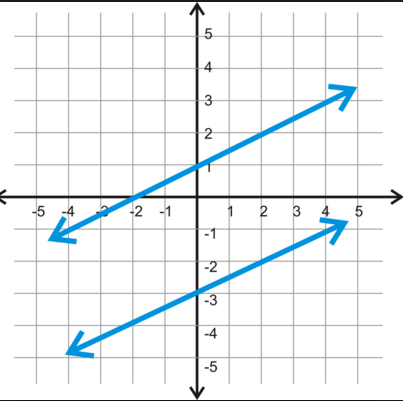
Write the slope-intercept form of the line shown in the graph.

a)

y = x − 4/5

b)

y = −4/5 x − 1

c)

y = 4/5 x − 1

d)

y = −x − 4/5

67.

Write the slope-intercept form of the equation shown in the graph.

a)

y = -1/3x - 2

b)

y = 1/3x - 2

c)

y = 3x - 2

d)

y = -3x - 2

68.

Write the slope-intercept form of the equation shown in the graph.

a)

y = 2x - 2

b)

y = -2x + 2

c)

y = -2x + 4

d)

y = 2x + 4

69.

Write the slope-intercept form of the equation shown in the graph.

a)

y = -2/3x + 4

b)

y = 2/3x + 4

c)

y = 3/2x + 4

d)

y = -3/2x + 4

70.

Find the slope and y-intercept. y=12x1y=\frac{1}{2}x-1  

a)

slope: 1/2 y-intercept: -1

b)

slope: 2 y-intercept: -1

c)

slope: 1/2x y-intercept: 1

d)

slope: 2 y-intercept: 5

71.

Find the slope of the line.

Hint: rise/run

a)

1/2

b)

-1/2

c)

2

d)

0

72.
y -intercept is where the line ______________.
a)
begins
b)
crosses the x-axis 
c)
crosses the y-axis 
d)
crosses each other
73.

When you graph a line using slope-intercept form (y=mx+b), you graph the ___________ first and then use the ___________ to find the second point.

a)

origin; slope

b)

slope; y-intercept

c)

y-intercept; x-intercept

d)

y-intercept; slope

74.

Which equation matches the graph?

a)

y = 2x

b)

y=14x+2y=\frac{1}{4}x+2

c)

y = x + 4

d)

y = 2x - 3

75.

Which of these is in slope-intercept form?

a)

m=y2y1x2x1m=\frac{y_2-y_1}{x_2-x_1}

b)

Ax + By = C

c)

y = mx + b

d)

yy1= m(xx1)y-y_1=\ m\left(x-x_1\right)

76.
Consider the equation:
y = -5x + 4
Identify the slope and y-intercept.
a)
m=4, b=x
b)
m=-5x, b=4
c)
m=5, b=4
d)
m=-5, b=4
77.

Which equation is written in STANDARD form?

a)

y=12xy=\frac{1}{2}x

b)

y = 2x + 1

c)

7x + 2y = 9

d)

2x + 3 = 6

78.

What is the y-intercept.

a)

y-intercept is -3

b)

y-intercept -2

c)

y-intercept is 3

d)

y-intercept is -1

79.

Find the slope of the line.

a)

Undefined

b)

0

c)

2

d)

-1

80.
Find the slope of the line.
a)
Undefined
b)
0
c)
1
d)
-1
81.

Write the equation for the line in slope-intercept form.

a)

y= -1x+3

b)

y= 4x+3

c)

y=14x+3y=\frac{1}{4}x+3

d)

y= -4x+3

82.

Write the equation of the line.

a)

y= -1x-3

b)

y= -3x-1

c)

y=13x1y=-\frac{1}{3}x-1

d)

y= -3x-3

83.

Which equation has a slope of -4?

a)

y=3x4y=3x-4

b)

y=14x+2y=-\frac{1}{4}x+2

c)

y=4x5y=-4x-5

d)

y=43x14y=\frac{4}{3}x-\frac{1}{4}

84.

Which equation has a y-intercept of 9?

a)

y=9x+3y=-9x+3  

b)

y=4x9y=4x-9  

c)

y=9x2y=9x-2  

d)

y=7x+9y=7x+9  

85.

Which explains how you would graph a line with the slope 23-\frac{2}{3}  ?

a)

Down 2, Right 3

b)

Up 3, Left 2

c)

Up 3, Right 2

d)

Up 2, Left 3

86.

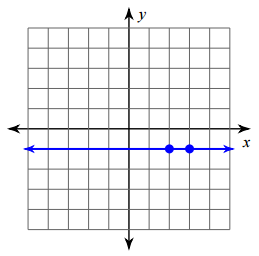
What is the equation of the red line? (horizontal)

a)

x = -3

b)

y = 3

c)

y = -3

d)

x = 3

87.

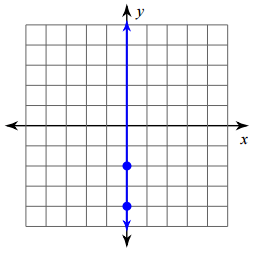
What is the equation of the red line? (vertical)

a)

x = 2

b)

y = 2

c)

y = -2

d)

x = -2

88.

Find the intercepts of the equation. 2x3y=62x-3y=-6  

a)

(0, 3) and (-2, 0)

b)

(-3, 0) and (2, 0)

c)

(3, 0) and (0, -2)

d)

(-3, 0) and (0, 2)

89.

Find the intercepts of the equation. 4xy=84x-y=8  

a)

(2, 0) and (0, -8)

b)

(-2, 0) and (0, 8)

c)

(-8, 0) and (2, 0)

d)

(8, 0) and (0, -2)

90.

Give the range of the set of ordered pairs: (2, 11), (9, -3), (7, 21), (-8, 6)

a)

{2, 9, 7, -8}

b)

{11, -3, 21, 6}

c)

-8 < x < 9

d)

-3 < y < 21

91.

Does the graph show a function?

a)

Yes

b)

No

92.

Which set of ordered pairs is not a function?

a)

(1, 3), (2, 7), (3, 8), (4, 11)

b)

(2, 3), (4, 9), (3, 8), (4, 15)

c)

(1, 2), (3, 5), (6, 9), (7, 11)

d)

(-9, 4), (-6, 3), (-2, 8), (0, 21)

93.

Which mapping diagram is not a function?

a)
b)
c)
d)
94.

Which graph is not a function?

a)
b)
c)
d)
95.

What is a function?

a)

A relation in which every domain value is only used once.

b)

A relation that maps every range value to exactly one domain value.

c)

Any set of ordered pairs.

d)

Any graph of x and y values.

96.

What is the test to determine if a graph represents a function?

a)

Horizontal line test

b)

Vertical line test

c)

Heidelberg Uncertainty Test

d)

Obi Wan Kenobi Test

97.
Does this table represent a function?
a)
Yes!
b)
No!
c)
I Don't Know
98.
Is this relation a Function?
a)
Yes
b)
No
c)
I Don't Know
99.
The table of values are shown. What is the range of the relation? From least to greatest. 
a)

{-4,-8,-3}

b)

{-3,2,6}

c)

{-8,-4,4}

d)

{6,2,-3}

100.
Is the relation a function? Why?
a)

Yes, because the x-value 11 has two y-values paired with it.

b)

Yes, because each x-value has only one y-value paired with it.

c)

No, because the x-value 11 has two y-values paired with it.

d)

No, because each x-value has only one y-value paired with it.

101.
For the function {(0,1), (1,-3), (2,-4), (-4,1)}, write the domain and range.
a)
D: {1, -3, -4,}
R: {0, 1, 2, -4}
b)
D: {-4, 0, 1, 2}
R:{-4, -3, 1}
c)
D: {0, 1, 2, 3, 4}
R:{1, -3, -4}
d)
D: {0, 1, 2, -4}
R: {1, -3, -4, 1}
102.
a)
{1, 2, 3, 4, 5}
b)
{-1, 1, 2, 3}
c)
{1, 2, 3, 5}
d)
[1, 5]
103.

Give the range of the set of ordered pairs: (2, 11), (9, -3), (7, 21), (-8, 6)

a)

{2, 9, 7, -8}

b)

{-3, 6, 11, 21}

c)

-8 < x < 9

d)

-3 < y < 21

104.

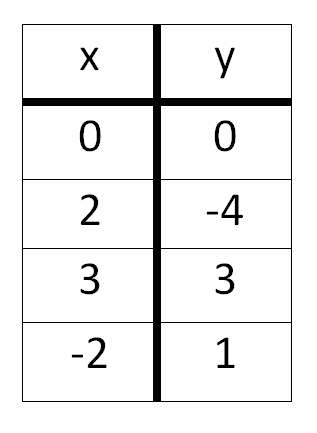
What is the range of the table?

a)

{-4, 0, 1, 3}

b)

{-2, 0, 2, 3}

c)

{-4, -2, 0, 1, 2, 3}

d)

{ (0, 0), (2, -4), (3, 3), (-2, 1) }

105.
Which point below is NOT part of the solution set?
a)
(0, 0)
b)
(5, 1)
c)
(-1, -3)
d)
(20, -5)
106.
Is (-2,4) a solution to the system?
a)
Solution
b)
Not a solution
107.
Which point is a solution?
a)
(0, 6)
b)
(-3, 4)
c)
(1, 0)
d)
(-4, 3)
108.
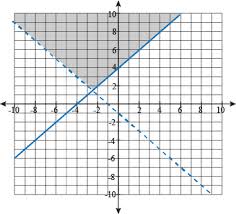
Which of the following is not a solution to this system of inequalities?
a)
(0,-1)
b)
(0,3)
c)
(4,0)
d)
(6,-2)
109.
Match the system to the graph (solution set is on the left)
a)
y ≤ 3x   and  y ≤ -2x + 4
b)
y > 3x   and  y > -2x + 4
c)
y < 3x   and  y > -2x + 3
d)
y > 3x   and  y < -2x + 4
110.
This system has an infinite number of solutions, TRUE or FALSE?
a)
TRUE
b)
FALSE
111.

Solve the system of inequalities by graphing.

a)
b)
c)
d)
112.
Select the correct graph for each inequality.
a)
A
b)
B
c)
C
d)
D
113.

Solve the system of inequalities by graphing.

a)
b)
c)
d)
114.
When graphing an inequality, you use a dotted line when you use which symbol?
a)
<, >
b)
≤, ≥ 
115.
When you graph an inequality, you used a solid line when you use which symbols?
a)
≤, ≥ 
b)
<, >
116.
Consider the function y<2x+3. Which is true?
a)
The line would be solid with shading above.
b)
The line would be dashed with shading above.
c)
The line would be solid with shading below.
d)
None of these.
117.

Rewrite this inequality in slope-intercept form.

3x - 6y > 12

a)

y > 1/2x - 2

b)

y < -1/2x + 2

c)

y < 1/2x - 2

d)

y > -3x - 2

118.

Which is the graph of the system of inequalities?

a)
b)
c)
d)
119.

Solve the system of inequalities by graphing. 8x +4y10 and 3x6y>128x\ +4y\ge10\ and\ 3x-6y>12  

a)
b)
c)
d)
120.
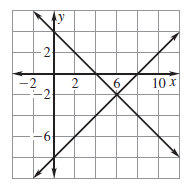
What is the solution to this system?
a)
(1, -1)
b)
(-1, 1)
c)
(0, -2)
d)
(2, 0)
121.
When you graph the exact same equation twice,
a)
you will have no solution. 
b)
you will have one solution.
c)
you will have infinite solutions. 
d)
you will graph a giraffe. 
122.
How many solutions will this system have? 
a)
No solution
b)
One Solution
c)
I Don't Know
d)
Infinitely Many Solutions
123.
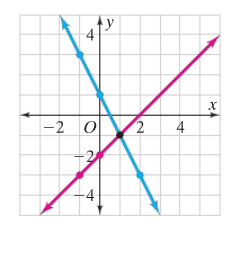
What is the solution to the system?
a)
(3, -1)
b)
(2, -6)
c)
No Solution 
d)
(6, -2)
124.
The solution to the system is
a)
(-2, -8)
b)
(-8, -2)
c)
(2, -8)
d)
No solution
125.
Solve the following system by graphing.  What is the solution?
a)
(3, -2)
b)
(3, -3)
c)
(-3, 2)
d)
(-3, -2)
126.
Solve the following system by graphing.  What is the solution?
a)
Infinity
b)
(3, 3)
c)
(3, -3)
d)
(-3, 3)
127.
What is the solution?
a)
(1, -1)
b)
(-1, 1)
c)
(0, -2)
d)
(0, 1)
128.
Solve the following system by graphing.  What is the solution?
a)
Infinite number of solutions
b)
(3, 3)
c)
(3, -3)
d)
(-3, 3)
129.
For the equation
y - 3 = 2(x + 4),
the line has a slope of 2 and contains what point?
a)
(-4, 3)
b)
(3, -4)
c)
(-3, -4)
d)
(-4, -3)
130.
Write the equation in point-slope form of the line that passes through the given point and has the given slope.
(4, -7); m = -1/4
a)
y + 7 = -1/4(x - 4)
b)
y - 4 = -1/4(x + 7)
c)
y + 7 = 4(x - 4)
d)
y - 7 = -1/4(x - 4)
131.
Write the equation in point-slope form of the line that passes through the given point and has the given slope:
 (-2, -1); m= -3
a)
y + 1 = -3(x - 2)
b)
y + 1 = -3(x + 2)
c)
y - 1 = 3(x - 1)
d)
y + 2 = -3(x + 1)
132.
Write the equation of the line in Point-Slope form that goes through the point (10,5) and has a slope of -3
a)
y - 5 = -3(x - 10)
b)
y= -3x + 35
c)
y + 5= -3(x + 10)
d)
y= -3x - 35
133.

convert to slope intercept form:

y + 9 = 3(x - 1)

a)

y = 3x + 12

b)

y = 3x - 12

c)

y = 3x - 6

d)

y = 3x + 6

134.

convert to slope intercept form:

y - 3 = 3(x - 1)

a)

y = 3x + 6

b)

y = 3x - 6

c)

y = 3x

d)

y=3x - 4

135.
Which is NOT a correct point-slope equation for the line in #14?
a)
y - 0 = 1/2(x + 2)
b)
y - 1 = 1/2(x - 0)
c)
y + 2 = 1/2(x + 2) 
d)
y - 2 = 1/2(x - 2)
136.
a)
y= 3/4 x + 3
b)
y= 1/2 x +3
c)
y= 2x+3
d)
y=2x-7
137.

Solve the inequality:

–2x > –10

a)

x > 5

b)

x < 5

c)

x > –5

d)

x < –5

138.

Solve the inequality:

3(x – 1) ≥ –9

a)

x ≥ –2

b)

x ≥ 2

c)

x ≤ –2

d)

x ≤ 2

139.

Graph the solution set of the inequality.


–4n + 1 > –23

a)
b)
c)
d)
140.

Graph the solution set of the inequality.


–4a ≤ –28

a)
b)
c)
d)
141.

Graph the solution set of the inequality.


2n + 4 < 16

a)
b)
c)
d)
142.

Solve the inequality:


10 – 2x ≥ –4

a)

x ≥ –7

b)

x ≤ 7

c)

x ≥ 7

d)

x ≤ –7

143.

Solve the inequality:


–3x + 1 ≤ 13

a)

x ≤ –4

b)

x ≥ –4

c)

x ≥ 15

d)

x ≤ 15

144.
When you graph an inequality, you used a closed dot when you use which symbols?
a)
≤, ≥ 
b)
<, >
145.
When graphing an inequality, you use an open dot when you use which symbol?
a)
<, >
b)
≤,  
146.
"At most" and "No more than" are both clue words for...
a)
<
b)
>
c)
d)
147.
- 2k > 18
a)
k is greater than 20
b)
k is less than negative 9
c)
k is greater than negative 9
d)
k is less than 36 
148.

6 + 2h > 30

a)

h < 24

b)

18 > h

c)

h > 12

d)

h < -12

149.
-4x + 14 ≤ 54
a)
x ≥ -10
b)
x ≤ -10
c)
x ≥ 10
d)
x ≤ 10
150.
Write the phrase as an expression.
twice a number x plus 8 is greater than 12
a)
2 + 8x < 12
b)
2x + 8 > 12
c)
2(x+8) ≠ 12
d)
8(2+x) 
151.
-2(x+2) < 14
a)
x < - 5
b)
x > -5
c)
x < -9
d)
x > -9
152.
What are two solutions to
x < 8?
a)
8.6, 7.9
b)
11, 16
c)
0.8, 5.9
d)
12, 7.1
153.

Does the given value make the inequality true? x + 9 > 21, when x = 15

a)

True

b)

Not True

154.
10 < 3x + 19
a)
x < 3
b)
x > 3
c)
x < -3
d)
x > -3
155.
5z - 2 - 2z < 13
a)
z > 5
b)
z < 5
c)
z > 1
d)
z < 1
156.
2x+6>12
a)
x>9
b)
x>3
c)
x<9
d)
x<3