
 Worksheets
Transformations- Franco#1
Total questions: 160
Worksheet time: 3hrs 22mins
Name
Class
Date
1.
A turn is also called a ___________.
a)
Translation
b)
Reflection
c)
Rotation
d)
Transformation
2.
Translations, reflections and rotations are all known as ________________________.
a)
Geometry
b)
Transformations
c)
Congruent
3.
Translations, reflections and rotations are all known as ________________________.
a)
Geometry
b)
Transformations
c)
Congruent
4.

Name the transformation.
a)
Translation
b)
Reflection
c)
Rotation
5.
When you translate, you ______ a number to x and y.
a)
Add or subtract
b)
Multiply or divide
c)
Add or multiply
d)
Subtract or divide
6.
Translation are always _______
a)
Congruent
b)
Bigger
c)
Smaller
d)
Rotated
7.
When you translate, (x-4,y) will move _____.
a)
4 units right
b)
4 units left
c)
4 units up
d)
4 units down
8.
When you translate, (x,y+6) will move _____.
a)
6 units right
b)
6 units left
c)
6 units up
d)
6 units down
9.
When you reflect a shape, you ______ over an axis or line.
a)
Flip
b)
Rotate
c)
Slide
d)
Expand
10.

Write a rule for the translation.
a)
(x -1, y + 2)
b)
(x -2, y + 1)
c)
(x +2, y - 1)
d)
(x +1, y - 2)
11.

Identify the transformation from ABC to A'B'C'.
a)
90o clockwise rotation
b)
90o counter clockwise rotation
c)
Reflection across the y-axis
d)
Reflection across the x-axis
12.

Identify the transformation from ABCD to A'B'C'D'.
a)
Translation
b)
Reflection across the y-axis
c)
Reflection across the x-axis
d)
90o counter clockwise Rotation
13.
Point (-5,2) is reflected over the y axis. Where is the new point located?
a)
(5,2)
b)
(-5,-2)
c)
(-5,2)
d)
(5,-2)
14.

Reflections over the x-axis change the ____-__________.
a)
y-coordinate
b)
x-coordinate
15.
The original figure prior to a transformation.
a)
Pre-image
b)
Image
16.

Is the picture being reflected in the y-axis or x-axis?
a)
y-axis
b)
x-axis
17.
A slide is also called a _________.
a)
Translation
b)
Reflection
c)
Rotation
d)
Transformation
18.

If you were to rotate ABCD 180° about the origin, what would the coordinate of A' be?
a)
(-5, 5)
b)
(-3, -5)
c)
(-5, 3)
d)
(-3, 3)
19.

How many degrees was the figure rotated?
a)
90 degrees counterclockwise
b)
180 degrees
c)
90 degrees clockwise
20.
What is a reflection?
a)
When you turn an object around a point.
b)
When you slide an object form one place to another.
c)
When you flip or mirror an object across a line.
d)
When you resize an object.
21.

Identify the transformation from C to D.
a)
90o Counter Clockwise Rotation
b)
180o Rotation
c)
270o Counter clockwise Rotation
d)
360o Rotation
22.

Identify the transformation from ABC to A'B'C'.
a)
Reflection across the x-axis
b)
Reflection across the y-axis
c)
90o clockwise rotation
d)
90o counterclockwise rotation
23.

Which rule would dilate shows a scale factor of 4
a)
(x, y) → (y, x)
b)
(x, y) → (x + 4, y + 4)
c)
(x, y) → (x, -y)
d)
(x, y) → (4x, 4y)
24.

Identify the transformation from ABC to A'B'C'.
a)
(x+8, y+4)
b)
(x-8, y-4)
c)
(x+4, y+8)
d)
(x-4, y-8)
25.
True or False : When you transform a figure, it is congruent to the original figure.
a)
True
b)
False
26.
Which of the following is an acceptable explanation why transformed figures are congruent to the original figures.
a)
The figures are actually NOT congruent.
b)
It depends on whether you translated, rotated, or reflected.
c)
Side lengths and angles measures stay the same when transformed.
d)
The figures look the same.
27.
Rotating a pre-image _____degrees will place it back to its original position.
a)
180
b)
90
c)
270
d)
360
28.
Congruent geometric figures have the:
a)
Same size
b)
Sides Equal
c)
Same Size and Same Shape
d)
Angles Equal
29.

Does the transformation shown preserve congruence and/or orientation?
a)
Congruence yes, Orientation yes
b)
Congruence No, Orientation No
c)
Congruence No, Orientation yes
d)
Congruence Yes, Orientation No
30.
Shapes that are identical in size, shape and measure are...
a)
Congruent
b)
Image
c)
Angles
d)
Vertices
31.

What is the sequence of transformations for the image given?
a)
Reflect over the x-axis, translate (x+8,y)
b)
Reflect over the x-axis then translate (x+6, y)
c)
Reflect over the y-axis then (x+1, y+1)
d)
Translate down 4 (y-4) and to the right 5 (x+5)
32.
Which of the following are congruence transformations?
a)
Rotations
b)
Translations
c)
Reflections
d)
All Three
33.

Describe the Translation
a)
Translation
b)
Reflection
c)
Rotation
34.
Translations, reflections and rotations are all known as ________________________.
a)
Geometry
b)
Objects
c)
Images
d)
Congruent transformations
35.

What is the sequence of transformations?
a)
Reflect over the y then reflect over the x
b)
Reflect over the x then reflect over the y
c)
Translate 4 units then rotate 90˚
d)
Rotate 90˚ then reflect over the x
36.

The figure is an example of which transformation?
a)
Composition
b)
Reflection
c)
Translation
d)
Dilation
37.
Which transformation(s) maintain congruency but not orientation?
a)
Translation
b)
Translation & Reflection
c)
Rotation
d)
Reflection & Rotation
38.
Which transformation is not a rigid transformation?
a)
Translation
b)
Reflection
c)
Rotation
d)
Dilation
39.
Which transformation changes the orientation of the shape?
a)
Translation
b)
Reflection
c)
Rotation
d)
Dilation
40.
A dilation with a scale factor of 1/3 is a reduction.
a)
True
b)
False
41.
A dilation with a scale factor of 2 is a reduction.
a)
True
b)
False
42.
(x, y) -------> (-x, -y) is a rotation of 180 degrees.
a)
True
b)
False
43.
(x, y) -------> (x, y - 2) is a translation of 2 units up.
a)
True
b)
False
44.
(x, y) -------> (x - 3, y) is a translation of 3 units to the left.
a)
True
b)
False
45.
(x, y) -------> (x, -y) is a reflection over the x axis.
a)
True
b)
False
46.
Identify the transformation from ABC to A'B'C'.
a)
90o clockwise rotation
b)
90o counter clockwise rotation
c)
Reflection across the y-axis
d)
Reflection across the x-axis
47.

Solve for x.
a)
5
b)
12
c)
-7
d)
-6
48.
In a triangle, how many total degrees are there?
a)
100%
b)
180 degrees
c)
it varies
d)
360 degrees
49.
If 2 of the angles of a triangle are 30 and 70 degrees, the third angle measures...
a)
80
b)
100
c)
60
d)
90
50.

Find the missing angle.
a)
29°
b)
39°
c)
49°
d)
59°
51.

Find the measure of angle D.
a)
140 degrees
b)
16 degrees
c)
40 degrees
d)
90 degrees
52.

Find the measure of the indicated angle.
a)
95
b)
85
c)
35
d)
45
53.

Find the measure of the indicated angle.
a)
26
b)
36
c)
85
d)
144
54.

What is the measure of the unlabeled angle of the triangle?
a)
90*
b)
82*
c)
98*
d)
75*
55.
In an equilateral triangle, all angles are equal. How many degrees in each?
a)
180
b)
60
c)
50
d)
90
56.

Find the measure of the missing angle.
a)
90o
b)
100
c)
130o
d)
50o
57.

Find the measure of the missing angle.
a)
8o
b)
58o
c)
122o
d)
64o
58.

Find the measure of the missing angle.
a)
30o
b)
110o
c)
150o
d)
40o
59.
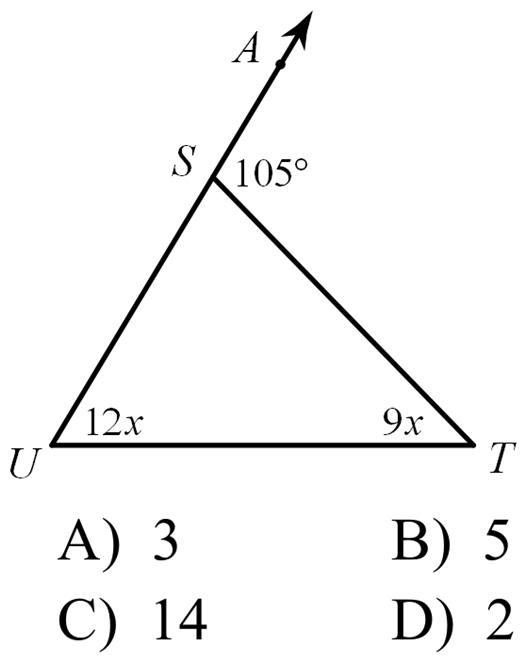
Find the value of x by using the exterior angle theorem.
a)
A
b)
B
c)
C
d)
D
60.

Find the measure of the indicated angle.
a)
34
b)
46
c)
62
d)
36
61.

Solve for x.
a)
-11
b)
9
c)
-9
d)
10
62.

Find the measure of angle A.
a)
132 degrees
b)
111 degrees
c)
28 degrees
d)
22 degrees
63.

Find the measure of the indicated angle.
a)
40
b)
108
c)
72
d)
68
64.

Find the measure of the indicated angle.
a)
35
b)
145
c)
78
d)
67
65.

What type of angle is shown?
a)
acute
b)
obtuse
c)
right
d)
straight
66.

What type of angle is shown?
a)
acute
b)
obtuse
c)
right
d)
straight
67.
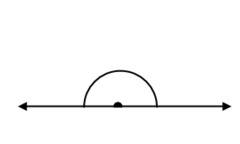
What type of angle is shown?
a)
acute
b)
obtuse
c)
right
d)
straight
68.

What type of angle is shown?
a)
acute
b)
obtuse
c)
right
d)
straight
69.

The angle relationship shown is -
a)
complementary angles
b)
supplementary angles
c)
vertical angles
d)
angle bisector
70.

∠1 and ∠3 can best be described as -
a)
complementary angles
b)
supplementary angles
c)
vertical angles
d)
adjacent angles
71.

∠AOB and ∠COB can best be described as -
a)
complementary angles
b)
supplementary angles
c)
vertical angles
d)
adjacent angles
72.

The angle relationship shown is -
a)
complementary angles
b)
supplementary angles
c)
vertical angles
d)
adjacent angles
73.

If m∠1 = 30°, then m∠3 =
a)
30°
b)
60°
c)
150°
d)
undetermined
74.
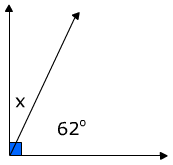
Find the value of x.
a)
18°
b)
28°
c)
38°
d)
118°
75.

Find the value of x.
a)
38°
b)
52°
c)
142°
d)
152°
76.

1. Find ∠ AOC
a)
130
b)
50
c)
40
77.

2. Find X
a)
9
b)
27
c)
45
78.

2. FIND ∠SOR
a)
45
b)
135
c)
90
d)
180
79.

3. Find X
a)
59
b)
31
c)
177
80.
Angles whose measure sum up to 180 degrees.
a)
Vertical
b)
Adjacent
c)
Complementary
d)
Supplementary
81.
An angle whose measure is exactly 90 degrees.
a)
acute
b)
vertical
c)
right
d)
straight
82.
How many degrees is a straight angle?
a)
90
b)
360
c)
180
d)
145
83.

This is what kind of angle?
a)
acute
b)
obtuse
c)
right
d)
straight
84.

This is what kind of angle?
a)
right
b)
acute
c)
obtuse
d)
straight
85.

This is what kind of angle?
a)
obtuse
b)
right
c)
straight
d)
acute
86.
Angles are measured using a ______.
a)
compass
b)
protractor
c)
ruler
d)
prospector
87.

complementary, supplementary, or neither?
a)
Complementary
b)
Supplementary
c)
Neither
88.

complementary, supplementary, or neither?
a)
Complementary
b)
Supplementary
c)
Neither
89.

.
.
.
What is the name of this ray?
.
.
What is the name of this ray?
a)
Ray AB
b)
Ray BA
c)
Ray ABC
d)
Ray AC
90.

What angle pair is pictured?
a)
Alternate Interior Angles
b)
Supplementary Angles
c)
Vertical Angles
d)
Corresponding Angles
91.
Complementary angles measures _____ degrees.
a)
45
b)
180
c)
90
d)
30
92.

Find the missing angle.
a)
60
b)
70
c)
50
d)
140
93.

Identify the type of angle shown.
a)
Complementary
b)
Supplementary
94.
Write 7.113 x 10⁷ in standard form.
a)
71,130,00
b)
7,113,000
c)
0.0000007113
d)
7,113
95.
Write 0.00000707 in scientific notation.
a)
7.07 x 10⁻⁶
b)
7.07 x 10⁶
c)
707 x 108
d)
707 x 10-8
96.
Write 2.08 x 10² in standard form.
a)
208
b)
0.0208
c)
20,800
d)
0.208
97.
Write 7.8 x 10⁻³ in standard form.
a)
0.0078
b)
7,800
c)
78
d)
0.078
98.
Write 8.73 x 10⁻⁴ in standard form.
a)
0.000873
b)
0.0873
c)
87,300
d)
8,730
99.
Write 6,700 in scientific notation.
a)
6.7 x 10³
b)
6.7 x10⁻³
c)
67 x 102
d)
67 x 10-2
100.
Write 52,300,000 in scientific notation.
a)
5.23 x 10⁷
b)
5.23 x 10⁻⁷
c)
52.3 x 10⁶
d)
52.3 x 10⁻⁶
101.
Write 0.037 in scientific notation.
a)
3.7 x 10⁻²
b)
3.7 x 10²
c)
37 x 10-3
d)
37 x 103
102.
Arrange the numbers from least to greatest:
216,000,000 ; 2.2 x 10³ ; 3.1 x 10⁷ ; 310,000
216,000,000 ; 2.2 x 10³ ; 3.1 x 10⁷ ; 310,000
a)
2.2 x 10³ ; 310,000; 3.1 x 10⁷ ; 216,000,000
b)
310,000 ; 2.2 x 10³ ; 3.1 x 10⁷; 216,000,000
c)
3.1 x 10⁷ ; 310,000; 2.2 x 10³; 216,000,000
d)
2.2 x 10³ ; 3.1 x 10⁷ ; 310,000 ; 216,000,000
103.

The table shows the mass in grams of one atom of each of several elements. List the elements in order from the least mass to greatest mass per atom.
a)
hydrogen, carbon, oxygen, silver, gold
b)
hydrogen, oxygen, gold, siver, carbon
c)
carbon, oxygen, silver, gold, hydrogen
d)
gold, oxygen, carbon, silver, hydrogen
104.
The rule of scientific notation is to write all exponents with a base of ____.
a)
50
b)
5
c)
100
d)
10
105.
When writing a number in scientific notation, the first number must be greater than 1, but less than 10.
a)
False
b)
True
106.
Scientific Notation is made up of two number parts. The second part is a power of base 10.
a)
True
b)
False
107.
Scientific Notation is made up of two number parts. The first part should be a number between 1 and 100.
a)
True
b)
False
108.
How would you write -5.6 x 10⁻³ in standard form?
a)
0.0056
b)
-5,600
c)
0.00056
d)
-0.0056
109.
How would you write 0.0005 in scientific notation?
a)
50 x 105
b)
5 x 10⁴
c)
5 x 10³
d)
.5 x 103
110.
How would you write 4.3756 x 10⁴ in standard form?
a)
437,560,000
b)
0.00043756
c)
43,756
d)
4,3756
111.
Express the following in standard notation:
8.025 x 10⁻⁸
8.025 x 10⁻⁸
a)
.00000008025
b)
.000000008025
c)
802,500,000,000
d)
80,250,000,000
112.
Express the following in standard notation:
8.025 x 10⁻⁸
8.025 x 10⁻⁸
a)
.00000008025
b)
.000000008025
c)
802,500,000,000
d)
80,250,000,000
113.
Express the following in scientific notation:
.000045
.000045
a)
4.5 x 10⁻⁵
b)
45 x 10-6
c)
4.5 x10⁵
d)
45 x 106
114.
Convert to standard notation:
2.4 x 10⁻³
2.4 x 10⁻³
a)
2400
b)
0.24
c)
0.024
d)
0.0024
115.
Convert to scientific notation:
520,000,000
520,000,000
a)
52 x 107
b)
5.2 x 10⁷
c)
5.2 x 10⁸
d)
0.52 x 10⁹
116.
What is scientific notation?
a)
A long way to write really short numbers
b)
A short way to write really long numbers
c)
I don't know...
d)
None of the above
117.
Which of the following is correct scientific notation?
a)
20.35 x 10⁴
b)
.2035 x 104
c)
2035 4
d)
2.035 x10⁴
118.
UNDERSTANDING
If the exponent is a positive number...
If the exponent is a positive number...
a)
you will get a large number
b)
you will get a smaller number
119.
UNDERSTANDING
If the exponent is a negative number...
If the exponent is a negative number...
a)
you will get a large number
b)
you will get a small number
120.
How many zeros would be in this number if written in standard form?
6.47 x 10¹¹
6.47 x 10¹¹
a)
11
b)
9
c)
10
d)
12
121.
(2.9 x 10⁻⁹) - (1.7 x 10⁻⁹)
a)
1.2 x 10⁻¹⁸
b)
1.2 x 10⁻⁹
c)
4.6 x 10⁻⁹
d)
1.335 x 10⁻⁴
122.
Write the answer in scientific notation.
5 x 10⁸ - 3.4 x 108 =
5 x 10⁸ - 3.4 x 108 =
a)
2.4 x 10⁸
b)
2.4 x 100
c)
1.6 x 100
d)
1.6 x 10⁸
123.
Write the answer in scientific notation.
4.1 x 10⁶ + 5.5 x 106 =
4.1 x 10⁶ + 5.5 x 106 =
a)
5.91 x 10⁶
b)
9.6 x 10⁶
c)
9.6 x 10¹¹
d)
4.65 x 10⁵
124.
Write the answer in scientific notation.
4.1 x 10⁶ + 5.5 x 106 =
4.1 x 10⁶ + 5.5 x 106 =
a)
5.91 x 10⁶
b)
9.6 x 10⁶
c)
9.6 x 10¹¹
d)
4.65 x 10⁵
125.
(2.3 x 10²)+(4.1 x 10²)=
a)
6.4 x 10⁴
b)
6.4 x 10²
c)
6.4 x 100
d)
.64 x 101
126.
Write the answer in scientific notation.
5 x 10⁸ - 3.4 x 108 =
5 x 10⁸ - 3.4 x 108 =
a)
2.4 x 10⁸
b)
2.4 x 100
c)
1.6 x 100
d)
1.6 x 10⁸
127.
Write the answer in scientific notation.
9.9 x 10⁸ - 3.4 x 108 =
9.9 x 10⁸ - 3.4 x 108 =
a)
2.4 x 10⁸
b)
2.4 x 100
c)
1.6 x 100
d)
6.5 x 10⁸
128.
(8 x 10-23) - (2 x 10-25)
a)
7.98 x 10⁻²³
b)
6 x 10-23
c)
6 x 10-25
d)
7.98 x 10⁻²⁵
129.
Solve:
(8.0 x 10¹³) - (7.5 x 10¹²)
(8.0 x 10¹³) - (7.5 x 10¹²)
a)
1.55 x 10¹³
b)
0.5 x 100
c)
5.0 x 10¹¹
d)
5.0 x 10¹³
130.
Add using scientific notation.
(5.2 x 10⁷) + (3.01 x 10⁴)
(5.2 x 10⁷) + (3.01 x 10⁴)
a)
5.20301 x 10¹¹
b)
.520301 x 10⁷
c)
5.20301 x 10⁷
d)
5.20301 x 10⁸
131.
Write the answer in scientific notation.
7.3 x 10⁵ + 3.7 x 105 =
7.3 x 10⁵ + 3.7 x 105 =
a)
11.0 x 10⁵
b)
1.1 x 10¹⁰
c)
1.10 x 10¹¹
d)
1.1 x 10 6
132.
(7.7 x 10²) + (3.1 x 10²)=
a)
8.8 x 10⁴
b)
10.8 x 10²
c)
1.08 x 10³
d)
6.6 x 10²
133.
Write the answer in scientific notation.
9.9 x 10⁸ - 3.4 x 108 =
9.9 x 10⁸ - 3.4 x 108 =
a)
2.4 x 10⁸
b)
2.4 x 100
c)
1.6 x 100
d)
6.5 x 10⁸
134.
Write the answer in scientific notation.
5 x 10⁸ - 3.4 x 108 =
5 x 10⁸ - 3.4 x 108 =
a)
2.4 x 10⁸
b)
2.4 x 100
c)
1.6 x 100
d)
1.6 x 10⁸
135.

What is the simplified version of
a)
3.9 x 10⁶
b)
4 x 10²⁰
c)
4 x 10⁶
d)
3.9 x 10²⁰
136.
A microgram is equal to 1 x 10 -6 grams. How many times greater than a microgram is 1 x 10² grams?
a)
1 x 10⁻⁸
b)
1 x 10⁻⁴
c)
1 x 10⁴
d)
1 x 10⁸
137.
Multiply:
(9.4 x 10⁶)(3.2 x 10⁵)
(9.4 x 10⁶)(3.2 x 10⁵)
a)
30.08 x 10¹¹
b)
3.8 x 101
c)
3.008 x 10¹²
d)
2.9375 x 101
138.
(2.5 x 10⁴) (4 x 10³)
a)
1.0 x 10⁷
b)
1.0 x 10⁸
c)
10 x 107
d)
1.0 x 10⁶
139.
Solve:
(6 x 10⁶) / (2 x 10³)
(6 x 10⁶) / (2 x 10³)
a)
12 x 103
b)
3 x 10⁹
c)
1.2 x 10⁴
d)
3 x 10³
140.
What is it called when you go from this form to this next form?
0.0088 to 8.8 x 10³
0.0088 to 8.8 x 10³
a)
Standard form to scientific notation
b)
Scientific notation to regular form
c)
Scientific notation to standard form
d)
Standard form to regular form
141.
ANY number raised to a power of 0 will be....
a)
10
b)
itself
c)
1
d)
0
142.
When multiplying numbers in scientific notation, what do you do to the leading numbers?
For example:
(4×10⁵)(3×10⁻²)
For example:
(4×10⁵)(3×10⁻²)
a)
Keep them the same
b)
Divide them
c)
Add them
d)
Multiply them
143.
Solve:
(2.1×102) × (3.0×104)
(2.1×102) × (3.0×104)
a)
5.1 x 10²
b)
6.3 x 10⁶
c)
5.1 x 10⁶
d)
6.3 x 10⁸
144.
Solve:
(6 x 10⁶) / (2 x 10³)
(6 x 10⁶) / (2 x 10³)
a)
12 x 103
b)
3 x 10⁹
c)
1.2 x 10⁴
d)
3 x 10³
145.
Solve:
(9 x 10⁻⁶) divided by (3 x 10⁻³)
(9 x 10⁻⁶) divided by (3 x 10⁻³)
a)
27 x 10-9
b)
3 x 10⁻³
c)
3 x 10⁻⁹
d)
27 x 10-3
146.
Solve:
(2.1×102) × (3.0×104)
(2.1×102) × (3.0×104)
a)
5.1 x 10²
b)
6.3 x 10⁶
c)
5.1 x 10⁶
d)
6.3 x 10⁸
147.
Solve:
(6 x 10⁶) / (2 x 10³)
(6 x 10⁶) / (2 x 10³)
a)
12 x 103
b)
3 x 10⁹
c)
1.2 x 10⁴
d)
3 x 10³
148.
Solve:
-4x = 24
-4x = 24
a)
20
b)
-20
c)
6
d)
-6
149.
Solve:
3x + 7 = -8
3x + 7 = -8
a)
5
b)
-5
c)
-12
d)
-18
150.
Solve:
7x - 3x - 8 = 24
7x - 3x - 8 = 24
a)
8
b)
-8
c)
3.2
d)
4
151.
Solve:
-8 + 5x - 2 = 20
-8 + 5x - 2 = 20
a)
6
b)
-6
c)
2
d)
-2
152.
Solve:
3(x - 2) = 18
3(x - 2) = 18
a)
6.7
b)
4
c)
8
d)
-4
153.
Solve:
6(5x - 3) + 2 = 14
6(5x - 3) + 2 = 14
a)
2
b)
.5
c)
-1
d)
1
154.
Solve:
7x + 19 = -2x + 55
7x + 19 = -2x + 55
a)
4
b)
14.8
c)
8.2
d)
-4
155.
Solve:
32 - 7x = -6(x + 3)
32 - 7x = -6(x + 3)
a)
50
b)
3
c)
-3
d)
-50
156.
Solve. -4n = 22
a)
-5.2
b)
-5.5
c)
-2/11
d)
2/11
157.
What is the first step (after setting up your workspace) to complete when solving this equation?
10 - 3y = 4
10 - 3y = 4
a)
Add 10
b)
Subtract 10
c)
Add 3
d)
Divide by -3
158.
Translate:
Five more than a number
Five more than a number
a)
x + 5
b)
5x
c)
5 - x
d)
5 divided by x
159.
Translate:
Twelve less than a number
Twelve less than a number
a)
12 - x
b)
x - 12
c)
12x
d)
x + 12
160.
Translate:
Four times a number plus six IS 30.
Four times a number plus six IS 30.
a)
4 + 6 = 30
b)
4x + 6 = 30
c)
x + 4 times 6 = 30
d)
30 = 4x
100 %

