
 Worksheets
Science End of Year Review
Total questions: 148
Worksheet time: 3hrs 37mins
Light
bright wave lengths that can move through solid objects
a form of energy that can travel through space and be seen by the human eye
a form of energy that can move through objects
a form of energy that cannot be seen by the human eye
transparent
a parent of light
not completely clear, but clear enough to let rays of light to pass through
not able to be seen through
clear enough to be seen though
opaque
a parent of light
not completely clear, but clear enough to let rays of light to pass through
not able to be seen through
clear enough to be seen though
translucent
a parent of light
not completely clear, but clear enough to let rays of light to pass through
not able to be seen through
clear enough to be seen though
desk
translucent
opaque
transparent
light
hand lens
translucent
opaque
transparent
light
wax paper
translucent
opaque
transparent
light
plastic bag
translucent
opaque
transparent
light
tinted windshield
translucent
opaque
transparent
light
dog
translucent
opaque
transparent
light
A student notices the lights are covered. He wonders if these covers affect the light in any way, and decides to try to figure out if they are transparent or translucent.
Which of question should they ask?
they can try turning off the lights.
they can research on the internet to find out.
The student can interview the person that installed the lights.
the student can take the cover off of the light and shine a light on both sides to see if they can see the light through it.
Which material would allow ALL light through?
cardboard
clothes
glass
metal
Which correctly represents reflection?


When would you be most likely to see your reflection?
heating up metal
enlarging the size of an object with a magnifying glass
measuring the shadows created by the sun
looking at yourself in STILL water
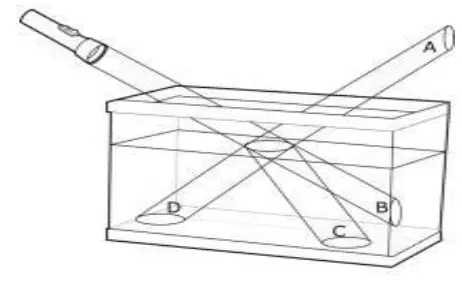
Which beam shows the refracted light from the flashlight?
A
B
C
D
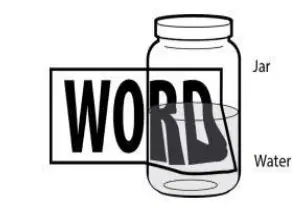
The light rays in the picture are
bent
reflected
absorbed
not reflected.
Sound travels fastest in...
solids
liquids
gases
air

A place where no sound exists is...
in the air
under water
space
all of the above
Which of these is NOT a medium?
light
air
wood
metal
Which sentence BEST describes how sound moves?
Sound can move through solids, liquids, or gases.
Sound can move through empty space or through matter.
Sound can move through solids and liquids but not through gases.
Sound can move through liquids and gases but not through solids.
How can I produce a sound?
heating an object
hitting an object
moving the mouth
looking an object
When people speak their ________ vibrate.
ear drums
vocal chords
ears
tongue

Sarah and Maria made a telephone using two cans and a string. It was a very long string. Maria went upstairs in her house and Sarah stayed downstairs. Maria spoke softly into the can. "I can hear you!' Sarah said back. How can this happen?
Sound waves travel through a vacuum.
Sound waves travel from high to low.
Sound waves travel through solids like the string.
Maria talked so loudly that Sarah could hear her without the phone.
Will a homemade telephone made of two cans and a string work better with a tightly-woven string or a loosely-woven string?
a tightly woven string because it will not come apart as easily
a loosely woven string because the sound waves have more room to move
a tightly woven string because sound waves travel best through dense materials
a loosely woven string because sound waves travel best through less dense materials
Sound travels faster in objects that have a greater.....
Mass
Density
Volume
Yards

A severe thunderstorm with a possible tornado is approaching your town. The mayor needs to decide whether the citizens need to take shelter.
Which TWO weather instruments will aid the mayor in making this decision?
A and C
A and D
A and B
B and C
The news is explaining how the temperature outside will be 90°F this week. Which instrument can students use to confirm the temperature and why?
The thermometer because it measures the air temperature outside.
An anemometer because it measures outside air temperature and it measures air pressure
The thermometer because it measures the temperature and measures wind speeds outside.
An anemometer because it measures the direction of the wind bringing in the air temperatures.

Use the information and chart to answer the following question.
Students are using weather instruments to predict if we are going to have a snow day due to a blizzard.
Which TWO instruments will the students use to predict a snowy day and why?
a barometer to tell if the air pressure is low; a thermometer to check if the temperature is near freezing
a rain gauge to measure the precipitation; a weather vane to tell wind speed
a barometer to tell if the temperature is near freezing; a wind vane to tell wind speed
an anemometer for wind speed of the storm; a barometer to tell if the temperature is near freezing
Students in a fourth-grade class want to observe what happens before any type of weather changes. Which instrument should the students use and why?
An anemometer shows the precipitation change that usually indicates a change in weather.
An anemometer shows the pressure change that usually indicates a change in weather
A barometer shows the precipitation change that usually indicates a change in weather
A barometer shows the pressure change that usually indicates a change in weather.

If cold dry air is moving into warm, moist air, what kind of front would be approaching, and what weather might occur?
A warm front that brings an all day of rain with low clouds.
A cold front that brings thunderstorms followed by clear skies.
A low-pressure front brings clear skies and no clouds.
A high-pressure front that brings stormy weather and low clouds.

Based on the weather map, what can you conclude about the weather and how people should dress in the Northwest near Seattle?
People should wear coats, hats, and gloves; the forecast is for snow.
People should wear tank tops and flip-flops; the forecast is for a heatwave.
People should wear long sleeves and pants; the forecast is for clear, mild weather.
People should wear rain gear and rainboots; the forecast is for rainy, cold weather.

Based on the weather map, which can you conclude about the weather and how people should dress in the Southeast near Miami?
People should wear coats, hats, and gloves; the forecast is for snow.
People should wear tank tops and flip-flops; the forecast is for a heatwave.
People should wear long sleeves and pants; the forecast is for clear, mild weather.
People should wear rain gear and rain boots; the forecast is for rainy, cold weather.
Students are boiling water to show how temperature affects water. Which of the following temperatures will students observe steam evaporating from the water?
214°F
104°F
55°F
30°F
Use the scenario to answer the following question.
A student wants to draw the impact of the water cycle. Water is a clear, colorless, tasteless, and odorless liquid that makes up seas, lakes, rivers, and rain. It is one of the most common substances on Earth and covers 70% of its surface. Water from a pond in Georgia can end up watering a forest around the world in China.
How can a drop of water from Georgia end up watering a forest in China?
The water cycle is limited to one area. The water will evaporate towards China.
The water cycle is limited to one area. The water will evaporate, condense in the clouds and rain in the same area.
The water cycle is not limited to one area. The water will be pushed by winds when it becomes clouds.
Sam notices the sky has a few clouds. Which question will his friends ask him to determine if it is a cumulus cloud?
Are the clouds dark gray?
Are the clouds high in the sky?
Are the clouds large and look like cotton balls?
Are the clouds small and look like a thin ribbon?
The weatherman identifies stratus clouds in the sky. Which question can students ask the weatherman to determine the day’s weather forecast?
Will it be hot and dry outside?
Will it be cold and dry outside?
Is there a chance of light snow?
Is there a chance of heavy rain?
Which of the following BEST describes the difference between weather and climate?
Weather is what is happening right now outside. Climate is what is predicted to happen next week.
Climate data can be used to predict what you should wear next month. Weather data can be used to predict what you should wear tomorrow.
The climate of an area depends on the type of weather recorded over several years. Weather depends on what is happening outside right now.
Weather is predicted using temperature. The temperature of an area is not used to describe the climate.
Which of the following will help to learn about the climate in a certain area?
A chart that shows the average temperatures and rain amounts for several years.
A forecast that predicts the amount of snow expected in the next month.
A chart that shows the cloud types recorded over the past week.
A forecast that predicts the rain amounts for the next 10 days.
Which of the following BEST describes the weather conditions in a certain area?
Florida has a rainy season from May to October.
California deserts are scorching hot during the day.
Georgia has a warm front approaching in two days.
New York has cold temperatures in the winter months.
A fourth-grade student is confused about how climate is different from the weather. Which explanation BEST describes the difference?
Climate and temperature are very similar, the only difference is that climate changes daily.
Climate and temperature are different since climate describes the weather patterns year after year.
Climate and temperature are different since weather describes the weather patterns year after year.
Climate and temperature are very similar, the only difference is that temperature shows trends in data.

A severe thunderstorm with a chance of flooding is approaching Gwinnett County. The mayor needs to decide whether the citizens need to relocate to higher elevations.
Which weather instrument will aid the mayor in making this decision?
Instrument A
Instrument B
Instrument C
Instrument D

What type of front is shown on the weather map?
cold front
warm front
occluded front
stationary front
David and his friend Delia arrive at the playground. David and his friend are so much alike. They are the same age, the same height, and they even weigh the same. They can't wait to play on the new seesaw at the playground. David hops onto one side and Delia hops onto the other.
What will most likely happen to David and Delia on the seesaw?
David and Delia will not move because their forces are balanced.
David and Delia will not move because their forces are unbalanced.
David will move up, and Delia will move down because their forces are unbalanced.
David will move down, and Delia will move up because their forces are unbalanced.
A fourth grade class with 24 students is playing tug of war with a rope against their teacher. Which of the following BEST describes the expected outcome?
The 24 students and the teacher will result in a tie since their forces are balanced.
The results cannot be unpredicted since balanced and unbalanced forces are random.
The teacher will win since the forces are balanced because the teacher will have more force pulling than all 24 students.
The 24 students will win since the forces are unbalanced because they will have more force pulling on their side compared to the one teacher.
. Students want to investigate how a marble can demonstrate a balanced force. Which situation below would BEST demonstrate a balanced force?
Student 1 sets up a ramp with a book and rolls a marble down the book.
Student 2 pushes a marble along a smooth surface, and the marble rolls along the surface.
Student 3 blows on a marble with a straw, but the marble does not move.
Student 4 pushes a marble across carpet, and the marble slowly moves along the surface.
Students were asked to show balanced and unbalanced forces in the classroom. Some of their investigations are below.
Investigation 1:Students pushed on the heavy art cabinet and neither the student nor the wall moved.
Investigation 2: Students pushed pencils across the desk.
Investigation 3: Students pulled on a ruler and neither of the students moved.
Investigation 4: Students pull on a chair and it slides on the floor.
Which of the following BEST explains the results of the investigation?
Investigations 1 and 3 demonstrate balanced forces since there was no movement, whereas investigations 2 and 4 demonstrate unbalanced forces since students caused objects to move.
Investigations 1 and 3 demonstrate unbalanced forces since there was no movement, whereas investigations 2 and 4 demonstrate balanced forces since students caused objects to move.
All the investigations demonstrate balanced forces since there were students and objects involved in each investigation.
All the investigations demonstrate unbalanced forces since all of the investigations involved moving objects.
A fourth grade student wants to investigate how friction affects the motion of a ball rolling on different surfaces after rolling down a ramp.
Carpet: The ball rolls 14 inches.
Tile : The ball rolls 22 inches
Which of the following best explains the results of the investigation?
The ball rolling on the tile shows an unbalanced force since there was less friction than when the ball rolled on the carpet.
The ball rolling on the carpet shows an unbalanced force since there was less friction than when the ball rolled on the tile.
The ball rolling on the tile shows a balanced force since there was less friction than when the ball rolled on the carpet.
The ball rolling on the carpet shows a balanced force since there was less friction than when the ball rolled on the tile.
A student is trying to move boxes of books. All of the books are the same size and weight. One box has 2 books and another box has 10 books. What evidence could you use to support the claim that you need more force to move the box with 10 books?
It will take more force because all of the books are the same size.
It will take more force because all of the books weigh the same.
It will take more force because the box with 10 books weighs less.
It will take more force because the box with 10 books weighs more.
4. A student claims that whenever they kick a soccer ball in the air, the force of gravity impacts the soccer ball. Which piece of evidence would support the student’s claim.
The soccer ball moves at a quick speed the moment the student kicks the soccer ball.
The soccer ball slows down and falls towards the ground.
The soccer ball goes up towards the sky when kicked.
The soccer ball is caught by the goalie.
. Max must help his brother move their new stove into the house. He must help unload the stove from the truck, put it on a moving cart, prop open the front door of the house and unload the stove in the kitchen.
Materials Max Has:
Inclined Plane
Wheel and Axle
Wedge
From the list above, which question should Max ask to figure out that he should use the wheel and axle to move the stove from the truck?
Will I need to elevate the stove from the sidewalk into the front door?
Will I need to constantly keep the door open without shutting?
Will I need to roll the stove from the truck to the front door?
Will I need to elevate the stove to bring it inside the house?
Students in a classroom are investigating simple machines found around the school and playground. A student claims that a seesaw is a lever.
What question could a friend ask to determine this claim is correct?
Is a seesaw supported by a fulcrum to lift up a student?
How does a wedge on a seesaw stay in place to lift up a student?
Does a seesaw lift and lower a student through a rope and wheel system?
Will a seesaw lift up a student by rotating with a wheel rotating around a rod?
6. A teacher is moving classrooms across the school and wants to make the move as easy as possible. Which of the following questions should the teacher ask to determine the best simple machine to use for the move?
Should the teacher use an inclined plane to push all of the classroom objects from one place to another?
Should the teacher use a wheel and axle to move the classroom objects from one place to another?
Should the teacher use a lever to lift and move the classroom objects from one place to another?
Should the teacher use a pulley to pull all of the classroom objects from one place to another?

A student wanted to show a diagram of their accurate investigation of the flow of energy in water as it changes state. The same label should be added to all the black arrows and a different label should be added to all the white arrows.
Which would be the best way to label the directions for the investigation?
The black arrows should be labeled with the phrase “heat removed” and the white arrows should be labeled with the phrase “heat added.”
The black arrows should be labeled with the phrase “heat added” and the white arrows should be labeled with the phrase “heat removed.”
The black arrows should be labeled with the phrase “freezing” and the white arrows should be labeled with the phrase “melting.”
The black arrows should be labeled with the phrase “condensation” and the white arrows should be labeled with the phrase “evaporation.”
2. You are planning an investigation to show water change from a solid to a liquid. Which of the following experiments would show this?
Put a cup of water in the freezer.
Put a cup of water in the microwave.
Put a cup of ice in the sunlight.
Put a cup of ice in a cooler.

Examine the picture below:
A student is planning an investigation to show that a liquid can change into a gas. What would be the best way to plan the investigation?
Beaker #2 could be heated to 32 degrees, which will result in less energy.
Beaker #1 could be cooled to 32 degrees, which will result in less energy.
Beaker #3 could be cooled to 78 degrees, which will result in more energy.
Beaker #3 could be heated until 212 degrees, which will result in more energy.
4. The Glaciers are melting most likely because Earth’s temperatures are rising. A student wanted to show how heat affects ice. What temperature does it need to be so that the ice doesn’t melt?
114 ℉
214 ℉
30 ℉
55 ℉
5. Fourth grade students are planning an investigation to observe the energy in water when there are different temperatures. Which of the following investigations would correctly show going from a liquid to a solid?
Students can show how energy increases from a liquid to a solid when the students place a cup of water in the freezer.
Students can show how energy decreases from a liquid to a solid when the students place a cup of water in the freezer.
Students will show how energy increases from a liquid to a solid when the students place a cup of water in the microwave.
Students will show how energy decreases from a liquid to a solid when the students place a cup of water in the microwave.
6. Students are boiling water to show how temperature affects water. Which of the following temperatures will students observe steam evaporating from the water?
104 ℉
214 ℉
30 ℉
55 ℉
. Jasmine filled two cups with equal amounts of water. She put a lid on Cup A and left Cup B without a lid. She then placed them outside on her deck on a warm spring day. She wanted to see what would happen to the water in each cup after several days.
The amount of water in Cup A will decrease. The amount of water in Cup B will increase. In the water cycle, water condenses to fill up lakes and rivers.
The amount of water in both Cup A and Cup B will remain the same. In the water cycle, water evaporates into the air but condenses to form rain and falls back to the earth.
The amount of water in Cup A will remain the same. The amount of water in Cup B will decrease. The water in Cup B may be completely gone. In the water cycle, water evaporates into the air.
The amount of water in Cup A will remain the same. The amount of water in Cup B will increase. The water in Cup B may be completely full. In the water cycle, water evaporates into the air.
2. A student wants to create a model of the water cycle to show what happens to a water droplet that just fell to the ground as snow. What should the student include next in the model and why?
Nothing will happen because the water droplet reached the end of the water cycle.
The water droplet will eventually evaporate because that’s the next step in the water cycle.
The water droplet will turn into rain because it is precipitation.
The water droplet will begin to condense and form a new cloud.
A student wants to draw the impact of the water cycle. Water is a clear, colorless, tasteless and odorless liquid that makes up seas, lakes, rivers and rain. It is one of the most common substances on Earth and in fact covers 70 percent of the planet's surface. Water from a pond in Georgia can end up watering a forest around the world in China.
What information should the student include to describe how a drop of water from Georgia can end up watering a forest in China?
The water cycle is a cycle that is constantly changing. The water will evaporate towards China.
This is impossible because water will evaporate, condensate in the clouds, and rain in the same area.
The water cycle is not limited to one area. The water will be pushed by winds when it becomes clouds.
The water cycle is a cycle that travels across the world in one day. Whenever water evaporates, it will quickly condensate and travel across the world.

Josh drew the picture below to show what he knew about the water cycle. He turned it into his teacher, but she gave it back to him because he did not label it. She told him he needed to label each number.
What label should be on each number and why?
1: Condensation forms clouds; 2: Evaporation from a body of water; 3: Precipitation such as rain, sleet, snow or hail; 4: Runoff is water that lands on the ground and moves down the hill to a body of water.
1: Evaporation from a body of water; 2: Condensation forms clouds; 3: Precipitation such as rain, sleet, snow or hail; 4: Runoff is water that lands on the ground and moves down the hill to a body of water.
1: Precipitation such as rain, sleet, snow or hail; 2: Condensation forms clouds; 3: Evaporation from a body of water; 4: Runoff is water that lands on the ground and moves down the hill to a body of water.
1: Evaporation from a body of water; 2: Precipitation such as rain, sleet, snow or hail; 3: Condensation forms clouds; 4: Runoff is water that lands on the ground and moves down the hill to a body of water.
What is the correct order of the water cycle?
evaporation, condensation, precipitation, runoff
condensation, runoff, precipitation, evaporation
evaporation, precipitation, condensation, runoff
evaporation, condensation, runoff, precipitation
During what part of water cycle does water vapor turn into liquid droplets?
precipitation
condensation
evaporation
runoff
What must happen to water vapor in order for it to turn into liquid droplets?
It must be heated.
It must be cooled.
It must remain the same temperature.
It must be pushed by wind.
What is the correct order of the water cycle?
water vapor, rain cloud
water vapor, cloud, rain
cloud, rain, water vapor
rain. cloud, water vapor
How do clouds form from water vapor?
evaporation then precipitation
precipitation then condensation
condensation then precipitation
evaporation then runoff
After condensation, the droplets of water in the clouds fall to Earth in different forms.
evaporation
condensation
precipitation
runoff
When water is heated in the ocean by the sun and turns into water vapor.
evaporation
condensation
precipitation
runoff
When water flows back into the ocean is called,
transpiration
condensation
runoff
evaporation
Most evaporation in the water cycle happens in ocean because,
they contain salt
they have ice in them
they are the largest bodies of water
all of the choices are correct
The main source of energy for the water cycle is
Liquid
Sun
Water
Evaporation
The movement of water both on and above the Earth's surface is known as a the _____________.
Rock Cycle
Sun
Water Cycle
Evaporation
You are planning an investigation to show water change from a solid to a liquid. Which of the following experiments would show this?
Put a cup in the freezer
Put a cup of water outside
Put a ice in sunlight
Put a cup of water in the microwave
The Glaciers are melting most likely because Earth’s temperatures are rising. A student wanted to show how heat affects ice. What temperature does it need to be so that the ice doesn’t melt?
112 degrees F
30 degrees F
212 degrees F
78 degrees F
Students are boiling water to show how temperature affects water. Which of the following temperatures will students observe steam evaporating from the water?
104 degrees F
30 degrees F
214 degrees F
98 degrees F

What part of their model represents precipitation in the atmosphere?
droplets forming on the pan
water drops falling from the pan
water vapor rising from the beaker
water heating inside the beaker
After rain falls to the ground, for it to go back into the atmosphere, which of the following happens?
water soaks into the soil, and later on, plants absorb it through their roots
water flows through rock layers and becomes trapped below the surface of the Earth
water collects in caves until animals enter the cave and drink the water
water flows underground until it reaches a lake where the Sun can shine on it
Molecules in a liquid are
close together
far apart and free to move
apart and take the shape of the container they are in
Molecules in a gas are
close together
far apart and free to move
apart and take the shape of the container they are in
Molecules in a solid are
close together
far apart and free to move
apart and take the shape of the container they are in
In order for a liquid to become a gas what must you add or remove?
Add heat
Remove heat
A student is creating a model of the Earth and the Sun to explain why the length of day and night change throughout the year. Which of the following will be the MOST important feature to add to the model and why?
The Earth should make a perfect circle around the Sun so that the Sun’s light hits all surfaces equally.
The Earth should make an elliptical orbit around the Sun so that the Sun is at different distances throughout the year.
The Earth should be tilted on its axis as it goes around the Sun so that the amount of light hitting the Earth varies depending on the tilt.
The Earth should be placed upright on its axis as it goes around the Sun so that it shows the Earth slowing its rotation.

All parts of the Earth do not have day and night at the same time. Why does this happen?
Earth revolves around the Sun on an axis, and it is a day only.
The Sun revolves around Earth, and it can only shine on half of Earth at one time.
Earth rotates on its axis, and only the part of Earth facing the Sun experiences day.
The moon revolves around Earth and blocks the Sun from certain parts of Earth at different times.

Which explanation is supported by this model?
The part of the Earth that is receiving direct sunlight is experiencing night.
The part of the Earth that is receiving direct sunlight is experiencing day.
The part of the Earth that is receiving direct sunlight is experiencing spring.
The part of the Earth that is receiving direct sunlight is experiencing fall

A student created a model about the phases of the moon.
Which statement is TRUE based on the model?
It shows how each phase appears when viewed from Earth.
It shows that the cycle of moon phases takes exactly one day.
It shows that the moon is always half-illuminated in every phase.
It shows why the moon is visible during the day and the night.

When the Moon is in the position shown, how would the Moon look to an observer?
View A
View B
View C
View D
Which argument regarding the earth’s tilt, the earth’s orbit, and the seasonson Earth is CORRECT?
The Earth’s orbit and the Earth’s tilt cause the seasons on Earth.
The Earth’s orbit and the seasons on Earth cause the Earth’s tilt.
The Earth’s tilt and the seasons on Earth cause the Earth’s orbit.
The Earth’s tilt, the seasons on Earth, and the Earth’s orbit are not related.
Use the information to answer the following question.
A student wrote the argument to explain why we experience different seasons on Earth:
We experience seasons on Earth because the Earth is tilted on its axis. The Hemisphere experiencing summer is tilted toward the sun and receives more direct sunlight. The Hemisphere experiencing winter is tilted away from the sun and receives more indirect sunlight.
Which of the following is a way that the student’s argument can be improved?
The student should not say that the tilt of the Earth causes the seasons.
The student should not say that direct and indirect sunlight causes the seasons.
The student should add the Earth’s orbit around the sun to the argument.
The student should add the Earth’s distance from the moon to the argument.

Students are given the following image to try to figure out which season is represented in the images and provide evidence for their explanation.
Which of the following explanations BEST describes the seasons shown?
Image A represents the summer months because there are direct rays of sunlight.
Image A represents the summer months because the Earth is tilted away from the sun.
Image D represents the winter months because there are direct rays of sunlight.
Image D represents the winter months because the Earth is tilted towards the sun.
Which of the following questions can be asked to understand how technology has affected observations made about space over time?
How are technology sizes different from many years ago compared to today?
How does the information collected today compare to information collected many years ago?
Is the technology used today more complex than they were in ancient times?
When were other galaxies discovered?
Use the information to answer the following question.
A group of astronomers is studying objects that are very distant from our solar system. They are trying to decide if a new device is useful for their research.
Which question would MOST help them decide if the device is helpful for their research?
Is the device larger than other devices?
Will the device use more electricity than other devices?
Does this device take longer to build than other devices?
Can the device gather data from further distances than other devices?
The United States has landed a device on Mars. Using this device, which question can now be answered that could not be answered before?
What is the shape and color of Mars?
How many moons does Mars have?
What is the soil like on Mars?
How far away is Mars?
Two fourth grade boys are looking at the night sky with a telescope and notice some stars are brighter and bigger than other stars. Which statement BEST explains why some stars are brighter and bigger?
The stars are bigger than other stars because they are physically bigger.
The stars are brighter than other stars because they are physically brighter.
The stars appear bigger and brighter because of their closeness to the Earth.
The stars appear bigger and brighter because of their closeness to surrounding stars.
Use the information to answer the following question.
During recess, Tony and Josephine were talking about the sun and stars. Tony told Josephine that the sun is really a star. Josephine asked why it was so big and bright.
If the sun is a star, why is it so big and bright?
The sun is not really a star. It is a sun and that’s why it is so big and bright.
Since the sun is the closest star to the earth, it appears bigger and brighter than the other stars.
The sun is brighter than all the other stars in the sky, so it looks bigger from the earth even though it is really farther away than most stars.
The sun is a star, but it is made up of gasses that are much different from the other stars, and this makes it appear bigger and brighter than the other stars.

The following chart shows the average length of the daytime from sunrise to sunset for six months of the year in Atlanta, Georgia.
How can a student develop a model to show why the length of daytime is different in the months?
The student can take two balls to represent the Earth and Sun. The student can show that the Earth is tilted towards the sun most in June and tilted away from the sun most in December.
The student can take two balls to represent the Earth and Sun. The student can show that the Earth is tilted towards the sun most in December and tilted away from the sun most in June.
The student can take two balls to represent the Earth and Sun. The student can show that the Earth spins faster in June and spins slower in December.
The student can take two balls to represent the Earth and Sun. The student can show that the Earth spins slower in June and spins faster in December.
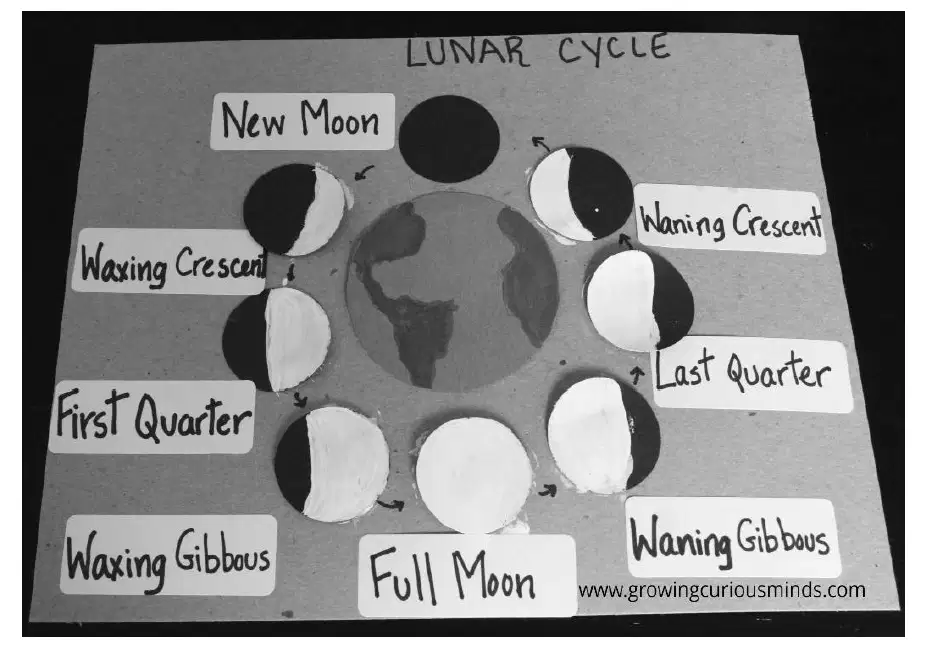
Use the information and model to answer the following question.
A student wants to design a model to show different phases of the moon.
Which of the following revisions should the student make to the model?
The student should swap the locations of the full moon and new moon to show how quick the moon phases change.
The student should remove the Earth since the Earth has no relationship with the phases of the moon.
The student needs to add a Sun to the model to show how the moon illuminates from the rays from the sun.
The student needs to change the order of the arrows because the cycle goes in the opposite
A student constructs the following explanation to compare planets and stars: Stars are much larger than planets and have gas in their composition, which planets do not. Nearby planets can sometimes be seen in the night sky, but stars can be very far away and still seen in the night sky because they emit light. Finally, planets orbit around stars.
Which of the following changes can improve the student’s explanation the MOST?
Planets cannot be seen in the night sky, but stars can.
Some stars are larger than planets, but not all of them.
Planets and stars move in a revolving pattern around each other.
Some planets also have gas in their composition, but not all planets.
A student is completing research about how stars are different from planets. Which of the following descriptions would you expect the student to conclude from their research?
Stars are made out of gases and give off light.
Stars each have one moon that orbits around it.
Stars orbit around planets that they are close to.
Stars are evenly spread out in the sky because of thei
Which of the following explanations correctly compares planets and stars?
stars orbit around planets
stars are larger than planets
stars can be seen in the sky at night and planets cannot
planets are made of gas and plasma; Stars are made of gas or rock
A group of fourth graders are studying a timeline of technological advances in space research. Which of the following questions could the student research to further understand the similarities and differences between the data collected from the technology?
How has technology improved the quality of photos over time?
What were the dates that each technology was invented?
Who were the scientists who invented the technology?
When was the first space discovery first documented?
Use the information to answer the following question.
During recess, Tony and Josephine were talking about the Sun and stars. Tony told Josephine that the Sun is really a star. Josephine asked why it was so big and bright.
If the Sun is a star why is it so big and bright?
The Sun is not really a star. It is a Sun and that’s why it is so big and bright.
Since the Sun is the closest star to the earth, it appears bigger and brighter than the other stars.
The Sun is brighter than all the other stars in the sky, so it looks bigger than the Earth even though it is really farther away than most stars.
The Sun is a star, but it is made up of gasses that are much different from the other stars and this makes it appear bigger and brighter than the other stars.
Which of the following is a TRUE statement about humans and the environment?
All human activities destroy habitats
All human activities are good for the environment
All human activities are bad for the environment
Some human activities are good for the environment
Decomposers such as fungi, insects, and molds get their energy from __________.
Water
Decaying plants and animals
Fertilizer
All of the above
One year, there are more new snakes hatched in the forest than in other years. How would this affect the other organisms that year?
The plants would have fewer nutrients.
There would be an increase in the number of birds
The tigers would have more to eat.
There would be fewer mushrooms
The student draws a diagram to show the roles of the producers, consumers, and decomposers in the rainforest. How is the role of the decomposers different from the role of the producers?
The decomposers eat the plants to get energy.
The decomposers make food using energy from the sun
The decomposers provide nutrients for the atmosphere.
They decomposers break down dead organisms.
A student is developing a model of an ecosystem. Why does she want to include the sun in her model?
The sun is needed to make the seasons on Earth.
The sun keeps everything warm on Earth.
The sun allows plants and animals to be part of the same ecosystem.
The sun provides the energy for the production of food in the ecosystem.
Which of the following statements about producers is CORRECT?
they make their own food
they eat other organisms
they make things other than food
they obtain food by breaking down the remains of other living things
Which of the following statements about consumers is CORRECT?
they make their own food
they eat other organisms
they make things other than food
they obtain food by breaking down the remains of other living things
Which of the following human activities has a positive effect on the environment?
planting new forests
recycling paper and plastic
protecting endangered species
All of the above
How does an increase in the number of people on Earth negatively affect the environment?
more water is used causing draughts and affecting habitats
more fossil fuels are burned
habitats are destroyed because more space is needed
All of the above
A wetland has been cleared to make space for a new housing development. Which of the following would be considered a negative effect to the bog turtle, a native organism living in the area?
the bog turtles would eventually be taken in by residents as pets
a new man–made lake would provide cleaner water to the bog turtle than the wetland
there would be less predators in the area to prey on the bog turtle
the bog turtle would no longer have the habitat it is accustomed to in which to lay its eggs
All animals in an ecosystem depend on __________ for energy.
Decomposers
Producers
Consumers
Herbivores
Loggers remove a large portion of forest. Which of the following would NOT be considered a harmful effect this would have on the habitat of a squirrel?
the squirrel would have fewer places to use as shelter
the squirrel would have more space to move around
the squirrel would face more exposure to predators
the squirrel would have less resources to use as food

A student wants to build a model of a grasslands food chain that includes a frog, grasshopper, snake, and grass. Which organism belongs in this food chain immediately after the Sun?
Grass
Frog
Snake
Mosquito
Use the food chain below to answer the following question:
Forest food chain
trees → bugs→ birds → fox
If the trees are destroyed in a forest fire, what could happen to the rest of the food chain?
there will be no change in the food chain
the population of the primary producers will increase
the population of the consumers will increase
the population of the consumers will decrease

What is missing in this simple food chain?
Consumer
Producer
Decomposer
Herbivore
A ____________ is an illustration that shows how energy is passed from one living thing to another.
herbivore
food chain
food web
carnivore
A ___________ is an illustration that shows how animals are connected in their search for food within an ecosystem.
decomposer
food chain
food web
herbivore
Green plants can make food in their leaves. A living thing that can make food with energy from the sun is called a _____________________.
consumer
producer
omivore
decomposer
Animals get their energy by eating plants and animals. A living thing that needs to eat to obtain energy is called a ______________________.
omnivore
consumer
decomposer
carnivore
Mushrooms can not make their own food and the do not eat food. Instead, they get their energy by breaking down and absorbing dead organic matter. These types of living things are called _______________________.
omnivore
carnivore
consumers
decomposers
A leopard seal eats fish and penguins. It never eats plants. Since the leopard seal eats only meat, it is a __________________________________.
omnivore
herbivore
carnivore
producer
A deer eats grass and plants found in its habitat. Since the deer eats only plants, it is a _________________________.
omnivore
carnivore
herbivore
decomposer
A racoon eats other animals like crayfish, as well as plant life. Since the racoon eats both plants and animals it is an ________________________________.
predator
carnivore
herbivore
omnivore

Name the living thing in the food web that is a producer.
(a)

Name the living things in the food web that are consumers.

What living things does the wild cat consume?
goat,rabbit,rat
rabbit, rat
owl, lion, fox

What living things does the hawk eat
(a)

What is eaten by the goat, rabbit, and mouse?
(a)

Which item in this food chain is a producer ( makes its own food)?
leaf
caterpillar
blue bird
hawk
Which of the following is a nonliving part of an ecosystem?
grass
water
birds
bacteria
Which of the following is a decomposer?
bacteria
fungi
worms
all of them
Choose all of the biomes.
Andalusia
rainforest
desert
grasslands
An organism that only eats meat is called an______________.
omnivore
carnivore
producer
herbivore
An organism that only eats plants is called an __________________.
herbivore
omnivore
consumer
producer
An organism that eats both plants and animals is called an___________________.
herbivore
carnivore
omnivore
consumer

