
Font size
 Worksheets
Evolutionary Theory
Total questions: 20
Worksheet time: 43mins
(a) is the fact that organisms change over time and are related through common ancestors.
(a) occurs when individuals within a population with the most favorable traits for an environment survive and pass on those traits.

Farmers breed cows to produce high amounts of milk. This is an example of...
Natural Selection
Variations in a species
Selective Breeding
Where the better adapted organisms survive to pass traits along to offspring.
Evolution
Natural Selection
Extinction
Artificial Selection
In natural selection, the selective agent is the
humans
mutations
breeders
environment

This image shows that
These animals have no simliarities in their structures.
two different species may have evolved from a common ancestor.
These animals are from the same species.
These animals likely evolved from different ancestors due to their differences.
This kind of structure is when the structures have the same function but have a different structure. (bird wings and bat wings)
analogous structure
homologous structure
vestigial structure
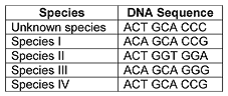
According to this data, the unknown bacterial species is most closely related to:
Species I
Species II
Species III
Species IV
When you compare DNA or proteins to support evolution, you are using what kind of evidence?
anatomical evidence
molecular evidence
fossil evidence
There are three species of birds on an island. Bird A has a heavy bill for eating seeds. Bird B has a pointed bill for eating insects. Bird C has a sharp bill for eating both insects and seeds. If all insects on the island suddenly disappeared, which bird or birds would be the LEAST affected?
Bird A
Bird B
Bird C
Bird A and Bird B

The image shows an example of..
vestigial structure
analogous structure
homologous structure

Which type of evidence is illustrated in this picture
fossil evidence
molecular
anatomical
embryological

What best describes the hind leg bones seen in the whale?
The bones are analogous structures to the fins of living fish.
The bones are vestigial structures that had a function in an ancestor.
The bones are homologous structures to the wings of butterflies.
The bones are fossil structures from an extinct ancestor.
Analogous Structure
Same function different structure
Homologous Structure
Same structure different function
Comparative Embryology
Comparing embryological development of different species
Biochemical Evidence
Comparing DNA and amino acid sequences of different species
Vestigial Structures
Structures in the body of an organism that no longer work.

Which species’ DNA is most similar to the DNA of the toothed whale? (a)

What number is the common ancestor of C and D
1
2
3
4
_________________ show clear changes in an organism over time, the environment organisms lived in, the time period the organism lived in, and where the organism lived.
DNA
Vestigial structures
Fossils
Homologous structures

Observe the two fish in the image. The cave fish and minnow are genetically related to each other and are similar in many ways. The cave fish lives very deep in the ocean where there is no light. It has only the remnants of eyes and is blind. Minnows live in shallow waters where the water has light. Their eye sight is important for their survival. Which statement below best describes these two fish?
The DNA of the cave fish has changed over time to differ from the minnow. Since there is no light where the cave fish lives, it was not necessary to have working eyes. Over time, mutations occurred which proved to improve the survival of the cave fish, which is why they are now blind and have only physical remnants of eyes.
The DNA has not mutated over time and despite all of the evidence that suggests these two are genetically similar, one has eyes and the other does not so they must not be related.
Cave fish must have been attacked by predators, which is why they only have the remnants of eyes.
Which of the following is NOT considered a vestigial structure in humans?
Eye lashes
Appendix
Wisdom teeth
Tail bone

