
 Worksheets
Enzymes
Total questions: 20
Worksheet time: 17mins
Name
Class
Date
1.
Label the parts of the enzyme model
a)Substrate
b)Products
c)Enzyme
d)Active site
1
2
3
4
1)
2)
3)
4)
2.
Click on the temperature that this enzyme is having optimum activity.
A
B
C
3.
Enzymes are...
a)
nucleic acids
b)
proteins
c)
lipids
d)
carbohydrates
4.

Which enzyme is most efficient in a basic solution?
a)
A
b)
B
5.
What happens when enzymes are heated to a high temperature?
a)
The enzymes die.
b)
The shapes of the enzyme are altered denature
c)
The enzymes' amino acid sequence changes.
d)
The enzymes remain the same
6.
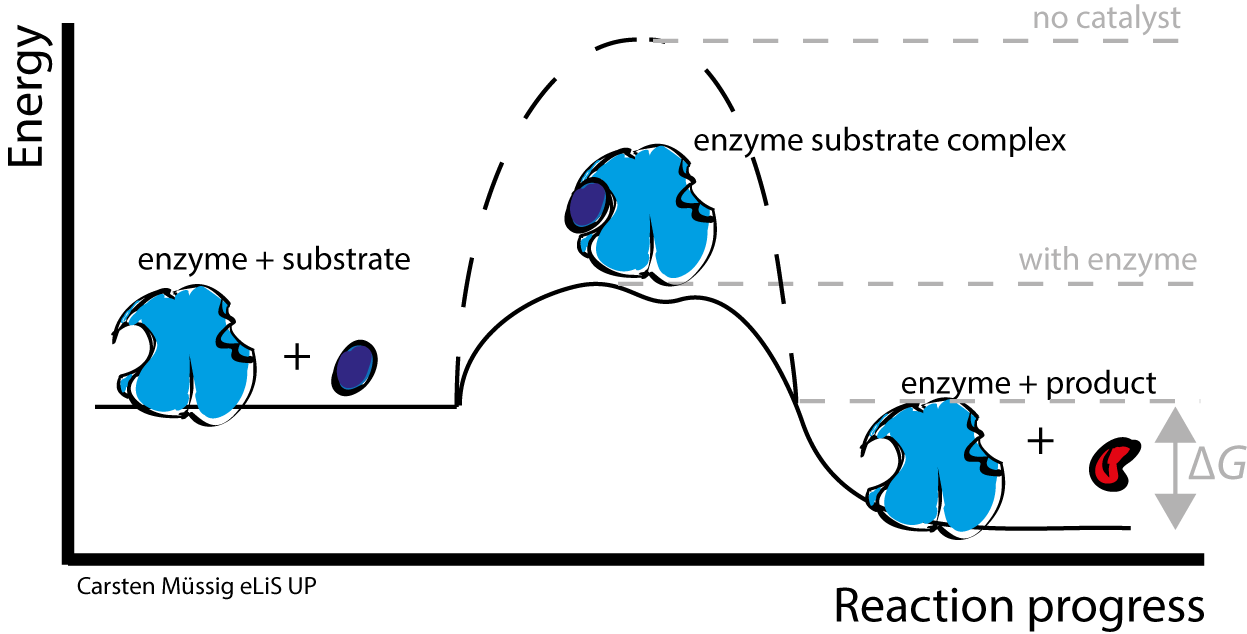
An enzyme speeds up a reaction by
a)
lowering the activation energy.
b)
raising the activation energy.
c)
releasing energy.
d)
absorbing energy.
7.
What happens to an enzyme when it is denatured?
a)
Activation energy is lowered.
b)
It becomes stronger.
c)
It loses its shape.
d)
Activation energy is raised.
8.
What is the purpose of an enzyme?
a)
control how many reactions occur
b)
raise activation energy
c)
give permission for the reaction
d)
speed up chemical reactions
9.
Enzymes are (a) that (b) chemical reactions by (c) the amount of activation energy required to start the reaction.
Choose from the below words
proteins
speed-up
decreasing
carbohydrates
increasing
slow-down
10.
Match the following Macromolecules to its structure
a)
1.
Carbohydrate
b)
2.
Lipid
c)
3.
Nucleic Acids
d)
4.
Protein
11.
Enzymes act on many different substrates
a)
True
b)
False
12.
Enzyme can be used again and again
a)
True
b)
False
13.
What 3 letters do enzymes typically end in?
a)
-ose
b)
-ase
c)
-ese
d)
-tic
14.
Any substance that is acted upon by an enzyme is called a(n)?
a)
Coenzyme
b)
Substrate
c)
Vitamin
d)
Polypeptide
15.
After the enzyme and substrate bind together and perform the reaction, what does the substrate become?
a)
a substrate
b)
an enzyme
c)
a product
d)
an active site
16.
Enzymes provide a site where reactants called substrates can be brought together in an enzyme-catalyzed reaction. The site is called the
a)
enzyme substrate complex.
b)
reaction site.
c)
active site.
d)
lock and key.
17.
Every enzyme has a optimal temperature and pH. True or False?
a)
True
b)
False
18.
A(n) ______ is a substance with a pH less than 7
a)
Acid
b)
Alkaline
c)
Base
d)
Buffer
19.
A(n) _______ is a substance with a pH greater than 7.
a)
Base
b)
Acid
c)
Buffer
d)
Water
20.
Substances with a pH of 7 are
a)
Acidic
b)
Basic
c)
Neutral
d)
Saturated
100 %

