
 Worksheets
World History Final Review
Total questions: 140
Worksheet time: 2hrs 37mins

Which of the following statements is true concerning the Greco-Persian Wars?
The Persians defeated the Greek city-states
Athens started its decline after the end of the war
Sparta and Athens were united against the Persians
Persian ideas were adopted by the Athenians


Which of the following statements is true concerning the Greco-Persian Wars?
The Persians defeated the Greek city-states
Athens started its decline after the end of the war
Sparta and Athens were united against the Persians
Persian ideas were adopted by the Athenians


True or False: Winning the Persian War preserved Greek independence.
True
False


The leader of the Persians when they first attacked Greece in 490BCE.
Darius
Alexander the Great
Xerxes
Cleopatra
The initial event which triggered the Persians to invade Greece, which occurred in 499BCE was
the Greek cities of Anatolia, with help from Athens, revolted against their Persian overlords
the ancient Greece city-state of Sparta attempting to invade Persia
Athens excluding Persia from trade
No answers are correct
The 2nd Persian invasion was led by
Darius
Xerxes
Alexander the Great
Cleopatra
At Thermopylae in 480 BCE
the Spartan king, Leonidas, held a narrow mountain pass against the Persians delaying their advance
a Greek fleet fought three battles against the much larger Persian fleet
The Athenians captured Xerxes
No answers are correct
What happened at Salamis?
The Spartans attacked the Persian army and defeated them.
The Greek navy attacked the Persians completely defeating them.
The Persians landed their army and invaded Athens.
The Persians landed their army and invaded Sparta.

Which of the following choices does the image best illustrate?
the Persian cavalry
the Greek hoplite army
the Roman gladiators
the Chinese samurais

How did Persian rulers treat most of the people in lands that were taken into the empire?
They forced the people to assimilate within the Persian culture.
The Persian rulers imprisoned the citizens and sentenced many to death.
They placed the citizens into slavery and worked them for the rest of their lives.
They allowed them to keep their unique cultures, languages, and religions.
What is this letter of the greek alphabet?
Αα
Alpha
Chi
Gamma
Pi
What is this letter of the greek alphabet?
Ββ
Sigma
Beta
Psi
Omega

What city-state is shown in the red?
Greece
Sparta
Athens
Peloponnesus
Crete
what age dose spartan boys go to miltary school
7
10
32
8

Spartan women had more rights than women in the other city-states.
True
False

Greek city-state where democracy was first created
Sparta
Athens
Thebes
Corinth

Greek city-state that became a military society
Sparta
Athens
Thebes
Corinth

How many oceans are there?
6
7
3
5

How many continents are there?
3
5
7
10

Where is 1?
Persia
Egypt
China
India


What is the name of this temple located in Athens?
Colosseum
Parthenon
Southport State High School
Acropolis

What is 4?
Athens
Sparta
Delphi
Olympia

The decline of the Roman Empire was
accelerated (happened faster) because?
Rome waged war against a single
powerful trade rival.
Rome allowed Christianity to spread.
Rome was conquered by the Islamic
Empire.
Rome faced invasions from many
"Barbarian"/Germanic tribes.
How did Rome's economy begin its descent?
The government began taxing the people too much, which forced people back into poverty and debt. Trade suffered as well.
People began stealing from the government funds and the people suffered because of it.
Which Barbarian tribe was the first to attack Rome in 410 AD?
A) The Visigoths
B) The Ostrogoths
C) The Huns
D) The Vandals

Italy is in which continent?
North America
Africa
Europe
Asia

True/False: The Roman Empire was far too large to govern for one person?
True
False
TRUE/FALSe: Poor leaders weakened the government
TRUE
FALSE
TRUE/FALSE: Taxes were too great, many rich people stopped paying
TRUE
FALSE
TRUE/FALSE: No money to pay military = weak military
and Constant threat of invaders on empire’s borders
TRUE
FALSE

What is inflation?
Increase general price level of goods and services
Increase price level from one private organisation
Decrease general price level of goods
Increase general price level of services

What was the building above used for?
Holding Water
Games, Gladiator Fights, performances, naval battle
a Place to watch movies
A place to race cars
___________ was the emperor of the Byzantine Empire at its peak. He was a strong Leader and skilled general. He Created a Code, which was a list of laws that his empire must follow. ( This is the basis for our court system today.)
Constantine
Justinian
Mehmet
Odoacer
Justinian's wife __________ helped him rule? She was very influential for women's rights
Madonna
Cleopatra
Theodora
Mary I
Which part of the Roman Empire became known as the Byzantine Empire?
Northern
Eastern
Western
Southern
Where was the city of Constantinople located?
Italy and Germany
between the Mediterranean and Black Seas
Africa and Spain
What made many people sick in Constantinople in 542?
taxes
population
plague
barbarians
Rome was divided into two sections in order to try to stabilize the empire. What were these TWO empires called?
Northern
Southern
Eastern
Western
Why was Constantinople such a prosperous city?
located at the crossroads of trade
Great architecture
Strong autocratic rulers
The pope lives there


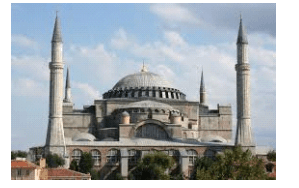
What does "Hagia Sophia" mean?
Holy Wisdom
High Sights
Home in the West
Home in the east

a picture or pattern produced by arranging together small colored pieces of hard material, such as stone, tile, or glass.
Jigsaw
Puzzle
Mosaic
Architecture
Alexander the Great is from this kindgom
Greece
Sparta
Macedonia
Perisa
What was the name of the Greek philosopher who became Alexander's tutor
Aristotle
Diogenes
Socrates
Plato
What does it mean to say that Alexander conquered by using kindness
He let towns that surrendered to his army keep their own leaders
He convinced people to vote for him to make him their leader
He offered lessons for people in the religion he wanted them to practice
He gave people gifts of gold and jewels in order to become their leader
Who was King Philip II
King of Mesopotamia
The son of Zeus
King of Greece
The father of Alexander
Alexander built cities with these features: an agora, a temple, a theater, and a university. Why did he design cities this way?
He enjoyed watching people buy and sell their goods
He believed people needed a public place to pray
He wanted the cities to be like Greek cities
He thought it would encourage people to attend plays
When Alexander and his men conquered Egypt he created a city famed for its library and lighthouse. What was the name of that city?
Macedonia
Athens
Alexandria
Cario
A type of culture typically referred to after the conquests of Alexander the Great. The expansion of the Greek culture.
Calvary
Hellenistic
Infantry
Phalanx
A unit of soldiers who ride horses
Calvary
Infantry
Phalanx
Tanks
A military formation of foot soldiers armed with spears and shields
Calvary
Infantry
Phalanx
Hellenistic
What were the two main social classes of the Roman Republic?
Generals and soldiers
Emperors and Civilians
Plebeians and Patricians
Romans and Carthaginians
Who was Rome's first Emperor?
Charlemagne
Augustus Cesar
Dwayne "The Rock" Johnson
Hadrian
What are Aqueducts?
These stone arches and
underground pipes
brought fresh, clean
water to the people in all different parts of the Roman
Empire.
A Bridge.
Source of food for the people.
Roads so people can get from city to city.
What was Carthage?
A powerful city and major rival of Rome.
A small city.
A Not so important country.
Friends of Rome.
Where did Carthage’s power lie?
Leaders.
Cannons.
Horses.
Navy
How many Punic Wars were there?
5
3
10
1

Cleopatra was queen of which country?
Egypt
Rome
Greece
What an animal did Hannibal bring for his invasions of Italy?
rhinoceros
lions
giraffes
elephants
The cause of the first Punic war was over the island of
Sardinia
Corsica
Sicily
Hispania

Italy is in which continent?
North America
Africa
Europe
Asia
What was the building above used for?
Holding Water
Games, Gladiator Fights, performances, naval battle
a Place to watch movies
A place to race cars
Justinian's wife __________ helped him rule? She was very influential for women's rights
Madonna
Cleopatra
Theodora
Mary I
What does "Hagia Sophia" mean?
Holy Wisdom
High Sights
Home in the West
Home in the east
a picture or pattern produced by arranging together small colored pieces of hard material, such as stone, tile, or glass.
Jigsaw
Puzzle
Mosaic
Architecture
The belief that when you die your soul finds another body
The Middle Way
Reincarnation
Nirvana
Hajj
The belief that when you die your soul finds another body
The Middle Way
Reincarnation
Nirvana
Hajj
Who started the religion of Islam
Buddha
Jesus
Moses
Muhammad
What religion/philosophy follows the 4 noble truths
Hinduism
Christianity
Buddhism
Taoism
A belief systems about nature of the universe, the existence of one God or several gods, and the role of the individual is called
party
idea
spirituality
religion
Monotheism
belief in one god
belief in more than one god
belief in no god
all of the above
What is Polytheism?
belief in one god
belief in more than one god
belief in no god
all of the above
________ is a monotheistic religion
Judaism
Christianity
Islam
All of the Above
Jesus Christ and his Apostles are the founders for:
Christianity
Islam
Muslim
Bedoiuns
Which two religions were founded in India?
Buddhism and Islam
Islam and Christianity
Judaism and Hinduism
Hinduism and Buddhism
Who was the founder of Hinduism?
Yahwah
Siddhartha Gautama
No One
Abraham
The cow is sacred to which religion
Buddhism
Hinduism
Islam
Christianity
The founder of the religion of Buddhism was...
Julius Caesar
Emperor Ashoka
Siddhartha Gautama
Francisco Pizarro
The Taj Mahal is located in what country?
Saudi Arabia
India
Pakistan
Iran
What leaders were inspired by M. Ghandi?
V,Putin and D. Trump
G.Bush and M.L. King
M.L. King and Nelson Mandela
M.Ghandi fought for
India's independence
lower food prices
equality of rights


Which institution held the most power during the Medieval Times?
The King
The Nobles
The Serfs
The Church

How much of Europe's population was killed by the Black Death?
1/4
1/2
1/3
1/5
To exclude a person from church memebership
concprdat
Excommunicate
impeach
Between A.D. 800 and 900 Europe was invaded by Muslims, Magyars and _______
Jews
Saxons
vikings
The goal of the Crusades was to reclaim
the Holy Land
Palestine
Syria
Persia

The ___________________ was largely key to the Mongols success. It provided transportation and food
Cow
Lizard
Horse
Ox
Around 1200 CE, this person unified the Mongol Empire
Kublai Khan
Genghis Khan
Confucius
Marco Polo

Jews were ordered to convert to Christianity or leave Spain by ______________________.
the College of Cardinals
King Henry VII
Parliament
the Spanish Inquisition
Which group was safest during the Spanish Inquisition?
Muslims (Moors)
Jews
Protestants
Roman Catholics
What does "renaissance" mean?
Beautiful art
A rebirth
Classical Architecture
Realism
no answer
Reformation
began as an attempt to reform the Catholic church, but ended in the creation of Protestant churches
studying classical texts and human achievements instead of religion
a way to pay for forgiveness in the Catholic church using money / goods
a period of reverting back to the Middle Ages way of life
Why is Christopher Columbus such an important historical figure?
he proved that the earth was round
his discovery led to the colonization of the Americas
he opened up a new trade route th Asia
he was a great mapmaker
In what year did Christopher Columbus sail on his first voyage?
1429
1492
1942
1518
Where were the Aztecs located?
Plains of Mexico
Yucatan Peninsula
Andes Mountains
Panama Canal

