
 Worksheets
WWII Unit Test Review 2023
Total questions: 87
Worksheet time: 1hrs 1mins
Which statements about Fascism and Communism is true?
Both believe in a classless society
Both used totalitarian methods to control populataions
Both thrive on blind devotion to the state
Both were nationalist
Both were supported by business and property owners
Which of the following are characteristic of Fascism?
protection of individual rights and liberties
state comes before the individual
extreme nationalism
democratic process
aggressive foreign expansion
Which of the following describes Italy's satisfaction with the outcome of the Treaty of Versailles?
Italy was very satisfied with the outcome of the treaty - land promised in 1915 was given to Italy
Italian government was bitter and frustrated over the outcome of the treaty - land promised in 1915 was not fully given
Both Hitler and Mussolini came to power through legal means. (a)
Which of the following was true about anti-Semitism?
Anti-Semitism is the hatred of Muslims
Anti-Semitism was a part of the Nazi ideology
Anti-Semitism was a part of Nazi propaganda
Anti-Semitism was the hatred of Jews
Anti-Semitism contributed to the Jews being treated as scapegoats.
What are reparations?
Debts incurred by countries at war
Loans for countries at war
Payments for war damages
Taxes placed a nation to pay for war
The Treaty of Versailles punished Germany for WWII by
Britain and France getting German colonies
LImited military, no submarines or airforce
Being divided into East and West Germany and occupied
Heavy reparations
Requiring its participation in the League of Nations
The (a) allowed for Hitler to assume dictatorial powers for 4 years in Germany.
Which event is viewed as the start of WWII in the Pacific?
Japanese annexation of Korea
Japan's invasion of French Indochina
Japanese victory in the Russo-Japanese War
Japan's invasion of China in 1937, starting the Second Sino-Japanese War
Japan's attack on Pearl Harbor
Japan invaded (a) in 1931.
In the years between WWI and WWII, the US followed (a) as its foreign policy
What is the term for avoiding political involvement in other countries affairs ? (a)
What event brought the US into WWII?
Germany's invasion of Poland
Mussolini's invasion of Ethiopia
Japan's invasion of China
Japan's attack at Pearl Harbor
Germany's acquisition of Czechoslovakia 6 months after the Munich Conference
What was the reaction or response to Italy's invasion of Ethiopia in 1935?
Invasion was condemned, and sanctions placed on Italy, however there was no way to enforce sanctions
Italy's was forced to remove her military from Ethiopia
Germany invaded Italy
Ethiopia fought back and defeated the Italian invaders, much like Menelik II had done in the 1890s
In 1936, Hitler invaded which demilitarized region between France and Germany without pushback from Britain or France? (a)
The British and French, both desired to avoid war with Germany. They adopted the policy of (a) - the idea of giving in to an aggressor to keep the peace.
The US Neutrality Acts were intended to maintain US isolationism due to the growing threats in Europe. According to these laws
No Americans could travel on ships that belonged to countries at war
No Americans could buy food from countries at war
No American banks could provide loans to countries at war
No American munitions makers could sell weapons to countries at war
No Americans could live in countries at war.
In 1936, Italy, Germany and Japan joined to form the Tripartite Pact and became known as the Allied Powers. (a)
One goal that Hitler had for Germany was to create more lebensraum. He would do this by taking lands in eastern Europe and eliminating the undesirable races of the region, then use the land for German growth, food and industry, Lebensraum means (a)
In 1938, Germany annexed Austria. This union of Austria and Germany was called (a) and was prohibited by the Treaty of Versailles.
In September 1938, Hitler gained control of the ______ as a result of the Munich Conference. In exchange, Hitler promised to respect the new boundaries of Czechoslovakia, which he didn't , taking the rest of teh country 6 months later.
Rhineland
Sudentenland
Poland
Deutschland
Which political leaders met at Munich to decide the fate of the Sudetenland?
Benito Mussolini
Adolf Hitler
Joseph Stalin
Neville Chamberlain
Édouard Daladier
As a result of being left out of the Munich Conference and feeling that he needed to do what was necessary to protect the USSR's borders, Stalin made an agreement with _____ in the Molotov-Ribbentrop Pact
Roosevelt
Hitler
Lenin
Churchill
By making the Nzai-Soviet Pact with Stalin, Hitler was able to invade ______ without risking war with the USSR.
Poland
Austria
France
Serbia
The German invasion of Poland prompted France and Britain to
invade Germany
declare war on Germany
continue with appeasement
negotiate to protect other European nations from Nazi aggression
What is not true about a totalitarian society?
people have individual freedom
censorship is used
government controls public and private life
police use terror to enforce the will of the government
In a totalitarian society, there is ____ leader(s) that exercises complete control over the nation.
2
3
1
4
Term for a system of government beliefs. (a)
Which of the following is not a method of totalitarian control?
police terror
indoctrination
propaganda & censorship
persecution of a group (ethnic or religion)
genocide
In a totalitarian state, the purpose of the police it to
spy on citizens
create fear to keep people in line
protect the citizens
crush opposition
protect the rights of the people
To indoctrinate the people, totalitarian governments control the ______ system.
economic
farming
education
religious
industrial
The use of youth groups to instruct people in the government's ideology and develop future leader is an example of (a)
Term for biased or incomplete information used to sway people to accept a certain belief or action
censorship
gulags
Bolshevik
propaganda
communism
Censorship restricts a person's freedom of
privacy
speech
religion
travel
A group that is used to place blame on in order to divert it away from the government or the real source of the problem.
scapegoat
kulaks
gulags
terror groups
Read the statement then answer the question:
To slow down would mean falling behind. And those who fall behind are beaten. But we do not want to be beaten! One feature of the old Russia was the continual beatings she suffered for falling behind, for her backwardness…Do you want our Socialist fatherland to be beaten?...If you don’t want this, you must end our backwardness. You must develop a real Bolshevik tempo [speed] in building our Socialist economy. There is no other road.We lag behind the advanced countries by fifty to hundred years. We must make good this distance in ten years. Either we do it, or we shall be crushed.
-Stalin, 1928 speech to the Russian people
Stalin uses what events to justify Russia's need for rapid industrial development?
WWI
Russo-Japanese War
Armenian War
Crimean War
Franco-Prussian War
What was Stalin's program for rapid industrial development? (a)
Read the excerpt from Stalin's 1929 speech on collectivization (gathering of all farm land and resources under government control)
The solution lies in enlarging the agricultural units...and in changing the agricultural base of our national economy....the Socialist way, which is to set up collective farms and state farms which leads to the joining together of the small peasant farms into large collective farms, technically and scientifically equipped, and to the squeezing out of the capitalist elements from agriculture… Now we are able to carry on a determined offensive against the kulaks, to break their resistance, to eliminate them as a class and subsitute for their output the output of the collective farms and state farms.
According to Stalin, what group of people are standing in the way of Stalin's collectivization program?
Kulaks
farmers
factory owners
children
Which of the following best describes Stalin’s background?
Stalin’s family was very involved in the Russian Revolution. Stalin learned at a young age about the ideas of Karl Marx and became an active participant of the revolution.
Stalin was from a very poor family from Georgia. His mother worked as a maid and his father was a violent, cruel alcoholic. Stalin was very bright but instead of going into the priesthood, he joined in with the Bolsheviks and rose through the party to become one of Lenin’s inner circle.
Stalin’s was part of the Romanov family. He was educated at the Royal Academy and took an active role in defending Nicholas II in the March Revolution. Like many other Russian soldiers, he joined with the Russian people against the czar and worked alongside Lenin in taking control of the country in the Russian civil war.
His family was wealthy Ukrainian kulaks and Stalin was educated to become a Russian Orthodox priest. While in the priesthood, he witnessed the cruel and harsh treatment of the Russian people by the czarist government. This led Stalin to joining with the Bolsheviks.
Between 1934 and 1939, the Great Purge was a campaign to eliminate
traditional religious beliefs
food and housing shortages
supporters of the Communist Party
Opposition to Stalin's power
The Great Purge was an example of
indoctrination
propaganda
censorship
police terror
During WWII, the USSR joined with the Allies after it was invaded by
Italy
Germany
Poland
Romania
Which of the following statements best explains why the Nazi-Soviet Pact was an unusual pact between Stalin and Hitler?
Hitler and Stalin shared the same political views.
Hitler and Stalin both desired to control farmland of Eastern Europe.
Hitler and Stalin had opposing political views and viewed each others political ideology as the enemy.
Stalin was expected to side with the British and French at the outbreak of war.
Which 3 countries are collectively known as the Baltic States?
Lithuania
Poland
Finland
Lativa
Estonia
What is the term for "lightning war"? This tactic was used by the German military to quickly and powerfully over run much of Europe and the USSR.
luftwaffe
blitzkrieg
lebensraum
bushido code
The period between the German attack on Poland in Sept 1939 and the German invasion of western Europe in April 1941 was referred to as the
Quiet War
Fake War
Waitng War
Phony War
The German blitzkrieg resulted in British and French troops being trapped in the French port city of _____. The trapped troops were rescued by various types of vessels and transported across the English Channel to England.
Dunkirk
Paris
Calias
Marseilles
Following Germany's conquest of western Europe, The German air force, the Luftwaffe, launch bombing raids over major industrial cities in England. People sought shelter underground in places like the subway tunnels. This battle was called the
Battle of Britain
Battle of Antwerp
Battle of Stalingrad
Battle of France
TRUE OR FALSE - Germany defeated Great Britain in the Battle of Britain and launched an invasion of the British Isles.
TRUE
FALSE
What was the significance of the Battle of Britain?
It proved that Hitler could be stopped
It provided Hitler's Luftwaffe with significant experience in night flights
It proved that Hitler's forces could not be stopped
It changed the course of the war in the Pacific
TRUE or FALSE: Following Germany's failure to break the British and take over Great Britain, Hitler moved his focus to Eastern Europe and the USSR.
True
False
What was the name for the German plan to invade the USSR?
Operation Overlord
Operation Barbarossa
Operation Iceberg
Operation Torch
Operation Red
What 3 Eastern European powers joined the Axis Powers in the Summer of 1941?
Czechoslovakia
Romania
Hungary
Greece
Bulgaria
In addition to the Japanese attack at Pearl Harbor, Japanese forces simultaneously hit Guam, Philippines and British (a)
TRUE OR FALSE: The Allies agreed to focus their fighting forces against Hitler and adopted a "Europe First " strategy.
TRUE
FALSE
What 2 resources, located in Northern Africa, were targeted by the Axis Powers?
Sand
Oil
gold
Suez Canal
Who was the German commander of the Afrika Korps?
Montgomery
Eisenhower
Rommel
Patton
As a result of ________ Allied forces were able to defeat the Axis Powers in Northern Africa.
Opeation Overlord
the Battle of Sicily
Battle of Stalingrad
Operation Torch
Battle of El Alamein
After which battle were German troops pushed out of the USSR? This Soviet victory was a major turning point in the war Germany was now fighting for survival against the USSR in the east.
Battle of Moscow
Battle of El Alamein
Battle of the Bulge
Battle of Stalingrad
Battle of Leningrad
The Allied invasion of France on June 6, 1944 at the shores of Normandy, is known as the
D-Day Invasion.
Battle of France
Fight for Dunkirk
Battle of the Bulge
How did WWII end for both Hitler and Mussolini?
Both were captured and held for war crimes trials
Both died - Hitler by suicide and Mussolini by firing squad
Both surrendered to avoid further devestation
Both negotiated deals with the Allies to end the war
Germany surrendered in May,
1944
1943
1945
1946
TRUE OR FALSE: The surrender of Germany also ended the war in the Pacific with Japan.
True
False
On which two Japanese cities was the atomic bomb dropped?
Tokyo
Kyoto
Hiroshima
Hokkaido
Nagasaki
What was the program for the development of the atomic bomb?
New York Project
Manhatten Project
Los Alamos Project
Hiroshima Project
The Battle of the Bulge took place in
the Ardennes Forest, western Europe
the Rhineland, wesern Europe
the USSR
North Africa
TRUE OR FALSE: Hitler's goal for the attack in the Ardennes against the Allies in the winter of 1944-45 was to split the Allied line and force separate peace agreements with the US and Soviets.
TRUE
FALSE
TRUE OR FALSE: Germany won the Battle of the Bulge and forced the Allies to surrender
TRUE
FALSE
Which event carried out in April 1942, proved that the US could strike Japan, boosting morale in the US and at the same time, shook Japanese confidence that they were untouchable?
Doolittle's Raid over Tokyo
Battle of Okinawa
Battle of Midway
Battle of Guadalcanal
The Battles of Iwo Jima and Okinawa were the last major battles in the Pacific that were part of the plan to be able to launch a land invasion of ______, which due to the heavy loss of life, never happened.
India
USSR
Germany
Japan
Italy
The Battle of ______ was a major turning point in the war in the Pacific for the US. As a result, the US was able to start their island hopping campaign in an effort to reach Japan.
Midway
Guadalcanal
Iwo Jima
Okinawa
Who became president of the US upon the death of FDR?
Harry Truman
Dwight D Eisenhower
John F Kennedy
Woodrow Wilson
What was the term for Japanese suicide pilots?
Death Pilots
Dive bombers
Banzai Pilots
Kamikaze

WWII began in Europe when Germany invaded (a)
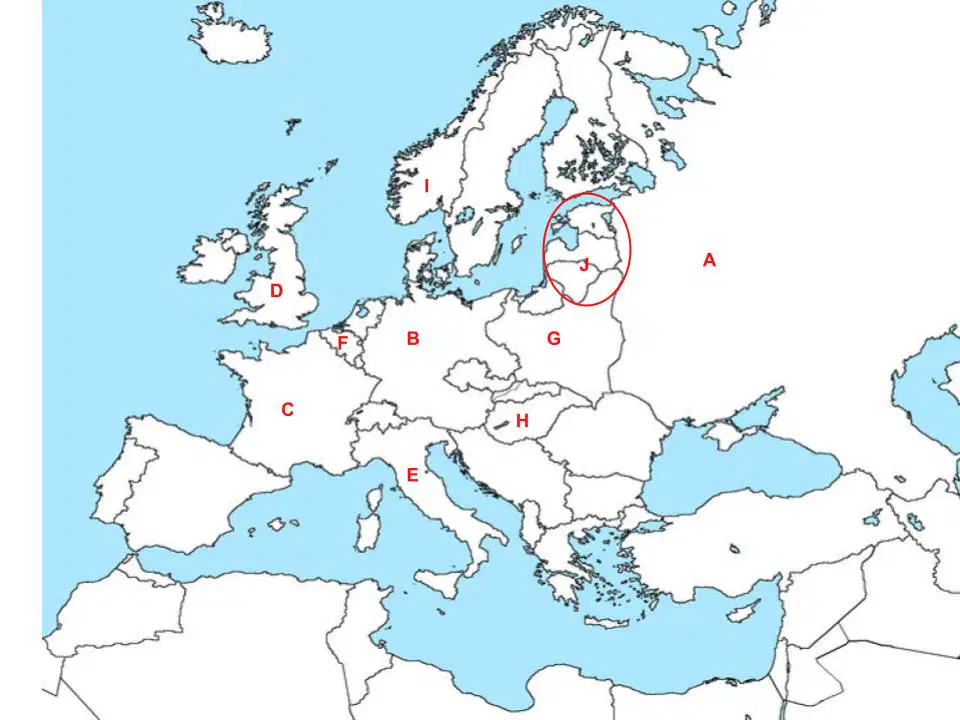
Which letter on the map corresponds with the Baltic States? (a)
Place the following events in chronological order from earliest to latest.
Russia invades Finland in the Winter War
France surrenders to Germany
Battle of Britain begins
Germany invades Russia
Allies launch invasion of Italy


Which term means prejudice against or hostility towards Jews?
Semitism
Anti-semitism
Genocide
Holocaust
Nazi mobile killing units that preceded the more "efficient" gas chambers.
Stormtroopers
Tiergarten
Einsatzgruppen
The SA
Why did Himmler decide that a Final Solution was necessary at the conference at Wannsee?
faulty reasoning
inefficient methods
sufficient weaponry
lack of military resources

windows of synagogues, homes, and
Jewish-owned businesses were plundered
and destroyed.
Treblinka are all examples of this.
Which statement best summarizes the Nuremberg War Crimes Trails?
The court ruled that the German government could restrict the right of the Jews is the were not
citizens of Germany.
The trials were used to decide which Jews would be sent to the death camps in Germany.
The trials were used to convict Hitler of crimes against humanity and sentence him to death.
The trial led to the conviction and death of twelve Nazi officials and civilians.

