
 Worksheets
AP Euro- Unit 4 Test Review Quizizz
Total questions: 85
Worksheet time: 45mins
Which was a major difference between Medieval and Renaissance Art?
Heavier influence on themes of morality and emotion
Subjects where more often Christian in nature.
Greater use of color
Better representations of perspective

Which Enlightened Absolutist was the patron of Denis Diderot and greatly expanded Russia. Those they struggled with internal rebellions and never emancipated the serfs?
Catherine "The Great"
Frederick "The Great"
Peter "The Great"
Jospeh "The not so great..."

Which Enlightened Absolutist tried doing too much and ultimately had all of his reformed reversed after this death?
Catherine "The Great"
Frederick "The Great"
Peter "The Great"
Jospeh "The not so great..."
The Holy Roman Empire by 1700 ...
had a very strong central government.
was a patchwork of several hundred small separate states.
included Russia.
was entirely Protestant.
Prussia emerges as a ______ and ________speaking country.
Catholic and German
Protestant and German
Islamic and Arabic
Protestant and Russian
What family ruled over Austria?
Hapsburg
Hohenzollern
Burgermeister
Bismarck
By using his army to win victories over the great powers of Europe, Frederick II earned this nickname.
Frederick the Great
Frederick of Silesia
Frederick the Conqueror
Frederick the Bold
Where is Austria located
Asia
Africa
Europe
North America
What happened to the writings of both Diderot and Voltaire in France?
The King ordered them banned.
The King ordered them to be mandatory reading.
The King ordered them to be put into the Royal Library.
The King ordered them to be made into a Broadway musical.
Which of the following was Denis Diderot's contribution to the world?
The Dictionary
The Atlas
The Almanac
The Encyclopedia
Which of the following was Voltaire's contribution to the world?
Freedom of religion
Freedom of speech
Freedom of choice
Freedom of liberty
What does deductive reasoning use to form its arguments?
patterns
specific cases
observed examples
facts, definitions, accepted properties, and laws of logic


"The power of judging must be separated from legislative and executive power."
Voltaire
Diderot
Montesquieu
Wollstonecraft
"I disapprove of what you say, but will defend to the death your right to say it."
Rousseau
Montesquieu
Smith
Voltaire
"I do not wish women to have power over men; but over themselves."
Becarria
Wollstonecraft
Rousseau
Voltaire
"Science, art, literature, and philosophy are simply the manifestation of the Encyclopedia."
Montesquieu
Smith
Becarria
Diderot
What theory states that all knowledge should be collected through the senses/observation/experimentation?
empiricism
structuralism
functionalism
introspection
Who is considered the father of the scientific revolution?
Isaac Newton
Galileo Galilei
Johannes Kepler
Nicolaus Copernicus
Which philosopher is known for his work on the social contract theory?
Karl Marx
Socrates
Aristotle
Jean-Jacques Rousseau
What was the main focus of the Enlightenment period?
Promotion of blind faith and dogma
Rejection of scientific inquiry
Use of reason and rationality
Embracing superstition and irrationality
Who is credited with the invention of the printing press?
Isaac Newton
Albert Einstein
Leonardo da Vinci
Johannes Gutenberg
Which scientist proposed the heliocentric model of the universe?
Isaac Newton
Galileo Galilei
Albert Einstein
Nicolaus Copernicus
What was the impact of the scientific revolution on society?
It led to advancements in technology, medicine, and understanding of the natural world.
It caused a decline in technological advancements
It led to an increase in superstition and ignorance
It had no impact on society
What was the role of women in the scientific revolution and Enlightenment?
Women played limited roles in the scientific revolution and Enlightenment, often excluded from formal education and professional scientific societies.
Women had equal opportunities in education and professional scientific societies
Women were the primary contributors to scientific discoveries during this time
Women were the leaders of the scientific revolution and Enlightenment
What was the impact of the Enlightenment on the political landscape of Europe?
It had no impact on the political landscape
It resulted in the decline of political ideologies
It led to the strengthening of monarchies
It led to the rise of new political ideas such as democracy, individual rights, and the separation of powers.
Which Enlightenment philosopher is known for his theory of 'Tabula Rasa'?
John Locke
Voltaire
Montesquieu
Rousseau
What was the impact of the Enlightenment on the American Revolution?
It had no impact on the American Revolution
It led to the rejection of the American Revolution
It influenced the American Revolution, inspiring key principles such as liberty, equality, and justice
It led to the suppression of the American Revolution
Who is known for his laws of motion and universal gravitation?
Galileo Galilei
Isaac Newton
Albert Einstein
Nicolaus Copernicus
Which Enlightenment philosopher is known for his work 'Leviathan'?
Thomas Hobbes
John Locke
Voltaire
Rousseau
What was the impact of the Enlightenment on the development of modern education?
It had no impact on the development of modern education
It led to the rejection of modern education
It influenced the development of modern education, promoting the importance of reason, critical thinking, and evidence-based knowledge
It led to the suppression of modern education
Which country became the main example of an absolute monarchy?
Spain
England
France
Sweden

Identify the art style.
Rococo
Baroque
Neoclassical
High Renaissance
Hellenistic
Which of the following correctly associates the artist with the art style?
El Greco / Mannerism
Michelangelo / Baroque
Artemisia Gentileschi / Romanticism
Salvador Dali / Dadaism


Which of the following best helps to explain the economic and political decline of Spain during the 17th Century?
The collective security measures implemented by Cardinal Richelieu in order to prevent the spread of Catholicism
The extensive battles waged in the Iberian Peninsula between the imperial forces and various coalitions of Protestants
The extension of the empire’s commitments beyond its resources
The advocacy of religious toleration by the Spanish rulers to promote the immigration of non-Catholic groups into Spain
The secret treaty between England and France to embargo Spanish ports
An important factor in establishing French absolutism was the
Creation of a central, state bank centered in Paris
Separation of the Roman Catholic Church and the French state
Increased power of the nobles in their localities
Royal ban on the sale of bureaucratic offices and the prevention of personal loans
Royal appointment of intendants to supervise the affairs in the provinces
Which of the following is not correct historically?
The Dutch opened the century as the strongest economic power with developing East and West Indies companies
The Prussians began the process to unify into a country led by the Junker nobility class
The Russians were becoming more powerful and westernized under the progressive and brutal leadership of Peter the Great
The Polish were at the height of their power with the liberum veto empowering the king
Among the principle characteristics of 17th and 18th century absolutist states were all of the following EXCEPT
large standing armies
development of constitutions
weakening the nobility
absolutist rule based on divine right
A non- democratic or authoritarian leader who exercises their political power based upon the principles of the Enlightenment. They distinguished themselves from ordinary rulers by claiming to rule for their subjects' well-being.
Enlightened Absolutists
despots
Constitutional monarchs
Parliamentarians
What type of power is held by an absolute monarch?
Power over all aspects of a nation's social, political, economic, and cultural identity.
Extensive power, but limited by a constitution and the nobility
Only the power the nation is willing to give, often just enough to act as a government figurehead.
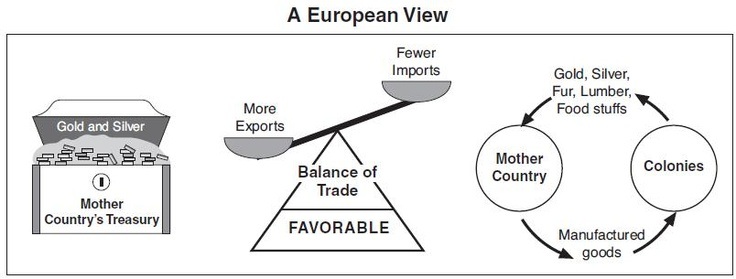
What is mercantilism?
A system where a mother countries gains money and power from natural resources that come from its colonies.
where colonies trade gold and silver with each other.
Wars that start over money.
Plantation colonies trading slaves for money.
Movement where land that was previously public became private; usually fenced off and used by landowners to experiment with crops.
Enclosure Movement
Crop Rotation
Three-Field System
Industrial Revolution
The enlightened absolutists, such as Frederick the Great of Prussia, Maria Theresa of Austria and Catherine the Great of Russia, all believed that...
serfdom was holding their nation's development back
monarchy was the best for of governance
Jews should be emancipated from social restrictions
the Austro-Hungarian Empire should be systematically dismembered
What is Favorable Balance of Trade?
When a nation exports more than it imports
When a nation exports more than it import
A country where they trade chickens for gold
When a countries economy is balanced with the population of poverty
One common concern of both Maria Theresa and Joseph II was
providing state social services to the needy
granting autonomy to the various ethnic groups within the Austrian Empire
industrializing the country
centralizing power
Why did Frederick the Great of Prussia only abolish serfdom on crown lands and not the lands held by the Junkers?
The Junkers didn't possess serfs because they were a military caste.
He wanted to keep the loyalty of the Junkers.
85% of Prussia's serfs lived on Crown lands.
He thought it was immoral for the monarchy to keep peasants in serfdom.
What two major events limited the scope of Catherine the Great's reforms in Russia?
the Pugachev Rebellion and the French Revolution
the wars against the Ottoman Empire and the partition of Poland
the Pugachev Rebellion and Catherine's active social life
the American and French Revolutions
European Jews benefited the most from which enlightened despot?
Louis XVI
Frederick the Great
Joseph II
Philip II
Overall, the reforms of the enlightened despots
were not able to take hold because of limited support among the nobility.
paved the way for democratic systems and the welfare state.
led to a counter-reaction and the return of absolutist rule all over Europe.
led to the feudalization of Europe.
The partition of Poland 1772-1795
eliminated Poland as an independent state.
divided Poland between Sweden, Finland, and Lithuania.
divided Poland between Russia, Hungary, and Austria.
led to the emergence of an independent Lithuanian state.
Sweden lost its position as a formidable European power as a result of
the Thirty Years' War
the Great Northern War
the War of Spanish Succession
weak central government
In the 18th century, the principle economic activity of the Netherlands was
banking and maritime commerce
tulip cultivation
timber production and export
agricultural production
Mercantilism was principally characterized by
government efforts to build a strong, self-sufficient economy
the efforts of the merchant class to influence policy by subsidizing the government
the efforts of bankers and exporters to establish free trade
the view that labor ought to be able to seek its own market
All of the following were reasons why the Dutch were the commercial and financial leaders in Europe in the 17th century EXCEPT
they standardized currency throughout Europe
the Dutch government guaranteed the safety of the deposits
the Dutch charged no interest on long-term loans
depositors were allowed to draw checks against their accounts
All of the following mercantilist policies were implemented by Jean-Baptiste Colbert between 1648 and 1653 EXCEPT
establishing new industries and improving infrastructure
increasing internal tariffs
founding the French East India Company
creating a commercial code for businesses covering the entire country
Which of the following became a British possession as a result of the treaty that ended the War of the Spanish Succession?
Jamaica
Gibraltar
Canada
India
What major impact did the Scientific Revolution have on the Enlightenment?
Through application of the concept of natural law to political theory, society could be governed in a more rational way.
With the confirmation of the existence of a supreme divinity, the concept of the divine right of kings was strengthened.
Failure to discover all of the laws that governed nature meant skepticism in separation of powers.
The Scientific Revolution had a marginal impact on the Enlightenment since the latter encompassed political theory, education, and culture while the former dealt with mathematics and science.

