
Font size
 Worksheets
Cardiovascular Practice
Total questions: 35
Worksheet time: 24mins
What prevents blood from flowing back into the atria when the ventricles contract?
semilunar valves
sinoatrial node
atrioventricular node
tricuspid and bicuspid valves
When blood leaves this chamber of the heart, it heads out to the body (not the lungs)
left atrium
right atrium
left ventricle
right ventricle
This initiates the action potential that causes the heart to beat (the "pacemaker")
Inferior vena cava
Atrioventricular node (AV node)
Superior vena cava
Sinoatrial node (SA node)
When blood leaves this chamber of the heart, it heads to the lungs
right atrium
right ventricle
left atrium
left ventricle
This chamber of the heart receives oxygenated blood from the lungs
right atrium
right ventricle
left atrium
left ventricle
These are the smallest blood vessels with the thinnest walls in order to maximize diffusion of nutrients in and out of the interstitial fluid
arteries
veins
capillaries
aorta
These carry blood towards the heart
arteries
veins
These carry blood away from the heart
Arteries
Veins
The largest artery in the body is called
ARTERIOLE
AORTA
AORTA CAVA
PERICARIDUM:
OUTER LAYER OF HEART
MIDDLE LAYER OF HEART
INNERMOST LAYER OF HEART
SAC THAT SITS AROUND THE HEART FOR PROTECTION
EPICARDIUM
OUTER LAYER OF HEART
MIDDLE LAYER OF HEART
INNERMOST LAYER OF HEAR
ENDOCARDIUM:
OUTER LAYER OF HEART
MIDDLE LAYER OF HEART
INNERMOST LAYER OF HEART
MYOCARDIUM
OUTER LAYER OF HEART
MIDDLE LAYER OF HEART
INNERMOST LAYER OF HEART
BLOOD LEAVES THE HEART TO GO OUT TO BODY THROUGH THE:
BICUSPID VALVE
PULMONARY VALVE
AORTIC VALVE
THE 2 SUPERIOR CHAMBERS OF THE HEART ARE THE:
ARTERIES
VENTRICLES
ATRIA
True or False? Arteries are the thickest walled vessels.
True
False
Contains hemoglobin, supplies body with oxygen
Plasma
Platelet
White Blood Cell
Red Blood Cell
Cell fragments that help clot blood are called
Platelets
Lymph
Plasma
White Blood Cells
Fight bacteria and viruses by entering infected tissue, destroying bacteria/viruses and absorb dead blood cells
White Blood Cells
Red Blood Cells
Platelets
Plasma
Select all answers that represent a "Blood Type"
O
AO
BO
AB
A
The liquid part of blood made of mostly water; nutrients, minerals and oxygen are dissolved
Marrow
Plasma
Proteins
Urea
Where are red blood cells produced?
Bone Marrow
Heart
Lungs
Brain
Which blood type would only have Rh and A antigens on the surface of red blood cells?
A-
A+
B-
B+
1. vascular spasm
2. ___________
3. coagulation
Which of the following is NOT a type of white blood cell?
Neutrophil
Erythrocyte
Monocyte
Lymphocyte
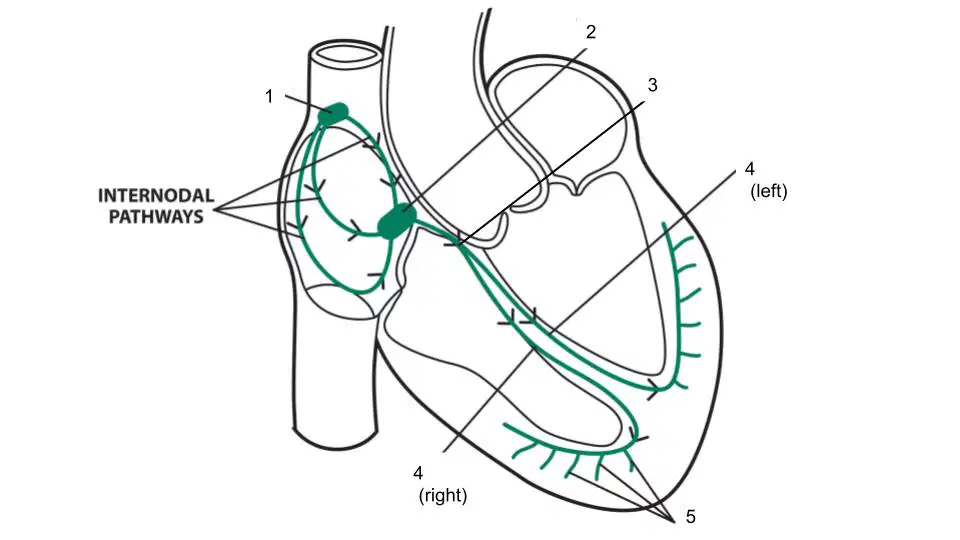
Match the labeled parts on the picture:
#1
SA (sinoatrial) node
#2
AV (atrioventricular) node
#3
AV Bundle (Bundle of His)
#4
Bundle Branches
#5
Perkenji fibers

