wayground logo

Free Printable Worksheets

NEW

Font size

S
M
L
XL
Worksheets

Chapter 2.2 Structure & Functions of Organelles

Total questions: 40

Worksheet time: 1hrs 5mins

Name
Class
Date
1.

Identify the MITOCHONDRIA.

a)

K

b)

F

c)

A

d)

H

2.

Identify the Rough Endoplasmic Reticulum.

a)

D

b)

R

c)

P

d)

F

3.

Identify "B"

a)

Nucleus

b)

Nuclear pores

c)

Chromatin

d)

Ribosomes

4.

What is the function of nuclear pores?

a)

for the nucleus to breath

b)

to allow in/out of nucleus

c)

to store new DNA inside the nucleus

d)

to remove old DNA from nucleus

5.

Which organelle transports protein throughout the cell?

a)

Cytoplasm

b)

Lysosomes

c)

Cell Wall

d)

Endoplasmic Reticulum (ER)

6.

Which organelle makes proteins for the cell?

a)

Mitochondria

b)

Cell Wall

c)

Nucleus

d)

Ribosomes

7.

What is the jelly like substance that contains the organelles?

a)

Endoplasmic Rticulum (ER)

b)

Cytoplasm

c)

Lysosomes

d)

Nucleolus

8.

Which organelle produces ribosomes?

a)

Nucleolus

b)

Cell Membrane

c)

Nucleus

d)

Mitochondria

9.

Which organelle helps break down food (ONLY IN ANIMAL CELLS)?

a)

Cell Wall

b)

Lysosomes

c)

Chloroplasts

d)

Ribosomes

10.

Which organelle provides support to the plant cell (ONLY IN PLANT CELLS)?

a)

Endoplasmic Reticulum (ER)

b)

Mitochondria

c)

Lysosomes

d)

Cell Wall

11.

Which organelle produces energy for the cell?

a)

Mitochondria

b)

Ribosomes

c)

Cell Membrane

d)

Endoplasmic Reticulum

12.

What is the function of a chloroplast?

a)

makes proteins for animal cells

b)

allows materials in and out of the cell

c)

provides structure and support

d)

creates sugar via photosynthesis

13.

Prokaryotic Cells do not have a nucleus or other membrane bound organelles

a)

True

b)

False

14.

Descriptions are shown below. Which describes a

eukaryotic cell?

a)

no ribosomes

b)

free-floating DNA

c)

DNA contained in nucleus

d)

simple with no membrane-bound organelles

15.

The diagram shows an illustration of a Euglena (YEW-gleena) with labeled organelles. Based on the diagram, what type of organism is the Euglena?

a)

Bacteria

b)

Prokaryotic

c)

Animal

d)

Eukaryotic

16.
The Golgi apparatus _____.
a)
packages cell products for export
b)
eliminates waste
c)
stores DNA
d)
makes energy
17.
This organelle eliminates waste. 
a)
Nucleus
b)
ER
c)
Vacuole
d)
Lysosome
18.
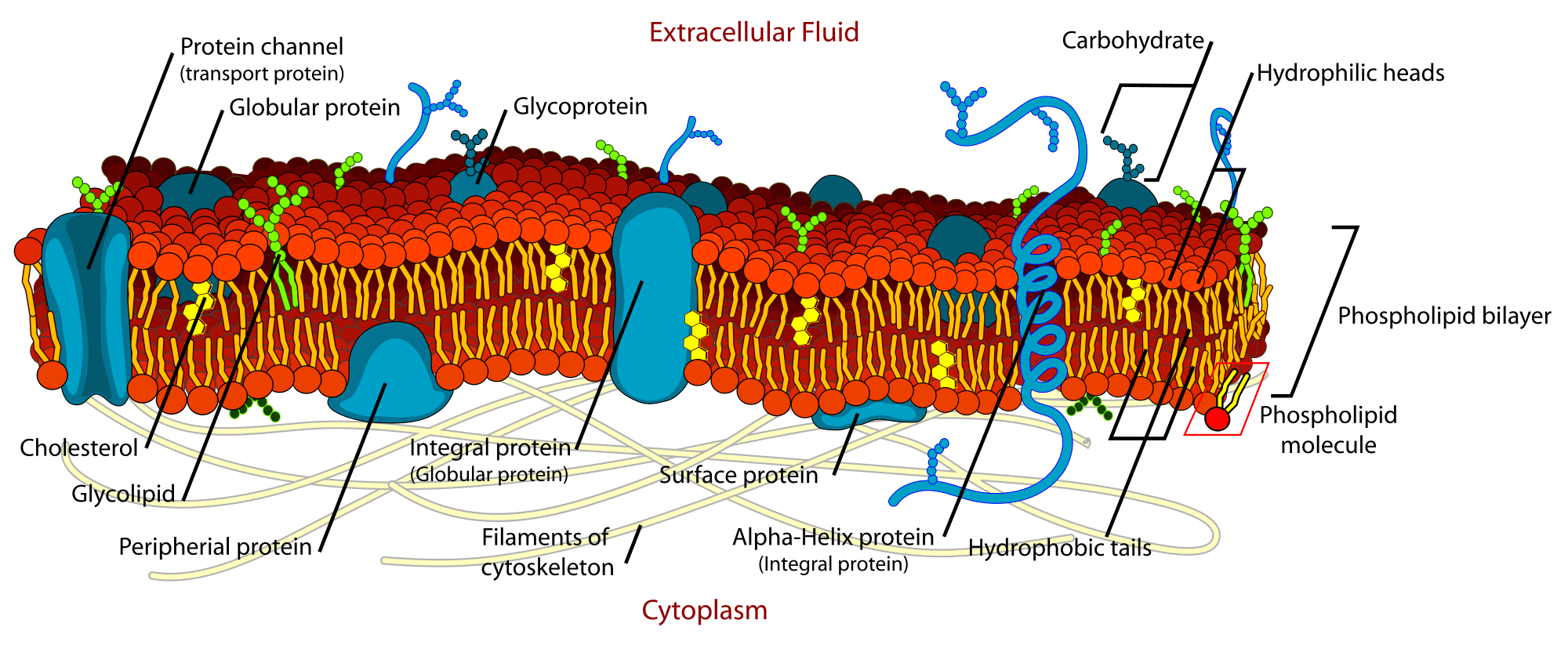
This is a double layer of phospholipids that creates a barrier between the cells internal and external environments; it controls what comes in or out of the cell (selective permeable)
a)
Nucleus
b)
Cilia
c)
Cell membrane
d)
Flagella
19.
What is this image?
a)
cell membrane
b)
mitochondria
c)
golgi apparatus
d)
endoplasmic reticulum
20.
The function of the plasma membrane is....
a)
to regulate what enters and leaves the cell.
b)
fight bacteria and viruses that enter the cell.
c)
provide rigid support and protection to the cell.
d)
make sure each cell can move
21.
When something is 'water fearing' it is....
a)
Hydrophobic
b)
Hydrophilic 
c)
Hydroelectric 
d)
Hydrochloric
22.
When something is 'water loving' it is.....
a)
Hydrophobic
b)
Hydrophilic 
c)
Hydroelectric 
d)
Hydroloric
23.
The cell membrane is selectively permeable, which means...
a)
All materials can enter and leave the cell
b)
Certain things can enter while others cannot
c)
The cell manually sorts through all materials
d)
Only certain cells can interact with the cell.
24.
Which part of this phospholipid is hydrophobic?
a)
fatty lipid tails
b)
head
c)
all of it is hydrophobic
d)
none of it is hydrophobic
25.

Which statement best describes the role cholesterol plays in the membrane?

a)

It clogs the membrane

b)

It increases membrane fluidity

c)

It decreases membrane fluidity

d)

It holds the membrane together

26.

The primary component of the cell membrane is the group of lipids called

a)

prostaglandins

b)

cholesterol

c)

phospholipids

d)

carbohydrate

27.

Describes the arrangement of the cell membrane as bendable and made of many parts.

a)

the fluid mosaic model

b)

the major mobility model

c)

the crazy cell model

d)

the cell theroy model

28.

The ability to allow only certain molecules into or out of the cell.

a)

permeability

b)

impermability

c)

unpermeability

d)

semipermeablity

29.
What type of cell is shown below?
a)
Prokaryotic
b)
Eukaryotic
c)
Awesomekaryotic
d)
Lamekaryotic
30.
Protects plants cells and helps plants stand upright. Makes treebark rough and rigid.
a)
Cell wall
b)
Cell membrane
c)
Cytoskeleton
d)
Cytoplasm
31.
Controls all cell activities and contains DNA
a)
Ribosome
b)
Chloroplast
c)
Endoplasmic reticulum
d)
Nucleus
32.
Uses energy from the sun to make sugars/food for the cell
a)
Mitochondria
b)
Chloroplast
c)
Vacuole
d)
Lysosome
33.
Transports molecules throughout the cell like a post office
a)
Golgi apparatus
b)
Endoplasmic reticulum
c)
Lysosome
d)
Cytoskeleton
34.
Controls what enters and exits the cell, like a fence
a)
Cell membrane
b)
Cytoplasm
c)
Nucleus
d)
Ribosome
35.
Makes proteins, works like a “contractor”, building more cell parts
a)
Endoplasmic reticulum
b)
Mitochondria
c)
Chloroplast
d)
Ribosome
36.
Jelly-like substance that holds all the organelles in place
a)
Cytoplasm
b)
Cytoskeleton
c)
Nucleus
d)
Cell membrane
37.
Break down molecules and dead organelles, works like a “garbage disposal”
a)
Mitochondria
b)
Vacuole
c)
Lysosome
d)
Ribosome
38.
“Powerhouse” of the cell, breaks food down into energy for the cell
a)
Vacuole
b)
Chloroplast
c)
Nucleus
d)
Mitochondria
39.
Stores food and water like a refrigerator for the cell
a)
Chloroplast
b)
Vacuole
c)
Lysosome
d)
Cytoplasm
40.
“Powerhouse” of the cell, breaks food down into energy for the cell
a)
Vacuole
b)
Chloroplast
c)
Nucleus
d)
Mitochondria