wayground logo

Free Printable Worksheets

Font size

S
M
L
XL
Worksheets

Unit 4 Review

Total questions: 40

Worksheet time: 1hrs 6mins
Name
Class
Date
1.
Which of the following best describes a DNA molecule?
a)
double helix
b)
contains ribose
c)
made of amino acids
d)
contains Uracil
2.
Why is DNA important?
a)
it is very small and very complicated
b)
it's in everything
c)
it serves as the blueprint for traits of all living things
d)
because we eat it every day for energy
3.
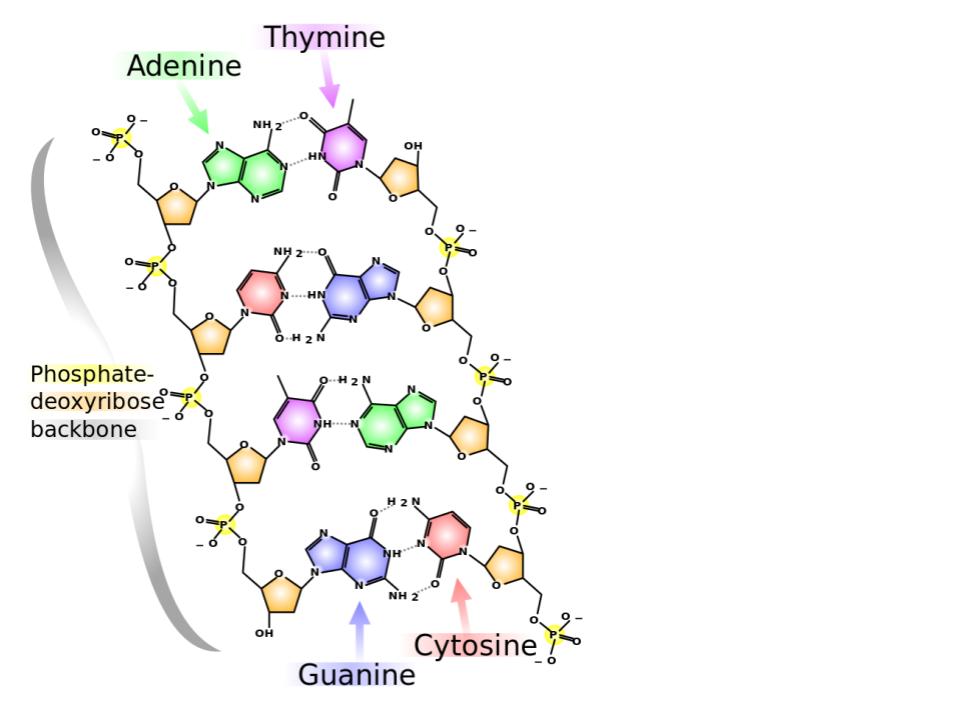
Which 2 molecules form the sides (backbone) of the DNA ladder?
a)
deoxyribose sugar and adenine
b)
deoxyribose sugar and a hydrogen bond
c)
deoxyribose sugar and the nucleus
d)
deoxyribose sugar and phosphate
4.
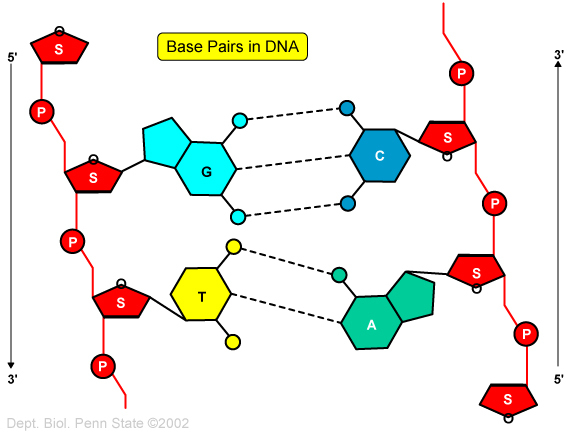
Nitrogenous bases are joined by which type of bond?
a)
polar bonds
b)
ionic bonds
c)
covalent bonds
d)
hydrogen bonds
5.
Which 2 molecules forms the sides (backbone) of the DNA ladder?
a)
deoxyribose and adenine
b)
deoxyribose and a hydrogen bond
c)
sugar and the nucleus
d)
deoxyribose (sugar) and phosphate
6.
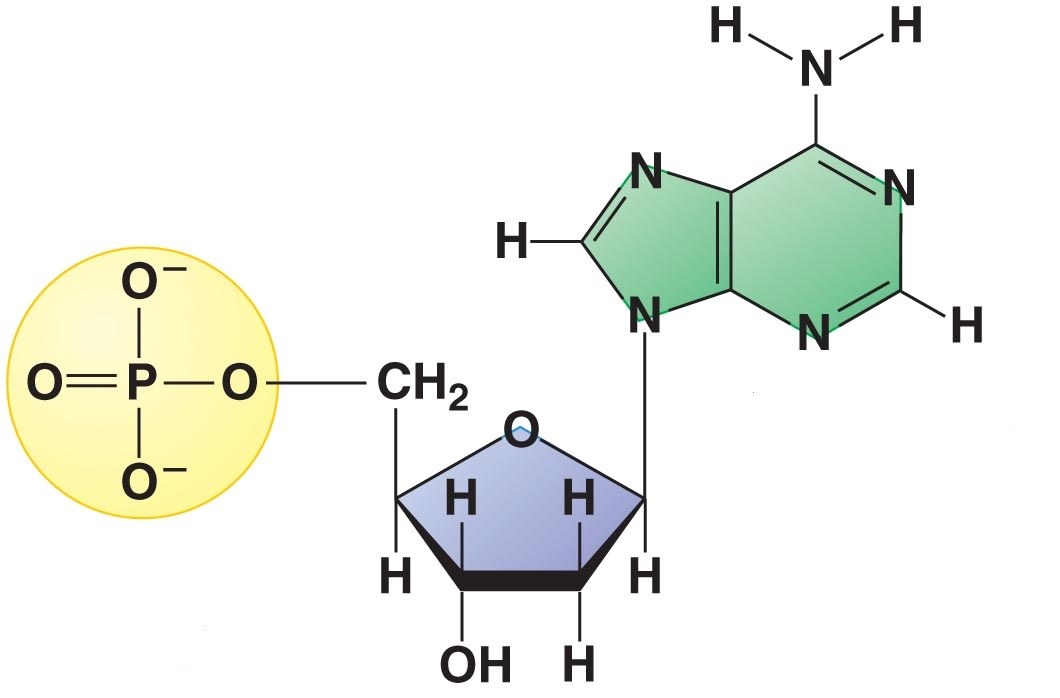
What are the three components of a nucleotide?
a)
sugar, hydrogen, nitrogen base
b)
sugar, oxygen, nitrogen base
c)
sugar, phosphate, nitrogen base
d)
sugar, phosphate, protein
7.
Cytosine always pairs with
a)
Adenine
b)
Thymine
c)
Uracil
d)
Guanine
8.
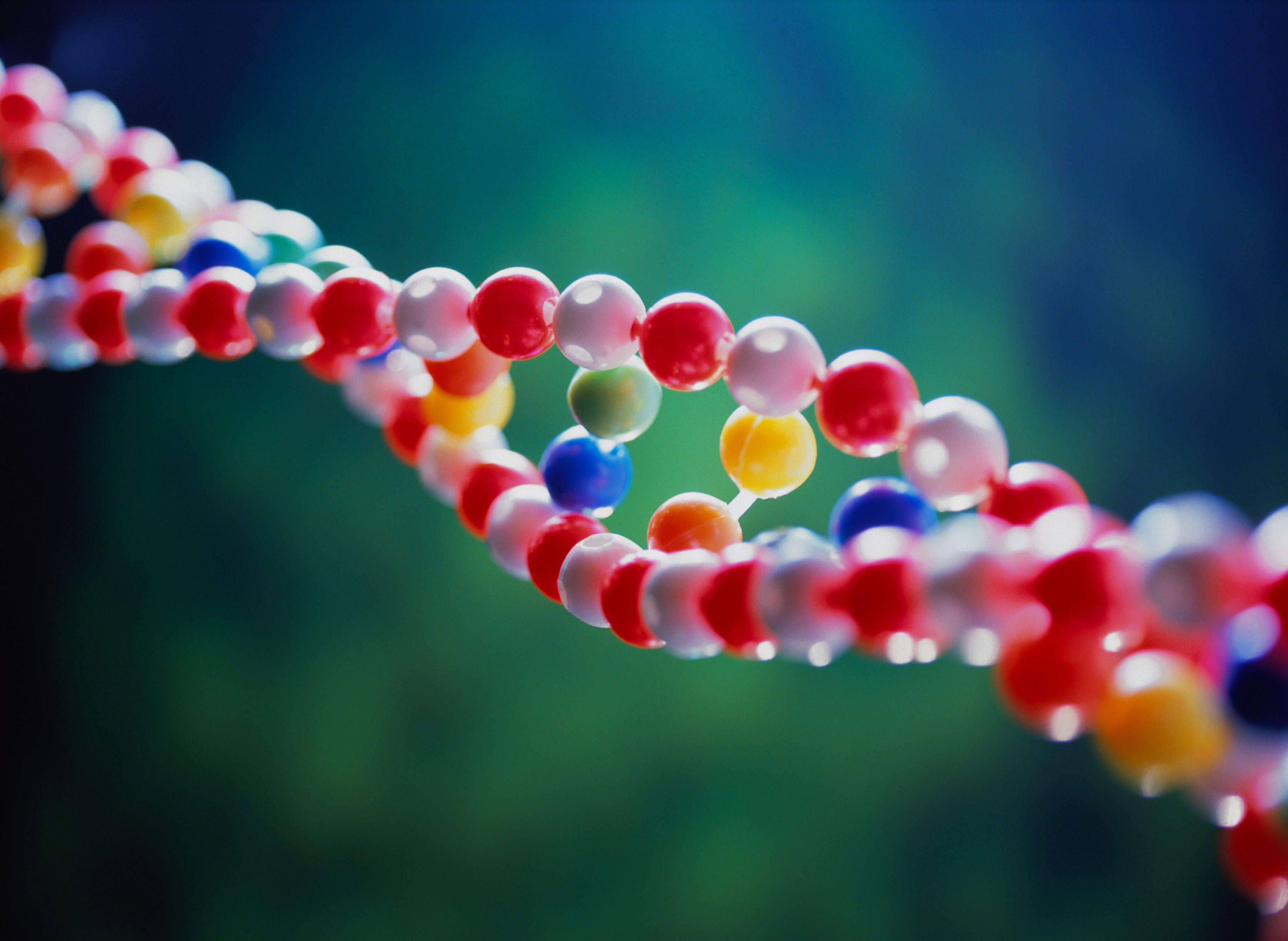
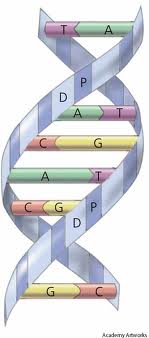
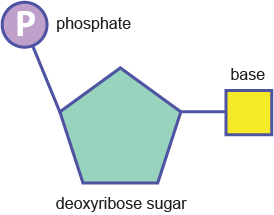
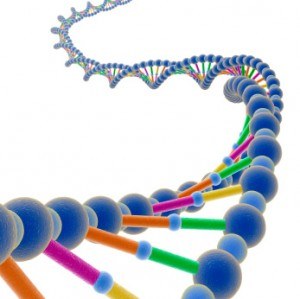
Name this structure
a)
double helix
b)
nucelotide
c)
twisted ladder
d)
hydrogen bond
9.
Which organelle is DNA usually found in?
a)
cell membrane
b)
vacuole
c)
ribosome
d)
nucleus
10.
Nucleotides are made up of a sugar, phosphate, and..?
a)
nitrogenous base
b)
nucleic acid
c)
cholesterol
d)
fatty acid
11.
Guanine bonds with ______________.
a)
Adenine
b)
Guanine
c)
Cytosine
d)
Thymine
12.
The two strands of DNA are held together by:
a)
Hydrogen Bonds
b)
Phosphodiester Bonds
c)
Glycolsyl Bonds
d)
Glycosidic Linkages
13.
What is the complement to the DNA strand below:
5'-ATGCCAT-3'
a)
5'-TACGGTA-3'
b)
3'-TACGGTA-5'
c)
3'-ATGGCAT-5'
d)
5'-ATGGCAT-3'
14.

Which of the following is a base pair?

a)

Adenine - Cytosine

b)

Cytosine - Thymine

c)

Deoxyribose - Cytosine

d)

Cytosine - Guanine

15.
Which of the following is not a component of DNA?
a)
5 Carbon Sugar
b)
Phosphate Group
c)
Carbon Base
d)
Nitrogen Base
16.
Which of the following is not a nitrogen base found in DNA?
a)
Thymine
b)
Uracil 
c)
Guanine
d)
Adenine
17.

How is the instructions for your traits carried on a DNA molecule?

a)

Sequence of the nitrogen bases

b)

In the Deoxyribose Sugar

c)

In the bond between the phosphate and the sugar

d)

In the phosphate group

18.
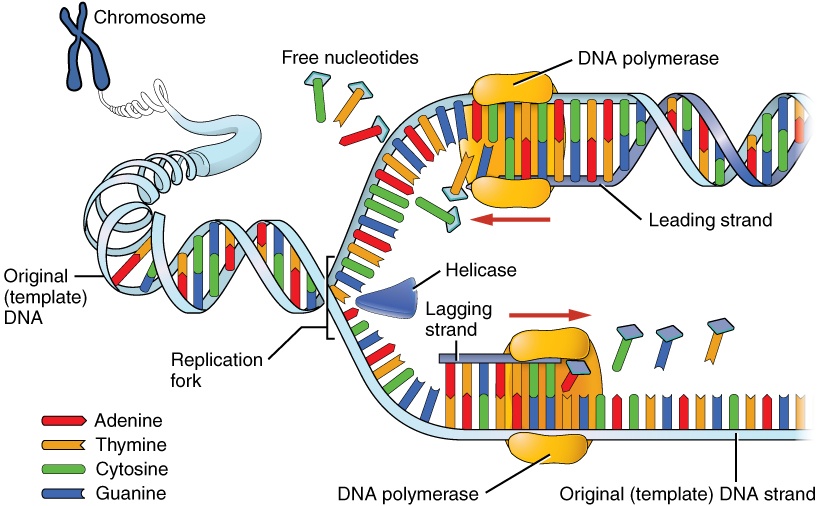
Why would it be important to replicate DNA before a cell divides in mitosis or meiosis?
a)
In order for genetic information to be transferred into daughter cells.
b)
In order for the cell to be able to increase in size.
c)
In order for the DNA to be contained in the nucleus.
d)
In order for the cell to re-order the DNA sequencing in the new cells.
19.

The end of mitosis results in  ____ to each other.

a)

2 cells that are identical

b)

4 cells that are identical

c)

2 cells that are not identical

d)

4 cells that are not identical

20.
The end of meiosis results in  ____ to each other.
a)
2 cells that are identical
b)
4 cells that are identical
c)
2 cells that are not identical
d)
4 cells that are not identical
21.

Reorder the phases of mitosis

a)

Prophase

b)

Metaphase

c)

Anaphase

d)

Telophase

1)
2)
3)
4)
22.

Reorder the phases of meiosis

a)

Prophase I

b)

Metaphase I

c)

Anaphase I

d)

Telophase I

e)

Prophase II

1)
2)
3)
4)
5)
23.
What phase is shown here?
a)
Prophase II
b)
Metaphase I
c)
Metaphase II
d)
Anaphase I
24.
What phase is this?
a)
Interphase II
b)
Prophase I
c)
Metaphase I
d)
Anaphase II
25.
What are chromosomes?
a)
different versions of genes
b)
condensed DNA 
c)
uncoiled DNA
26.
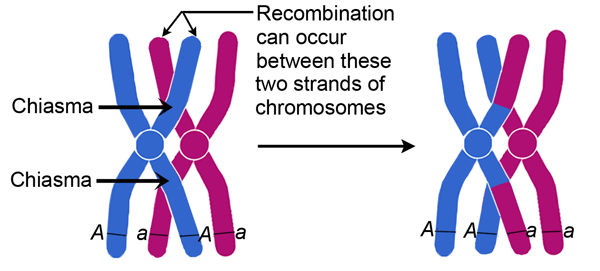
This image shows chromosomes during Prophase 1. Which of the following correctly describes the process shown?
a)

segregation of sister chromatids

b)

condensation and segregation of alleles

c)

mutationin which the DNA content of the gene is altered

d)

crossing - over in which genes are exchanged

27.

A chromosome is composed of two identical sister

a)

centromeres

b)

chromatids

c)

autosomes

d)

somatic cells

28.

In which type of cell division does crossing over occur?

a)

mitosis

b)

meiosis

29.

During meiosis, if an organism has 10 chromosomes, how many will the new daughter cells have?

a)

10

b)

8

c)

5

d)

2

30.

During mitosis, if an organism has 10 chromosomes, how many will the new daughter cells have?

a)

10

b)

8

c)

5

d)

2

31.

Which event is an important factor in increasing variety among sexually reproducing organisms?

a)

crossing over

b)

gene linkage

c)

testcross

d)

mitosis

32.

Select the image that represents meiosis:

a)
b)
33.

Haploid

a)

Chromosome number is maintained

b)

Chromosome number is halved

c)

Chromosome number is doubled

d)

Chromosome number is tripled

34.

Diploid

a)

Chromosome number is maintained

b)

Chromosome number is halved

c)

Chromosome number is doubled

d)

Chromosome number is tripled

35.

Somatic cells

a)

Body cells

b)

Sex cells

c)

Gametes

d)

Sperm

36.

Gametes

a)

Body cells

b)

Sex cells

c)

Skin cells

d)

Somatic cells

37.

The blending of two traits is known as ---

a)

incomplete dominance

b)

codominance

38.

A condition in which both alleles for a gene are expressed so that both traits are visible is known as ---

a)

Codominance

b)

Incomplete dominance

39.

What type of inheritance pattern is shown here?

a)

Codominance

b)

Incomplete dominance

40.

This is an example of ---

a)

Incomplete dominance

b)

Codominance