
 Worksheets
Unit 7: Astronomy
Total questions: 212
Worksheet time: 2hrs 46mins


Which object in space is NOT made of rock and metal/iron?
Asteroid
Meteor
Meteorite
Comet

The asteroid belt is located between which 2 planets?
Mercury and Venus
Jupiter and Saturn
Uranus and Neptune
Mars and Jupiter

Why does a comet's tail always point AWAY from the sun?
Because the sun gives off a strong solar wind blowing the tail away
The comets tail is being pulled by a gravitational force
A comets tail always points towards the sun
Which object in space looks like a "dirty snowball" because of its composition of ice, gas and dust?
Asteroid
Meteoroid
Comet
Meteor

A _____________ bursts through Earth's atmosphere at amazingly fast speeds and appears as a "shooting star"
Meteorite
Meteor
Meteoroid

A meteor that does not burn up in Earth's atmosphere and reaches Earth's surface
Meteorite
Meteoroid
Meteor
These are composed mainly of rock and metal.
comets and stars
stars and meteors
asteroid and meteors
comets and asteroid
Which is found in the belt between Mars and Jupiter
Comets
Asteroids
Meteors
Stars
A meteorite is DIFFERENT from a comet mainly because
has a tail of ice and gas
is found in orbit between Jupiter and Mars
enters the Earth's atmoshere
has a nucleus made of rock and snow.
I am a rock entering a planet's atmosphere.
meteor
moon
asteroid
comet

Which object in space is larger?
Asteroid
Meteoroid

A meteor when it burns in the atmosphere is also known as a ____.
rock
shooting star
ball of ice
A chunk of rock that is not burned up by the atmosphere and hits Earth's surface.
Meteoroid
Meteor
Meteorite
Comet
A chunk of rock or dust in space that comes from an asteroid or comet.
Meteoroid
Meteor
Meteorite
Comet
A rocky object that revolves around the sun, but is too small to be considered a planet.
Meteor
Comet
Asteroid
The craters on the moon were caused by the impact of ________________.
Asteroids
Comets
Meteors
Meteorites
A chunk of ice and dust whose orbit is usually a long, narrow ellipse
Meteoroid
Comet
Asteroid
Meteor
The nucleus, coma, and tail are the three parts of a(n) __________________________.
Comet
Asteroid
Meteor
Gas and dust form a fuzzy outer layer around a comet's head, called a ______________________.
Nucleus
Coat
Coma
Tail
Scientists hypothesize that the dinosaurs became extinct as a result of a large _______________ hitting Earth 65 million years ago.
Comet
Asteroid
Meteor
As a comet approaches the sun, the gas and dust heat up and ____________________________.
form a fuzzy coma.
stream outward forming tails.
disappear.
shrink.
Chunks of ice and dust who orbits are usually a long, narrow ellipse.
Meteor
Comet
Asteroid
Which objects are found in the Oort cloud and Kuiper belt?
Comets
Meteors
Asteroids
The asteroid belt passes between the orbits of which two planets?
Earth and Mars
Mars and Jupiter
Jupiter and Saturn
Saturn and Uranus
A doughnut-shaped region of comets that extends from beyond Neptune's orbit to about 100 times Earth's distance from the sun.
Kuiper Belt
Asteroid Belt
Oort Cloud
Milky Way
A spherical region of comets that surrounds the solar system out to more than 1000 times the distance between Pluto and the sun.
Kuiper Belt
Asteroid Belt
Oort Cloud
Milky Way
A streak of light in our atmosphere is a _____________________.
Meteor
Comet
Asteroid
Falling/Shooting Star
Which objects are smallest?
Meteoroids
Asteroids
Comets

Select the 3 materials a comet is composed (made) of
Dust
Metal
Ice
Small rocky particles

Asteroids are found in a region called the
Kuiper Belt
Asteroid Belt
Oort Cloud
Earth's surface

Which object in space has a long, narrow orbit around the sun. We never see this object except once every 76 years!
Asteroid
Comet
Meteor
Meteorite

A comet forms a tail when
It is deep in outer space and begins to melt
It gets close to the sun and begins to melt

Ceres is the largest asteroid located in the asteroid belt. It is nearly 587 miles wide and is between the orbits of ________________
the sun and Earth
Mars and Jupiter
Saturn and Neptune
Jupiter and Uranus

A small rock orbiting the sun in space. This object is a small broken off piece of a larger asteroid
Meteoroid
Meteor
Meteorite

Planets, asteroids, comets and meteoroids all stay in orbit around the sun due to the sun's strong force of _________________
electricity
solar power
gravity
motion


True or False: Tides are caused by the gravitational pull of the Moon and Sun on the surface waters of Earth.
True
False
True or False: The position of Earth, the moon, and sun determine the phase of the moon.
True
False
The bright side of the moon is getting smaller on the left, (light on the left), this is a _________ moon.
Waxing
Waning
The the bright side of the moon is growing on the right, (light on the right) it is a _______ moon.
Waxing
Waning
Approximately how long does it take the moon to make one revolution around Earth?
365.25 days
24 hours
29 days
84 years
True or False: The moon does not create it own light, but reflects light from the sun.
True
False
What is the order of the moon phases?
full moon, waxing gibbous, 1st quarter, waxing crescent, new moon, waning crescent, 3rd quarter, waning gibbous
new moon, waxing crescent, 1st quarter, waxing gibbous, full moon, waning gibbous, 3rd quarter, waning crescent
new moon, 1st quarter, waxing crescent, waxing gibbous, full moon, waning crescent, waning gibbous, 3rd quarter
new moon, waning crescent, 3rd quarter, waning gibbous, full moon, waxing gibbous, 1st quarter, waxing crescent
What does waxing mean?
illumination is getting smaller on the left
illumination is getting smaller on the right
illumination is getting bigger on the left
illumination is getting bigger on the right
What does waning mean?
illumination is getting bigger on the right
illumination is getting smaller on the left
illumination is getting smaller on the right
illumination is getting bigger on the left
What does crescent mean?
fully illuminated
half illuminated
more than half illuminated
less than half illuminated
What does gibbous mean?
more than half illuminated
half illuminated
less than half illuminated
no illumination
What does quarter mean?
fully illuminated
less than half illuminated
half illuminated
more than half illuminated
What causes moon phases?
The moon is half illuminated by the sun and as it orbits the earth, we see different amounts of that illumination.
Mrs. Turman causes moon phases.
The moon is always completely illuminated by the sun and as it rotates we see some of it.
The moon is never illuminated by the sun and as it spins around we see none of it.

What type of eclipse is this an example of?
Lunar Eclipse
Solar Eclipse

What type of eclipse is this an example of?
Lunar Eclipse
Solar Eclipse

What type of eclipse is this an example of?
Lunar Eclipse
Solar Eclipse

What type of eclipse is this an example of?
Lunar Eclipse
Solar Eclipse
The order for a solar eclipse is Sun, Moon, Earth.
True
False
The moon phase for a solar eclipse is a full moon.
True
False
A solar eclipse happens during the day.
True
False
The moon phase for a lunar eclipse is a full moon.
True
False
A _________________ is the blocking of the Sun's light that occurs during a new moon when the moon's shadow falls on earth.
solar eclipse
lunar eclipse
umbra
penumbra
A _______________ is the blocking of sunlight to the moon; occurs when the moon passes through earth's shadow.
solar eclipse
lunar eclipse
umbra
penumbra
Which statement about the universe is NOT true?
The universe is bigger than our solar system
It is colder today than it was 13.8 billion years ago
The universe was formed 7 billion years ago
The universe contains leftover energy from the Big Bang
The observation that light from galaxies appears red supports the theory that...
The universe is expanding
The universe is shrinking
Galaxies are moving towards the Earth
Sound waves are moving away from the Earth
What force of energy caused all the particles to come together to form galaxies, planets, etc..?
Gravitational
Magnetic
Electrical
Radiant
Which of the following statements is true?
Our solar system is one of many systems in the universe
Galaxies do not contain solar systems within them
There are only two galaxies in the universe
A light year is the distance between the Earth and the Sun
What is the definition of a SOLAR SYSTEM?
Two or more atoms joined together chemically
Planets, stars, asteroids that orbit or travel around a star
A collection of gas, dust, and stars held together by gravity
Distance light travels in on year, equal to 6 trillion miles
The name of our galaxy...
Andromeda Galaxy
Milky Way Galaxy
Pinwheel Galaxy
Sombrero Galaxy
Most scientists believe the Big Bang Theory explains which of the following questions?
How our planets and moons formed
How our universe began
How the sun turns hydrogen into helium
How fast light travels through space
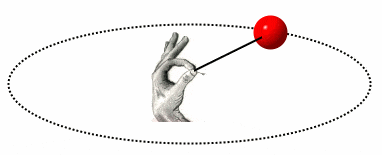
Which force in the Solar System is similar to the tension in the string?
What do the initial moments after the Big Bang have in common with the universe as it exists now? Choose the best answer.
all the stars, galaxies, and planets that exist today were formed moments after the Big Bang
the universe could not sustain life back then, and it cannot sustain life now
the universe is extremely hot then, and it is still extremely hot now
the universe began expanding then, and it is still expanding now
According to the Big Bang theory, how old is the universe?
6,000 years
65 million years old
4.5 billion years
14.5 billion years
What is one major piece of evidence that the Big Bang theory is correct?
astronomers have detected leftover radiation from the Big Bang
everything in the universe has remained the in same location for billions of years
astronomers have detected that the universe is no longer expanding
astronomers have detected that the universe is contracting

Which type of galaxy is characterized by having no particular axis of rotation, stars having random orbits, and having older stars?
A. elliptical galaxy
B. irregular galaxy
C. lenticular galaxy
D. spiral galaxy

Which type of galaxy is characterized by active formation of new stars, presence of a central bulge and "arms," and stars orbiting around the center in the same direction?
A. elliptical galaxy
B. irregular galaxy
C. lenticular galaxy
D. spiral galaxy

Which type of galaxy which does not have a definite shape?
A. elliptical galaxy
B. irregular galaxy
C. lenticular galaxy
D. spiral galaxy
Which of the following is a galaxy similar to our own, the Milky Way galaxy?


The spiral shape of the Milky Way cannot be seen from Earth because ______________.
we are located above the galaxy
we are located in one of its spiral arms
our view is blocked by the Sun
none of the above
There are _________ of galaxies in our universe.
hundreds
thousands
millions
billions
What is at the middle of a Heliocentric system?
Mars
Moon
Sun
Earth
What is at the middle of a Geocentric system?
Sun
Neptune
Earth
The Universe
Who supported the Geocentric system?
Ptolemy
Aristotle
Copernicus
Galileo
Who proposed the Heliocentric system?
Copernicus
Ptolemy
Aristotle
Galileo
What does the Geocentric system look like?
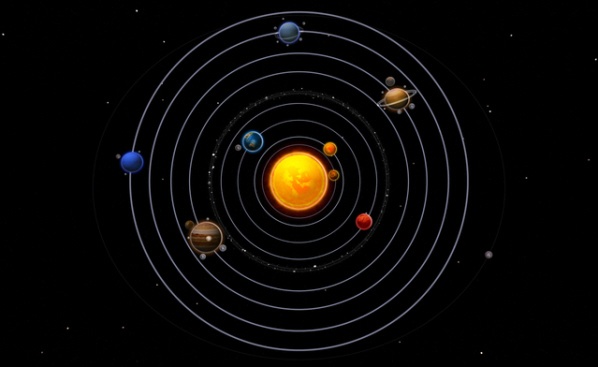
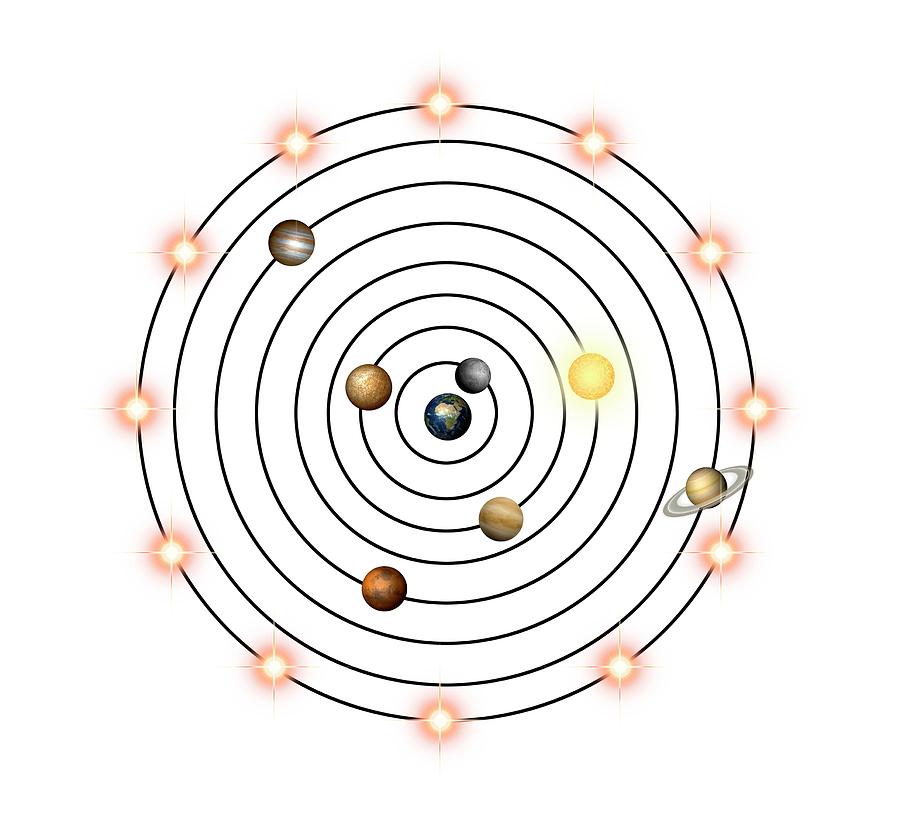
What does the Heliocentric system look like?


What is the biggest difference between the Geocentric Model and the Heliocentric Model?
the shape of the planets' orbits
the movement of the moon
the center of the solar system
Kepler's first law states that the orbits of the planets are in the shape of a/an...
perfect circle
ellipse
spiral

Whose book was published about the heliocentric model of the universe just after he died?
Ptolemy
Copernicus

Who came up with this model?
Copernicus
Kepler
Galileo Galilee
Ptolemy

Which scientific instrument did Galileo use to change the world?
telescope
spyglass
mirror
magnifying glass
Which object is the center of the solar system according to Galileo?
Earth
Moon
Sun
Neptune
Who supported Copernicus's Heliocentric Model
Galileo
Plato
Ptolemy
No one
Which astronomer first observed the phases of Venus and Jupiter's moons with the help of a telescope?
Gailieo
Aristarchus
Kepler
Aristotle
Copernicus
Who discovered the shape of a planet's orbit is actually an ellipse?
Ptolemy
Copernicus
Kepler
Galileo
Who used a telescope to prove that the Earth could not be the center of the universe?
Ptolemy
Copernicus
Kepler
Galileo
What is the smallest planet?
Venus
Pluto
Jupiter
Mercury
What is the hottest planet?
Venus
Mercury
Earth
Jupiter
Pluto is a..?
Tiny planet
Dwarf planet
A planet
Moon
What planets are IN FRONT OF the asteroid belt?
Inner planets
Outer planets
Both
None
Select all that apply to the GAS GIANTS
They all have rings
They are all made of gas
They have a rocky surface
They are very small
Which planet tilts 90 degrees on its axis(which planet is upside down) ?
Jupiter
Earth
Saturn
Uranus
Which planets are BEHIND the asteroid belt?
Inner planets
Outer planets
Both
None
Select all that apply to the ROCKY or TERRESTRIAL planets
They are small
They are made of gas
They have a rocky surface
They are closer to the sun
Which of the gas giants has the largest rings?
Jupiter
Saturn
Mercury
Neptune
Why is Venus so hot?
It's closest to the sun
It was just made like that
gas composition of its atmosphere
It is pure fire
Which is the correct order of the planets furthest from the sun?
Saturn, Uranus, Jupiter, Neptune
Uranus, Neptune, Jupiter, Saturn
Neptune, Jupiter, Uranus, Saturn
Jupiter, Saturn, Uranus, Neptune
Which planet is the largest planet in our solar system
Jupiter
Saturn
Mars
Earth
Which of the following is a gas giant?
Venus
Earth
Mars
Neptune

Where is the asteroid belt located?
between Earth and Mars
between Jupiter and Saturn
between Mars and Mercury
between Mars and Jupiter
Supports life
Composed of rock
3rd planet from sun
Venus
Earth
Mercury
Mars
8th planet from the Sun; an outer planet
Mars
Neptune
Earth

Which planet is the only planet to spin on its side?
Earth
Jupiter
Neptune
Uranus
Which of the following best describes the outer planets? Click all the apply
Very large
Made of liquids and gases
Smaller
Further apart
Which of these planets has the coldest surface temperature?
Uranus
Saturn
Jupiter
Neptune
Dry, rocky planet covered in toxic clouds
Mercury
Venus
Earth
Mars

Which planet is known as the "red planet"?
Venus
Mercury
Earth
Mars
least dense planet, could float in water
Jupiter
Saturn
Uranus
Neptune
What is the correct order of the planets starting from the sun
mars, venus, mercury, earth
venus, mercury, earth, mars
mercury, venus, earth, mars
mercury, earth, venus, mars
What planet is most similar to earth?
Mars
Venus
Earth
Mercury
The planets that are deemed the inner planets can be described as the following: Pick 3
Rocky
Smaller
Gaseous
Terrestrial
What set of planets are known to be closer together?
Inner Planets
Outer Planets
What causes planets to orbit the sun rather than the sun to orbit the planets?
sun has a greater mass than planets
sun is center of universe
planets have a smaller diameter than sun
sun is center of solar system
How old is the Sun?
365 days
2.5 millions
4.6 billion
1 million

What is the 4th planet from the Sun?
Earth
Jupiter
Mars
Mercury
What planet has 1 moon?
Venus
Jupiter
Earth
Mercury
1. Inner Planets are also called.
Terrace Planets
Terminal Planets
Terrestrial Planets
Treasure Planets
Which of the following is considered the 'Red Planet?
Mars
Earth
Venus
Mercury
Even though Mercury is the closest planet to the Sun, Venus is the hottest of all planets in the solar system.
Yes
No
How many planets are there?
7
9
8
3
What are the 4 outer planets?
Mercury, Venus, Earth, Mars
Uranus, Mercury, Earth, Mars
Jupiter, Uranus, Saturn, Neptune
Jupiter, Saturn, Earth, Mars
The inner planets share 2 qualities or characteristics
Humans can live on them, they all have water
They are rocky, and humans can find food on them
They are rocky and close to the Sun
They are close to the Sun, and humans can live on them
The first planet, closest to the Sun, and the smallest planet. Is extremely hot during the day and freezing cold at night.
Mercury
Jupiter
Venus
Uranus
The second planet from the Sun, the atmosphere is made up of 96% carbon dioxide, extremely hot and the atmospheric pressure is bone crushing.
Earth
Venus
Mars
Saturn
The third planet from the Sun, has liquid water, and keeps a temperature that allows humans to live
Earth
Venus
Mercury
Mars
The fourth planet from the Sun, called the Red planet, and extensively explored and observed
Neptune
Venus
Jupiter
Mars
What are the 2 characteristics of the 4 outer planets.
They are rocky and small in size
Larger planets and made of gas
Closer to the Sun and made of gas
Farther from the Sun and made of gas
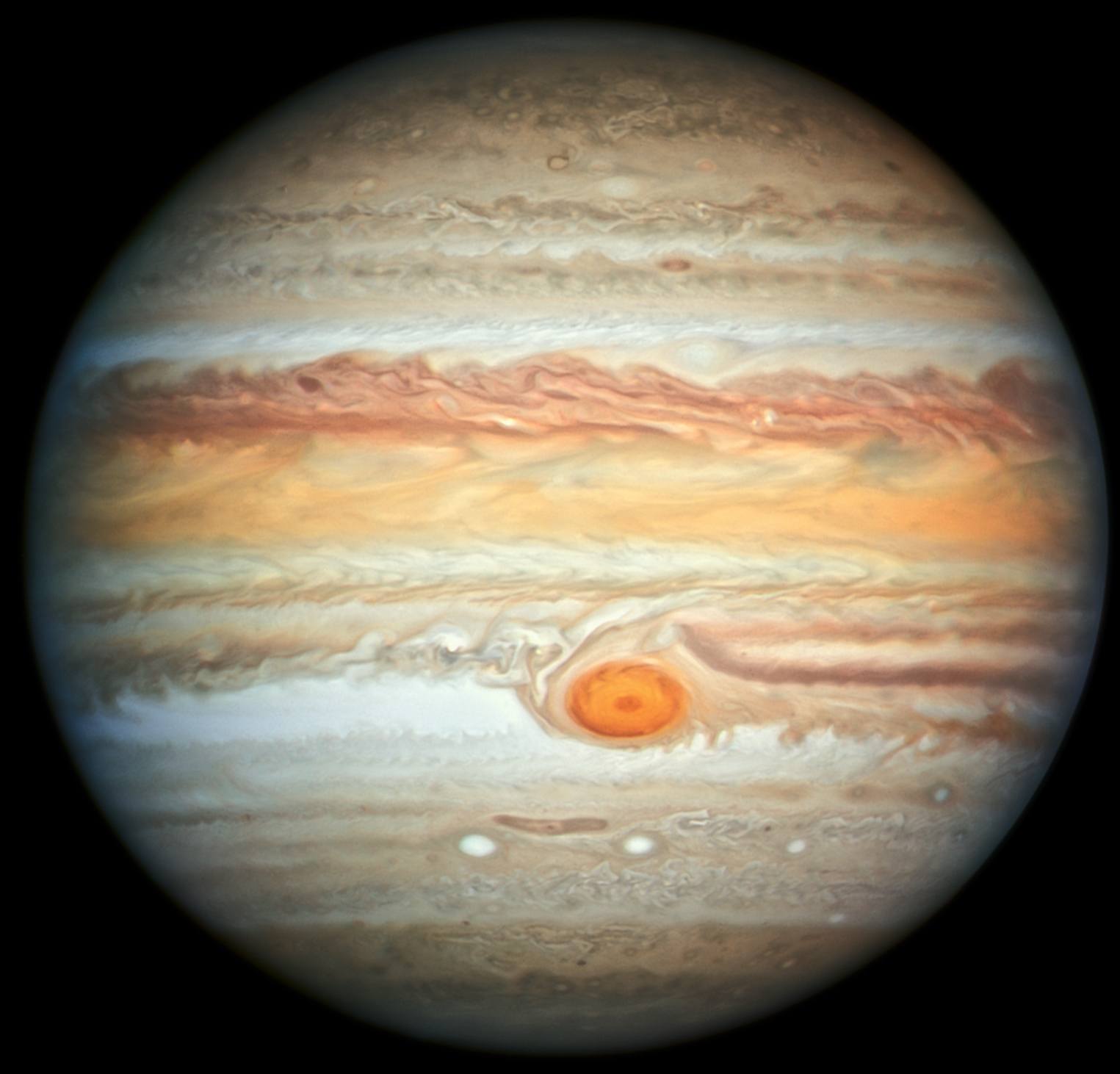
The fifth planet, the largest planet and has a large storm called the Giant Red Spot that is visible from Earth
Neptune
Uranus
Jupiter
Earth
The sixth planet, known for its rings made of ice particles, considered the lightest planet and is 95% than Earth
Jupiter
Saturn
Neptune
Uranus
The seventh planet, originally called Herschel, rotates on its side due to the angle of the axis.
Uranus
Jupiter
Neptune
Mercury
The eighth planet, a dark blue color, windiest planet, with a set of rings including a set of rings that are braided
Neptune
Uranus
Earth
Mars
Discovered in 1930, originally a planet and then switched to a dwarf planet in 2006.
Pluto
Neptune
Uranus
Jupiter
Is the sun a planet?
Yes.
No.
Which of the following is a true statement?
The Sun is the center of the Milky Way Galaxy.
Our solar system is near the center of the Milky Way Galaxy.
The Sun is the center of the solar system.
The galactic center is the center of our solar system.
This planet has a THICK, toxic atmosphere which makes it unable to sustain life
Mercury
Venus
Earth
Mars
This planet is about 1/2 the diameter of the Earth
Mercury
Venus
Earth
Mars
This planet can be referred to as Earth's ✨TWIN✨
Mars
Earth
Venus
Mercury
Which planet is the smallest
Mercury
Venus
Earth
Mars


What is special about the length of daylight on the fall equinox?
Day and night are equal
Longest day of the year
Shortest day of the year
What is special about the length of daylight on the spring equinox?
Day and night are equal
Longest day of the year
Shortest day of the year
What is special about the length of daylight on the summer solstice?
Day and night are equal
Longest day of the year
Shortest day of the year
What is special about the length of daylight on the winter solstice?
Day and night are equal
Longest day of the year
Shortest day of the year
Where are the sun's rays shining most directly on the fall equinox?
Equator
Northern Hemisphere
Southern Hemisphere
What causes seasons?
Tilt of the Earth on its axis
Earth's distance from the sun
Why does the earth experience day and night?
Earth is rotating around the sun.
Earth is rotating around the sun and moon.
Earth makes one full rotation on its axis every 24 hours.
Earth makes one full revolution around the sun in 365 days.

Which hemisphere will experience shorter days and longer nights?
Northern
Southern

What season will it be in the southern hemisphere in 6 months?
Summer
Spring
Fall
Winter

What season will come next in the norther hemisphere?
Summer
Winter
Spring
Fall

What season is represented in the southern hemisphere?
Summer
Winter
Fall
Spring

