
 Worksheets
Res Geo Semester 2 Exam Review
Total questions: 196
Worksheet time: 2hrs 38mins
Name
Class
Date
1.
The largest hot desert in the world, stretching across most of North Africa
a)
Siberia
b)
Sahara
c)
Gobi
2.
Rulers of ancient Egypt
a)
pharaohs
b)
czars
c)
princes
3.
the narrow waterway that separates Europe from Africa by 8 miles
a)
English Channel
b)
Red Sea
c)
Strait of Gibraltar
4.
a ship canal in northeastern Egypt linking the Red Sea with the Mediterranean Sea
a)
English Channel
b)
Aswan High Dam
c)
Suez Canal
5.
Large areas of sand with tall dunes in the Sahara
a)
wadis
b)
hamadas
c)
ergs
6.
Underground water bearing layers of porous rock, sand or gravel
a)
hamada
b)
aquifer
c)
heiroglyphic
7.
monumental architecture typical of ancient Egypt; used as important burial sites
a)
pyramids
b)
aquifers
c)
hamadas
8.
A series of public protests, strikes, and rebellions in the Middle East and North Africa, often facilitated by social media that has called for fundamental government and economic reforms
a)
Arab Spring
b)
Arab Summer
c)
Arab Fall
9.
a structure to control the floodwaters of the Nile River and create electricity
a)
Sphinx
b)
Suez Canal
c)
Aswan High Dam
10.
World's longest river, which flows northward through northeast Africa into the Mediterranean Sea.
a)
Nile River
b)
Amazon River
c)
Jordan River
11.
Africa's longest mountain range
a)
Ural Mountains
b)
Himalayan Mountains
c)
Atlas Mountains
12.
Members of a group that have no permanent home, wandering from place to place in search of food and water
a)
hamadas
b)
sheiks
c)
nomads
13.
Which country of North Africa has the most oil reserves?
a)
Morocco
b)
Libya
c)
Egypt
14.
What is the official language of all 5 countries of North Africa?
a)
French
b)
Parsi
c)
Arabic
15.
Which North African country is directly WEST of Egypt?
a)
Jordan
b)
Sudan
c)
Libya
16.
What is the name of the desert that covers much of North Africa?
a)
the Arabian Desert
b)
the Sahara Desert
c)
the Egyptian Desert
17.
Name:
4 lines
18.
What are three major water problems in Southwest Asia?
a)
Water shortages, unequal distribution, pollution
b)
Water shortages, flooding, pollution
c)
Too much ground water, aquifers, pollution
d)
Flooding, pollution, dams
19.
___________________ location between Europe and Asia means that it has been at the center of trade routes for thousands of years.
a)
Iraq's
b)
Syria's
c)
Turkey's
d)
Saudi Arabia's
20.
_________ are the most common physical feature here and make up 66% of the area.
a)
Deserts
b)
Mountains
c)
Grasslands
21.
Much of the world’s oil supply is shipped through the narrow waterway between Iran and the Arabian Peninsula called the __________________.
a)
Suez Canal
b)
Panama Canal
c)
Strait of Hormuz
d)
Strait of Gibraltor
22.
Which river is the key water source for Israel, Lebanon, and Syria?
a)
Tigris River
b)
Euphrates River
c)
Suez Canal
d)
Jordan River
23.
Disputes over what two natural resources are problematic for many Southwest Asian countries?
a)
Oil and Water
b)
Diamonds and Natural Gas
c)
Water and Diamonds
d)
Oil and Diamonds
24.
Which rivers flow through Turkey and Iraq?
a)
Jordan and Tigris
b)
Tigris and Euphrates
c)
Red and Jordan
d)
Jordan and Euphrates
25.
Because of its harsh climate, which country has to rely on desalination plants to provide most of its citizens’ drinking water?
a)
Israel
b)
Saudi Arabia
c)
Syria
d)
Turkey
26.
Pollution from oil spills on the Black Sea contaminate this country’s water supply:
a)
Israel
b)
Turkey
c)
Saudi Arabia
d)
Iran
27.
The process of removing salt from salt water in order to make it suitable for farming and drinking is known as
a)
Extraction
b)
Desalination
c)
Absorption
28.
This area holds one of the largest and most important oil fields in the world.
All of the countries that produce oil in that region depend on it as a shipping route.
a)
Arabian Sea
b)
Red Sea
c)
Persian Gulf
d)
Dead Sea
29.
What non-renewable natural resource has contributed to the growth of the Middle East?
a)
Oil
b)
Timber
c)
Water
d)
Cotton
30.
Which country has fought military battles over water rights to the Jordan River?
a)
Israel
b)
Iran
c)
Iraq
d)
Turkey
31.
Which best describes the climate of much of Southwest Asia?
a)
hot and dry
b)
tropical and rainy
c)
windy and cold
d)
moderate and cold
32.
The climate of Southwest Asia has led much of the region to experience a scarcity of _____________.
a)
trading
b)
oil production
c)
rainfall
33.
This 25-mile territory has been a source of dispute between Israel and its neighbors for many years:
a)
Gaza Strip
b)
Strait of Hormuz
c)
Persian Gulf
34.
The Strait of Hormuz connects which bodies of water?
a)
Red Sea & Arabian Sea
b)
Mediterranean Sea & Persian Gulf
c)
Persian Gulf & Arabian Sea
35.
irrigation
a)
Underground tunnels in Southwest Asia that bring water from the hills to dry plains
b)
The process of using salt water for drinking water
c)
The process of removing salt and other chemicals from the salt water
d)
Providing water for crops
36.
Drip irrigation
a)
Watering fields
b)
A system using computers, that measure out how much water each plant receives
c)
Using hoses to water plants
d)
Tapping fossil water
37.
Hydroelectric Power
a)
Creating a reservoir lake on a river
b)
The building of dams on rivers
c)
The collection of river water behind a dam
d)
Electricity produced from the energy of running water
38.
Nomads
a)
Sunni Muslims
b)
People who move from place to place, usually traveling by camel, looking for water or food
c)
People who hunt and gather
d)
People who live on the areas surrounding the desert
39.
Qanats
a)
Underground tunnels in Southwest Asia that bring water from the hills to dry plains
b)
Layers of untapped fossil water
c)
Layers of underground rock where water runoff from rains and streams is trapped
d)
Underground lake
40.
Gaza Strip
a)
The border area between Jordan and Israel
b)
The disputed area of the Muslims and Palestinians
c)
A coastal region at the southeastern corner of the Mediterranean Sea bordering Israel and Egypt
d)
The area held by the Israelis
41.
Underground Aquifers
a)
Underground tunnels in Southwest Asia that bring water from the hills to dry plains
b)
The use of water wheels
c)
Layers of underground rock where water runoff from rains and streams is trapped
d)
Using pumps to gain access to fossil water
42.
Desalination
a)
The process of removing salt and other chemicals from the salt water
b)
Providing water to crops
c)
The drinking of salt water
d)
The addition of salt to fossil water
43.
OPEC
a)
Operation of Petroleum Exporting Countries founded to set oil prices and polices
b)
Organization of Petroleum Exporting Countries founded to set oil prices and policies
c)
Original Petroleum Exporting Countries founded to set oil prices and policies
d)
Organizing Petroleum Exporting Counties founded to set oil prices and policies
44.
Subsistence Farming
a)
Growing food to provide for the sustenance (that which sustains life; nourishment, food) of your family
b)
Growing enough food to sell at the farmer's market
c)
Growing food to sell to the government
d)
A government coop that grows food
45.
Name:
4 lines
46.
True or False. Russia is physically, the largest country in the world?
a)
true
b)
false
47.
Which Russian river flows into the Caspian Sea?
a)
Amur River
b)
Yenisei River
c)
Lena River
d)
Volga River
48.
If travelling from Russia to Europe, which direction would you travel?
a)
north
b)
south
c)
east
d)
west
49.
Which city is the capital of Russia?
a)
Siberia
b)
St. Petersburg
c)
Vladivostok
d)
Moscow
50.
Which landform serves as the "dividing line" between European Russia and Siberia?
a)
The Ural Mountains
b)
The Volga River
c)
The Caucasus Mountains
d)
The Taiga Forest
51.
Siberia occupies how much of Russia?
a)
3/4
b)
1/4
c)
1/2
d)
1/3
52.
Of the choices listed, which river is located in Western Russia?
a)
Lena River
b)
Yenisei River
c)
Volga River
d)
Ob River
53.
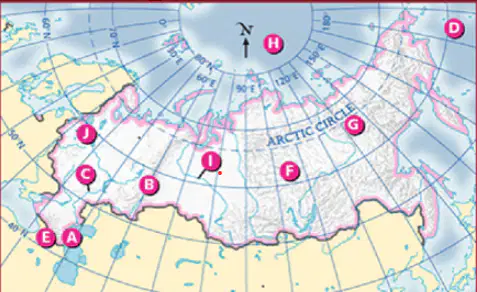
What is located at letter A?
a)
Caspian Sea
b)
Caucasus Mountains
c)
Ural River
d)
Ob River
54.
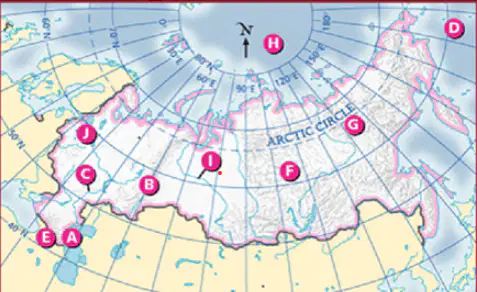
What is located at letter B?
a)
Zurich
b)
St. Petersburg
c)
Leningrad
d)
Moscow
55.
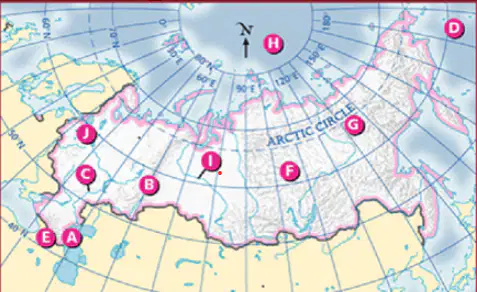
What is located at letter C?
a)
Zurich
b)
Leningrad
c)
Moscow
d)
St. Petersburg
56.
What is an upland?
a)
an area of high elevation
b)
a sloping area
c)
an area with a plateau on top
d)
a place with a high cost of living
57.
How many time zones are covered in Russia?
a)
2
b)
11
c)
16
d)
9
58.
What is the world's deepest freshwater lake?
a)
Lake Onega
b)
Lake Ontario
c)
Lake Chaney
d)
Lake Baikal
59.
Which part of Russia has permafrost?
a)
North
b)
East
c)
West
d)
South
60.
What is the "taiga" portion of Russia?
a)
a type of mammal in Russian Siberia
b)
a zone of coniferous forest in Russia
c)
a zone of deciduous forest in Russia
d)
a food native to Russian culture
61.
What is the largest inland body of water in the world?
a)
Lake Michigan
b)
The Red Sea
c)
The Caspian Sea
d)
The Black Sea
62.
What is the world's largest and flattest plain?
a)
West Siberian Plain
b)
Russian Plain
c)
The Great Plains
d)
East Siberian Plain
63.
The Ural Mountains are how many years old?
a)
100,000
b)
100
c)
250,000,000
d)
1,000,000
64.
Which Russian river flows into the Caspian Sea?
a)
Volga
b)
Amur
c)
Yenisey
d)
Lena
65.
Most of Russia's natural gas, coal, and oil can be found where?
a)
Moscow
b)
Siberia
c)
Kazan
d)
Sochi
66.
South of the Russian Plain you can find ______.
a)
the Alps
b)
the Appalachian Mountains
c)
Gold
d)
the Caucasus Mountains
67.
Which choice is an example of the amount of natural resources found in Russia?
a)
an abundance
b)
none
c)
a good amount
d)
very little
68.
Russia is a massive country, it is the _____ largest country in the world.
a)
2nd
b)
6th
c)
1st
d)
3rd
69.
Within the Russian Plain, you can find most of Russia's ______.
a)
human rights issues
b)
mountains
c)
food sources
d)
people and cities
70.
The Ural mountains can be found in which direction from the Russian Plain?
a)
west
b)
south
c)
east
d)
north
71.
a policy that allows the rebuilding of the Soviet economy
a)
collective farm
b)
glasnost
c)
perestroika
d)
coup
72.
the sudden violent overthrow of top government leaders by another group of leaders
a)
collective farm
b)
glasnost
c)
perestroika
d)
coup
73.
a policy that allows open discussion about Soviet life and politics.
a)
collective farm
b)
glasnost
c)
perestroika
d)
coup
74.
a large farm run by a group of people working together under government supervision
a)
collective farm
b)
glasnost
c)
perestroika
d)
coup
75.
land that is dry, flat, and covered with grass
a)
permafrost
b)
steppe
c)
estate
d)
serf
76.
a large area of land or property that is usually owned by one person or family
a)
permafrost
b)
steppe
c)
estate
d)
serf
77.
a peasant who cannot legally leave the land in which he or she works
a)
permafrost
b)
steppe
c)
estate
d)
serf
78.
permanently frozen layer of soil just beneath the Earth's surface
a)
permafrost
b)
steppe
c)
estate
d)
serf
79.
Who was the first "czar" of Russia?
a)
Peter the Great
b)
Ivan the Third
c)
Joseph Stalin
d)
Pavel Demitra
80.
Which city is considered the "crown jewel" of Russia?
a)
Moscow
b)
Leningrad
c)
Perm
d)
St. Petersburg
81.
Name:
4 lines
82.
What is the capital of Norway?
a)
Oslo
b)
Stockholm
c)
Copenhagen
83.
What is the capital of Sweden?
a)
Oslo
b)
Stockholm
c)
Copenhagen
d)
Reykjavik
84.
What is the capital of Iceland?
a)
Oslo
b)
Stockholm
c)
Copenhagen
d)
Reykjavik
85.
Which country of Scandinavia has the most lakes?
a)
Sweden
b)
Finland
c)
Denmark
d)
Iceland
86.
What is the capital of Finland?
a)
Reykjavik
b)
Helsinki
c)
Oslo
d)
Copenhagen
87.
What is the capital of Denmark?
a)
Copenhagen
b)
Stockholm
c)
Nuuk
d)
Helsinki
88.
What is the capital of Greenland?
a)
Copenhagen
b)
Oslo
c)
Nuuk
d)
Helsinki
89.
What are the Northern Lights?
a)
Pollution from some of the major cities in Scandinavia, orbitting earth
b)
Particles colliding in the atmosphere turning into visable light
c)
Space dust reflecting against the moon and stars to glow green
90.
What is a fjord?
a)
An island that is ringed by cliffs
b)
A cliff that juts out into the ocean
c)
An inlet of ocean surrounded by cliffs
91.
Which peninsula is mainland Denmark on?
a)
Scandinavian
b)
Jutland
c)
Iberian
92.
Which city has the lowest average temperature?
a)
London
b)
Umea
c)
Copenhagen
93.
What is the main religion of Scandinavia?
a)
Christianity
b)
Lutheranism
c)
Protestantism
94.
What is the name of the tallest waterfall in Norway?
a)
Pffhuseeium
b)
Kloutneer
c)
Vinnufossen
95.
Which country has a seed bank that contains a sample of at least one of all seeds in the world?
a)
Sweden
b)
Norway
c)
Denmark
96.
What is the tallest mountain in Norway?
a)
Galdhøpiggen
b)
Gooløjkkien
c)
Samara
97.
Which country contains Lake Vanern, the 3rd largest freshwater lake in Europe?
a)
Sweden
b)
Norway
c)
Finland
98.
Which sea is North of the North Sea?
a)
Norwegian
b)
Barents
c)
Baltic
99.
What was the Baltic Ice Lake?
a)
A new Sweedish Spa
b)
The name of the ship that is built to travel in the Arctic Circle
c)
A stage in for the formation of The Baltic Sea
100.
Which country do the Faeroe Islands belong to?
a)
Sweden
b)
Denmark
c)
Iceland
101.
Which three countries are actually considered to be Scandinavia?
a)
Finland, Norway, Sweden
b)
Denmark, Sweden, Finland
c)
Norway, Sweden, Denmark
102.
What is a glacier?
a)
A lake of ice-cold water that freezes in the summer
b)
When snow is compacted into sheets of ice
c)
A village built with ice/snow (igloos)
103.
Which country is NOT part of Scandinavia?
a)
Russia
b)
Norway
c)
Finland
104.
Lapland is the area of Europe north of _____.
a)
Prime Meridian
b)
Arctic Circle
c)
Equator
105.
Which country is NOT a part of Lapland?
a)
Russia
b)
Finland
c)
Denmark
106.
What is the time of year from May 22nd-July 23rd called?
a)
Land of Lots of Sun
b)
Land of Eternal Sunshine
c)
Land of the Midnight Sun
107.
Which country is part of Lapland, but not part of Scandinavia?
a)
Russia
b)
Finland
c)
Sweden
108.
Scandinavia is in what part of Europe?
a)
Northern
b)
Western
c)
Eastern
109.
What is the special kind of power used in Lapland?
a)
wind
b)
hydroelectric
c)
geothermal
110.
What happens from May 22nd-July 23rd in Lapland?
a)
it snows a lot
b)
it rains a lot
c)
it is sunny all day
111.
What is the unusual industry found in Lapland?
a)
snow leopard
b)
reindeer
c)
elk
d)
jackalope
112.
What do they call the people that live in Lapland?
a)
Lapps
b)
Laplanders
c)
Laplap
d)
Lapsters
113.
Name:
4 lines
114.
The Northern European Plain provides the region's best...
a)
livestock
b)
rain
c)
farmland
d)
sunshine
115.
The Danube and Rhine are...
a)
important land forms in west-central Europe
b)
important rivers in west-central Europe
c)
important cities in west-central Europe
d)
important trade routes in west-central Europe
116.
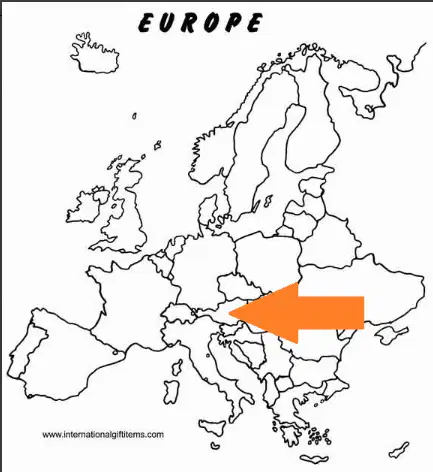
Which country is the arrow pointing to?
a)
France
b)
Germany
c)
Austria
d)
Portugal
117.
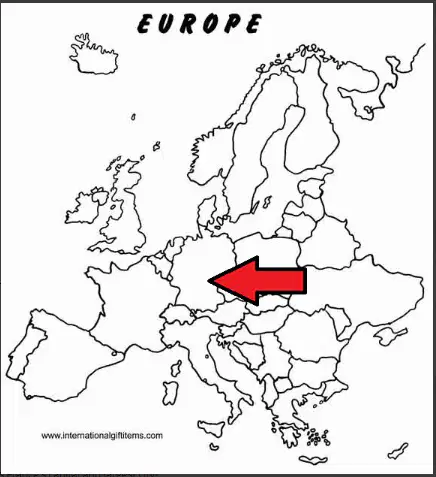
Which country is the arrow pointing to?
a)
France
b)
Germany
c)
Austria
d)
Portugal
118.
What is France's capital and largest city?
a)
Lyon
b)
Bourdeaux
c)
Paris
119.
Switzerland has 26 of these districts:
a)
counties
b)
regions
c)
parishes
d)
cantons
120.
What European military invaded France in both WWI and WWII?
a)
Great Britain
b)
Russia
c)
Germany
121.
What shape is France?
a)
octagon
b)
hexagon
c)
polygon
122.
How many sides does France have?
a)
8
b)
6
c)
4
123.
The Alps run through France and _______.
a)
Spain
b)
Switzerland
c)
Portugal
124.
What is the capital and largest city in France?
a)
Paris
b)
Lyon
c)
Bordeaux
125.
Most French people identify themselves as being of the _____ religion.
a)
Buddhist
b)
Hebrew
c)
Catholic
126.
How much of France is found in Western Europe?
a)
95%
b)
100%
c)
5%
127.
France is second only to ______ in terms of its population in Western Europe.
a)
Spain
b)
Portugal
c)
Germany
128.
There are _____ regions in France.
a)
13
b)
14
c)
15
129.
In addition to its food culture, France is considered to be the _______ capital of the world.
a)
technology
b)
agricultural
c)
fashion
130.
France has the _______ quality of soil in all of the European Union.
a)
highest
b)
lowest
131.
What is the national animal of France?
a)
bull
b)
eagle
c)
rooster
132.
French people are very _____ of their culture and academic success.
a)
embarassed
b)
proud
c)
resistant
133.
Over 67 million people visit France each year; this makes it the _______ ________ place in the world.
a)
least visited
b)
most visited
134.
The five major exports of France are _____.
a)
air crafts, iron, oil, motor vehicles, electricity
b)
iron, medicine, computers, horse, air crafts
c)
air crafts, iron, electricity, motor vehicles, medicines
135.
How much of French Guiana is covered in forests and trees?
a)
5%
b)
50%
c)
95%
136.
True or False. France does not concern itself with conservation or wasting things.
a)
true
b)
false
137.
France is _________ square kilometers in physical size (only counting the part in western Europe)
a)
64,000
b)
6,000
c)
643,000
138.
What ethnicity are most people living in France?
a)
white/Caucasian
b)
Asian
c)
North African
139.
a barrier built to hold back sea water:
a)
dike
b)
capitalism
c)
currency
d)
reformation
e)
reunification
140.
16th century religious movement which began the Protestant branch of Christianity
a)
reformation
b)
capitalism
c)
currency
d)
dike
e)
reunification
141.
to come together after being divided:
a)
reunification
b)
capitalism
c)
currency
d)
reformation
e)
dike
142.
a sharp conflict between countries without an actual war:
a)
cold war
b)
capitalism
c)
currency
d)
reformation
e)
dike
143.
type of money used in any particular country
a)
currency
b)
capitalism
c)
reformation
d)
dike
e)
reunification
144.
system in which land, factories, and businesses are privately owned and run for profit
a)
capitalism
b)
currency
c)
reformation
d)
dike
e)
reunification
145.
Notre Dame Cathedral can be found in this city...
a)
Lyon
b)
Bordeaux
c)
Paris
146.
What landform covers much of Switzerland and Austria?
a)
the Alps
b)
the Pyrenees
c)
the Himilayas
147.
East Germans tore down the ________________________ after communism started to collapse in 1989.
a)
Berlin Wall
b)
Iron Curtain
c)
Bastille Pass
148.
Capital of Austria
a)
Hamburg
b)
Vienna
c)
Brussels
149.
The Eiffel Tower and Notre Dame Cathedral are two famous landmarks in the French city of ________________.
a)
Paris
b)
Bordeaux
c)
Lyon
150.
What type of government does France have today?
a)
dictatorship
b)
monarchy
c)
theocracy
d)
republic
151.
Tourism is a valuable natural resource of West Central Europe
a)
true
b)
false
152.
A navigable river is one that is deep and wide enough for ships to use.
a)
true
b)
false
153.
Which is Europe's highest mountain range?
a)
The Alps
b)
The Pyrenees
c)
The Vesuvius
154.
A broad coastal plain that stretches from the Atlantic Coast into Eastern Europe
a)
Northern European Plain
b)
Central Uplands
c)
The Alps
d)
The Massif Central
155.
What does the word NEUTRAL mean?
a)
taking both sides in a conflict
b)
taking no sides in a conflict
c)
taking one side over the other in a conflict
156.
The English Channel is the body of water between...
a)
France and Spain
b)
England and Ireland
c)
England and France
d)
Switzerland and France
157.
Which of the following is not one of the three main types of land forms that can be found in West-Central Europe
a)
mountains
b)
plateaus
c)
plains
d)
deserts
158.
Name:
4 lines
159.
The Capital of Spain is ____.
a)
Iberia
b)
San Juan
c)
Madrid
d)
Barcelona
160.
Europe's highest mountains, some of which are located in northern Italy are the ______.
a)
Appalachian Mountains
b)
Rocky Mountains
c)
Pyrenees Mountains
d)
Alps
161.
Which two countries make up the Iberian Peninsula?
a)
Spain and Italy
b)
Spain and Portugal
c)
Italy and Greece
d)
Greece and Spain
162.
The countries of Southern Europe are Italy, Spain, Greece and _____.
a)
France
b)
Ireland
c)
Russia
d)
Portugal
163.
What is the name of the famous Roman amphitheater still standing today?
a)
Parthenon
b)
Acropolis
c)
Pantheon
d)
Colosseum
164.
______ is an economic allegiance with free trade and travel between many European countries.
a)
Mercosur
b)
European Union
c)
NAFTA
d)
NATO
165.
Europe is made up of many ______.
a)
deserts
b)
oceans
c)
peninsulas
d)
rivers
166.
The natural waterway between Europe (Spain) and Africa that connects the Mediterranean Sea and the Atlantic Ocean.
a)
Strait of Gibraltar
b)
Lake Somerville
c)
Panama Canal
d)
Rhine River
167.
One central government that controls smaller ones (began in Ancient Rome)
a)
theocracy
b)
democracy
c)
republic
d)
communism
168.
Common currency on the continent of Europe.
a)
peso
b)
euro
c)
franc
d)
mark
169.
Who is the leader of the Catholic Church?
a)
King
b)
Pope
c)
Emperor
d)
Oligarch
170.
The climate found in most Southern European countries is a ________ climate.
a)
Tropical
b)
Luxury
c)
Mediterranean
d)
Aquatic
171.
An independent state located within the city of Rome, Italy:
a)
Venice
b)
San Marino
c)
Constantinople
d)
Vatican City
172.
Which 1 choice is an ancient Greek monument?
a)
Parthenon
b)
Pantheon
c)
Colosseum
d)
Forum
173.
Which country is known to import more than it exports?
a)
Greece
b)
Spain
c)
Portugal
d)
Italy
174.
Many southern Europeans fear that too much immigration into their countries will threaten their ____
a)
religion and government
b)
economy and religion
c)
democracy and theocracy
d)
jobs and weaken their culture
175.
Many ______ are leaving war torn areas in the Middle East and Africa and are going to Greece for safety.
a)
immigrants
b)
citizens
c)
refugees
d)
people
176.
Which 2 choices are named after the apostle Peter?
a)
St. Peter's Square
b)
St. Petersburg, FL
c)
St. Peter's Basilica
d)
Peterbilt
177.
The ancient Greeks invented ______.
a)
democracy
b)
repubican government
c)
communism
d)
theocracy
178.
Which 3 choices are examples of Italian cuisine?
a)
cheese
b)
pizza
c)
hamburgers
d)
pasta
179.
What was the manmade water system that supplied Roman cities with water?
a)
aquarium
b)
aqueducts
c)
mallard ducks
d)
pipes
180.
Where is the headquarters of the Catholic Church?
a)
St. Mary's Church of Venice
b)
Washington, DC
c)
Rome
d)
Vatican City
181.
Which person proved that the Earth was not the center of the universe?
a)
Leonardo da Vinci
b)
Pablo Picasso
c)
Aristotle
d)
Galileo
182.
Artist that used perspective in his paintings.
a)
Leonardo da Vinci
b)
Pablo Picasso
c)
Michaelangelo
d)
Rembrandt
183.
A country inside another country- for example San Marino
a)
theocracy
b)
cuisine
c)
enclave
d)
communism
184.
Which 3 choices are examples of Ancient Roman Monuments?
a)
Colosseum
b)
Forum
c)
Pantheon
d)
Parthenon
185.
The Vatican has a _____ type of government.
a)
theocratic
b)
communist
c)
papal
d)
democratic
186.
Europe's standard of living is comparable to ____
a)
Nigeria
b)
Argentina
c)
U.S.
d)
Venezuela
187.
Spanish artist that used Cubism-
a)
Rembrandt
b)
Jackson Pollack
c)
Pablo Picasso
d)
Leonardo da Vinci
188.
Ferdinand and Isabella gave ships and supplies to _____, who then sailed across the Atlantic and claimed the land he discovered for Spain.
a)
Ferdinand Magellan
b)
Jack Sparrow
c)
Christopher Columbus
d)
Leif Erickson
189.
Which mountains are found in Northern Italy?
a)
Andes Mountains
b)
Alps
c)
Rocky Mountains
d)
Pyrenees
190.
What is the capital of Greece?
a)
Madrid
b)
Rome
c)
Athens
d)
Venice
191.
Which word best describes the Renaissance?
a)
stagnant
b)
rebirth
c)
reverse
d)
religious
192.
Which choice refers to a period in Europe from 1400-1600 in which science, art and exploration were popular?
a)
pesticide
b)
marine
c)
Renaissance
d)
fascism
e)
philosopher
193.
Which choice refers to the chemicals commonly used to protect crops from insects and other animals?
a)
pesticide
b)
marine
c)
Renaissance
d)
fascism
e)
philosopher
194.
Which choice refers to anything having to do with the sea?
a)
pesticide
b)
marine
c)
Renaissance
d)
fascism
e)
philosopher
195.
Which choice refers to a person of wisdom who is often found to be in a state of thought?
a)
pesticide
b)
marine
c)
Renaissance
d)
fascism
e)
philosopher
196.
Which choice refers to a type of government in which private business is allowed, but the government controls many aspects of their citizens' lives?
a)
pesticide
b)
marine
c)
Renaissance
d)
fascism
e)
philosopher
100 %
![US GOV Final Exam [200]](https://cf.quizizz.com/image/image-loader.svg)
