
 Worksheets
G6 Science Chapter 14 Lesson 3 Review
Total questions: 20
Worksheet time: 15mins
Name
Class
Date
1.
Sound waves are what kind of wave?
a)
Longitudinal
b)
Transverse
c)
Surface
d)
Electromagnetic
2.
What happens when you increase the amplitude of a sound?
a)
it makes the sound louder
b)
it makes the sound travel faster
c)
it increases the wavelength of the sound
d)
it increases the frequency of the sound
3.
This is the unit used to measure the volume of a sound.
a)
Decibel
b)
Medium
c)
Vibration
d)
Oscilloscope
4.
True or False: Can sound travel through a vacuum (space).
a)
True
b)
False
5.
What is a pitch?
a)
highness or lowness of a sound
b)
the intensity of a vibration
c)
the amplitude of the sound wave
d)
volume of sound
6.
Why is sound able to travel faster through a solid than a gas?
a)
Gas molecules are packed tightly.
b)
Sound does not travel faster through a solid than a gas.
c)
Solid molecules are packed tightly.
d)
Gas molecules move slowly.
7.
Which of these waves represents the loudest sound?
a)
b)
c)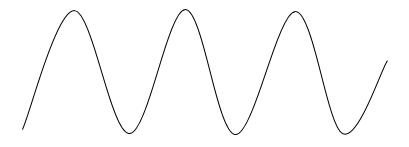
d)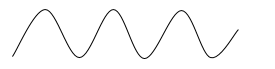
8.
What are you doing when you're making sound?
a)
Causing photons to travel.
b)
Causing air molecules to vibrate.
c)
Causing electromagnetic waves to radiate.
d)
Causing air pressure to drop.
9.
What is compression?
a)
When air molecules move apart from one another.
b)
When air molecules collide with each other.
c)
When air molecules become packed tightly together.
d)
When air molecules move around freely.
10.
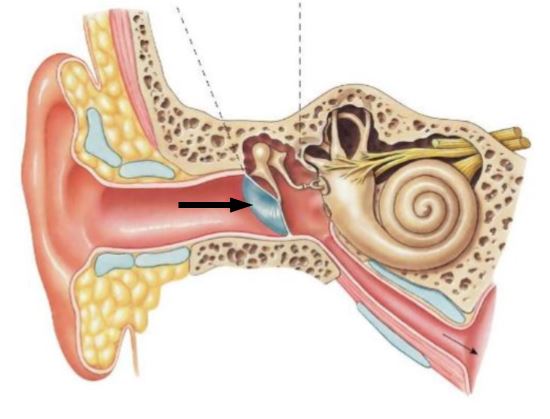
What is this?
a)
Ear Drum
b)
Ear Canal
c)
Pinna
d)
Hammer
e)
Cochlea
11.

In General Sound waves travel the slowest in __________
a)
solid
b)
liquid
c)
Gas
d)
Plasma
12.
A reflected sound wave is called a(n) ______.
a)
frequency
b)
pitch
c)
echo
d)
rarefaction
13.
The number of wavelengths that pass a point each second
a)
frequency
b)
wavelength
c)
pitch
d)
amplitude
14.
Where is the Cochlea located
a)
The Inner Ear
b)
The Middle Ear
c)
The Outer Ear
15.

What is this?
a)
Hearing Nerve
b)
Cochlea
c)
Pinna
d)
Stirrup
e)
Hammer
16.

What is this?
a)
Anvil
b)
Hammer
c)
Stirrup
d)
Cochlea
e)
Ear drum
17.

# 5 refers to the layer of receptor cells at the back of the eye in which the image is focused
a)
Retina
b)
Lens
c)
Optic Nerve
d)
Lens
18.

#2 refers to
a)
optic nerve
b)
cornea
c)
iris
d)
pupil
19.

#1 Refers to the clear tissue that covers the front of the eye
a)
Retina
b)
Cornea
c)
Pupil
d)
Iris
20.
black circle, allows light to enter the eye
a)
iris
b)
pupil
c)
optic nerve
d)
retina
100 %

