wayground logo

Free Printable Worksheets

NEW

Font size

S
M
L
XL
Worksheets

HP.U14.A1

Total questions: 35

Worksheet time: 56mins

Name
Class
Date
1.
When light bounces back it is _____
a)
Reflected
b)
Refracted
c)
Absorbed
d)
Optical Density
2.
We see shadows because light travels in a __________________ line.
a)
curved
b)
straight
c)
rainbow
3.
What is reflection?
a)
Reflection is the bouncing  of light off the surface that it strikes on.
b)
Reflection is the absorbing of light off the surface that it strikes on.
c)
Reflection is the bending of light off the surface that it strikes on.
d)
Reflection is the scattering of light off the surface that it strikes on.
4.

Which term describes when light bounces off of a smooth surface?

a)

Diffuse Reflection

b)

Transmission

c)

Absorption

d)

Specular Reflection

5.
The imaginary line perpendicular to a reflecting surface is called _____.
a)
crooked line
b)
parallel line
c)
angular line
d)
normal line
6.

In the diagram, which letter represents the angle of incidence?

a)

A

b)

B

c)

C

d)

D

7.

Which diagram represents diffuse reflection?

a)

A

b)

B

8.

Type of mirror used as a side mirror on a vehicle to provide a wide angle view...

a)

Plane

b)

Convex

c)

Concave

9.

For a spherical mirror, the focal length is equal to

a)

the radius of curvature

b)

the diameter of curvature

c)

half radius of curvature

d)

half diameter of curvature

10.
The following is a picture of what type of mirror? 
a)
Convex (diverging) mirror
b)
Concave (converging) mirror
c)
Plane Mirror
d)
Flat Mirror
11.
An image that forms where light seems to come from a point but light rays don't actually meet is a 
a)
virtual image
b)
real image
c)
Inverted Image
d)
Pizza
12.
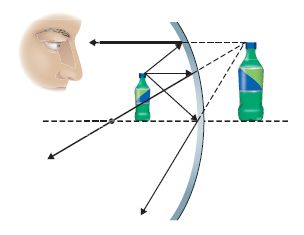
Which terms describe the reflection seen in this image?
a)
virtual, upright
b)
virtual, inverted
c)
real, upright
d)
real, inverted
13.

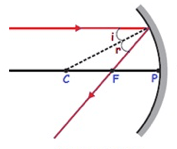
This ray diagram is for which mirror?

a)

concave

b)

convex

c)

plane

d)

window

14.

An object placed at the center of curvature will form an image that is .............. the size of the object.

a)

larger than

b)

the same as

c)

smaller than

15.

A real image is always

a)

virtual

b)

upright

c)

behind the mirror

d)

in front of the mirror

16.

A virtual image is always

a)

virtual

b)

upright

c)

behind the mirror

d)

in front of the mirror

17.
The point where the rays meet is known as....
a)
Fire
b)
the focal point
c)
refraction
d)
Plane of the lens
18.
___ is when light travels through a material and bends.
a)
Diffraction
b)
Dispersion
c)
Mirage
d)
Refraction
19.
Is a convex lens thicker or thinner in the middle?
a)
Thicker 
b)
Thinner 
20.
Is a concave lens thicker or thinner in the middle? 
a)
Thicker 
b)
Thinner 
21.

When light waves move from passing through air to passing through a glass lens when happens to them?

a)

They slow down and change direction

b)

They speed up and change direction

c)

They maintain the same speed and change direction

d)

They maintain their same speed and direction

22.

A concave lens has an inward curved shape. It refracts light outward from the lens. They light rays spread apart as they exit the lens. Which represents a concave lens?

a)

A

b)

B

c)

A and B

d)

neither A or B

23.
What does the word "diverging" mean?
a)
to spread apart
b)
to come together
c)
parallel
d)
perpendicular
24.
What does the word "converging" mean?
a)
to separate
b)
to come together
c)
parallel 
d)
perpendicular
25.

What type of lens do you have in your eye?

a)

Concave

b)

Prismatic

c)

Objective

d)

Convex

26.
A converging lens is also known as a ____ lens.
a)
convex
b)
concave
c)
double
d)
refracted
27.
When an object is placed between the focal point and the convex lens, the image produced is ___.
a)
real, reduced, and inverted
b)
real, enlarged, and inverted
c)
virtual, enlarged, and upright
d)
virtual, reduced, and upright
28.
This image is.....
a)
inverted and smaller
b)
inverted and larger
c)
not inverted and smaller
d)
not inverted and larger
29.
The dfor a virtual image will have a ______ value.
a)
positive
b)
negative
30.

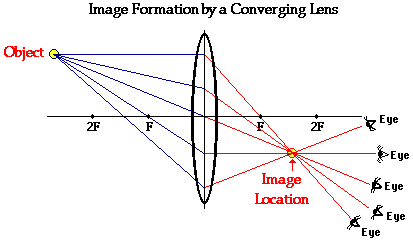
What type of image is formed?

a)

virtual and inverted

b)

virtual and upright

c)

real and upright

d)

real and inverted

31.
In the thin lens equation, do represents 
a)
Distance of the object from the lens
b)
Distance of the image from the lens
32.

An object is located 35.0 cm from a convex lens. The lens forms a real image at a distance of 15.0 cm. What is the focal length?

a)

0.0953 cm

b)

10.5 cm

c)

26.2 cm

d)

0.0678 cm

33.
A normal human eye has a focal length of about 0.023 m. If you look at the tip of a pencil, 0.553 m from your eye, how far is the image from the lens of your eye? 
a)
0.024 m
b)
0.033 m
c)
0.045
d)
0.055
34.
The focal length of the lens in your eye is about 0.015 m. If the object is 1 m from your eye, where is the image produced? 
a)
0.0315 m
b)
0.0243 m
c)
0.0152 m
d)
0.0601 m
35.
A converging lens produces an image twice the size of the original. If the object is placed 0.40 m from the lens, and the image produced is 0.80 m from the lens. What is the focal length of the lens? 
a)
0.351 m
b)
0.267 m
c)
0.416 m
d)
0.112 m