
 Worksheets
7th Grade Life Science Final Exam
Total questions: 213
Worksheet time: 3hrs 25mins


Moves stage up and down for focusing; locates the specimen
Fine Focus Knob
Large Focus Knob
Course Focus Knob
Small Focus Knob

Label the part of the microscope. What is part E?
stage
stage clips
focus knob
eyepiece tube

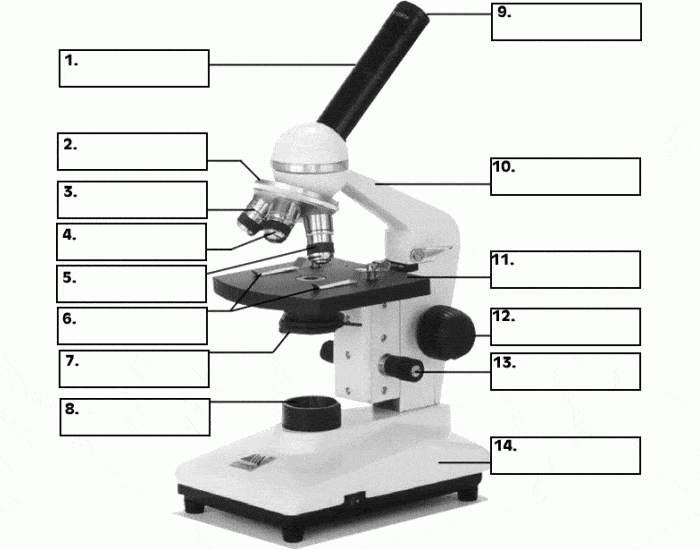


Which part of the microscope is labeled 10?
Ocular Lens
Fine adjustment knob
base
light source
What is the purpose of the scientific method?
To solve problems and create experiments
To research new information
To practice safety
To become a scientist
What is the final step in the scientific method?
Write a conclusion about your results
Record and analyze the data
Form a hypothesis
Research your topic
What is a procedure?
Step by step instructions
Safety rules
What stays the same in an experiment
A prediction
What is the first step in the scientific method?
Form a hypothesis
Make an observation and ask a question about it
Research your topic
Record and analyze data
What should you wear in science lab to be safe and protected from dangerous chemicals?
Goggles
Lab apron
Closed toe shoes
ALL OF THESE
If you do not understand a direction, you should:
Try several methods until something works
Ask the teacher before proceeding
Skip it and go onto the next part
Mix chemicals randomly

You have been injured in the laboratory (cut,
burned, etc.). FIRST you should:
visit the school nurse.
see a doctor after school.
tell the teacher at once.
apply first aid yourself.
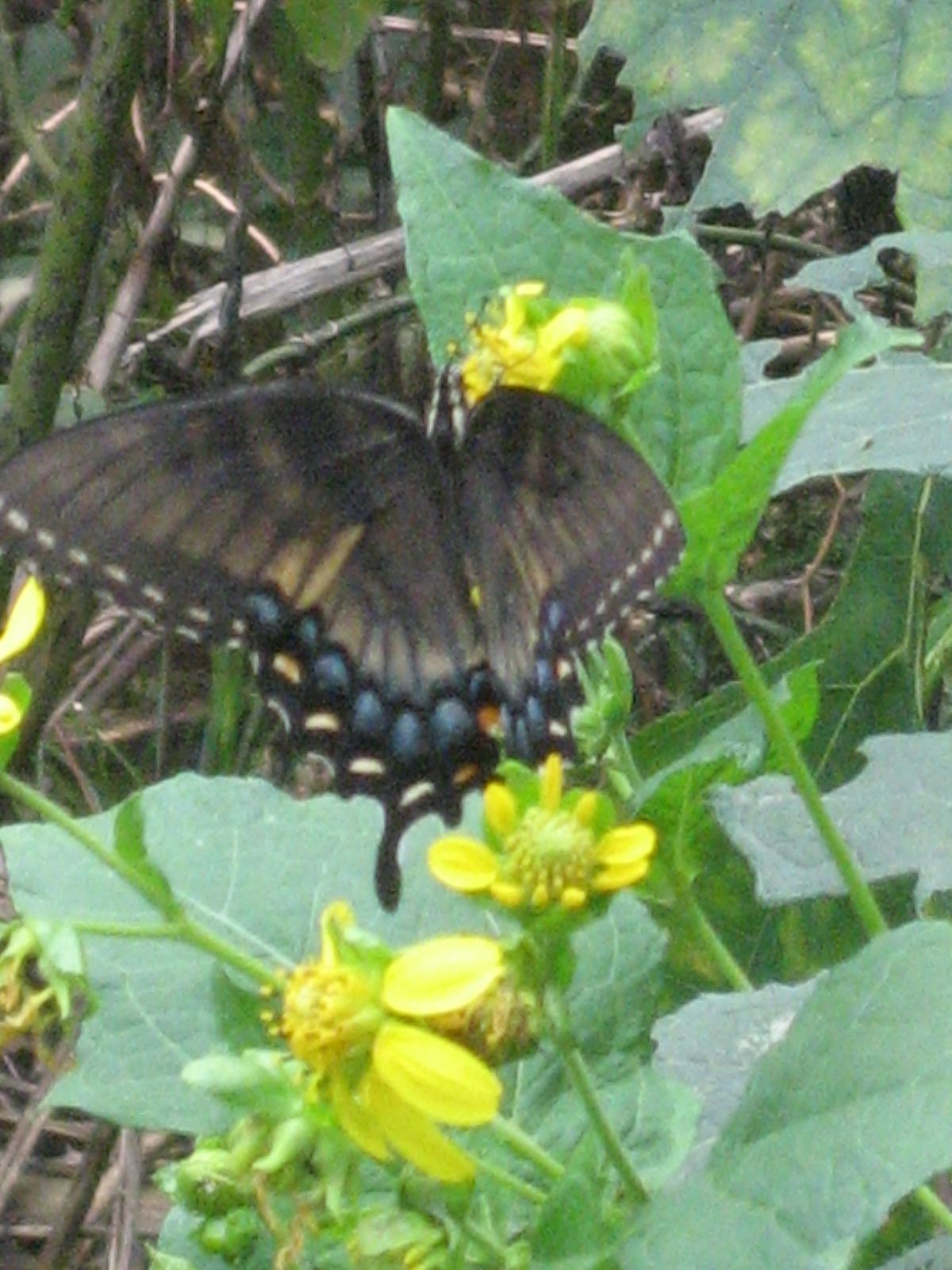
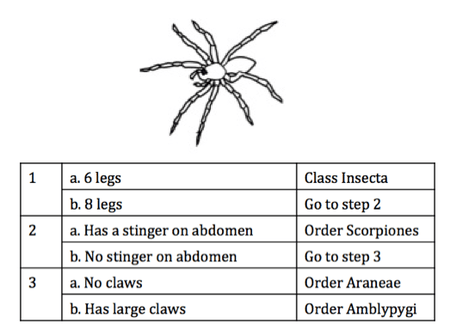
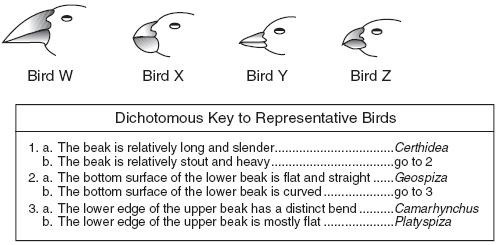

Reaction to changes in the environment
adaptation
stimulus
response
internal stimuli
How many characteristics do all living things have to have?
5
6
7
8
What characteristic is this:
The smallest unit of an organism that carries the function of life.
Made up of cells
Grow and Develop
Respond
Homeostasis
Use Energy
What characteristic is this:
Cells increase as the organism gets older.
Made up of cells
Grow and develop
Respond
Use Energy
Reproduce
What characteristic is this:
Used by organisms, plants get it from the sun, and animals get it from eating.
Homeostasis
Use energy
Reproduce
Respond
Grow and Develop
What characteristic is this:
They have to make more of themselves.
Reproduce
Be made of cells
Grow and develop
Respond
Use Energy
Worms feed off of the living matter in the soil.
reproduce
exchange and eliminate
consume nutrients
respond to the environment
I am made of many cells. My cells have an organized nucleus. I mostly have two parents, but sometimes one. I make my own food. What kingdom do I belong to?
Fungi
Bacteria
Plantae
Animalia
I have no nucleus and can live in extreme temperatures. What kingdom do I belong to?
Fungi
Protista
Bacteria
Archaea
I reproduce sexually and I am multicellular. My cells have a nucleus. I am not able to make my own food. What kingdom do I belong to?
Plantae
Animalia
Fungi
Protista
I am mostly unicellular. My cells have a nucleus. I am a heterotroph and I reproduce sexually and asexually.
What kingdom do I belong to?
Fungi
Archaea
Bacteria
Protista
The Eukarya Domain has which kingdoms?
Archaea
Bacteria
Plantae, Animalia, Fungi and Protista
none of the above
I am an autotroph
I am multicellular
What am I?
I am prokaryotic
I am found in extreme ecosystems
What kingdom do I belong to?
Who am I?

The 3 parts of the Cell Theory are...?
All living things are composed of cells.
Cells are the basic units of structure and function in living things.
All cells are produced from other cells.
All living things are composed of cells.
Cells are the basic units of dance and vibes in living things.
All cells are destroyed from other aliens.
All living things are composed of Jell-O.
Cells are the basic units of structure and function in living things.
All cells are produced from factories in Canada.
All living things are composed of cells.
Cells do karate and practice eating whole pies in their free time.
All cells are produced from other cells.


This cell is a ...
Prokaryotic Cell
Eukaryotic Cell
Which cells contain Ribosomes?
Prokaryotic
Eukaryotic
Both
Which cell is larger?
Prokaryotic
Eukaryotic
Which cell is smaller?
Prokaryotic
Eukaryotic
Please select all types of Passive Transport. (hint: there will be more than one answer)
Simple Diffusion
Endocytosis
Osmosis
Facilitated Diffusion
Exocytosis


Which of the following scientists contributed to the cell theory?
Rudolf Virchow, Robert Hooke, Anton van Leuwenhoek
Matthais Schleiden, Theodor Schwann, Rudolf Virchow
Robert Hooke, Theodor Schwann, Anton von Leuwenhoek
Theodor Schwann, Matthais Schleiden, Robert Hooke
Which Scientist said all plants are made of cells?
Hooke
Leeuwenhoek
Schleiden
Schwann
Virchow
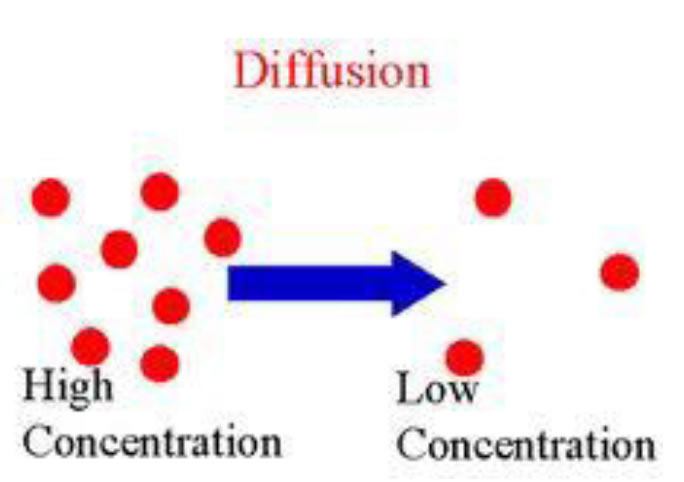
Please select all types of Active Transport. (hint: there will be more than one answer)
Simple Diffusion
Endocytosis
Active Transport
Facilitated Diffusion
Exocytosis
Which biomolecule is used to store and transport genetic information?
nucleic acid
protein
carbohydrates
lipids
Which biomolecules are used for the growth and repair of cells?
proteins
nucleic acids
lipids
carbohydrates
Which biomolecule makes up the cell membrane and is used for long term energy storage?
lipids
carbohydrates
proteins
nucleic acids
Which biomolecule is used for short term energy storage?
carbohydrates
proteins
lipids
nucleic acids
This biomolecule includes sugars and starches.
carbohydrate
protein
lipids
nucleic acids
Which biomolecule contains fats, oils, and waxes?
lipids
carbohydrates
nucleic acids
proteins
Which biomolecule is a source of fast, quick energy for cells?
carbohydrates
lipids
nucleic acids
proteins
4. Which biomolecules transport oxygen and other substances and also form part of most organelles?
Lipids
Carbohydrates
Proteins
Nucleic Acids
5. Which biomolecules provide quick energy for the cell and also provide materials to build the cell membrane/wall?
Carbohydrates
Proteins
Lipids
Nucleic Acids
10. Your friend is feeling irritable, lightheaded and dizzy. They are also feeling a bit of confusion and brain fog. Which biomolecule would you recommend your friend consume?
Protein
Carbohydrates
Nucleic Acid
Lipid
2. Which biomolecules contains your genetic information?
Proteins
Lipids
Carbohydrates
Nucleic Acids
9. Amino Acids are the monomers of __________.
Nucleic Acids
Proteins
Carbohydrates
Lipids
6. The monomer of carbohydrates is known as _______.
Amino Acid
Fatty Acid
Nucleotide
Saccharide
Just under an orca's skin lies a thick layer of blubber. Blubber helps insulate a whale from heat loss. Based on this information, which biomolecule is blubber primarily made of?
Lipids
Nucleic Acids
Proteins
Carbohydrates
7. Glycerol and fatty acids are the monomers of _________.
Lipids
Carbohydrates
Proteins
Nucleic Acids
3. Which biomolecules act as energy storage for the cell and also cushions and insulates organs?
Carbohyrdates
Lipids
Proteins
Nucleic Acids
8. The monomer of Nucleic Acids is known as _________.
Amino Acid
Fatty Acid
Nucleotide
Saccharide
11. People with albinism do not produce the melanin protein. Melanin allows for people to be protected from the sun and thus people with albinism are prone to severe sunburns. Which biomolecule would you infer is responsible for albinism?
Carbohydrate
Protein
Lipid
Nucleic Acid
Which two biomolecules are made of Carbon, Hydrogen, and Oxygen?
Nucleic Acids
Proteins
Lipids
Carbohydrates
Which biomolecule are made of Carbon, Hydrogen, Oxygen, and Nitrogen?
Nucleic Acids
Proteins
Lipids
Carbohydrates
Which biomolecule are made of Carbon, Hydrogen, Oxygen, Nitrogen, and Phosphorus?
Nucleic Acids
Proteins
Lipids
Carbohydrates
The products of photosynthesis are...
glucose and oxygen
carbon dioxide and water
The reactants to photosynthesis are...
glucose and oxygen
carbon dioxide and water
What gives the leaf its green color and absorbs sunlight?
stomata
chlorophyll
roots
flowers
What are the products of cellular respiration? Choose 3.
water
ATP
Oxygen
Sunlight
Carbon Dioxide
The process in which a cell harvests energy from glucose and makes it into usable energy for the body is called-----
cellular fermentation
anaerobic respiration
aerobic fermentaion
cellular respiration
Which organ in a cell produces a large amount of ATP through cellular respiration?
chloroplast
mitochondrion
nucleus
ribosome
Fermentation does not require oxygen. Which type of human cell is the most common site for fermentation?
skin cells
muscle cells
nerve cells
bone cells
How many daughter cells does mitosis produce?
1
2
3
4
The genotype for a yellow plant is...

Which of the following genotypes is homozygous recessive?
Tt
tt
TT
tT

ATG TGA CAG


What is most likely to happen to moth populations in the picture shown?
Light moths--hunted easily, dark moths--population increase
Dark moths--hunted easily, dark moths--population increase
Light moths--hunted easily, light moths--population increase
Lights moths will change their color to match dark moths.
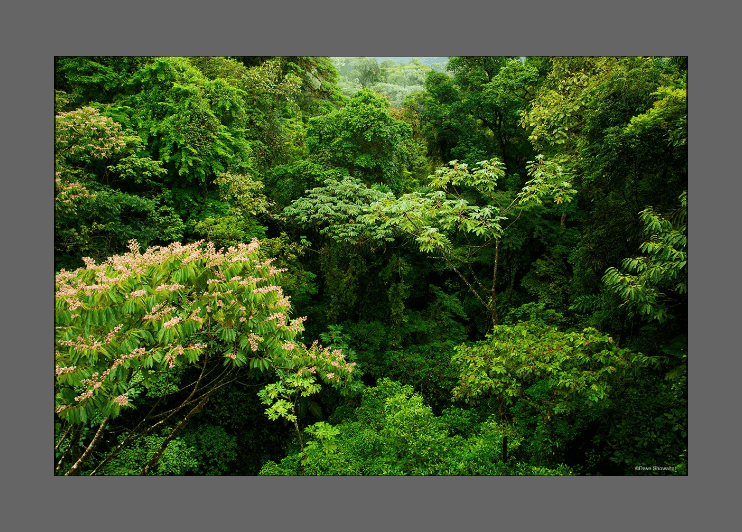
A yellow morph and green morph of an insect lives in the rainforest canopy. You would expect:
the green population to increase and the yellow to decrease
both populations should stay the same
both populations will increase
the green population to decrease and the yellow to increaseThis is a wrong answer
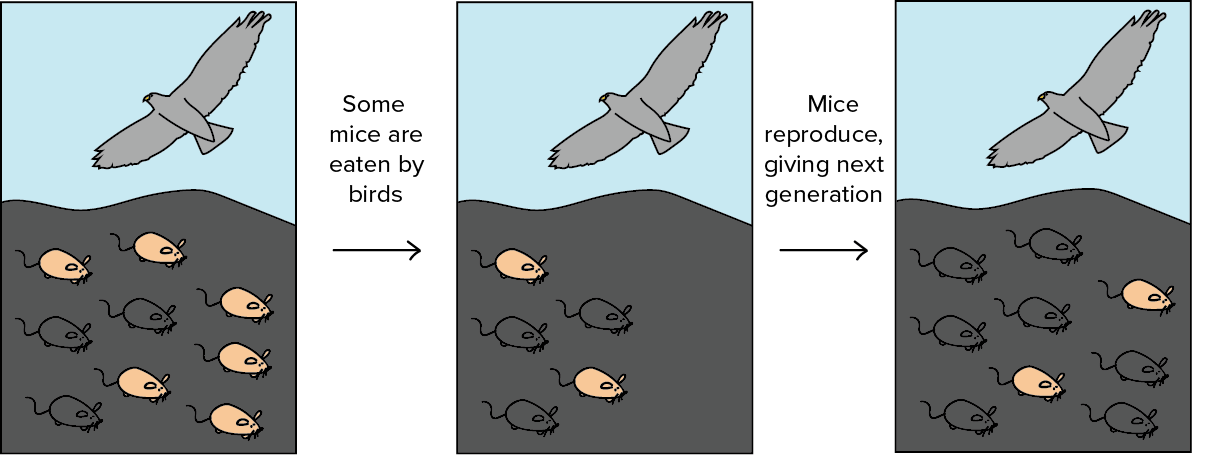
How do you "win" at natural selection?
survive
go extinct
survive & reproduce

What do we call structures that no longer perform their original function?
Natural Selection
Analogous Structure
Vestigial Structure
Homologous Structure

What do you call similar structures that related species have inherited from a common ancestor?
Natural Selection
Analogous Structure
Vestigial Structure
Homologous Structure
How is DNA connected to evolution and adaptations?
Mutations occur randomly in our DNA.
It's not at all.
We get our DNA from our parents.
this process describes how humans choose individuals to reproduce to get offspring with more desirable traits
selective breeding / artificial selection
natural selection
adaptations

The rancher selects the fastest horses and has them reproduce. This is...
natural selection
selective breeding

What is one ABIOTIC factor in this ecosystem?
frog
tadpole
water
snail

What is one BIOTIC factor in this ecosystem?
Soil
Water weeds
Sun
Water
Water, nutrients, soil, sunlight, temperature, and living space are examples of Biotic Factors in a habitat
True
False
Habitat is defined as an environment that provides things which an organism needs to live, grow and reproduce.
True
False
All the different populations that live together in an area is the definition of ____________.
Ecosystem
Community
Population
Organism


What is this biome?
Taiga
Desert


Has clumps of trees and seasonal rains
temperate deciduous forest
coniferous forest
savanna
prairie

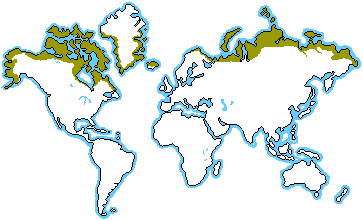

In which biome would you MOST LIKELY find this organism?
savanna
tropical rainforest
prairie
tundra

What is Tundra?
The very large area of wet land in the far northern parts of the world that is covered with conifer trees
Thick forest that grows in hot parts of the world
Vegetation composed primarily of broad-leaved trees that shed all their leaves during one season
A vast, flat, treeless Arctic region of Europe, Asia, and North America in which the subsoil is permanently frozen.

What does a desert look like?
A vast, flat, treeless Arctic region in which the subsoil is permanently frozen.
An area, often covered with sand or rocks, where there is very little rain and not many plants.
A large open area of country covered with grass, especially one used for grazing.
A large naturally occurring community of plants and animals occupying a major habitat

What does Taiga look like?
Vegetation composed primarily of broad-leaved trees that shed all their leaves during one season.
Thick forest that grows in hot parts of the world.
A large open area of country covered with grass, especially one used for grazing.
A very large area of wet land in the far northern parts of the world that is covered with conifer trees

What is a Tropical Forest?
Thick forest that grows in hot parts of the world.
Vegetation composed primarily of broad-leaved trees that shed all their leaves during one season
A large open area of country covered with grass, especially one used for grazing
A vast, flat, treeless Arctic region of Europe, Asia, and North America in which the subsoil is permanently frozen.

What Biome has vegetation composed primarily of broad-leaved trees that shed all their leaves during one season?
Grasslands
Deciduous Forest
Tropical Rainforest
Taiga

What biome is described as a large open area of country covered with grass, especially used for grazing?
Desert
Tundra
Grasslands
Taiga

This describes what system: The process of water circulating through a system through evaporation and precipitation (rainfall).
Nutrient Cycle
Inputs
Water Cycle
Natural Systems

What are living things that break down the remains of other living things?
Humans
Animals
Plants
Decomposers

What is a food chain?
The natural home of an animal.
The use of land for growing crops and rearing animals.
A model that shows how energy flows between living things.
A group of parts within a specific area that work together as a whole.
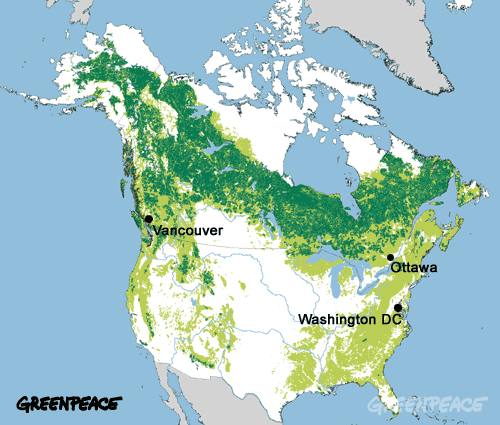
Which biome covers most of Canada?
Tundra
Taiga
Temperate Forest
Desert
How do animals get carbon?
By eating plants and or other animals.
They absorb it from the atmosphere.
From the ground
They do not get carbon from anywhere.
Carbon enters the soil through dead plant or animal matter.
Decomposition
Respiration
Photosynthesis
Diffusion

Which of the following are producers in the food web?
Phytoplankton and seaweed
Phytoplankton and zooplankton
Squid and Elephant Seal
Seaweed and Crabs

The original source of energy for a food web is...
plants
sun
producers
decomposers

Decomposers get energy from...
the sun
eating plants
eating animals
dead things and waste

Arrows in a food web represent...
eating
sunlight
energy
matter

An organism that gets energy from eating other organisms is a ______________
producer
consumer
decomposer
If an arrow points from a rabbit to a fox it means
The energy is going from the rabbit to the fox when it eats it.
The energy is going from the fox to the rabbit when the fox eats the rabbit.
Which way do arrows point in a food web.
Point from the prey to the predator
Point from the predator to the prey
Point from the food to what is eating it
Point from the animal eating to the food.

What is eating the grasshopper? Choose all that apply.
Owls
Birds
grains

What are the birds eating? Choose all that apply.
grasses
grains
grasshoppers
foxes

Which of the following is a producer in the web?
owl
carrot
rabbit
birds

Which of the following is a first level consumer in the web?
fox
rabbit
birds
grasses

Which of the following is an omnivore in the web?
owls
foxes
mice
birds

Which of the following is a carnivore in the web?
fox
rabbit
mice
birds

Which of the following is a herbivore in the web?
mice
fox
owls
birds

How many herbivores are shown in the web?
1
2
3
9

How many carnivores are shown in the web?
1
2
3
9
The digestive and respiratory systems pair together to ...
bring carbon dioxide and wastes to cells for diffusion.
bring oxygen and wastes to cells for diffusion.
bring oxygen and nutrients to cells for cellular respiration.
bring carbon dioxide and nutrients to cells for cellular respiration.
The digestive and respiratory rely on the ___ systems to transport needed materials to the cells.
circlatory and excretory
circulatory and muscular
nervous and digestive
nervous and skeletal
The immune system fights diseases. The circulatory system pairs with the immune system because ___.
blood is made in the bones.
plasma carries nutrients.
red blood cells carry oxygen.
white blood cells fight infection.
The organ within the circulatory system that allows for the diffusion of materials between all other tissues of the body is the...
heart
artery
capillary
vein
Why are the lungs, the major organ of the respiratory system, also considered an excretory organ?
They get rid of carbon dioxide, a cellular waste
They get rid of oxygen, a cellular waste
They get rid of urea, a cellular waste
They get rid of salt, a cellular waste
How do the skeletal and circulatory systems relate to each other?
Bone marrow produces blood.
The heart is made of cardiac muscle tissue.
The heart is held in place in the chest by ligaments.
The blood brings carbon dioxide and glucose to the cells of the bones.
When your body comes in contact with a sharp object, an impulse sent you your brain triggers a reflex that causes you to move away from the object. What body systems are interacting to cause this response?
Nervous, Respiratory,
Nervous, Muscular
Nervous, Skeletal
Nervous, Digestive
Kidneys are part of the urinary system in a human body. They purify the impure blood and send it back to the rest of the body. Which system is mainly responsible for the transport of blood to the kidneys?
Respiratory system
Circulatory system
Muscular system
Nervous system
Olympic sprinters undergo increased heart and breathing rates while competing. Which of the following best describes the interactions among systems of a sprinter?
Respiratory system is working to obtain more oxygen, while the circulatory system works to transport the oxygen to the muscles.
The digestive system takes in more glucose, while the excretory system removes waste.
The endocrine system transports ATP to the nervous system
Excretory system removes waste from the digestive system to reduce weight so the sprinter can run faster
Which level of organization is listed correctly from simple to complex?
Organelle, organ, organ system, tissue, cell
Cell, tissue, organ, organ system, organism
Organism, organ system, organ, tissue, cell
cell, tissue, organ system, organ, organelle
Which set of Organs belongs to the Excretory System?
Heart, blood vessels
Trachea, larynx, pharynx, and lungs
Kidneys, urinary bladder
Brain, spinal column
Which set of organs belong to the Nervous System?
Heart, blood vessels
Kidneys, urinary bladder
Esophagus, stomach, intestines
Brain, spinal column
Which organs belong to the Circulatory System
Heart, blood vessels
Esophagus, stomach
Trachea, larynx, pharynx, lungs
Brain, spinal column
Which organs belong to the Respiratory System?
Bones, cartilage
Cardiac, smooth, skeletal
Trachea, larynx, pharynx, lungs
Kidneys, urinary bladder
What is the purpose of the Skeletal System?
Transports oxygen and nutrients
Supports and protects the body, creates blood
Movement and heat production
Gas exchange in the body and lungs
What is the purpose of the Muscular System?
Movement and heat production
Supports and protects the body and produces blood
Digests food and absorbs nutrients
Transports oxygen and nutrients

Which body system is shown on the right?
Digestive System
Muscular System
Circulatory System
Respiratory System

Which body system is shown on the left?
Muscular System
Circulatory System
Digestive System
Nervous System
Which system in the human body functions primarily to remove wastes from the body?
immune
urinary
nervous
muscular
Which body system eliminates pathogens and sicknesses from invading the body?
excretory system
nervous system
immune system
respiratory system

