
 Worksheets
WH Day 42
Total questions: 125
Worksheet time: 1hrs 15mins


What does this cartoon represent?
Communism
Urbanization
Manifest Destiny
Social Darwinism
Which aspect of imperialism do these words reflect?
“A single shelf of a good European library is worth the whole native literature of India and Arabia.”
Social Darwinism
direct rule
national prestige
humanitarian goals
________ is sometimes called the “father of modern Egypt.” He introduced a number of political and economic reforms, including improving tax collection, reorganizing the landholding system, and backing large irrigation projects to increase farm output.
Muhammad Ali
Shaka
Menelik II
Usman dan Fodio

Based on the map, what form of imperial rule did European powers use in China?
sphere of influence
protectorate
direct rule
indirect rule
How does nationalism and Social Darwinism relate to each other?
they both deal with the way counties control the taxes of the lower class.
they both show how one country should dominate another.
they both show how a nation should protect its elite social class.
they both show how each group needs to believe in the nation.
How did industrialization directly cause imperialism?
Industrialization caused too many people to move to the cities, therefore countries needed more land.
Industrialization caused European countries to need more raw materials than they needed before.
Imperialism was needed for industrialization to happen
Imperialism directly caused by the countries that had yet to experience industrialization.
In Bismarck’s practice of Realpolitik, his political actions were guided by
The needs of the people.
Traditional morality.
The principle of divine right
The needs of the state.

How did the Suez Canal influence the spread of Western European imperialism?
By connecting, the Mediterranean Sea and Red Sea, the canal significantly reduced the sailing time from Europe to trading destinations the East.
The Suez Canal helped with the colonization of the Americas by creating an alternative route for the Mediterranean countries.
England was able to control Egypt, which allowed for England to abolish the Berlin Conference and control almost all of Africa.
Europe was able to control a smaller amount of land than before because of the fighting between the countries in Africa.

What was the goal of the United States in establishing Open Door Policy?
to prevent a foreign monopoly on trade with China
to establish an American monopoly on Chinese trade
to avoid involvement in any foreign conflicts
to increase America's defensive capability

made shipping and defense much faster/easier
provided jobs for thousands of Americans
boosted the American economy through increased tourism from Latin America
increased America's role as an influential power in the world


How did the plague impact Europe?
People started to question the church
1/3 of the population died
It contributed to the decline of feudalism
All are correct

What type of government system did the create in Medieval Europe?
Feudalism
Crusades
Mercantilism
Renaissance

What was the main reason that Constantinople was a good location for the capital of the Byzantine Empire?
It was located at a crossroads for trade between Asia and Europe.
It was protected from invaders by the mountains of Asia Minor and the Balkans.
It was near the mouth of some of the region's greatest rivers.
It was close to the many islands that dot the Aegean Sea.

The gothic style architecture is noted for
stained glass windows and flying buttresses.
dark gloomy interiors
thick walls and towers
its fortress

After the death of Muhammad, what led to the split between the Sunni and Shia?
They could not agree on who should become leader.
They could not agree if they were allowed to eat pork.
They could not agree on how many times they should pray each day.
They could not agree on how to make Greek fire.
When Muslims conquered new lands, they often
imposed a special tax on non-Muslims.
forced the conquered people to convert to Islam
adopted the beliefs of the conquered people.
looted and burned conquered cities.


Which person is most associated with this map?
Pope Urban II
Hitler
George Washington
King Charles III
Feudal agreements were between...
Lords and their vassals(lower lords)
Kings and the church
traders and merchants
serfs and their peasants
"Let the holy sepulcher of our Lord and Savious, which is possessed by the unclean nations, especially arouse you... This royal city [Jerusalem], situated at eth center of the earth, is now held captive by the enemies of Christ and is subjected, by those who do not know God, to worship of the heathen. Accordingly, undertake this journey eargerly for teh remission of your sins, with the assurance of the reward of imperishable glory in the kingdom of heaven." Pope Urban II in 1095
What took place after this quote?
the Crusades
Urbanization
end of feudalism
Charlemagne was crowned emporer of Europe.

What commercial practice did Europeans adopt from the Muslim merchants with whom they traded?
This coin is from August Caesar the Roman Emperor who switched the Roman Republic to the Roman Empire reigning from 27 BC until his death in AD 14. The Prophet Muhammad was not even born until 570.
the use of credit
gold coins
using city charters
guilds
IN THE NAME OF ALLAH
THE COMPASSIONATE
THE MERCIFUL
Praise be to Allah, Lord of the creation,
The compassionate, the merciful,
King of the last judgment!
You alone we worship,
and to you alone we pray for help.
The Holy Qur’an
In which region does this text originate?
Middle East
China
West Africa
Eastern Europe

Mansa Musa's country of Mali was also rich in resources like.....
Gold and Salt
Iron and Food
Slaves and weapons
Camels and Books

Why did Mansa Musa leave Mali to Mecca?
He went on his Hajj (pilgrimage)
He went to war with the Muslims
He wanted to buy many things in Mecca
He wanted to to become a Muslim
Mali gained much of its wealth from
taxes from trade
taxes on the people living there
Selling gold
Selling salt
What is the short-term effect of Justinian's code?
It established the basis for legal codes in Western World.
It established all laws in the Byzantine Empire and was based on Roman law.
It established codes regarding the Eastern Orthodox Church
It established what entertainment acts were at Hippodrome

Which statement BEST describes the role of the Japanese emperor during the feudal period in Japan?
He had absolute power.
He was a cruel dictator.
He was seen as a god and had unlimited power.
He was a figurehead for the shogun, who had all the power.

“Commiserate the people in the present situation of affairs, or have pity upon me, and communicate to me the means of preserving life. I shall serve thee myself. I hope that at least thou wilt leave me a trifle of thy wisdom.”
What does Chinggis (Genghis) Khan’s letter to Changchun suggest about Mongol attitudes toward the belief systems of conquered peoples?
Even though the Mongols have conquered the Chinese, the Mongols are not above the Chinese.
The letter suggests that Mongols were open to the teachings of their conquered peoples’ belief systems
Changchun shall be placed in exile. If he returns, there will be a great loss of life.
According to the quote, Changchun shall be placed in control of China because Genghis Kahn does not know how to control the population.

In this Renaissance painting, this is a scene of___?
the power pyramid of the Middle Ages
interest in trade and banking
humanism in the representation of power to the people
humanism in the experience of betrayal


Which events did printing presses impact with their spread of knowledge? SELECT ALL THAT APPLY!
Reformation
Scientific Revolution
Enlightenment
What core Renaissance themes best summarize and express the characteristics of Shakespeare's work explained in the passage?
Shakespeare's genius was in expressing universal themes in everyday, realistic settings. His work explores Renaissance ideals such as the complexity of the individual and the importance of the classics. At the same time, his characters speak in language that common people can understand and appreciate. Shakespeare's love of words also vastly enriched the English language. More than 1,700 words appeared for the first time in his works.
humanism and secularism
theocracy and classicism
inquiry and investigation
spirituality and faith
Martin Luther's main complaint was against what?
Inquisitions
Indulgences
The Bible
Latin
How did the invention of the printing press help the Reformation?
Bibles printed allowed more people to read them.
People could read translations of the Bible in their language.
It allowed reformers to spread their ideas.
All of the Above
What event is this a part of?
“86. Again, "Why does not the pope, whose wealth is today greater than the wealth of the richest Crassus, build this one basilica of St. Peter with his own money rather than with the money of poor believers?"—Martin Luther, 95 Theses
Reformation
Renaissance
French Revolution
World War 2

What does this image represent?
The Geocentric Theory
The Heliocentric Theory
Aztec Calendar
Madonna and Child

Analyze the geographic locations of the Italian city-states. What role did trade play in the Renaissance?
wealth from trade fueled the Renaissance
wealth from trade led to higher prices for Renaissance art
wealth from trade unified Renaissance Italy
trade spread the Renaissance to the Muslim world
What was the leading thought during the European time period?
Medieval= Church/Religious
Renaissance= ???????
Enlightenment= Secularism
Humanism
Socratic
Newtonian
Structuralism

This Renaissance statue of David by Leonardo Da Vinci shows evidence of what belief system during this time period?
This statue features David holding a rock ready to sling it at the giant Goliath.
Humanism
Communism vs Capitalism
Feudalism
Confucianism

Why did Europe want to sponsor explorers to go to the Americas?
greater access to trade routes.
to discover new lands.
to obtain slaves for the slave trade.
To prove that the Earth is round.

Which of the following consequences of the Columbian Exchange most affected Amerindians in the sixteenth century?
diseases caused pandemics.
Newly introduced crops replaced indigenous American crops.
The influx of African slaves displaced Amerindians.
European livestock disrupted Amerindian agriculture.

What happened to Africa’s population because to the Columbian Exchange?
The population was reduced because of the Slave Trade.
The new foods increased population because they possessed more calories.
The population decreased because of wars between the Europeans.
The population increased because of climate and better trade.

How does this image best show a result of the Columbian Exchange?
It shows horses brought to the Americas from Europe being adapted by Native Americans.
It shows Native Americans stricken by diseases brought to the Americas by Europeans.
It shows Native Americans preparing for a voyage to Europe.
It shows weapons brought to the Americas from Europe being adapted by Native Americans.
_________ is a policy by which a nation sought to export more than it imported in order to build its supply of gold and silver.
Mercantilism
Communism
Socialism
Capitalism
Epidemics to the Amerindians were the resulted in...
Columbian Exchange
Easier colonization by Europeans
Europeans coming in contact with other Europeans
Better technology

What was one difference between the English and French monarchy during the Enlightenment?
The English monarch had to share power with Parliament.
The French monarch had to ask Parliament to declare war.
The French Monarch was the head of the Church.
The English monarch was the most loyal to the Pope.
New political freedoms granted in the Atlantic Revolutions were guaranteed to which of the following groups?
minorities
wealthy men
married women
all men
The United States Declaration of Independence and the French Declaration of the Rights of Man and Citizen reflect a shared concern for
physical elimination of the ruling class
protection of private property
confiscation of church property
preservation of the monarchy

Which statement most accurately interprets this portrayal of the First, Second, and Third Estates of France?
The privileged fear the anger of the underprivileged.
The nobility are the force that holds society together.
The middle class is the force that holds society together.
The monarchy fears the anger of the people.
This philosopher wrote in The Two Treatises of Government that everyone has the right to life, liberty, and property.
Thomas Hobbes
Mary Wollstonecraft
John Locke
Baron Montesquieu
American Colonies
Haiti
France
Russia
I. __________________________________
A. Ideas from the American Revolution spread.
B. Enslaved persons burned sugar fields and rebelled against French slave owners.
C. Toussaint L’Ouverture organized rebels.
Which title best completes this partial outline?
Causes for Bismarck’s Rise to Power
Factors of the Haitian Revolution
Results of the Munich Pact
Situations Contributing to the Zionist Movement

What ideology best describes Japanese culture between 1920 and 1945?
militarism
pacifist
democracy
communist
Read the diary entry below and answer the question that follows:
"…We have discovered the most terrible bomb in the history of the world. It may be the fire destruction prophesied in the Euphrates Valley era, after Noah and his fabulous ark. Anyway, we think we have found the way to cause a disintegration of the atom. An experiment in the New Mexico desert was startling -- to put it mildly. Thirteen pounds of the explosive caused a crater six hundred feet deep and twelve hundred feet in diameter, knocked over a steel tower a half mile away, and knocked men down ten thousand yards away. The explosion was visible for more than two hundred miles and audible for forty miles and more.
This weapon is to be used against Japan between now and August 10….The target will be a purely military one and we will issue a warning statement asking the Japs to surrender and save lives. I'm sure they will not do that, but we will have given them the chance. It is certainly a good thing for the world that Hitler's crowd or Stalin's did not discover this atomic bomb. It seems to be the most terrible thing ever discovered, but it can be made the most useful."
Source: Diary entry of President Harry S. Truman. July 25, 1945
Which war ended because of this decision?
World War 2
Crusades
World War 1
100 Years War

What time period does this graph mostly represent?
Cold War
World War I
Napoleon invading Russia
Crusades

The point of view of the author of this cartoon is that Deng Xiaoping will be remembered most for the
bloodshed in Tiananmen Square
destruction of Western art
preservation of Chinese historical sites
adoption of a capitalist economy
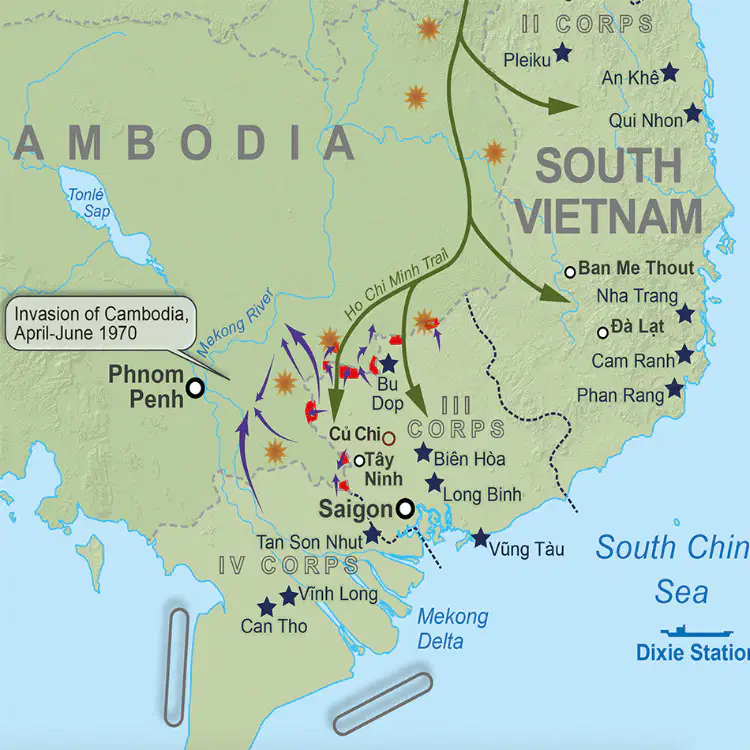
Which theory is most associated with the map and USA's involvement in the Vietnam War?
Brinksmanship
Domino Theory
Mercantilism
Humanism
. . . (1) Internally, arouse the masses of the people. That is, unite the working class, the peasantry, the urban petty bourgeoisie and the national bourgeoisie, form a domestic united front under the leadership of the working class, and advance from this to the establishment of a state which is a peoples democratic dictatorship under the leadership of the working class and based on the alliance of workers and peasants.
(2) Externally, unite in a common struggle with those nations of the world which treat us as equals and unite with the peoples of all countries. That is, ally ourselves with the Soviet Union, with the People’s Democracies and with the proletariat and the broad masses of the people in all other countries, and form an international united front. . . .
Source: MaoTse-Tung [Mao Zedong], Selected Works, Volume Five, 1945-1949
In this passage, Mao Zedong is using the ideas of
Thomas Malthus
Adam Smith
Karl Marx
Jiang Jieshi (Chiang Kai-Shek)

The changes in political boundaries shown on the maps occurred mainly because of
decolonization
population growth
economic development
communism

What event most likely influenced the action being taken in this cartoon?
End of Apartheid
Creation of the African Union
Cold War
End of the slave trade
. . . When the great scramble for Africa began in the last quarter of the nineteenth century, colonies had become a necessary appendage [extension] for European capitalism, which had by then reached the stage of industrial and financial monopoly that needed territorial expansion to provide spheres for capital investment, sources of raw materials, markets, and strategic points of imperial defence. Thus all the imperialists, without exception, evolved the means, their colonial policies, to satisfy the ends, the exploitation of the subject territories for the aggrandizement [enhancement] of the metropolitan [imperialistic] countries. They were all rapacious [greedy]; they all subserved the needs of the subject lands to their own demands; they all circumscribed [limited] human rights and liberties; they all repressed and despoiled [violated], degraded and oppressed. They took our lands, our lives, our resources, and our dignity. Without exception, they left us nothing but our resentment, and later, our determination to be free and rise once more to the level of men and women who walk with their heads held high. . . .
Source: Kwame Nkrumah, Africa Must Unite, International Publishers, 1970
Based on this excerpt, which event is this talking about?
Decolonization
Columbian Exchange
Industrialization
Renaissance

What event is shown in these maps?
Decolonization
Imperialism
Columbian Exchange
Reformation

The events depicted in this chart that took place in 1933 led to which of the following in Germany
a communist revolution
a totalitarian dictatorship
the start of World War I
increased freedom of expression
". . . The replacement of the bourgeois by the proletarian state is impossible without a violent revolution. The abolition of the proletarian state, i.e., of all states, is only possible through 'withering away.' . . ."
— V. I. Lenin, State and Revolution
The ideas in this quotation inspired
the Industrial Revolution
the Russian Revolution
the Cuban Revolution
the Haitian Revolution
Why did the United States support Ferdinand Marcos’s regime in the Philippines during the Cold War?
because Marcos was strongly anti-communist.
because Marcos was strongly committed to democratic principles.
because Marcos was trying to prevent takeover by a right-wing dictator.
because Marcos faithfully observed international human rights standards.
Which is an example of brinkmanship?
Cuban Missile Crisis
Korean War
WWII
NATO
The dictators of the 1930’s gained the support of their people by doing all of the following EXCEPT
creating numerous jobs and fixing the economy.
using propaganda to blame other groups for their problems.
promising a return to national glory
reducing their militaries to save money

Which of the following best describes the Marshall Plan?
the USA gave billions of dollars to Western European countries to help them rebuild after WW2
the USA loaned billions of dollars to Germany to help them make their war reparations payments after WW2
the USA initiated an airlift of supplies to the people of Berlin, Germany, so that they would not starve
the USA escalated the nuclear arms race in order to intimidate the USSR and limit the spread of radicalism

The idea that the earth is the center of the universe is the ___________ theory.
geocentric
heliocentric
earthcentric
all of the above

What was one major religious feature that was common to all 3 major pre-Columbian, native American civilizations?
monotheism
Catholicism
human sacrifice
baptism
… In addition, after the last battle they were afraid of the horses and guns, of our swords and crossbows and our good fighting. Above all was the great mercy of (Christian) God, Who gave us the strength to keep on.…
— Bernal Díaz del Castillo, The Bernal Díaz Chronicles, Doubleday & Company
In this passage about a conflict in Mexico, whose perspective is being expressed?
Spanish conquistador
Aztec warrior
Portuguese explorer
Inca emperor
“. . . (It) brought the potato, the pineapple, the turkey, dahlias, sunflowers, magnolias, maize, chillies and chocolate across the Atlantic. On the other hand, tens of millions died in the pandemics of the 16th century, victims of smallpox, measles and the other diseases brought by Europeans (and don’t forget that the African slave trade was begun by the Europeans, to replace the work force they had decimated).”. . .
— Michael Wood, BBC History (adapted)
Which historical development is being described in this quotation?
Columbian exchange
establishment of the line of Demarcation
creation of the Hanseatic League
Glorious Revolution

Which statement best explains the population trend shown on this graph? (ALL OF THESE ARE TRUE STATEMENTS, WHICH ONE IS SUPPORTED BY THE GRAPH!)
Europeans brought diseases to Latin America.
Native beliefs included human sacrifice.
Tribal warfare raged during this time period.
Native traditions encouraged polygamy.

What conclusion can be inferred from this photo of the famous ceiling of the Sistine Chapel, painted by Michelangelo?
The Church supported Renaissance artists by hiring them to beautify churches.
The Church insisted all Renaissance art blend religious and classical themes.
The Church dictated the themes and styles of Renaissance artists.
The Church dictated the themes and styles of Renaissance artists.

Which event is shown during the 18th and 19th centuries?
Gothic Architecture
Cold War
Renaissance
Industrialization

Known as the Father of modern economics, author of Wealth of Nations, based on the principle of Laissez-Faire?
Adam Smith
David Ricardo
Thomas Malthus
John Wesley
"In place of the bourgeois society, with its classes and class antagonisms, we shall have an association, in which the free development of each is the condition for the free development of all."
Who was the most likely author of the above quotation?
David Ricardo
Jeremy Bentham
Adam Smith
Karl Marx
"The city is the nerve center of our civilization. It is also the storm center…. The rich are richer, and the poor are poorer, in the city than elsewhere; and, as a rule, the greater the city, the greater are the riches of the rich and poverty of the poor."—Josiah Strong, Our Country: Its Possible Future and Its Present Crisis, 1885
Based on this text, Strong feels that cities are characterized by their
inequality.
opportunity.
poverty.
technology.
“It was a town of red brick, or of brick that would have been red if the smoke and ashes had allowed it; but as matters stood it was a town of unnatural red and black like the painted face of a savage. It was a town of machinery and tall chimneys, out of which interminable serpents of smoke trailed themselves for ever and ever, and never got uncoiled. It had a black canal in it, and a river that ran purple with illsmelling dye. . . .”
— Charles Dickens, Hard Times
Which problem is the subject of this passage?
urban pollution
economic inequality
lack of child labor laws
poor transportation systems

Start of WWI

Imperialism

Globalization

Made Mansa Musa wealthy

Made Byzantines/Constantinople wealthy

Made Spain Wealthy.

Aztecs & Mayans

Medieval Europe

Islam

Gothic Architecture

Split in Islam

Allowed for knowledge to spread rapidly.

Urbanization

Urban II Speech causes this.

Bushido in Japan

Heliocentric Theory
Urban II Speech causes this.

Geocentric Theory

Renaissance
Split in Islam
Allowed for knowledge to spread rapidly.
Start of WWI

Allowed for Easier colonization of the Americas

Mercantilism

Communism

Capitalism
Mercantilism

Cold War

Berlin Conference

Nonviolence
Franz Ferdinand is assassinated.
Austria Declares War on Serbia
3. Russia Declares War on Germany & Austria-Hungary
Britain Declares war after Germany invaded Belgium and France
Colonizing America
Industrialization
3. Imperialism
World War I
World War II
1. Farmers use more machines
Former farm workers move to cities.


Tet Offensive

Korean War

Domino Theory

Cuban Missile Crisis

Berlin Airlift
1. Franco-German War
WWI
WWII
4. Korean War
Vietnam War
Which title best completes the partial outline below?
I. ___________________
Berlin blockade
Cuban missile crisis
Vietnam War
Cold War Confrontations
Path to World War I
Victories for Democracy
Terrorism in the 20th Century
Religion Christianity and who controls the religion
Eastern Orthodox (a)
Catholic (b)
Protestant (c)

Islam

Christianity

Buddhism

1. WWII ends with iron curtain formed in Eastern Europe
Western Europe is worried about power of Communist Europe
3. NATO is formed in the West for protection from the Soviet Union.
Warsaw Pact formed as a response to NATO because Russia is concerned with the West.
Time Period Medieval Christian Europe (330-1450)
Who has Power? (a)
Society? (b)
Martin Luther
Reformation
Leonardo da Vinci
Renaissance
Bismark
Uniting Germany through nationalism
ROUSSEAU
Social Contract with the people
MONTESQUIEU
Separation of Powers into different branches of government.
VOLTAIRE
Freedom of thought and religion
LOCKE
People deserve natural rights and ownership of property
Match the following on the start of WWI

imperialism

nationalism

militarism

alliances
Match the following from the French Revolution
1st Estate
Clergy (church)
2nd Estate
Nobility
3rd Estate
Everyone else
Louis XIV
Divine Right King of France
Menelik II
Fought back against imperialism in Ethiopia.
Martin Luther
Reformation
Cuban Missile Crisis
Cold War
Hitler
World War 2
Match the following on the Columbian Exchange
Diseases
Biggest Impact on Native Americans
Slavery
Biggest Impact on Africa's population
New foods
Biggest Impact on Europe's population

