
Font size
 Worksheets
G6-Sci--T1-Unit Review HW
Total questions: 50
Worksheet time: 50mins
What does a magnifying glass do?
measure the size of an object
make objects look smaller
make objects look bigger
These hold the specimen in place so it does not shift while viewing it.
diaphragm
nosepiece
stage clips
base
The ___________ adjustment knob is used for moving the stage a little at a time, while making images more clear.
coarse
fine
diaphram
small
When carrying a microscope, you should hold onto which two parts of the microscope?
eyepiece and nosepiece
objective lenses and eyepiece
arm and stage
base and arm
The greater the ___________________, the smaller the field you are actually viewing.
detail
objective
magnification
body
Controls the amount of light that enters the body tube
Eyepiece
Mirror
Coarse Adjustment Knob
Diaphragm
What type of lens is used in a magnifying glass?
A) Concave lens
B) Convex lens
C) Flat lens
What happens to the field of view when the magnification is increased?
A) It gets larger
B) It stays the same
C) It gets smaller
D) It becomes clearer
How do you calculate the total magnification of a microscope?
A) Eyepiece magnification minus objective magnification
B) Eyepiece magnification divided by objective magnification
C) Eyepiece magnification times objective magnification
D) Eyepiece magnification plus objective magnification
What structure in onion cells is not present in cork cells?
A) Cell wall
B) Cytoplasm
C) Nucleus
D) Cell membrane
When using a microscope, why is iodine often used?
A) To illuminate the specimen
B) To stain the specimen
C) To magnify the specimen
D) To preserve the specimen
When using a microscope, it's important to start with the (a) magnification objective lens for initial focusing.
What is the purpose of the coarse adjustment knob?
A) To change the light intensity
B) To fine-tune the focus
C) To quickly and roughly bring the specimen into focus
D) To hold the lens in place
Which part of the microscope is responsible for changing the magnification?
A) Arm
B) Base
C) Nosepiece
D) Stage
What is the purpose of the stage on a microscope?
A) To support the lenses
B) To hold the specimen
C) To adjust the focus
D) To control the light
A (a) is a transparent glass used to cover specimens on a slide.
Different types of cells have unique (a) , which relate to their functions
Please arrange the following steps in the correct order, from first to last:
A. Add a drop of iodine solution along the edge of the coverslip to stain the specimen.
B.Place a drop of water on the center of a clean microscope slide.
C. Gently place the onion skin onto the water drop on the slide.
D. Peel a thin layer of onion skin from the onion bulb.
E. Use a tissue to gently blot away any excess water or iodine around the edges of the slide.
F. Add a coverslip at an angle over the onion skin to avoid air bubbles.
(a)
If the eyepiece lens has a magnification of 10x and the objective lens has a magnification of 40x, what is the total magnification of the microscope?
A) 50x
B) 100x
C) 400x
D) 4000x
The ___________ adjustment knob is used for moving the stage a little at a time, while making images more clear.
coarse
fine
diaphram
small
When you clean the lens what should you use?
lens paper
tissues

Who first used the term "cell" to describe the empty "rooms" he saw in his microscope?
Leeuwenhoek
Virchow
Pasteur
Hooke
When we combine two convex lenses in parallel, we've made a simple (a)
What type of cell is an onion skin cell classified as?
A) Animal cell
B) Plant cell
C) Bacterial cell
To prepare the onion skin for observation, you should peel a (a) layer from the onion bulb.
Onion skin cells have a rigid cell (a) that provides structure and support.
Which of the following is a common characteristic of microorganisms seen under a microscope?
A) They are large and can be seen without a microscope.
B) They can move.
C) They have structures like human cells.
What is the main purpose of using a cover slip when observing onion cells?
A) To increase magnification
B) To protect the specimen
C) To avoid air bubbles
D) To enhance color
Microorganisms are too _____ to directly observe?
large
rare
small
far
Are all microorganisms the same size?
Yes
No
Cells come in different sizes and shapes.
True
False
The tiny structures that make up all living things and are the smallest unit able to perform life functions.
electrons
molecules
cells
atoms
Almost all cells are ________.
large
microscopic
flat
round
Which statement is NOT true?
Microorganisms help dead things decay.
Microorganisms only live in soil.
Microorganisms cause disease.
Microorganisms are used to make cheese.
rigid outer layer that supports and allows it to grow tall
cell membrane
cell wall
chloroplast
cytoplasm
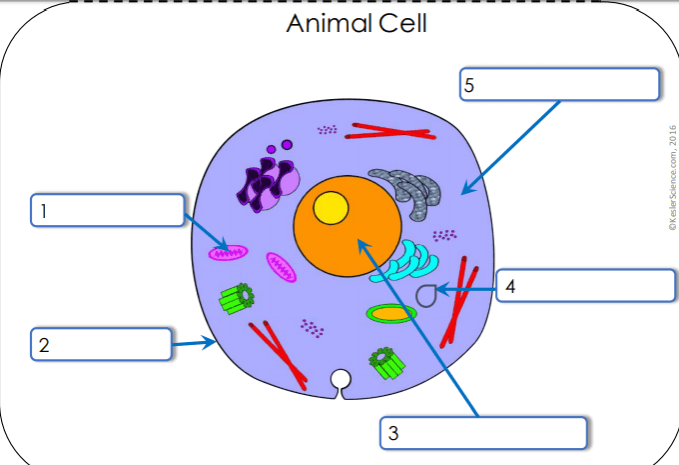
What is #3 in the diagram?
vacuoles
cell membrane
chloroplast
nucleus
What are cells?
Cells are the smallest unit of any organism that is microscopic, meaning it is too small to be seen.
Cells can be seen with our eyes on both animals and plants, and have different organelles with different functions.
Cells are too small to be seen with our eyes and are only found on animals.
Cells are the smallest unit of any organism, but have no purpose and can sometimes be seen with our eyes.


The cell is surrounded by two layers (labelled C). What is the outer layer of the cell called?
Nucleus
Cell Wall
Cell Membrane
Cytosol
What is the purpose of the cell wall?
Controls what the cell does (control centre of the cell).
The fluid that holds the organelles in place
Supports and protects the cell
Allows for substances to pass in and out of the cell
2.显微镜
(a)
7.光圈
(a)
12.细胞核
(a)
20.放大倍数
(a)

