
 Worksheets
Evolution
Total questions: 20
Worksheet time: 13mins
This is a mechanism for change in populations where an organism with a favorable phenotype survives, reproduces, and passes the favorable phenotype to the next generation. Organisms without the favorable phenotype are less likely to survive and reproduce.
natural selection
gene flow
disruptive selection
structural adaptation
What are body parts that do not have a common evolutionary origin but are similar in function?
analogous structures
homologous structures
vestigial structures
Which of the following is evidence of evolution?
fossils
anatomical
embryological
all of the above
What is natural selection that favors average individuals in a population?
directional selection
stabilizing selection
disruptive selection
Evolution occurs in _________________.
individuals
populations
The finches on the Galapagos Islands were similar in form except for variations of their beaks. Darwin observed that these variations were useful for _____________________.
attracting a mate
defending territory
building nests
gathering food
During a study session about evolution, one of your fellow students remarks, "The giraffe stretched itsneck while reaching for higher leaves; its offspring inherited longer necks as a result." Which statement is most likely to be helpful in correcting this student's misconception?
Characteristics gained during an organism's life are not passed on through genes.
Only favorable adaptions have survival value.
Disuse of an organ may lead to its eventual disappearance.
Natural selection is based on all of the following EXCEPT
Genetic variation exists within populations.
The best-adapted individuals tend to leave the most offspring.
Individuals adapt to their environments, and thereby, evolve.
In the earliest stages of development, a tail and gill slits can be seen in rabbits, fish, birds and humans. This is an example of ___________________ evidence of evolution.
fossil
embryoligical
anatomical
molecular (DNA)
Bird and butterfly wings have the same function but different structures. This is an example of ___.
homologous structures
analogous structures
vestigial structures

The image shown to the left illustrates what evolutionary concept?
embryolical similarities
vestigial structures
variation among sepcies
homologous structures
The hind leg bones in the whale are examples of _______.
homologous structures
fossil structures
analogous structures
vestigial structures
Rock pocket mice have evolved in different regions of the desert to have dark colored fur to better blend in with the environment after lava flows. How did some of the mice first have dark fur?
gene flow
mutations
acquired characteristics
survival of the fittest
Genetic drift is change in the allele frequency of a population due to...
random chance
natural selection
non-random mating (sexual selection)
artificial selection
One day a group of scientists collected a small group of brown anole lizards from a large group of the lizards. Then they placed this small group of lizards on an island that had no brown anole lizards on it. What is this an example of?
bottleneck effect
founder effect
hardy effect
Which of the following is an example of the bottle neck effect?
Bald Eagles are hunted until near extinction, and the population recovers.
A small group of iguanas floats to an island and starts a new population.
Red fox pups are more likely to survive in a snowy environment if they are born white.
When a farmer breeds only his or her best livestock, the process involved is.......
natural selection
mitosis
artificial selection
survival of the fittest
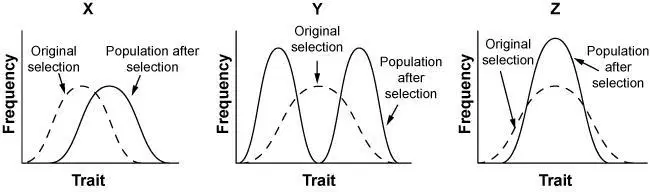
Which of the three graphs shows disruptive selection?
X
Y
Z
_________is when a plant or animal looks like another animal or object for defense or to gain an advantage.
copying
twinning
mimicry
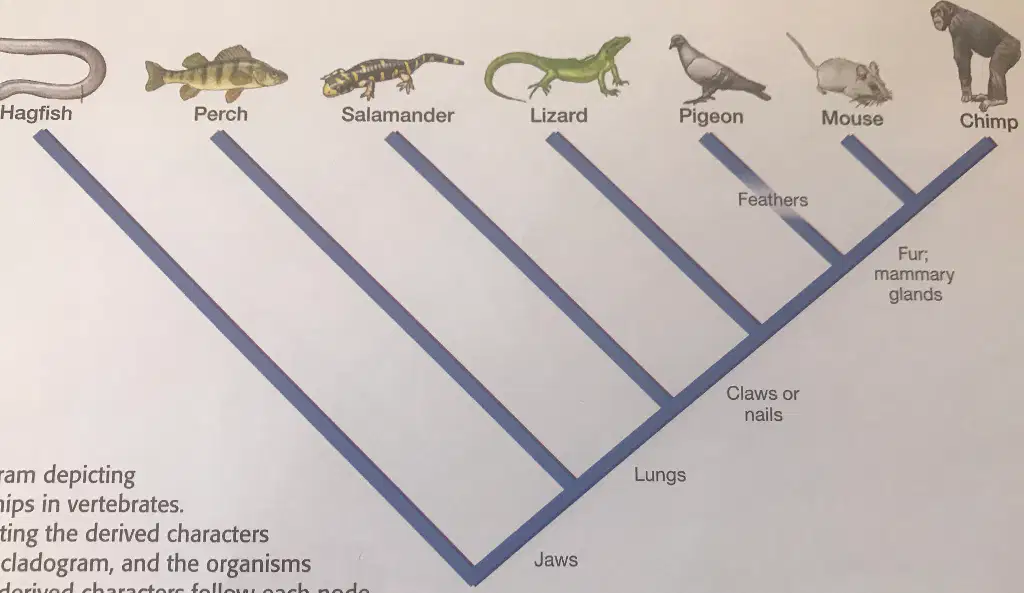
In the cladogram above, all the animals to the right of the hagfish would have the common characteristic of ___________.
fur
claws or nails
lungs
jaws

