wayground logo

Free Printable Worksheets

NEW

Font size

S
M
L
XL
Worksheets

Unit 1 Principles of Ecology

Total questions: 53

Worksheet time: 1hrs 8mins

Name
Class
Date
1.
What is this called?
a)
Food Web
b)
Food Chain
c)
Abiotic Factors
2.
What is this called?
a)
Food Web
b)
Food Chain
c)
Abiotic Factors
3.
If a frog is the prey, what could be the predator?
a)
Grass
b)
Insect
c)
Snake
d)
Snail
4.
What does a Primary Consumer eat?
a)
Tertiary Consumers
b)
Secondary Consumers
c)
Producers
5.
An organism that lives by breaking apart dead organic matter into simpler parts is...
a)
scavenger
b)
consumer
c)
decomposer
d)
carnivore
6.
A third-level consumer has to be which type?
a)
Carnivore.
b)
Decomposer.
c)
Producer.
d)
Herbivore.
7.
In a food web, arrows point at:
a)
who gets energy.
b)
who gets eaten.
8.
What does a food web represent?
a)
All connections of energy flow throughout all organisms in a ecosystem.
b)
The specific ways that mutualism is carried out.
c)
A single pathway or energy flow between organisms. 
d)
How carnivores get their food. 
9.
A community of living and nonliving things in their natural environment makes up a 
a)
food web
b)
ecosystem
c)
food chain
10.
What is a consumer? 
a)
Organism that creates their own food.
b)
Organism that eat other organisms for energy
c)
Organism that eat other dead organisms
11.
Which is the smallest level of an ecosystem?
a)
organsism
b)
population
c)
community
d)
ecosystem
12.

Which of the following best describes an energy pyramid?

a)

Each level represents a producer and the amount of energy available at each level

b)

Each level represents a trophic level and the amount of energy available at each level

c)

Each level represents a set of decomposers and the amount of energy available at each level

d)

Each level represents a apex predator
13.
The diagram represents a pyramid of energy in an ecosystem.  Which level would most likely contain members of the plant kingdom?
a)
A
b)
B
c)
C
d)
D
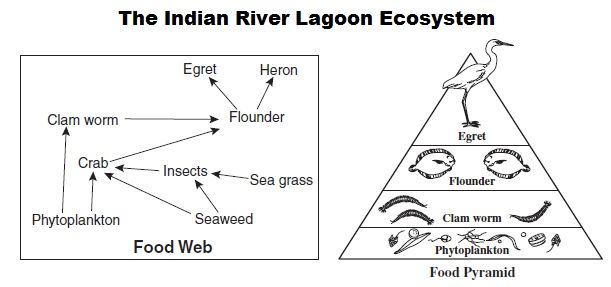
14.

Which of the following has the largest population in the Indian River Lagoon system?

a)

Crab

b)

Egret

c)

Flounder

d)

Phytoplankton

15.

The diagram below shows a desert food web.


How will a large decrease in the number of rats impact the food web shown above?

a)

There will be an increase in the number of ants, tarantulas, and snakes.

b)

There will be an increase in the number of snakes, coyotes, and hawks.

c)

There will be a decrease in the number of snakes, coyotes, and hawks.

d)

There will be a decrease in the number of cacti and sagebrush plants.

16.

Which of the following statements best describes the flow of energy in the energy pyramid above?

a)

As you go higher in the pyramid, the amount of energy increases.

b)

There is less energy in a producer level than a consumer level.

c)

There is no energy above the level of producers in the system.

d)

Each group receives only a small amount of the energy from the level below it.

17.

If there is 1000 Kcal available in the producers in trophic level 1, approximately how much energy is available in the herbivores in trophic level 2?

a)

10 Kcal

b)

1 Kcal

c)

100 Kcal

d)

1000 Kcal

18.

Autotrophs--The bottom trophic level where all organisms produce their own food, usually by photosynthesis.

a)

Trophic Levels

b)

Producers

c)

Ominvores

d)

Herbivores

19.
A food pyramid represent the relative amount of energy in trophic levels. Which of the following correctly shows a food pyramid?
a)
A
b)
B
c)
C
d)
D
20.
Which of the following would be the most likely effect, if there were a sudden increase in the cricket population?
a)
There would be a decrease in the small bird population.
b)
There would be a decrease in the grass/flowers population.
c)
There would be a decrease in the mice population.
d)
There would be an increase in the grass/flowers population.
21.

What is the process where bacteria turns Nitrogen gas from the atmospheres into usable compounds?

a)

nitrogen composition

b)

nitrogen fixation

c)

ammonia

d)

denitrification

22.

In the energy pyramid below, which organism has the least amount of energy available?

a)

Producers

b)

Herbivores

c)

Carnivores

d)

Top Predators

23.

What would happen to the bird if the green fish died out?

a)

the bird population would grow

b)

the bird population would die out

c)

the smaller fish will die out

24.

The diagram represents different levels of a marine food pyramid. Between which two levels is the greatest amount of energy transferred

a)

R and Q

b)

S and R

c)

T and S

d)

U and T

25.

Several owls live in a forest. The owls prey on mice. Hawks also prey on mice. Which might happen if several hawks move to the forest where the owls live?

a)

The number of owls will increase, and the number of hawks will decrease.

b)

The number of mice will increase, and the number of owls will decrease.

c)

The number of owls and hawks will increase.

d)

The number of owls and mice will decrease.

26.
If there is 1000 Kcal available in the producers in trophic level 1, how much energy is available in the herbivores in trophic level 2?
a)
10 Kcal
b)
1 Kcal
c)
100 Kcal
d)
1000 Kcal
27.

What is the number of of individuals that gets the second largest amount of energy?

a)

6

b)

67

c)

1478

d)

8863

28.

What is the number of of individuals that gets the largest amount of energy?

a)

6

b)

67

c)

1478

d)

8863

29.
If only 10% of an organism's energy is available for the next trophic level, what happens with the other 90% of the energy?
a)
It is destroyed after it is used up.
b)
It is used for life processes or lost as body heat.
c)
It remains for the next trophic level IF the predator consumes ALL of the organism.
d)
It is lost completely as body heat. 
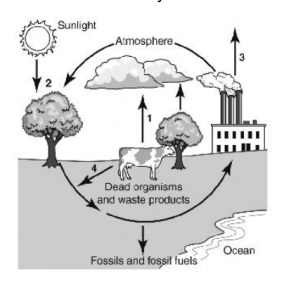
30.
What is happening at 1?
a)
respiration: releasing CO2
b)
decomposing COin the soil
c)
photosynthesis: absorbing CO2
d)
turning CO2 from the atmosphere into organic molecules
31.
Photosynthesis
a)
absorbs CO2
b)
releases CO2
32.
Animals obtain the nitrogen they need directly from the
a)
soil in their habitat
b)
air they breathe
c)
plants they eat
d)
bacteria living within them
33.
Bacteria that can use nitrogen in soil to make nitrogen compounds
a)
Eutrification
b)
Legumes
c)
Nitrogen Fixing
d)
decomposers
34.
How nitrogen is "fixed" into useable form for plants...
a)
through action of bacteria only
b)
through lightning only
c)
through action of bacteria & lightning
d)
through photosynthesis
35.
Which process moves carbon stored in fossil fuel into another carbon reservoir?
a)
When fossil fuels are burned, carbon enters the atmosphere as carbon dioxide.
b)
The denitrifying bacteria turns the fossil fuel into carbon dioxide gas.
c)
Decomposers convert the fossil fuels into greenhouse gases like carbon dioxide.
d)
The fossil fuels react with the soil to produce carbonates and carbon dioxide.
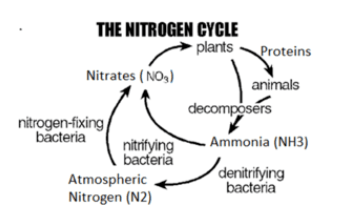
36.

According to this diagram, plants absorb

a)

nitrates

b)

nitrogen fixing bacteria

c)

animals

d)

decomposers

37.

A correct path that nitrogen could take would be _____

a)

air -> animals->plants->bacteria

b)

animals->air->bacteria->plants

c)

air -> bacteria ->plants -> animals

d)

bacteria ->air -> animals->plants

38.
  1. 10. The process represented by arrow 4 is __

a)
transpiration
b)
precipitation
c)
evaporation
d)
condensation
39.

What is the original, and biggest reservoir of phosphorus on the planet?

a)

live plants and animals

b)

groundwater

c)

the atmosphere

d)

rocks

40.

Energy can never be created nor destroyed. Which law does this refer to?

a)

0th law of thermodynamics

b)

1st law of thermodynamics

c)

2nd law of thermodynamics

d)

3rd law of thermodynamics

41.
Biome with many scattered shrubs, tall grasses and small trees.
a)
Savannah
b)
Grassland
c)
Desert
d)
Taiga
42.
Biome with many different species of cacti and reptiles and very little rainfall.
a)
Desert
b)
Temperate Rainforest
c)
Tropical Rainforest
d)
Tundra
43.
Cold, dry biome where the soil stays frozen the entire year. Very little precipitation.
a)
savannah
b)
taiga
c)
tundra
d)
desert
44.
A group of ecosystems with similar organisms and climates.
a)
desert
b)
deciduous
c)
canopy
d)
Biome
45.
Forest biome with many different trees, mosses and ferns; most trees lose and regrow their leaves each year.
a)
temperate rainforest
b)
biome
c)
savannah
d)
boreal
46.
Type of forest biome near the equator; receives a lot of rain; temperatures are warm all year.
a)
desert
b)
tropical rain forest
c)
arctic
d)
temperate rain forest
47.

Describe the levels of ecological organization.

a)

A) Individual, Population, Community, Ecosystem, Biome, Biosphere

b)

B) Cell, Tissue, Organ, Organ System, Organism

c)

C) Atom, Molecule, Cell, Organism, Population

d)

D) Species, Genus, Family, Order, Class

48.

Which of the following is the first level of organization in ecology?

a)

Population

b)

Community

c)

Individual

d)

Ecosystem

49.

At which level of organization do scientists study groups of the same species living in an area?

a)

Community

b)

Population

c)

Ecosystem

d)

Biosphere

50.
A collection of organisms that make up a community as well as all of the nonliving aspects of the environment.
a)
Population
b)
Community
c)
Habitat
d)
Ecosystem
51.
Abby is walking to school with her best friend Jaylyn. They begin talking about everything they see including the ash trees, grass, weeds, ants, and people. They also notice how cold it is, how there are several large puffy clouds out, and how the sun is just starting to come up.  What level of organization are they discussing?
a)
community
b)
ecosystem
c)
biome
d)
biosphere
52.

In which month do they get the most rain in this biome?

a)

January

b)

May

c)

August

d)

November

53.

Which is the desert climograph?

a)

A

b)

B

c)

C

d)

D