
 Worksheets
Biology Exam Practice
Total questions: 47
Worksheet time: 24mins
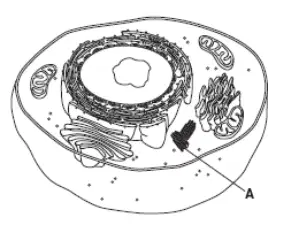
In Figure 10–1, what role does structure A
play in mitosis?
replicate DNA
increase cell volume
connects to spindle fibers
dissolve nuclear membrane
. During normal mitotic cell division, a parent cell that has four chromosomes will
produce two daughter cells, each containing
sixteen chromosomes
eight chromosomes
four chromosomes
two chromosomes
One difference between cell division in plant cells and in animal cells is that plant cells have
a cell plate
centromeres
chromatin
centrioles

This structure is a replicated chromosome.
true
false
The rate at which wastes are produced by a cell partially depends on the cell’s
a. ratio of surface area to volume.
b. volume.
c. type of membrane.
d.surface area.
type of membrane
surface area
ratio of surface area to volume
volume
When during the cell cycle is a cell’s DNA replicated?
G1 phase
G2 phase
M phase
S phase
If a pea plant has a recessive allele for green peas, it will produce
yellow peas, if it does not also have a dominant allele for green peas.
green peas, if it does not also have a dominant allele for yellow peas.
both green and yellow pease, if it also has a dominant allele for yellow peas.
green peas, if it also has a dominant allele for yellow peas.
If a gamete has a haploid number of 12 what will the diploid number be after fertilization?
36
4
24
6

In the Punnett square shown in Figure 11–1, which of the following is true about the offspring resulting from the cross?
About half will be short.
All will be short.
About three fourths will be tall.
All will be tall.

Use this Punnett square to answer the following question. If a pea plant that is heterozygous for round, yellow peas (RrYy) is crossed with a pea plant that is heterozygous for round peas and heterozygous for yellow peas (RrYy), how many different phenotypes are their offspring expected to show?
2
8
4
16
Gametes have
a. homologous chromosomes.
b. twice the number of chromosomes found in body cells.
c. two sets of chromosomes.
d. one allele for each gene.
homologous chromosomes
twice the number of chromosomes found in body cells
two sets of chromosomes
one allele for each gene.
What is formed at the end of mitosis?
two genetically identical cells
four genetically identical cells
two genetically different cells
four genetically different cells
What type of cells are gametes?
body cells
sex cells
haploid
diploid
What is formed at the end of meiosis?
two genetically identical cells
four genetically identical cells
four genetically different cells
two genetically different cells
A mule is the result of a cross between a donkey and a horse. A mule is a
tetrad
genotype
phenotype
hybrid
A tall plant (TT) is crossed with a short plant (tt). What will the resulting offspring look like?
The offspring will be of medium height.
All of the offspring will be short.
All of the offspring will be tall.
The offspring can be tall or short.
A heterozygous tall pea plant is crossed with a short plant. The probability that an F1 plant will be tall is
25%
75%
50%
100%
Organisms that have two identical alleles for a particular trait are said to be
heterozygous
homozygous
dominant
hybrid
If an organism’s diploid number is 12, its haploid number is
12
24
6
3
Gametes are produced by the process of
crossing over
replication
meiosis
mitosis
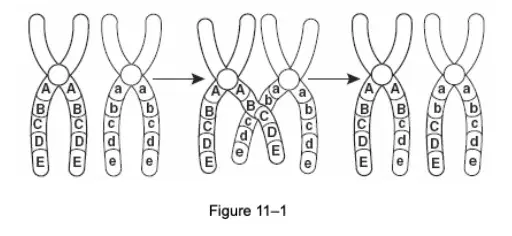
What is shown in Figure 11–1?
replication
crossing over
independent assortment
anaphase I of meiosis
Unlike mitosis, meiosis results in the formation of
diploid cells
2N daughter cells
haploid cells
body cells
As a cell grows larger, it has more trouble
moving through the cell cycle.
completing cell division.
replicating its chromosomes.
moving enough nutrients across the cell membrane.
What is cytokinesis?
the division of a cell’s cytoplasm
the final phase of interphase
a pigment in the chloroplast
the spreading of cancer cells throughout the body
In a eukaryote, the portion of the cell surrounding the nucleus is the
epithelial tissue.
organelle.
nuclear membrane.
cytoplasm.
During which phase of the cell cycle are chromosomes replicated?
S phase
M phase
G2 phase
G1 phase
Darwin noticed that many organisms seemed well suited to
swimming from South America to the Galápagos Islands.
providing humans with food.
surviving in the environments in which they lived.
being preserved as fossils.
Lamarck’s ideas about evolution include the concept that differences among the traits of organisms arise as a result of
the actions of organisms as they use or fail to use body structures.
the natural variations already present within the population of organisms.
continual increases in population size.
an unchanging local environment.
When a dairy farmer chooses to breed the cows that give the most milk in the herd, the farmers are following the principle of
natural selection.
artificial selection.
descent with modification.
acquired characteristics.
Which statement about the members of a population that live long enough to reproduce is consistent with the theory of evolution by natural selection?
They transmit characteristics acquired by use and disuse to their offspring.
They tend to produce fewer offspring than others in the population.
They are the ones that are best adapted to survive in their environment.
They will perpetuate unfavorable changes in the species.
Which is a structure common to ALL cells?
cell membrane
mitochondria
nucleus
endoplasmic reticulum
The semi-fluid matrix that surrounds organelles in a cell is called the:
stroma
nucleoplasm
cytoplasm
ribosome
The organelle that can collect, package, modify, and transport molecules is called the:
vesicle
plasma membrane
Golgi body
mitochondria
What structure is responsible for creating energy for a cell?
ribosome
mitochondria
Golgi Body
lysosome
The eukaryotic organelle that is directly involved in the transport of proteins:
mitochondrion
ER
(endoplasmic reticulum)
vacuole
Golgi body
In eukaryotes, the mitochondria are the organelles primarily involved in:
protein synthesis
export of enzymes
lipid synthesis
energy release/capture
The nucleolus is the site of:
lipid synthesis
protein synthesis
chromosome replication
ribosome assembly
Plants, fungi and bacteria all have this:
chloroplasts
cell walls
mitochondria
nucleus
A molecule of DNA is made up of
ATP and enzymes
amino acids and proteins
receptor enzymes
paired nucleotides
If the structure of DNA were likened to a ladder, what would make up the “supporting structure” (not the rungs that you step on but the sides you hold onto) of the ladder?
amino acids and sugars
nucleotides bases
phosphates and sugars
hydrogen bonds
Which organelle produces proteins?
lysosome
mitochondria
nucleus
ribosome
This organelle can burst open and destroy a cell when it becomes too old or worn.
lysosome
mitochondria
nucleus
ribosome
Which organelle contains the DNA of an organism?
lysosome
mitochondria
nucleus
ribosome
The nitrogenous base that always forms hydrogen bonds with guanine.
cytosine
helix
nitrogenous base
adenine
The four DNA nitrogenous bases are guanine, cytosine, thymine
and this.
nitrogenous base
cytosine
helix
adenine
The twisted ladder shape of DNA is called this.
nitrogenous bases
cytosine
helix
adenine
The sequence of this is what carries the genetic information
nitrogenous bases
cytosine
helix
adenine

