
 Worksheets
Final Cumulative Review
Total questions: 49
Worksheet time: 26mins
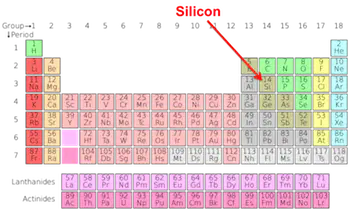
Which statement does NOT correctly compare silicon with another element?
(Look at the Periodic Table. Is it a metal, non-metal, or metalloid?)
Silicon is a better conductor of electricity than sulfur.
Silicon conducts electricity as well as copper does.
Silicon is a solid at room temperature, but argon is a gas.
Silicon is less malleable than silver.
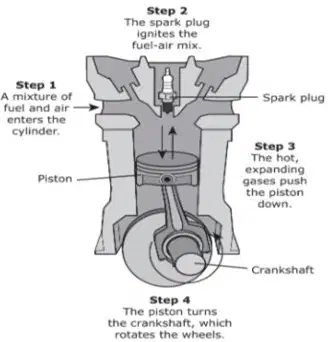
The diagram shows how a cylinder in a car engine causes the car to move.
Step 1--a mixture of fuel and air enters the cylinder
Step 2--the spark plug ignites the fuel-air mix
Step3--the hot, expanding gases push the piston down
Step 4--The piston turns the crankshaft, which rotates the wheels
Which description of the energy conversions in this process is correct?
The thermal energy in the fuel-air mixture is converted to electrical energy, which is then converted to mechanical energy.
The electrical energy in the fuel-air mixture is converted to mechanical energy, which is then converted to thermal energy.
The mechanical energy in the fuel-air mixture is converted to electrical energy, which is then converted to thermal energy.
The chemical energy in the fuel-air mixture is converted to thermal energy, which is then converted to mechanical energy.
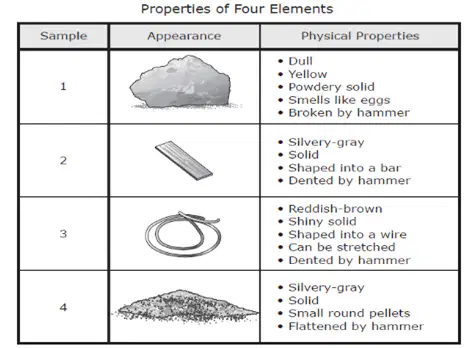
1 Some students conducted a laboratory investigation to learn more about the physical properties of different elements. They observed four samples and recorded their observations in the table.
Based on these observations, which sample is most likely a nonmetal ?
Sample 1
Sample 2
Sample 3
Sample 4
1 Aluminum, sulfur, and chlorine are elements found on the periodic table. Tests involving these three elements would show that at a normal room temperature -
sulfur is malleable and aluminum conducts electricity.
chlorine is malleable and conducts electricity.
aluminum is malleable and conducts electricity.
all three elements are malleable and conduct electricity.
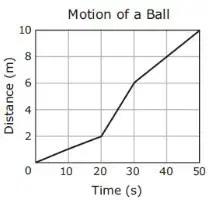
The graph shows the motion of a ball rolling on a straight track.
What was the ball's average speed during the time represented in the graph?
0.2 m/s
0.5 m/s
5.0 m/s
10.0 m/s
What keeps planets in the system from moving in straight lines through the galaxy?
Light energy
Gravity
Inertia
Potential energy
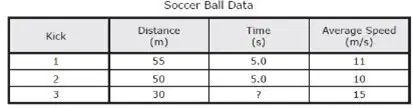
1 A student kicks a soccer ball three times. Another student records the distance, the amount time the ball travels, and the average speed in the table shown.
How many seconds did it take for the ball to travel 30 m during Kick 3?
0.5 s
1.0 s
1.5 s
2.0 s
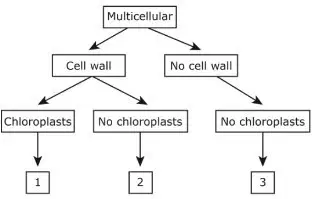
A group of students used the diagram to classify three organisms into different kingdoms.
Which table correctly identifies the three kingdoms?


A student makes a model of the sun-Earth system by swinging a ball around her head. Using this model, the student is trying to explain how Earth stays on a path around the sun.
The student explains that this path is the result of -
the magnetic attraction between Earth and the sun.
potential energy stored in Earth that originated in the sun.
electromagnetic energy from the sun pulling on Earth.
the gravitational attraction between the sun and Earth.
In which kingdom should this organism be classified?
Characteristics of an Organism
*Is multicellular
*Is autotrophic
*Has cell walls
*Has cell nuclei
*Can reproduce sexually or asexually
Fungi
Animalia
Plantae
Eubacteria
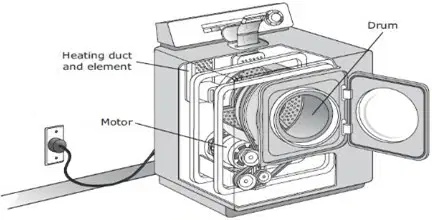
The main parts of a working clothes dryer are shown in the diagram. This appliance dries clothes primarily by converting -
(a) to (b) and (c)

What force causes Venus to travel along a curved path instead of moving in a straight line as indicated by the dashed line in the diagram?
Gravitational attraction between the sun and Venus.
Gravitational attraction between Mercury and Venus.
Electromagnetic attraction between the sun and Venus.
Electromagnetic attraction between Mercury and Venus.
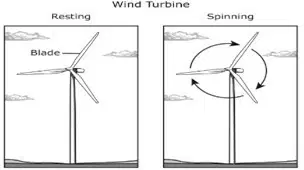
The blades of a wind turbine are at rest until the movement of air causes the blades to spin.
Which energy transformation happens when the blades are spinning as shown?
Electrical to mechanical
Chemical to electrical
Mechanical to electrical
Chemical to mechanical
Which list of characteristics describe organisms classified as animals?
Multicellular, eukaryotic, autotrophic
Unicellular, eukaryotic, heterotrophic
Multicellular, eukaryotic, heterotrophic
Unicellular, prokaryotic, autotrophic

The moon remains in orbit around Earth because of the force of -
the sun's gravity
Earth's gravity
the moon's rotation
Earth's rotation
In July 1994 the comet Shoemaker-Levy 9 collided with the planet Jupiter, as scientists had predicted. To be able to accurately predict when a comet will collide with a planet, it is essential to understand -
the formation of comets.
the attraction of opposite poles of a magnet to each other.
the gravitational attraction that exists between all bodies.
the composition of a planet's atmosphere.
A student runs two times around a running path at a local park. Each lap is 3 km. The student completes the first lap in 20 minutes. The student then sits on a bench and rests for 5 minutes before completing the second lap in 25 minutes. Which graph best represents the student's motion?
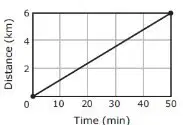
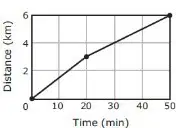
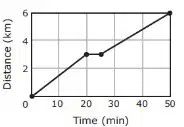
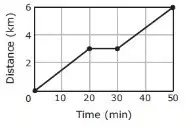
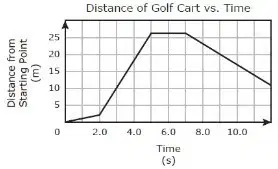
A golfer collected data on the distance a golf cart traveled in a straight line and plotted it on a graph.
Which of these does not describe the cart's motion on this graph?
The cart moved away from the starting point at a speed of 1 m/s for 2s.
The cart moved 11 m toward the starting point between 8 s and 10 s.
The cart moved toward the starting point at a speed of 3 m/s between 7 s and 12 s.
The cart moved 24 m away from the starting point between 2 s and 5 s.
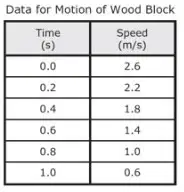
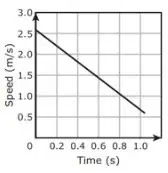
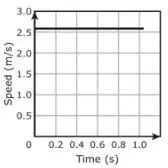
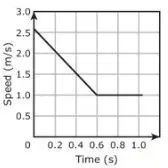
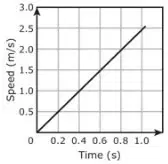
1 Students slid a small wood block along a flat tabletop for a distance of 1.6 m. The data show the motion of the block of wood.
Which graph displays the motion of the wood block?
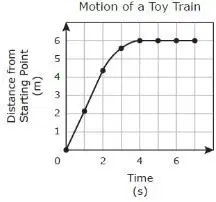
1 A hobbyist collected data about the motion of a toy train on a straight track and then recorded the data in the graph.
Which of these accurately describes the motion of the toy train?
The toy train speeds up while going forward and then slows down.
The toy train slows down while going forward and then moves backward.
The toy train moves forward at a constant speed, slows down, and then stops.
The toy train moves forward at an increasing speed, stops, and then moves forward.
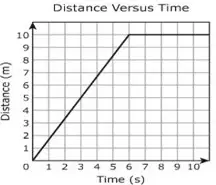
The graph shows the distance an object traveled in 11 seconds.
Which answer choice best describes the movement of the object between the times of 0 and 6 seconds on the graph?
Stopped
Moving at a constant speed
Accelerating
Moving toward the north
A teacher rubbed a match against a piece of sandpaper. The match started to burn. Which statement best describes the energy changes that occurred?
The chemical energy stored in the match changed to thermal energy and light energy
The light energy and thermal energy stored in the match changed to chemical energy.
The light energy and thermal energy stored in the match changed to mechanical energy
The thermal energy stored in the match changed to light energy and chemical energy.
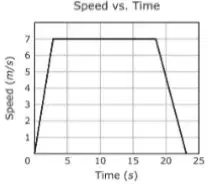
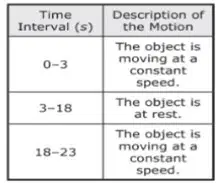
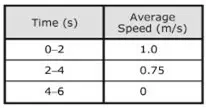
The speed of an object over time is shown in the graph.
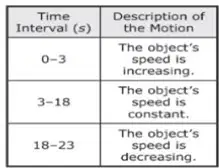
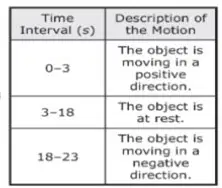
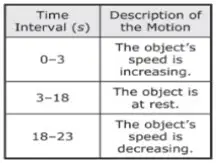
Which table describes the object's motion?

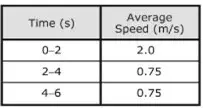
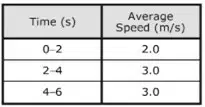
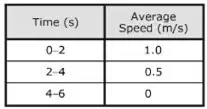
The distance a toy car travels over time is shown in the graph.
Which table shows the average speed of the toy car at different time intervals?
A cook heats a meal in a microwave oven. What energy transformations occur between the microwave oven and the meal?
Electrical to light energy to chemical energy
Chemical energy to thermal energy to light energy
Electrical energy to electromagnetic energy to thermal energy
Chemical energy to electromagnetic energy to chemical energy
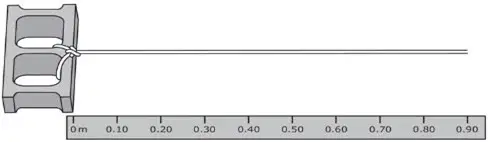
A block is pulled 0.90 m to the right in 2.5 s.
What is the block's average speed to the nearest hundredth of a m/s?
(Don't forget your triangle!)
0.5 m/s
0.9 m/s
0.36 m/s
2.5 m/s

A horse trainer records the distance a horse travels during three different trials.
What is the horse's average speed in kilometers per minute?
0.3
13.5
4.5
0.9
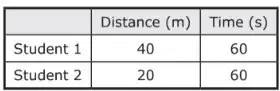
Two students record the distance they each traveled in 60 seconds in the data table shown.
If the students continue at the same speed, which statement describes the total distance traveled after 90 seconds?
Student 1 traveled 40 m, and student 2 traveled 20 m.
Student 1 traveled 50 m, and student 2 traveled 30 m.
Student 1 traveled 60 m, and student 2 traveled 30 m.
Student 1 traveled 70 m, and student 2 traveled 25 m.

A student drew the diagram below to show the movement of water through a hydroelectric dam.
The student used the diagram to describe changes in the potential and kinetic energy of the water. At which location is the gravitational potential energy of the water the greatest?
Location W
Location X
Location Y
Location Z
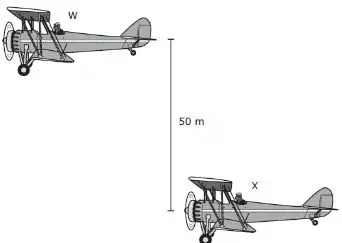
The drawing shows two identical airplanes at an air show. The airplanes are flying at the same speed. Airplane W is flying 50 m higher than Airplane X.
Which statement best describes the energy of the two airplanes?
Airplane W has a greater kinetic energy than Airplane X.
The two airplanes have the same gravitational potential energy but different kinetic energy.
Airplane X has more gravitational potential energy than Airplane W.
The two airplanes have the same kinetic energy but different gravitational energies.
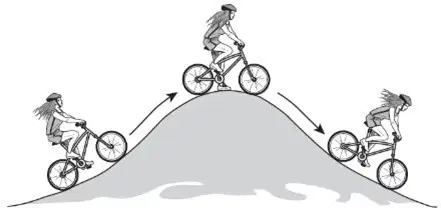
A bicycle rider is traveling up a hill. When the rider reaches the top of the hill, she stops to rest. Then she travels down the hill. The diagram shows the rider in three different positions.
Which of these correctly describes the potential energy and the kinetic energy of the bicycle rider?
When the rider is at the top of the hill, her potential energy is the greatest, and her kinetic energy is the least.
As the rider moves up the hill, her kinetic energy increases, and her potential energy decreases.
When the rider does down the hill, her potential energy increases, and her kinetic energy decreases.
As the rider reaches the bottom of the hill, her kinetic energy and her potential energy decrease.

A demonstration helps students understand a principle of roller coaster design.
Which answer choice correctly describes the ball's kinetic and potential energy?
The potential energy and kinetic energy of the ball are equal at position X.
The potential energy and kinetic energy of the ball are greatest at position Z.
The ball has more potential energy at position X than at position Z.
The ball has more kinetic energy at position Y than at position W.
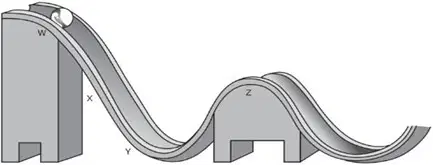
A marble is given potential energy by being placed at location W. When the marble is released, it rolls down the track.
At which location does the marble have maximum kinetic energy?
Location W
Location X
Location Y
Location Z
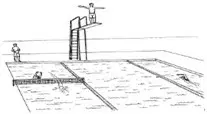
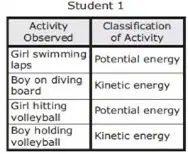
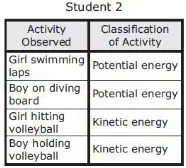
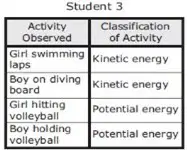
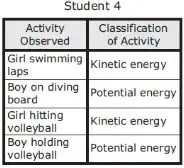
Four students were asked to classify the activities of the people in the picture below as examples of either potential or kinetic energy.
Which student correctly classified the activities?
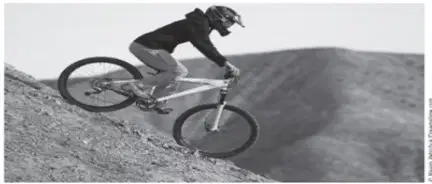
The picture shows a bicyclist increasing speed while riding down a hill during a bicycle race.
Which statements accurately describe the potential and kinetic energy of this bicyclist?
Kinetic energy increases.
Potential energy decreases.
Kinetic energy increases.
Potential energy remains constant.
Kinetic energy remains constant.
Potential energy decreases.
Kinetic energy remains constant.
Potential energy increases.
A student walks 2 km in 30 minutes. What is the student's average speed in km/h?
1 km/h
2 km/h
4 km/h
30 km/h
A car travels at a constant speed of 15 m/s for 2 minutes. The car increases its speed from 15 to 25 m/s during the next minute and then travels at a constant speed of 25 m/s for 2 more minutes. Which of the following graphs best represents the car's motion during the 5-minute period?
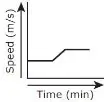
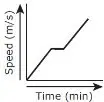
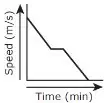
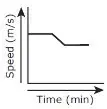
A bus travels 20 km in 30 minutes. What is the average speed of the bus?
20 km/h
30 km/h
40 km/h
50 km/h
Students observe an unknown species during a field study. They observe that the organism is multicellular, is autotrophic, and can reproduce both sexually and asexually.
Which kingdom does the organism most likely belong to?
Plantae
Archaea
Animalia
Bacteria

In the classroom demonstration shown below, a rubber ball is dropped from Position 1. The ball bounces as shown.
At which of these positions does the ball have both the greatest kinetic energy and the least potential energy?
Position 1
Position 2
Position 3
Position 4
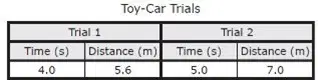
Some students were investigating the speed of a toy car they built. They performed two trial and recorded their data in the table below.
What was the average speed of the toy car during the two trials to the nearest tenth of m/s?
.14 m/s
.014 m/s
14 m/s
1.4 m/s
Roller coasters are popular attractions at amusement parks. A cart on a roller coaster approaches the highest point on the coaster. As the cart reaches the top, it slows down. Which statement best describes the energy of the roller coaster as it slows down while traveling to the top of the coaster?
The cart gains both kinetic and potential energy.
The cart gains kinetic energy and loses potential energy.
The cart loses kinetic energy and gains potential energy.
The cart loses both kinetic and potential energy.
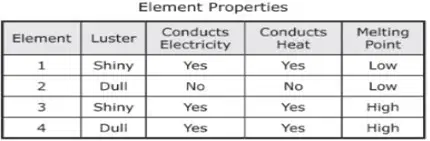
The chart shows properties of four elements.
Based on these properties, which element is most likely a nonmetal?
Element 1
Element 2
Element 3
Element 4
Which statements correctly compare metals and nonmetals?
Metals are good insulators of electricity.
Nonmetals tend to be good conductors of electricity.
Metals cannot be stretched into wires.
Nonmetals can be stretched into thin wires.
Metals tend to be good conductors of thermal energy.
Nonmetals tend to be good insulators of thermal energy
Metals are dull and brittle.
Nonmetals are shiny and malleable
Students build a circuit. The circuit has wires that connect a battery to a switch and a fan. Which energy transformations happen when the students close the circuit and the blades of the fan begin to spin?
Electrical to chemical to mechanical
Mechanical to electrical to chemical
Chemical to mechanical to electrical
Chemical to electrical to mechanical
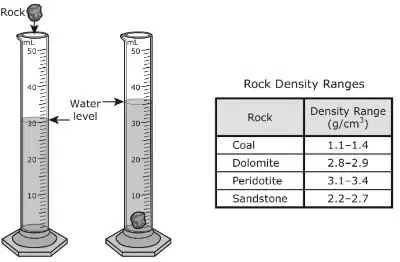
The mass of an unidentified rock is 13.5 grams. Students determine the volume of the rock by placing the rock in a cylinder with water. The students calculate the density of the rock. They determine the identity of the rock based on the density ranges in the table.
The students most likely have which type of rock?
Sandstone
Peridotite
Dolomite
Coal
A student measures the mass and volume of a small cube made of an unknown metal. The mass of the cube is 25.0 g, and the volume of the cube is 3.19 cm3. The student is told that the cube is a sample of one of the four metals listed in the table.
Based on the data given, the unknown metal is most likely -
iron
silver
tin
gold
A balance and a graduated cylinder are used to determine the density of a mineral sample. The sample has a mass of 14.7 g and a volume of 2.2 cm3. What is the density of the mineral sample?
6.7 g/cm3
13 g/cm3
32 g/cm3
0.15 g/cm3
A student is trying to classify an unidentified, solid gray material as a metal or a nonmetal. Which question will best help the student classify the material?
Is the material malleable or ductile?
Does the material feel hard to the touch?
Will the material float in water?
Does the material feel rough or smooth?

