wayground logo

Free Printable Worksheets

Font size

S
M
L
XL
Worksheets

Science 7R: Measurement, Human Impact and Ecology Review

Total questions: 70

Worksheet time: 53mins

Name
Class
Date
1.

What are herbivores?

a)

Animals that eat plants and animals.

b)

Animals that eat only plants.

c)

Animals that eat only animals.

d)

Animals that break down dead matter.

2.

The diagram pictured shows what?

a)

A food chain

b)

A food web

c)

A food pyramid

d)

A biomass pyramid

3.

What species is at the bottom of the food chain pictured?

a)

producer

b)

primary consumer

c)

tertiary consumer

d)

sun

4.

What is an example of a limiting factor?

a)

shelter

b)

strength

c)

number of offspring

d)

height

5.

What is the original source of energy in most ecosystems?

a)

carbohydrates

b)

sunlight

c)

water

d)

carbon

6.

Which relationship is when both organisms benefit?

a)

competition

b)

mutualism

c)

parasitism

d)

energy pyramid

7.

A living relationship between two species in which one organism is harmed and the other benefits is called...

a)

mutualism

b)

commensalism

c)

parasitism

d)

niche

8.

A group of organisms that are different species but all live in the same area and interact with one another.

a)

Population

b)

Ecosystem

c)

Community

d)

Organism

9.
A living organism that puts materials from dead  plants and animals back to the soil is called a ____________?
a)
carnivore
b)
decomposer
c)
herbivore
d)
omnivore
10.

In a parasitic relationship, one organism is ___________ and one organism is helped.

a)

helped

b)

harmed

c)

not effected

d)

happy

11.
Which of the following would be the most likely effect, if there were a sudden increase in the cricket population?
a)
There would be a decrease in the small bird population.
b)
There would be a decrease in the grass/flowers population.
c)
There would be a decrease in the mice population.
d)
There would be an increase in the grass/flowers population.
12.

Which of the following best describes the ladybug in the food web above?

a)

primary consumer

b)

secondary consumer

c)

tertiary consumer

d)

producer

13.

Which is NOT an abiotic factor:

a)

soil

b)

air

c)

bacteria

d)

water

14.

A food ____ is a series of overlapping food chains.

a)

chain

b)

pyramid

c)

web

15.

The producer in this food web is the ____.

a)

plant

b)

mouse

c)

boar

16.

The consumers in this food chain are the (pick three) ____.

a)

plant

b)

mouse

c)

boar

d)

wolf

17.

What is missing in this food web?

a)

producer

b)

secondary consumer

c)

herbivore

d)

decomposer

18.

The boar is a

a)

herbivore

b)

carnivore

c)

omnivore

19.
Any factor in an ecosystem that is currently living or has once lived is called?
a)
Abiotic Factor
b)
Biotic Factor
c)
Limiting Factor
d)
Non-Living Factor
20.
___________ ___________ are things that happen in an ecosystem that cause the population to change (usually decrease).
a)
Biotic Factors
b)
Abiotic Factors
c)
Limiting Factors
d)
Non-Living Factors
21.

The smallest level of ecological organization that consists of ONE living thing called an ___________.

a)

Population

b)

Organism

c)

Community

d)

Ecosystem

22.
A group of the same species living in an ecosystem is referred to as a ____________.
a)
Community
b)
Population
c)
Ecosystem
d)
Organism
23.
The largest level of ecological organization which includes all biotic and abiotic features
a)
Community
b)
Population
c)
Organism
d)
Ecosystem
24.
An environment that contains water, fish, turtles, sand, rocks and oxygen is considered to be a(n).
a)
Organism
b)
Population
c)
Community
d)
Ecosystem
25.
_______ are consumers that eat only meat.
a)
Herbivore
b)
Omnivore
c)
Carnivore
26.
________ are consumers that eat plants and meat.
a)
Herbivore
b)
Omnivore
c)
Carnivore
27.
Which organism make their own food through the process of photosynthesis? 
a)
decomposer
b)
consumer
c)
herbivore
d)
producer 
28.
Which describes a decomposer?
a)
an organism that eats only plants
b)
an organism that makes its own food
c)
an organism that breaks down dead matter
d)
an organism that recieves energy from the sun
29.
What are the nonliving parts of the ecosystem? This includes temperature, water, sunlight, air, and soil.
a)
biotic factors
b)
communities
c)
abiotic factors
d)
microorganisms 
30.
Which group of organisms makes up the largest part of the energy pyramid?
a)
producers
b)
consumers
c)
decomposers
31.

What is the job or role an organism plays in a community?

a)

niche

b)

habitat

c)

ecosystem

d)

population

32.
The diagram shows a graduated cylinder containing water.  From which position will the most accurate measure of the volume of water be made?
a)
Position 1
b)
Position 2
c)
Position 3
d)
Position 4
33.
_______________ is the amount of space an object takes up.
a)
mass
b)
volume
c)
weight
d)
density
34.

________________ is the amount of matter in an object

a)

mass

b)

volume

c)

length

d)

density

35.
Mass is measured in
a)
grams
b)
liters
c)
meters
d)
g/cm3
36.
The tool used to precisely measure liquid volume is the
a)
beaker
b)
flask
c)
graduated cylinder
37.

The curve at the top of the liquid is called the

a)

dip

b)

meniscus

c)

patella

d)

hibiscus

38.

What is the volume of the two red beads?

a)

2.4 Ml

b)

4.0 mL

c)

6.0 mL

d)

2.0 mL

39.
A graduated cylinder is used to measure the __________ of a liquid.
a)
temperature
b)
mass
c)
volume
d)
length
40.

What is the instrument used to measure the mass of an object?

a)

flask

b)

ruler

c)

balance scale

d)

triple beam balance

41.

What is the length of the object in centimeters?

a)

3.4 cm

b)

4.3 cm

c)

5.0 cm

d)

1 1/4 inches

42.

What is the volume of the liquid in this graduated cylinder?

a)

19.0 mL

b)

35.0 mL

c)

24.0 mL

d)

1.9 mL

43.

Which is largest?

a)

centimeter

b)

meter

c)

kilometer

d)

millimeter

44.
Which is a unit of mass?
a)
ml
b)
g
c)
cm
d)
lb
45.

Which is shorter: a meter or a kilometer?

a)

meter

b)

kilometer

46.

What is the mass on this triple beam?

a)

221.5g

b)

252.5g

c)

20.5g

d)

220.0g

47.
What's the mass?
a)
454.2 g
b)
545.2 g
c)
445.2 g
d)
253.8 g
48.
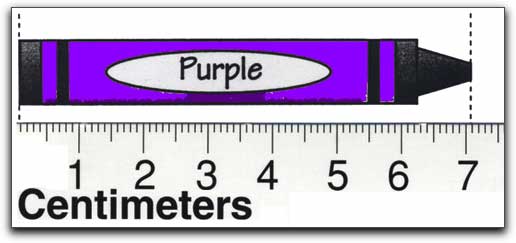
What is the length of this crayon to the nearest tenth of a centimeter?
a)
7 cm
b)
7.1
c)
7.0 cm
d)
7.1 cm
49.

What is the length of the eraser?

a)

3.0 cm

b)

2.0 cm

c)

5.0 cm

d)

7.0 cm

50.

Which formula can be used to find the volume of a box?

a)

length x width

b)

length x width x height

c)

height x length

d)

length + width + height

51.

What is the volume of this box?

a)

60.0 cubic centimeters

b)

15.0 cubic centimeters

c)

20.0 cubic centimeters

d)

6.0 cubic centimeters

52.
True or False:  The density of a specific type of material never changes.  
a)
True
b)
False
53.
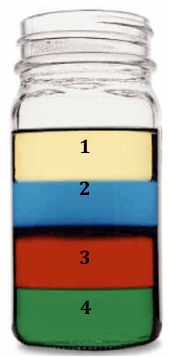
Put the liquids in order from most dense to least dense?
a)
4, 3, 2, 1
b)
1, 2, 3, 4
c)
3, 4, 2, 1, 
d)
4, 3, 1, 2
54.

If an object has a density of 0.6 g/cm3 and you put it into water, will it sink or float?

a)

sink

b)

float

55.
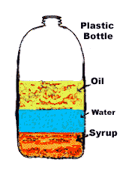
Which liquid is the least dense?
a)
oil
b)
water
c)
syrup 
d)
plastic bottle
56.
What is the formula for density?
a)
density = mass x volume
b)
density = mass / volume
c)
density = mass + volume
d)
density = mass - volume
57.
Jack has a rock. The rock has a mass of 14 g and a volume of 2 cm3. What is the density of the rock?
a)
7 mL
b)
7 g/cm3
c)
28 g/cm3
d)
1/7 g/cm3
58.

What is the amount of matter packed inside an object?

a)

mass

b)

volume

c)

density

d)

length

59.

If an object has a density of 5.2 g/cm3 and you put it into water, will it sink or float?

a)

sink

b)

float

60.
Increased carbon dioxide may cause global warming by trapping more ____________ in the atmosphere.
a)
water
b)
gases
c)
heat
d)
water vapor
61.

True or False: Climate on Earth never changes

a)

True

b)

False

62.

Which of these are fossil fuels? Select all fossil fuels listed.

a)

steam

b)

coal

c)

gas

d)

oil

63.

What happens to fossil fuels to create electricity?

a)

They are stored

b)

They are burned

c)

They are melted

d)

They are frozen

64.

What does non-renewable mean?

a)

Something that lasts forever

b)

Something that can be renewed

c)

Something that will eventually run out

d)

Something that has run out

65.
Why do we depend on fossil fuels? 
a)
Electricity, transportation, and heating
b)
Food
c)
Sunlight
d)
Growing, building muscle, calcium
66.

Fossil Fuels (choose ALL that apply)

a)

considered nonrenewable resources

b)

cause pollution in the atmosphere

c)

are renewable resources

d)

oil, coal and natural gas

67.

Global warming is the term used to describe the RISING of the average temperature on Earth.

a)

True

b)

False

68.

Global warming has negative effects on plants, animals and human beings.

a)

True

b)

False

69.

Deforestation is another cause of global warming.

a)

True

b)

False

70.

What is Global Warming?

a)

Increasing temperature in Earth's atmosphere

b)

Decreasing temperature in a city

c)

Increasing rain rates in Earth

d)

Decreasing temperature rates