
 Worksheets
6.16 Chromatography
Total questions: 25
Worksheet time: 14mins

The diagram shows the paper chromatograms of four substances, W, X, Y, and Z.
Which two substance are pure?
W and X
W and Y
X and Y
Z and X

A student is investigating a colored mixture using chromatography.
Where should he place the coloured mixture?
in the solvent
just above the pencil line
just below the pencil line
on the pencil line

Chromatography is used to find out if a banned dye, P, is present in foodstuffs. The result are shown in the diagram. Which foodstuff contains P?
A
B
C
D

Food colourings contain one or more food dyes. A student used paper colourings (E, F, and G) and one unknown food colouring (H) on the chromatography. The diagram shows the appearance of the paper before and after her experiment. How many food dyes are there in food colouring E?
1
2
5
6
Food colourings contain one or more food dyes. A student used paper colourings (E, F, and G) and one unknown food coloring (H) on the chromatography. The diagram shows the appearance of the paper before and after her experiment. How many food dyes are there in food colouring G?
1
2
5
6

The chromatogram obtained from four mixtures of dyes, P, Q, R, and S, is shown.\What is the total number of different dyes identified in the four mixtures?
3
4
5
8

Chromatography experiments are carried out on four substance, P, Q, R, and S. The same solvent is used in each experiment. The resulting chromatograms are shown below. Which statement is not correct?
P and Q are pure substances
P and R are different substances
R and S are pure substances
S is a mixture of substance
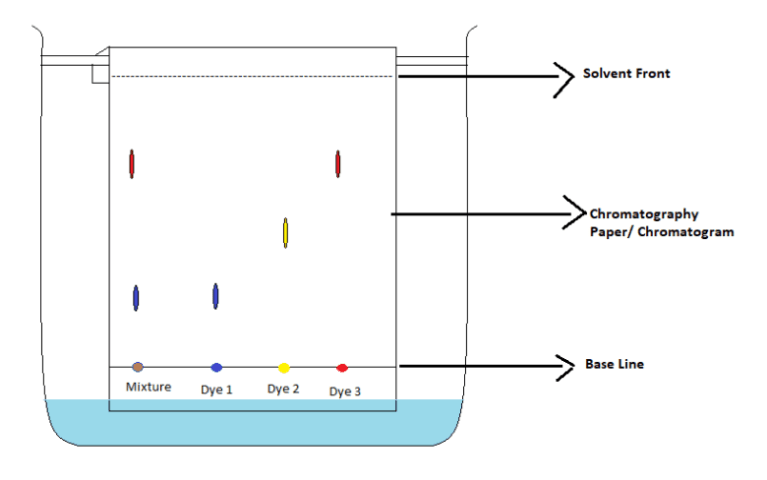
The mixture on the left contains...
All three dyes
None of the dyes
Dye 1 and Dye 2
Dye 1 and Dye 3
Dye 2 and Dye 3

Blue loves water.
Yellow loves water.
Green loves water.
A fruit drink coloured orange contains a dissolved mixture of red and yellow colouring agent.
One of these colouring agent is suspected of being illegal.
Which method could be used to show the presence of this illegal colouring agent?
Chromatography
Distillation
Evaporation
Filtration
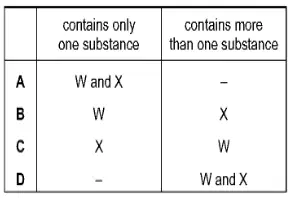
Solid W melts at exactly 54o C and boils at exactly 302o C.
Solid X when dissolved in water and examined using chromatography, shows a blue colour and red colour.
Which row is correct?
A
B
C
D
What is the correct image of paper chromatography???


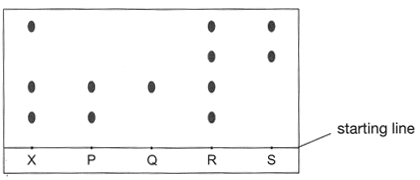
Based on this chromatogram, which substances contain dye Q?
X
P
R
S
Which of the following must be part of chromatography?
Ink
Solvent
water
None
The different components in a dye can also separate during chromatography because the substances______
are absorbed differently by the chromatography paper.
Are all the same
They are usually different colours
They are not the same

In the diagram below, there are four different colored inks represented by letters
S,G, F and H put on a filter paper along a pencil line. Which ink is made of more than one colour?
S
G
F
H

From the diagram shown. Which substance is impure?
H
S
G
T

Why do we use a pencil to draw that line in the diagram
Because the pencil is insoluble
Pencil has one separated color
Pencil is light
Pencil has not form
What is chromatography?
The process by which particles move from a region of higher concentration to lower concentration
The process by which water is purified
The method through which solutes are separated
The chromatography paper is a ___________?
Mobile phase
Stationary phase
None of the above
The attraction of one substance to the surface of another is defined as:
absorption
adsorption
desorption
intermolecular attraction
The output of a chromatography procedure is known as a:
calibration curve
chromatograph
chromatogram
spectrum
Component M has a greater attraction to the mobile phase than component X. Component P has a greater attraction to the stationary phase than component X. The retention times, from shortest to longest are:
M, P, X
M, X, P
P, X, M
P, M, X
Chromatography separates a mixture of..............................
solutes
solids
an insoluble solid from a liquid
iron and rice
What is the correct image of paper chromatography???

