wayground logo

Free Printable Worksheets

Font size

S
M
L
XL
Worksheets

McGraw - Final Review

Total questions: 160

Worksheet time: 9hrs 59mins

Name
Class
Date
1.
What is the definition of a Parallelogram?
a)
A quadrilateral with opposite sides that are parallel and congruent and opposite angles
that are congruent
b)
Having three dimensions – length, width, and height
c)
A characteristic, e.g. size, shape, color, number, value
d)
Being in the same plane but never meeting
2.
What is the definition of a Rhombus?
a)
A two-dimensional closed figure
b)
A half a circle
c)
A triangle that has one 90˚ angle
d)
A quadrilateral with 2 pairs of parallel sides, four congruent sides, and
congruent opposite angles
3.
What is the definition of a Square?
a)
A quadrilateral with at least one pair of parallel sides
b)
A quadrilateral with four 90˚ angles, 4 congruent sides, and 2 pairs of parallel sides
c)
A division or smaller part of a category
d)
Having two dimensions – length and width
4.
What is the definition of a Rectangle?
a)
A quadrilateral with 2 pairs of congruent parallel sides and 4 right angles
b)
Lines that cross each other at exactly one point
c)
A polygon with 5 sides
d)
A polygon with four sides and four angles
5.
What is the definition of a Trapezoid?
a)
A common feature or characteristic
b)
Having three dimensions – length, width, and height
c)
Having exactly the same size and shape
d)
A quadrilateral with at least one pair of parallel sides
6.
What is the definition of a Polygon?
a)
Being in the same plane but never meeting
b)
An angle measuring exactly 90˚
c)
A closed figure formed by three or more line segments
d)
having the same size, shape, and measure
7.
What is the definition of Congruent?
a)
Having the same size, shape, and measure
b)
An angle measuring less than 90˚
c)
A common feature or characteristic
d)
Having two dimensions – length and width
8.

An exact place or location

a)

ray

b)

line

c)

point

d)

plane

9.

An exact place or location

a)

ray

b)

line

c)

point

d)

plane

10.

A straight path that goes in both directions

a)

ray

b)

line

c)

point

d)

plane

11.

Part of a line with one endpoint and goes in one direction

a)

ray

b)

line

c)

point

d)

plane

12.

Part of a line with two endpoints

a)

ray

b)

segment

c)

point

d)

plane

13.

A flat surface

a)

ray

b)

segment

c)

point

d)

plane

14.

This word means equal shape and size

a)

angle

b)

vertex

c)

similar

d)

congruent

15.

This word means common endpoint.

a)

vertex

b)

point

c)

ray

d)

plane

16.

A right angle has ____ degrees.

a)

20

b)

180

c)

50

d)

90

17.

An acute angle has _____ _____ 90 degrees.

a)

equal to

b)

less than

c)

more than

d)

five times

18.

An obtuse angle is _____ _____ 90 degrees.

a)

lots shorter

b)

some taller

c)

smaller than

d)

bigger than

19.

A ________ ______ is 180 degrees.

a)

big turtle

b)

straight angle

c)

small car

d)

obtuse angle

20.

Complementary angles add up to be _____ degrees.

a)

60

b)

180

c)

90

d)

200

21.

Supplementary angles add up to be _____ degrees.

a)

60

b)

180

c)

90

d)

200

22.

________ lines intersect at 90 degrees.

a)

rays

b)

segments

c)

parallel

d)

perpendicular

23.

Parallel lines ______ intersect.

a)

never

b)

sometimes

c)

always

24.

Determine whether the triangles are similar by AA~, SSS~, SAS~, or not similar.

a)

AA

b)

SSS

c)

SAS

d)

Not similar

25.

Determine whether the triangles are similar by AA~, SSS~, SAS~, or not similar.

a)

SAS

b)

AA

c)

SSS

d)

not similar

26.

Determine whether the triangles are similar by AA~, SSS~, SAS~, or not similar.

a)

AA

b)

SSS

c)

SAS

d)

no similar

27.

Determine whether the triangles are similar by AA~, SSS~, SAS~, or not similar.

a)

SSS

b)

AA

c)

SAS

d)

not similar

28.

Determine whether the triangles are similar by AA~, SSS~, SAS~, or not similar.

a)

SSS

b)

AA

c)

SAS

d)

not similar

29.
a)

1:3

b)

3

c)

2:3

d)

3:2

30.
a)

7

b)

12

c)

6

d)

4

31.
a)

45°:117°:18°

b)

45°:18°:117°

c)

35°:115°:20°

d)

35°:120°:22°

32.
Use the information in the diagram to determine the height of the tree.
a)
80 feet
b)
320 feet
c)
40 feet
d)
160 feet
33.

Determine whether the triangles are similar by AA~, SSS~, SAS~, or not similar.

a)

AA

b)

SAS

c)

SSS

d)

Not Similar

34.
Are the triangles similar?
a)
Yes
b)
No
35.
Find missing side
a)
5
b)
7
c)
9
d)
11
36.
What is the measure of x?
a)
12
b)
15
c)
6
d)
9
37.
The triangles are similar, solve for the question mark.
a)
8
b)
12.5
c)
18
d)
24
38.
Complete each proportion.
CB / DM  =  AC / ?
a)
BM
b)
MA
c)
BC
d)
AD
39.
Choose the similarity statement for the triangles.
a)
ΔMNL ∼ ΔOPQ
b)
ΔNOM ∼ ΔPQL
c)
ΔLMN ∼ ΔPQO
d)
ΔMLN ∼ ΔPQO
40.
To measure the distance across a pond, a surveyor locates points A, B, C, D, and E as shown.  What is AB to the nearest meter?
a)
10
b)
12
c)
15
d)
18
41.
How long is side x?
a)
3
b)
1.5
c)
8
d)
2/3
42.
Find the length of the missing side. 
a)
17 cm
b)
22 cm
c)
15 cm
d)
13 cm
43.
Find the missing side
a)
48
b)
108
c)
83.6
d)
72
44.
You need a ladder that will reach up a 25 foot tall house when placed 10 feet away from the house. How tall does the ladder need to be?
a)
25 feet
b)
26 feet
c)
27 feet
d)
28 feet
45.
A rectangular field is 50 yards wide and 100 yards long. Patrick walks diagonally across the field. How far does he walk?
a)
111.8 yards
b)
115 yards
c)
127.3 yards
d)
119 yards
46.
a)
24/32
b)
32/24
c)
32/40
d)
24/40
47.
a)
14/48
b)
48/50
c)
14/50
d)
48/14
48.
a)
27/36
b)
27/45
c)
45/36
d)
45/27
49.
Choose the correct ratio.
a)
sin(37)=x/14
b)
cos(37)=x/14
c)
tan(37)=x/14
d)
sin(37)=14/x
50.

Find the measure of angle A using an inverse trig ratio.

a)

61.9 degrees

b)

28.1 degrees

c)

25.2 degrees

d)

.99997 degrees

51.

Which postulate can be used to prove the triangles congruent?

a)

ASA

b)

SAS

c)

AAS

d)

SSS

52.

Which additional piece of information would be needed to prove the triangles congruent using ASA?

a)

m<A = m<F

b)

AB = FE

c)

m<C = m<D

d)

AC = FD

53.

Which postulate can be used to prove triangle GEF is congruent to triangle GJH?

a)

SAS

b)

ASA

c)

AAS

d)

Not congruent

54.

For the given picture, EF = BC and AB = DE. Which postulate can be used to prove the triangles congruent?

a)

SAS

b)

ASA

c)

AAS

d)

HL

55.

For the given triangles, AD = CB and EC = EA. Which postulate can be used to prove the triangles congruent?

a)

SAS

b)

ASA

c)

AAS

d)

Not congruent

56.

For the given picture, what additional piece of information would be needed to prove triangle BAC is congruent to triangle DAC by SAS?

a)

m<BAC = m<DAC

b)

m<BDA = m<DCA

c)

m<ABC = m<ADC

d)

AC = AC

57.

For the given picture, point C is the midpoint of AD and BE. Which postulate can be used to prove triangle BAC congruent to triangle DEC?

a)

SSS

b)

ASA

c)

SAS

d)

HL

58.

For the given triangles, if LO=12 and OM=16, find the length of PQ.

a)

12

b)

16

c)

4

d)

28

59.

Which congruent postulate proves the triangles congruent?

a)

ASA

b)

SSA

c)

SAS

d)

AAS

60.

Find the value of y for the given picture.

a)

4

b)

5.75

c)

3.86

d)

2.86

61.

What does (h,k) stand for in the standard circle equation?

a)

(h,k) is the center of the circle

b)

(h,k) is a point on the circle.

c)

(h,k) is a point that we guess and find

d)

(h,k) is the distance of the circle

62.
In the equation (x-3)2+(y+4)2=121, the radius of the circle is
a)
242
b)
11
c)
121
d)
22
63.
What is the equation of a circle with radius 2 and center (3, 4)?
a)
(x+3)2 + (y+4)2 = 2
b)
(x-3)2 + (y-4)2 = 2
c)
(x+3)2 + (y+4)2 = 4
d)
(x-3)2 + (y-4)2 = 4
64.
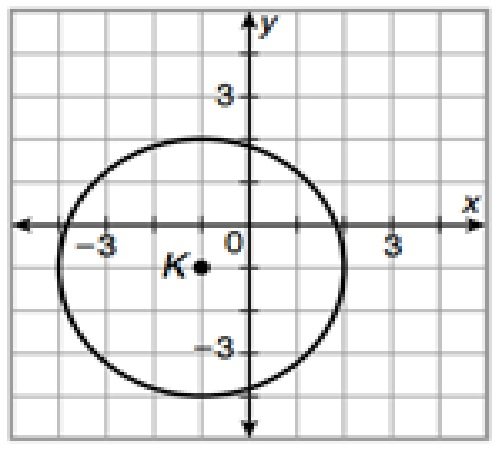
What is the equation of the circle?
a)
(x+1)2 + (y +1)2 = 3
b)
(x+1)2 + (y -1)2 = 3
c)
(x+1)2 + (y +1)2 = 9
d)
(x-1)2 + (y -1)2 = 9
65.
What are the coordinates of the center and the radius of the circle with equation:
(x - 4)2 + (y - 3)2 = 25 ?
a)
Center (4,3)
Radius = 5 units
b)
Center (4,3)
Radius = 25 units
c)
Center (-4,-3)
Radius = 25 units
d)
Center (-4,-3)
Radius = 5 units
66.
In the equation (x-3)2+(y-2)2=16, the center of the circle is...
a)
(3,2)
b)
(-3, -2)
c)
(-2, -3)
d)
(2, 3)
67.

The diameter of a circle has length 12. The center is at (-5, 2). Give the equation of the circle.

a)

(x + 5)2 + (y - 2)2 = 144

b)

(x - 5)2 + (y + 2)2 = 36

c)

(x + 5)2 + (y - 2)2 = 36

d)

(x - 5)2 + (y + 2)2 = 12

68.

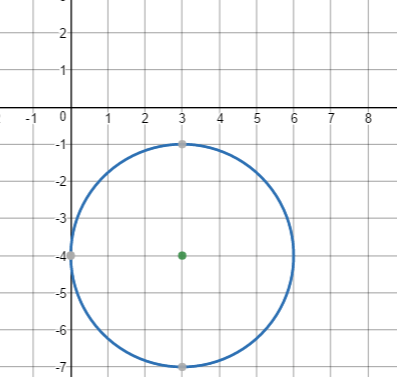
What is the equation of the circle.

a)

(x - 3)2 + (y + 4)2 = 9

b)

(x - 3)2 + (y + 4)2 = 3

c)

x2 + y2 = 9

d)

(x - 1)2 + (y + 1)2 = 7

69.

What is the center of the circle with equation x2 + y2 = 1?

a)

(1, 1)

b)

(0, 0)

c)

(0,1)

d)

not enough information

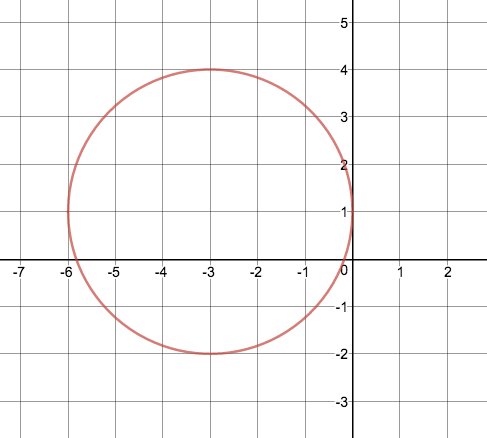
70.
a)
(x + 3)2 + (y - 1)2 = 9
b)
(x - 3)2 + (y + 1)2 = 9
c)
(x - 3)2 + (y + 1)2 = 3
d)
(x + 3)2 + (y - 1)2 = 3
71.
What is the formula for circumference of a circle given the diameter?
a)
C = π r
b)
C = 2 π r
c)
C = π d
d)
C = 2 π d
72.
If the circumference of a circle is 22π , what is the diameter?
a)
22 ft
b)
11 ft
c)
π ft
d)
0 ft
73.
If the circumference of a circle is 44 π feet, what is the radius?
a)
22 ft
b)
44 ft
c)
33 feet
d)
3.14 feet
74.
The _____ is the distance from the center to any point on the circle.
a)
diameter
b)
radius
c)
π
d)
center
75.
The distance across a circle through its center is called the _____.
a)
diameter
b)
radius
c)
π
d)
center
76.
A _____ is half of a circle.
a)
circumference
b)
pi
c)
semicircle
d)
 composite figure
77.
If you are given the diameter, how can you calculate the radius?
a)
Multiply the diameter by 2
b)
Divide the diameter by 2
c)
Add 2 to the diameter
d)
Subtract 2 from the diameter
78.
Which segment is the diameter?
a)
AC
b)
BD
c)
LM
d)
CE
79.
Which segment is a radius?
a)
LM
b)
DC
c)
BD
d)
ML
80.
State the angle relationship and find the measure of angle 1
a)
Corresponding
110
b)
Alternate Exterior
110
c)
Corresponding
70
d)
Alternate Exterior
70
81.
State the angle relationship and find the measure of angle 1
a)
Alternate Interior
37
b)
Alternate Interior
143
c)
Corresponding
143
d)
Corresponding
37
82.
If lines are parallel, then alternate interior angles are _____________
a)
congruent
b)
parallel
c)
complementary
d)
supplementary
83.
Name the angle relationship.
a)
Alternate Interior
b)
Alternate Exterior
c)
Corresponding
d)
Vertical Angles
84.
Name the angle relationship.
a)
Alternate Interior
b)
Alternate Exterior
c)
Corresponding
d)
Vertical Angles
85.
State the angle relationship and find the measure of angle 1
a)
Alternate Interior
49
b)
Same Side Interior
131
c)
Same Side Interior
49
d)
Alternate Interior
131
86.
What is the relationship of the Angles
a)
Alternate Interior
b)
Alternate Exterior
c)
Corresponding
d)
vertical 
87.
What angle is the same side interior angle to angle 4?
a)
angle 3
b)
angle 5
c)
angle 6
d)
angle 8
88.
Name the alternate interior angle to angle 3.
a)
4
b)
5
c)
6
d)
8
89.
∠1 and ∠3 can best be described as -
a)
complementary angles
b)
supplementary angles
c)
vertical angles
d)
adjacent angles
90.
The angle relationship shown is - 
a)
complementary angles
b)
supplementary angles
c)
vertical angles
d)
adjacent angles
91.
If m∠1 = 30°, then m∠3 = 
a)
30°
b)
60°
c)
150°
d)
undetermined
92.
Find the value of x.
a)
38°
b)
52°
c)
142°
d)
152°
93.
Identify the type of angle shown.
a)
Complementary
b)
Supplementary
94.
If lines are parallel, then alternate interior angles are _____________
a)
congruent
b)
parallel
c)
complementary
d)
supplementary
95.
What word describes line Z?
a)
Transversal
b)
Parallel
c)
Corresponding
d)
Same side interior
96.
Angle 1 = 27o
Find the measure of angle 2
a)
27o
b)
153o
c)
63o
d)
90o
97.
Find L
a)
∠L=51°
b)
∠L=129°
c)
∠L=180°
d)
∠L=39°
98.
Find C 
a)
∠C=116°
b)
∠C=64°
c)
∠C=180°
d)
∠C=26°
99.
What is the supplement angle to 45°?
*REMEMBER WHAT SUPPLEMENTARY ANGLES ADD TOO!
a)
45°
b)
180°
c)
135°
d)
100°
100.
a)
100°
b)
80°
c)
90°
d)
180°
101.
State the angle relationship and find the measure of angle 1
a)
Alternate Interior
49
b)
Same Side Interior
131
c)
Same Side Interior
49
d)
Alternate Interior
131
102.

If point H(–6, 2) is translated 3 units right and 4 units up, what are the coordinates of the translated image?

a)

(-2, 5)

b)

(-3, 6)

c)

(-9, -2)

d)

(-9, 6)

103.

Point N(6, –5) is reflected across the

x-axis. What are the coordinates of the image?

a)

(-6, -5)

b)

(-5, 6)

c)

(5, -6)

d)

(6, 5)

104.

If the figure is rotated 90 degrees clockwise, what are the coordinates of R?

a)

(-3, 3)

b)

(3, -3)

c)

(-3, -3)

d)

(3, 3)

105.

The vertices of triangle GHI are G(1, 2), H(3, 4), and I(4, 2). The triangle will be reflected across the x-axis. What will be the coordinates of the image point H′?

a)

(-3, 4)

b)

(3, -4)

c)

(-3, -4)

d)

(3, 4)

106.

Point W is located at (7, 3) on a coordinate plane. Point W is translated 2 units to the left and 3 units up. What are the coordinates of the image point W′?

a)

(10, 1)

b)

(9, 0)

c)

(5, 6)

d)

(4, 1)

107.

Determine how to translate triangle A'B'C' from triangle ABC.

a)
(x+2, y-5)
b)
(x+2, y-9)
c)
(x-2, y-9)
d)

(x-2, y+9)

108.
Identify the transformation.
a)
Reflection across y axis
b)
Reflection across x-axis
c)
180 Rotation
d)
Translation 2 units down
109.

Describe the transformation:

(x, y) -> (x-2, y+7)

a)

Translation 2 units to the left & 7 units up

b)

Translation 2 units to the left & 7 units down

c)

Translation 2 units to the right & 7 units up

d)

Translation 2 units to the right & 7 units down

110.

Describe the transformation:

(x, y) -> (x, -y)

a)

reflection across the x-axis

b)

reflection across the y-axis

c)

rotation 90 degrees clockwise

d)

rotation 90 degrees counterclockwise

111.

Describe the transformation:

(x, y) -> (-x, y)

a)

reflection across the x-axis

b)

reflection across the y-axis

c)

rotation 90 degrees clockwise

d)

rotation 90 degrees counterclockwise

112.

Describe the transformation:

(x, y) -> (-y, x)

a)

reflection across the x-axis

b)

reflection across the y-axis

c)

rotation 90 degrees clockwise

d)

rotation 90 degrees counterclockwise

113.

Describe the transformation:

(x, y) -> (y, -x)

a)

reflection across the x-axis

b)

reflection across the y-axis

c)

rotation 90 degrees clockwise

d)

rotation 90 degrees counterclockwise

114.
Reflect Point C over the y-axis:
a)
(-3, 2)
b)
(3,2)
c)
(-2,3)
d)
(3,0)
115.
Is the picture being reflected in the y-axis or x-axis?
a)
y-axis
b)
x-axis
116.
If you were to rotate ABCD 90° counterclockwise about the origin, what would the coordinate of A' be?
a)
(-5, 5)
b)
(-3, 5)
c)
(-5, 3)
d)
(-3, 3)
117.
If you were to rotate ABCD 180°  about the origin, what would the coordinate of A' be?
a)
(-5, 5)
b)
(-3, -5)
c)
(-5, 3)
d)
(-3, 3)
118.
Which answer shows a reflection across the y-axis?
a)
a
b)
b
c)
c
d)
d
119.

To slide or move a figure

a)

Translation

b)

Reflection

c)

Rotation

120.

A mirror image of a figure

a)

Translation

b)

Reflection

c)

Rotation

121.

Turning around a point

a)

Translation

b)

Reflection

c)

Rotation

122.
Solve for the misssing distance
a)
18.9
b)
19.5
c)
47
d)
27.5
123.
If you are given the hypotenuse and an adjacent side, which trig function should you use?
a)
sine
b)
cosine
c)
tangent
d)
cotangent
124.
Susan is flying a kite, which gets caught in the top of a tree.  Use the diagram to estimate the height of the tree. 
a)
63 ft
b)
65 ft
c)
74 ft
d)
87 ft
125.
a)
A
b)
B
c)
C
d)
D
126.
a)
A
b)
B
c)
C
d)
D
127.
a)
A
b)
B
c)
C
d)
D
128.
Which Trig function do you use?
a)
Sine
b)
Cosine
c)
Tangent
129.
REVIEW:
What is the value of x?
a)
132
b)
66
c)
114
d)
48
130.
REVIEW:
Lines r and s are cut by a transversal. What value of x proves r ∥ s?
a)
43
b)
37
c)
143
d)
37
131.
REVIEW:
Solve for X.
a)
2 ft
b)
3 ft
c)
4 ft
d)
6 ft
132.
REVIEW:
Choose the similarity statement for the triangles.
a)
ΔMNL ∼ ΔOPQ
b)
ΔNOM ∼ ΔPQL
c)
ΔLMN ∼ ΔPQO
d)
ΔMLN ∼ ΔPQO
133.
REVIEW:
Find the missing side
a)
48
b)
108
c)
83.6
d)
72
134.

Find x.

a)

10

b)

10310\sqrt{3}

c)

10210\sqrt{2}

d)

20

135.

Find x.

a)

22

b)

11311\sqrt{3}

c)

11211\sqrt{2}

d)

11

136.

Find a.

a)

3

b)

333\sqrt{3}

c)

6

d)

3\sqrt{3}

137.

Find a.

a)

12

b)

24

c)

24324\sqrt{3}

d)

16

138.

Find a.

a)

232\sqrt{3}

b)

2

c)

12

d)

6

139.

Find a.

a)

9

b)

939\sqrt{3}

c)

92\frac{9}{2}

d)

636\sqrt{3}

140.

Find x.

a)

9

b)

333\sqrt{3}

c)

6

d)

636\sqrt{3}

141.

Find x.

a)

232\sqrt{3}

b)

333\sqrt{3}

c)

3

d)

12

142.

Find y.

a)

6

b)

24

c)

12312\sqrt{3}

d)

636\sqrt{3}

143.

Find x.

a)

10

b)

10210\sqrt{2}

c)

535\sqrt{3}

d)

52\frac{5}{2}

144.

If you are given the SHORT LEG of a 30-60-90 triangle, how do you find the HYPOTENUSE?

a)

Multiply by 2

b)

Divide by 2

c)

Multiply by √3

d)

Divide by √3

145.

If you are given the SHORT LEG of a 30-60-90 triangle, how do you find the LONG LEG?

a)

Multiply by 2

b)

Divide by 2

c)

Multiply by √3

d)

Divide by √3

146.
Find the value of x and y.
a)
x = 8√3, y = 16
b)
x = 4, y = 8√3
c)
x = 16, y = 8√3
147.
What is the length of y in this picture?
a)
45
b)
5√2
c)
90
d)
5
148.
What is the length of y in this 45-45-90 triangle?
a)
8√2
b)
4√2
c)
4
d)
8
149.
What is the length of x in this 45-45-90 triangle?
a)
4√2
b)
4
c)
8
d)
4√3
150.
What is the value of x?
a)
2
b)
18
c)
2√9
d)
9√2
151.

Use the 45-45-90 theorem to solve for the hypotenuse.

a)

16

b)

8

c)

8√2

d)

√16

152.
Solve for a and b in the special right triangle.
a)
a = 5, b = 5
b)
a = 10, b = 10√2
c)
a = 10√2, b = 10√2
d)
a = 5√2, b = 5√2
153.
Find the value of x.
a)
3 sqrt(2)
b)
3
c)
6 sqrt(2)
d)
6
154.
What is the value of x?
a)
12√2
b)
2√12
c)
24
d)
2
155.
In order for ABCD to be a parallelogram, what must the value of x be?
a)
132
b)
66
c)
114
d)
48
156.
Determine the value of x and y that would classify this quadrilateral as a parallelogram. 
a)
x = 9 ; y = 16
b)
x = 16; y = 9
157.

Find m∠FHJ

a)

70 degrees

b)

82 degrees

c)

152 degrees

d)

28 degrees

158.

Is this a parallelogram? How do we know?

a)

yes, opposite sides are congruent

b)

no, we can not prove it is a parallelogram

c)

yes, one pair of sides are congruent and parallel

d)

yes, opposite sides are parallel

e)

yes, diagonals bisect each other

159.
State which method we can use to show that the quadrilateral is a parallelogram. 
a)
Both pairs of opposite angles are congruent.
b)
Both pairs of opposite sides are congruent.
c)
Both pairs of diagonals bisect each other.
d)
Both pairs of opposite sides are parallel. 
160.
State which method we can use to show that the quadrilateral is a parallelogram. 
a)
Both pairs of opposite angles are congruent.
b)
Both pairs of opposite sides are congruent.
c)
Both pairs of diagonals bisect each other.
d)
Both pairs of opposite sides are parallel.