
 Worksheets
Geometry Final Review Unit 3
Total questions: 160
Worksheet time: 5hrs 31mins
Name
Class
Date
1.

If ABCD is a parallelogram, what is the length of BD?
a)
10
b)
11
c)
7
d)
5
2.
The opposite angles of a parallelogram are ...
a)
complementary
b)
congruent
c)
supplementary
d)
perpendicular
3.

What is the value of x?
a)
132
b)
66
c)
114
d)
48
4.

The figure is a parallelogram.
Solve for x.
Solve for x.
a)
1
b)
11
c)
7
d)
6
5.

The figure is a parallelogram.
Solve for x.
Solve for x.
a)
9
b)
11
c)
0
d)
4
6.

The figure is a parallelogram.
Solve for x.
Solve for x.
a)
1
b)
10
c)
4
d)
5
7.

The figure is a parallelogram.
Solve for x.
Solve for x.
a)
11
b)
10
c)
6
d)
2
8.

The figure is a parallelogram.
Solve for x.
Solve for x.
a)
12
b)
4
c)
6
d)
2
9.

The figure is a parallelogram.
Solve for x.
Solve for x.
a)
9
b)
6
c)
10
d)
2
10.

The figure is a parallelogram.
Solve for x.
Solve for x.
a)
3
b)
2
c)
1
d)
7
11.

The figure is a parallelogram.
Solve for x.
Solve for x.
a)
10
b)
3
c)
5
d)
12
12.

Determine whether the figure is a parallelogram. If so, state the reason.
a)
Yes, quadrilateral with 2 pairs of opposite sides ≅
b)
Yes, quadrilateral with 2 pairs of opposite angles ≅
c)
Yes, quad with diagonals bisecting each other
d)
not a parallelogram
13.

Which statement below can be used to prove that EFGH is a parallelogram?
a)
EG and FH bisect each other
b)
EG and HF are congruent
c)
EF and FG are congruent
d)
EG and DF are congruent
14.

Given m∠E = 100°. What must be m∠G to prove EFGH is a parallelogram?
a)
20
b)
80
c)
90
d)
100
15.

10. Given m∠E = 100°. What must be m∠F and m∠H to prove EFGH is a parallelogram?
a)
20
b)
80
c)
90
d)
100
16.

Which statement below can be used to prove EFGH is a parellelogram?
a)
∠E ≅ ∠F and ∠F ≅ ∠G
b)
∠E ≅ ∠G and ∠F ≅ ∠D
c)
∠E ≅ ∠F and ∠D ≅ ∠G
d)
∠E ≅ ∠G and ∠F ≅ ∠H
17.

Determine whether the figure is a parallelogram. If so, state the reason.
a)
Yes, quadrilateral with 2 pairs of opposite sides ≅
b)
Yes, quad with any ∠ supplementary to both consecutive ∠s
c)
Yes, quad with 1 pair of opposite sides || and ≅
d)
not a parallelogram
18.

Determine whether the figure is a parallelogram. If so, state the reason.
a)
Yes, quadrilateral with 2 pairs of opposite sides ≅
b)
Yes, quad with 2 pair of opposite angles ≅
c)
Yes, quad with 1 pair of opposite sides || and ≅
d)
not a parallelogram
19.

Which statement below can be used to prove EFGH is a parellelogram?
a)
EF ≅ FG and GH ≅ HE
b)
EF ≅ EH and HG ≅ FG
c)
EF ≅ HG and EH ≅ FG
d)
EG ≅ FH and EH ≅ FG
20.

Determine whether the figure is a parallelogram. If so, state the reason.
a)
Yes, quadrilateral with 2 pairs of opposite sides ≅
b)
Yes, quad with any ∠ supplementary to both consecutive ∠s
c)
Yes, quad with 1 pair of opposite sides || and ≅
d)
not a parallelogram
21.

Which polygon is NOT a parallelogram?
a)
Figure 1
b)
Figure 2
c)
Figure 3
d)
Figure 4
22.

Determine whether the figure is a parallelogram. If so, state the reason.
a)
Yes, quadrilateral with 2 pairs of opposite sides ≅
b)
Yes, quadrilateral with 2 pairs of opposite angles ≅
c)
Yes, quad with diagonals bisecting each other
d)
not a parallelogram
23.

Is this image a parallelogram?
a)
Yes
b)
No
24.

Is this image a parallelogram?
a)
Yes
b)
No
25.

Is this structural image a parallelogram?
a)
Yes
b)
No
26.

Is this structural image a parallelogram?
a)
Yes
b)
No
27.

Are these images parallelograms?
a)
Yes
b)
No
28.
All parallelograms have __________ sides.
a)
2
b)
4
c)
6
d)
8
29.

Given that AB = BC = CD = DA, what additional information is needed to conclude that ABCD is a square?
a)
Segments BC and AD are parallel. Segments AB and DC are parallel.
b)
Diagonals BD and AC bisect each other.
c)
Angles A, B, C, and D each measure 90 degrees.
d)
Diagonals BD and AC are perpendicular.
30.
Use the diagonals to determine whether a parallelogram with vertices A(2, 7), B(7, 9), C(5, 4), and D(0, 2) is a rectangle, rhombus, or square. Give all the names that apply.
a)
Rhombus
b)
Rectangle
c)
Rectangle, Rhombus, and Square
31.
In a parallelogram, diagonals __________.
a)
are perpendicular
b)
bisect each other
c)
are congruent
d)
are parallel
32.
In a parallelogram, consecutive angles are __________.
a)
congruent
b)
supplementary
c)
corresponding
d)
parallel
33.
In a rhombus, all four sides are ___________.
a)
congruent
b)
parallel
c)
perpendicular
d)
unequal
34.
The diagonals of a rectangle are
a)
parallel
b)
congruent
c)
perpendicular
d)
not congruent
35.
What does it mean if diagonals are perpendicular (⊥)?
a)
They bisect the vertex
b)
Where they intersect is a 90˚ angle
c)
They are equal
d)
They cross
36.

Figure A is a...
a)
Rectangle
b)
Square
c)
Rhombus
37.

Figure B is a...
a)
Rectangle
b)
Square
c)
Rhombus
38.

If the figure is a rectangle, the value of x is...
a)
2
b)
12
c)
13
d)
28
39.

What is the value of x?
a)
132
b)
66
c)
114
d)
48
40.

If ABCD is a parallelogram, what is the length of BD?
a)
10
b)
11
c)
7
d)
5
41.

Consider Square ABCD. Solve for x.
a)
x = 36
b)
x = 9
c)
x = 5
d)
x = 18
42.

Consider the following Rhombus. Solve for y.
a)
y = 7.8
b)
y = 52°
c)
y = 23
43.
The diagonals of a rectangle ... ___________
a)
bisect the opposite angles
b)
are congruent
c)
are perpendicular
d)
have no relationship
44.

Find the measure of angle 4
a)
44
b)
68
c)
90
d)
136
45.
A quadrilateral will all congruent sides would best be described as a -?-
a)
square
b)
rectangle
c)
rhombus
d)
parallelogram
46.
A quadrilateral will all congruent angles would best be described as a -?-
a)
square
b)
rectangle
c)
rhombus
d)
parallelogram
47.
A quadrilateral opposite angles congruent would best be described as a -?-
a)
square
b)
rectangle
c)
rhombus
d)
parallelogram
48.

The fact that diagonals are ⊥ means this shape is a -?-
a)
quadrilateral
b)
rectangle
c)
rhombus
d)
parallelogram
49.

BCDE is square. Find CE.
a)
40
b)
90
c)
80
d)
20
50.

BCDE is square. Find m∠BFC
a)
45
b)
90
c)
180
d)
40
51.
The diagonals of a rhombus
a)
never intersect
b)
bisect the opposite angles
c)
are congruent
d)
bisect the sides
52.
A parallelogram that is both a rhombus and a rectangle is called a __________.
a)
Quadrilateral
b)
Parallelogram
c)
Trapezoid
d)
Square
53.

Consider Rhombus KLMN. Solve for x.
a)
x = 1
b)
x = 44.5
c)
x = 2
d)
x = 4
54.

Solve for x in the rectangle.
a)
25
b)
20
c)
30
d)
25/3
55.

If m∠B is 54° what is the m∠CDB?
a)
54°
b)
27°
c)
108°
d)
36°
56.

EFGH is a square.
If EI = 8, and EF = 12 what is FH?
If EI = 8, and EF = 12 what is FH?
a)
16
b)
8
c)
12
d)
6
57.
A rhombus is a parallelogram with...
a)
four congruent angles
b)
four right angles
c)
four congruent sides
d)
two congruent sides
58.
A rectangle is a parallelogram with...
a)
four right angles
b)
four congruent sides
c)
two sides parallel
d)
None of the above
59.
A square is a parallelogram with...(read all options before selecting)
a)
four right angles
b)
four congruent sides
c)
four right angles and four congruent sides
d)
none of the above
60.

Find the measure of angle 1
a)
54
b)
108
c)
72
d)
36
61.
Find the measure of angle 2
a)
54
b)
108
c)
72
d)
36
62.
Find the measure of angle 2
a)
68
b)
22
c)
136
d)
44
63.

Find the measure of angle 2
a)
50
b)
25
c)
90
d)
65
64.
All trapezoids have exactly one set of sides _____________.
a)
congruent
b)
parallel
c)
consecutive
d)
bisecting
65.
The legs of an isosceles trapezoid are _____.
a)
parallel
b)
perpendicular
c)
congruent
d)
skew
66.

Base angles are congruent for _______.
a)
trapezoids
b)
kites
c)
isosceles trapezoids
d)
circles
67.
The diagonals in an isosceles trapezoid are _______.
a)
congruent
b)
parallel
c)
consecutive
d)
bisecting
68.

Find the measure of ∠1:
a)
79°
b)
101°
c)
72°
d)
180°
69.

Find the measure of ∠2:
a)
96°
b)
88°
c)
84°
d)
92°
70.

Find the missing angle.
a)
60
b)
120
c)
140
d)
180
71.

Find m∠J in trapezoid JKLM.
a)
124⁰
b)
45⁰
c)
150⁰
d)
56⁰
72.
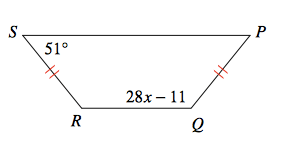
Find the value of x.
a)
4
b)
6
c)
5
d)
129
73.

Find the midsegment.
a)
11
b)
22
c)
None of these
d)
10.5
74.

Find the length of KL.
a)
10
b)
21
c)
26
d)
42
75.

Find the value of x.
a)
35
b)
3
c)
33
d)
None of these
76.

Find the value of x:
a)
5
b)
7
c)
8
d)
11
77.

Find the measure of the x (midsegment):
a)
25
b)
9
c)
12
d)
15
78.
Kites and trapezoids are parallelograms.
a)
always
b)
sometimes
c)
never
79.
The midsegment of a trapezoid is half the sum of the bases.
a)
True
b)
False
80.

Find the value of x that makes that shape a kite.
a)
x = 4.5
b)
x= 4
c)
x = 2
d)
x = 5
81.

Solve for Angle 1 and Angle 2.
a)
1= 92, 2 = 46 degrees
b)
1 = 118, 2 = 118 degrees
c)
1 = 92, 2 = 92
d)
1 = 136, 2 = 100
82.
The diagonals in a kite __________.
a)
are perpendicular
b)
are congruent
c)
bisect each other
83.

Find the measure of ∠3:
a)
90°
b)
42°
c)
48°
d)
24°
84.

Find the value of y.
a)
65
b)
110
c)
75
d)
None of these.
85.
I have 4 sides and two sets of adjacent sides that are congruent.
a)
Retangle
b)
Trapazoid
c)
Rhombus
d)
Kite
86.

Find the value of x that makes that shape a kite.
a)
x = 4.5
b)
x= 4
c)
x = 2
d)
x = 5
87.

What is the measure of angle 1?
a)
48
b)
101
c)
105.5
d)
360
88.

What is x?
a)
35
b)
45
c)
55
d)
90
89.
Base angles of an isosceles trapezoid are _____.
a)
neither
b)
supplementary
c)
congruent
90.

Which of the following statements is false?
a)
∠A = ∠B
b)
AC = BD
c)
the diagonals are perpendicular
d)
the legs are congruent
91.
Which of the following statements is true?
a)
∠D = ∠B
b)
AC = DA
c)
the diagonals are perpendicular
d)
∠C + ∠B = 180
92.
Which of the following statements is false?
a)
∠A = ∠B
b)
the diagonals form 4 congruent triangles
c)
AD = BC
d)
∠D + ∠A = 180
93.

What is the measure of ∠R?
a)
65 degrees
b)
115 degrees
c)
180 degrees
d)
None of the above
94.
What is the measure of ∠P?
a)
65 degrees
b)
115 degrees
c)
180 degrees
d)
None of the above
95.
What is the measure of ∠A?
a)
15 degrees
b)
115 degrees
c)
180 degrees
d)
None of the above
96.

Classify the following quadrilateral:
a)
Right trapezoid
b)
Isosceles trapezoid
c)
Parallelogram
d)
Kite
97.

Which of the following statements is false?
a)
all four angles are congruent
b)
the legs are congruent
c)
the diagonals are congruent
d)
the base angles are congruent
98.
True or False: The coordinates A(-3,0), B(2,4), C(3,1), D(-4, -3) create a trapezoid.
a)
True
b)
False
99.
True or False: The coordinates W(4, 8), L(8,5), C(-4,-1), O(-2, 5) create a trapezoid.
a)
True
b)
False
100.
One of the diagonals of trapezoid has a slope of -3/2. What is the slope of the other diagonal?
a)
-3/2
b)
2/3
c)
-2/3
d)
Cannot be determined
101.
Which of the following statements is false?
a)
a kite has no parallel sides
b)
a kite has one pare of congruent angles
c)
the diagonals of a kite are perpendicular
d)
the diagonals of a kite are congruent
102.
Which of the following statements is true?
a)
a kite has congruent opposite sides
b)
a kite has two pairs of congruent angles
c)
the diagonals of a kite are perpendicular
d)
the diagonals of a kite form 4 congruent triangles
103.

Which of the following statements about a kite is false?
a)
one diagonal bisects the other diagonal
b)
two angles are congruent
c)
the diagonals form 4 congruent triangles
d)
the diagonals are perpendicular
104.
Which of the following statements is false?
a)
BD and AC are perpendicular
b)
BD and AC are congruent
c)
∠A and ∠C are congruent
d)
BD bisects AC
105.
Which of the following statements is true?
a)
the diagonals bisect each other
b)
the diagonals are congruent
c)
∠B and ∠D are congruent
d)
DB bisects AC
106.
Given the slope of BD is 2/5, what is the slope of AC?
a)
Cannot be determined
b)
-2/5
c)
5/2
d)
-5/2
107.
Given the slope of AC is -3/8, what is the slope of BD?
a)
Cannot be determined
b)
3/8
c)
-8/3
d)
8/3
108.
y = 3x +2
y = 3x - 3
These lines are...
y = 3x - 3
These lines are...
a)
Parallel
b)
Perpendicular
c)
Neither
d)
The same line
109.
-6x + y = 2
6x + y = 2
These lines are...
6x + y = 2
These lines are...
a)
Parallel
b)
Perpendicular
c)
Neither
110.
y = -2/3x + 2
y = 3/2x + 9
These lines are...
y = 3/2x + 9
These lines are...
a)
Parallel
b)
Perpendicular
c)
Neither
111.
Slopes of perpendicular lines are...
a)
opposite sign reciprocals.
b)
opposites.
c)
identical.
d)
always 7.
112.
Slopes of parallel lines are...
a)
opposite reciprocals.
b)
opposites.
c)
the same.
d)
always 7.
113.
What is the slope of a line parallel to the line whose equation is: -2x + y = - 7?
a)
-2
b)
1/2
c)
-1/2
d)
2
114.
A line is perpendicular to
y = 2x - 7.
What is the slope of this line?
y = 2x - 7.
What is the slope of this line?
a)
-2
b)
1/2
c)
-1/2
d)
2
115.
What does "m" represent in y=mx+b?
a)
y-intercept
b)
slope
c)
macaroni
d)
nothing
116.
Which represents slope intercept form?
a)
y = mx + b
b)
y = b + mx
ax+ by = c
ax+ by = c
c)
x + y = b
d)
xy + b = 0
117.

The rectangle shown has coordinates (3, 2), (-2, 2), (-2, -1), (3, -1)
What is the length of the longest side of the rectangle?
What is the length of the longest side of the rectangle?
a)
4 units
b)
5 units
5 units
5 units
c)
6 units
d)
8 units
118.

What is length of the longest side of the rectangle?
a)
2 units
b)
15 units
c)
14 units
d)
8 units
119.

What is the length of the shortest side of the rectangle?
a)
3 units
b)
4 units
c)
9 units
d)
2 units
120.
What is the distance between points (3, -5) and (3, -8)?
a)
1 unit
b)
2 units
c)
3 units
d)
4 units
121.
What formula do you use to decide if there is a right angle based on coordinates?
a)
distance
b)
midpoint
c)
slope
d)
partitioning a segment
122.
Find AB given A(1,4) and B(3,9).
a)
√185
b)
√173
c)
√29
d)
√41
123.
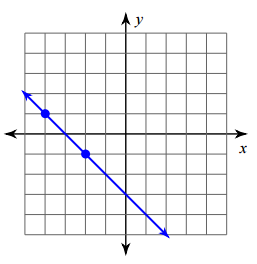
Find the slope of the line.
a)
-2
b)
2
c)
-1
d)
1
124.
How do you show that sides have the same length?
a)
slope formula
b)
midpoint
c)
distance formula
125.
how are lines parallel?
a)
same slope
b)
opposite recirpical slope
c)
Pythagorean theorem
d)
distance formula
126.
how are lines perpendicular?
a)
same slope
b)
negative reciprical slope
c)
Pythagorean theorem
d)
distance formula
127.
How do you find the perimeter of a figure
a)
multiply all the sides together
b)
add all the sides together
c)
subtract all the sides together
d)
divide all the sides toghther
128.

Find the area of the quadrilateral on the coordinate plane
a)
10 sq. units
b)
6 sq. units
c)
8 sq. units
d)
12 sq. units
129.
What is the midpoint between (-4,4) and (5,-1)?
a)
(4,5)
b)
(3,4)
c)
(1/2, 1 1/2)
d)
(7,2)
130.
What is the midpoint between (3, -1) and (7, -5)
a)
(5, -2)
b)
(10, -6)
c)
(5, -3)
d)
(2, -2)
131.

What is the area of the composite figure?
a)
80 cm2
b)
16 cm2
c)
96 cm2
d)
32 cm2
132.

What is the area of the shaded region?
a)
20 sq cm
b)
4 sq cm
c)
30 sq cm
d)
24 sq cm
133.

Find the Area of this triangle
a)
19.8 km2
b)
37.8 km2
c)
18.9 km2
d)
35 km2
134.

Find the area of the parallelogram.
a)
12 units2
b)
10 units2
c)
13 units2
d)
6 units
135.

Find the area of the trapezoid.
a)
68 m2
b)
88 m2
c)
44 m2
d)
528 m2
136.

What is the area of this figure?
a)
52 square centimeters
b)
36 centimeters
c)
57 square centimeters
d)
40 square centimeters
137.
how do you show that sides have the same length?
a)
slope formula
b)
midpoint
c)
Pythagorean theorem/distance formula
138.
how do you show that sides are parallel?
a)
slope formula
b)
midpoint
c)
Pythagorean theorem/distance formula
139.
how do you show that right angles are formed?
a)
slope formula
b)
midpoint
c)
Pythagorean theorem/distance formula
140.
How do you find the area of a parallelogram?
a)
bh
b)
bhl
c)
1/2bh
141.
How do you find the area of a triangle?
a)
bh
b)
bhl
c)
1/2bh
142.

Find the perimeter of the figure to the right. Round to the nearest tenth.
a)
20.8 units
b)
116 units
c)
11.5 units
d)
19.8 units
143.

What is the area of the shape?
a)
35 units squared
b)
24 units squared
c)
not enough information
d)
22 units squared
144.

What is the area of the triangle?
a)
60 square units
b)
90 square units
c)
45 square units
d)
30 square units
145.
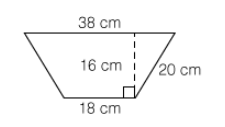
What is the area of this trapezoid?
a)
320 square centimeters
b)
416 square centimeters
c)
448 square centimeters
d)
560 square centimeters
146.

Find the area of the trapezoid.
a)
64 m
b)
72 m
c)
72 m2
d)
64 m2
147.
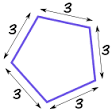
What is the perimeter?
a)
12
b)
15
c)
18
d)
3
148.
Choose the RECTANGLE
a)
b)
149.
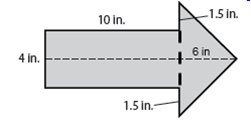
What is the area of the arrow?
a)
17 in2
b)
40 in2
c)
52 in2
d)
61 in2
150.
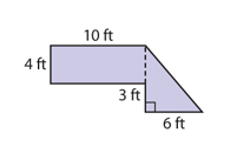
What is the area of the composite shape?
a)
40ft2
b)
9ft2
c)
49ft2
d)
61ft2
151.
Find the area of the figure to the right. Round to the nearest tenth.
a)
20 square units
b)
49 square units
c)
18 square units
d)
22 square units
152.

Write the system of inequalities that create the figure.
a)
x≥1, y≤ -4/3x + 7/3, y ≤ 4x + 13
b)
x ≥ 1, y ≤-x + 3, y≤ 4x + 12
c)
y ≥ 1, y ≤ -4/3x + 7/3, y ≤ 4x + 13
d)
y ≥ 1, y ≤-x + 3, y≤ 4x + 12
153.
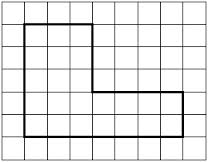
perimeter?
a)
30 units
b)
32 units
c)
24 units
d)
36 units
154.

What is the area of the triangle below?
a)
2 square units
b)
2.5 square units
c)
3 square units
d)
3.5 square units
155.

What is the area of the triangle below?
a)
2 square units
b)
2.5 square units
c)
3 square units
d)
3.5 square units
156.

What is the area of the triangle?
a)
2.5 square units
b)
3 square units
c)
3.5 square units
d)
4 square units
157.

What are the coordinates of the missing vertex that would form a parallelogram?
a)
(4, 5)
b)
(5, 4)
c)
(4, 6)
d)
(6, 4)
158.

a)
(4, 2)
b)
(2, 4)
c)
(5, 2)
d)
(2, 5)
159.

a)
(6, 5)
b)
(5, 6)
c)
(7, 5)
d)
(5, 7)
160.
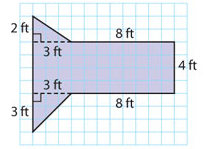
Find the area of the composite figure
a)
3 ft2
b)
51.5 ft2
c)
32 ft2
d)
44 ft2
100 %

