wayground logo

Free Printable Worksheets

Font size

S
M
L
XL
Worksheets

Final Exam

Total questions: 160

Worksheet time: 5hrs 29mins

Name
Class
Date
1.
What is the GCF of 18k and 15k3
a)
3k2
b)
3k3
c)
3k
d)
5k
2.

Factor the polynomial.

x2-4x-32

a)

(x-8)(x+4)

b)

(x-4)(x-32)

c)

(x+3)(x-4)

d)

(x+2)(x+5)

3.
Factor completely
10x2 + 15x-5
a)
25(10x3+45x-15)
b)
5(2x3 + 3x2-x)
c)
x(10x3+15x-5)
d)
5(2x2+3x-1)
4.
Factor completely: 
3x2 + 18x +15
Hint: Factor GCF first.
a)
3(x2 + 6x + 5)
b)
(x + 5)(x + 1)
c)
3(x + 5)(x + 1)
d)
Prime
5.
Factor
3a2 + 4a + 1
a)
(7a-10)(a-8)
b)
Not factorable
c)
(3a+1)(a+1)
d)
(3a-1)(a-1)
6.
Factor
n2-13n+40
a)
(n-5)(n-8)
b)
(n+5)(n-8)
c)
(n-5)(n+8)
d)
(n+6)(n+1)
7.
Factor
3v2 - 4v - 7
a)
(3v-7)(v+1)
b)
3(v-7)(v-1)
c)
(3v+1)(v-9)
d)
(3v+1)(v-10)
8.
Factor 6x2-27x
a)
(6x+1)(x+3)
b)
3x(2x-9)
c)
6x(x-9)
d)
(3x-9)(2x+3)
9.

Factor x2 + 6x + 9 = 0 and solve for x.

a)

(x+3)(x+3); x = -3

b)

(x+4)(x+5); x=-4, -5

c)

(x-3)(x-3); x=3

d)

Not factorable

10.
State the degree of the polynomial:
f(x) = 2x4 + 19x2 + 24
a)
1
b)
2
c)
3
d)
4
11.
State the leading term of the polynomial:
f(x) = 6x5 + 9x4 + 2x3 + 3x2 - 4x -6
a)
9x4
b)
-4x
c)
6x5
d)
3x2
12.
Which one of these is in standard form?
a)
x4 + 25x2 - 10x3
b)
x4 - 10x3 + 25x2
c)
- 10x3 + 25x2 + x4
d)
25x2 + x4 - 10x3
13.

How many terms are in this polynomial?

2x3 - 8x2 + 3x - 7

a)

7

b)

1

c)

4

d)

2

14.

What is the degree of this polynomial?

2x4 - 3x5 + x

a)

-3

b)

2

c)

4

d)

5

15.

Solve the polynomial equation:

x2-4x-32 =0

a)

x = -4,8

b)

x = 4,32

c)

x = -3,4

d)

x= -2,-5

16.

Solve the polynomial equation:

6x2-27x

a)

x = -3, -1/6

b)

x = 0, 9/2

c)

x = 0, 9

d)

x= -3/2, 3

17.

Solve the polynomial equation:

3x2 + 18x +15

a)

x = 1

b)

x = 1, 5

c)

x = -5, -1

d)

Prime

18.

Solve the polynomial equation:

n2-13n+40

a)

n = 5, 8

b)

n = -5, 8

c)

n = -8, 5

d)

n = 6, 1

19.

Solve the polynomial equation:

x2 + 15x + 64 = 20

a)

x = -8, 2

b)

x = -7, 5

c)

x = -11, -4

d)

x = -11

20.
Solve by Factoring:  4x2 + 11x - 3 = 0
a)
x = -3/4 and x = -1
b)
x = 4 and x = 3
c)
x = 1/4 and x = -3
d)
x = -1/4 and x = 3
21.
Solve by Factoring:
x2 + 15x + 64 = 20
a)
{-8, 2}
b)
{-7, 5}
c)
{-11, -4}
d)
{-11}
22.
Solve x4 - 256 = 0
a)
x = 4, x = - 4
b)
x = 4, x = 4i
c)
x = 4, x -4, x = 4i
d)
x = 4, x -4, x = 4i,         x = -4i
23.
Find all zeros for the polynomial function P(x) = x3 -3x2-5x+15
a)
3, √5 
b)
3, √5, -√5
c)
-3, √5, -√5
d)
-3, 5i, -5i
24.
Find all zeros of the polynomial function P(x) = x3+6x2+9x+54
a)
6, 3, -3
b)
-6, 3, -3
c)
-6, 3i, -3i
d)
6, 3i, -3i
25.

Solve (x2-9) = 0

a)

x = 9

b)

x = 9, -9

c)

x = 3, -3

d)

x = 3

26.

Solve the following equation. x4 + 4x3 + 3x2 = 0

a)

x = 0, x = 3, x = 1

b)

x = -3, x = -1

c)

x = 3, x = 1

d)

x = 0, x = -3, x = -1

27.
Solve for the values of x:
(2x - 1)(x + 4) = 0
a)
{ 1/2, -4 }
b)
 { 1/2, 4 }
c)
{ 2, -4 }
d)
{ -2, 4 }
28.
What are two solutions to the polynomial:
x2+14x=0
a)
x=0, x= 14
b)
x=-14
c)
x= 1, x =10
d)
x= -14, x = 0 
29.

Solve: 2x2-14x+24 = 0

a)

x = 4, 3

b)

x = 9/2, 10/4

c)

x = -3, -4

d)

x = -9/2, -10/4

30.

What are the solutions? (Hint Factor and solve)

a)

x=0, x=-2 and x=7

b)

x=2 and x=7

c)

x=-2 and x=7

d)

x=0 and x=3 and x= 42

31.
The solutions of the quadratic equation 
x2+5x+6=0 are
a)
x= -3 or x = -2
b)
x = -6 or x = 1
c)
x = 3 or x = 2
d)
x = -3 or x = 2
32.

Solve

x2 + 2x - 20 = 4

a)

x = -6, x = 4

b)

x = 6, x = -4

c)

x = 12, x = -2

d)

x = 8, x = -3

33.
Solve by factoring:3x2 + 5x + 2 = 0  
a)
x = -2/3 and x = -1
b)
x = -3/2 and x = -1
c)
x = 2/3 and x = 1
d)
x = 2/3 and x = -1
34.
Solve
16a2 - 9 = 0
a)
a = -3/43/4 
b)
a = -4/34/3 
c)
a = -9/169/16 
d)
a = -16/916/9 
35.

Solve: 14m2-12m = 0

a)

m=2 and m=76

b)

m=2 and m=0

c)

m=14 and m=12

d)

m=0 and m=6/7

36.
Factor this difference of cubes:
x3 - 343
a)
(x + 7) (x2 - 7x + 49)
b)
(x2 + 1) (x - 343)
c)
(x - 7) (x2 + 7x + 49)
d)
(x2 - 343) (x + 1)
37.
Factor:   x+ 1
a)
(x + 1)3
b)
(x+1)(x- x + 1)
c)
(x - 1) (x2 + x - 1)
d)
(x + 1)(x2 - 2x + 1)
38.
Factor by grouping:
30x3+15x2-18x-9
a)
(5x2-3)(6x+1)
b)
(5x2-3)(6x+3)
c)
3(5x2+3)(2x-1)
d)
3(5x2-3)(2x+1)
39.
Factor by grouping:
4p³+8p²+3p+6
a)
(2p²+3)(p+2)
b)
(2p²+6)(p+4)
c)
(4p²+3)(p+2)
d)
(4p²+8p)(3p+6)
40.

Even Multiplicities have which of the following effects on the x-axis?

a)

touches and bounces back

b)

wiggle

c)

crosses the x-axis

41.
Which zero has an odd multiplicity?
a)
-4
b)
4
c)
2
d)
-2
42.
Which root has even multiplicity?
a)
1
b)
-4
c)
-1
d)
2
43.
What are the zeros of the polynomial function?
y = x(x - 6)(x + 5)
a)
0, 6, -5
b)
6, -5
c)
0, -6, 5
d)
1, -6, 5
44.
What are the roots of the polynomial function?
y = (x + 2)(x - 7)3
a)
-2, 7 multiplicity 3
b)
-2, 7, 3
c)
2, -7 multiplicity 3
d)
2, -7, 3
45.
What is the Degree of this polynomial:
f(x)= x3(x + 3)2(x – 5)
a)
Degree: 6
b)
Degree: 5
c)
Degree: 3
d)
Degree: 2
46.

For each function, determine the real zeros and state the multiplicity of any repeated zeros.

a)

{0 mult. 3, 5, 2}

b)

{−2 mult. 3, 3, 1}

c)

{0 mult. 3, 3, 2}

d)

{2 mult. 3, 3, 3}

47.

For each function, determine the real zeros and state the multiplicity of any repeated zeros.

a)

{0 mult. 3}

b)

{0, 3, 1}

c)

{0, −2, −1}

d)

{−2, 3, 1}

48.

f(x) = (x+2)(x-3)2(x-4)

Which choice best describes the zeros?

a)

-2, 3 (multiplicity 2), 4

b)

-2 (multiplicity 2), 3, 4

c)

2, -3 (multiplicity 2), -4

d)

2 (multiplicity 2), -3, -4

49.
Select polynomial whose zeros and degree are given.
Zeros: – 5(multiplicity of 3), 9(multiplicity of 2), – 2, 4.
a)
(x + 5)3(x - 9)2(x + 2)(x - 4)
b)
(x + 5)3(x - 9)2(x + 2)7(x - 4)7
c)
(x + 5)3(x - 9)2(x + 2)
d)
(x + 5)(x - 9)(x + 2)(x - 4)
50.
What are the roots of the polynomial function?
y = 9(x + 2)(x - 7)3
a)
-2, 7 multiplicity 3
b)
-2, 7, 0
c)
9, 2, -7 multiplicity 3
d)
2, -7, 3
51.
f(x)=(x+4)(x-3)(x-2)
List the zeros for this function.
a)
x = -4, x = 3, x = -2
b)
x = -4, x = 3, x = 2 
c)
x = -4, x = -3, x = 2
d)
x = 4, x = 3, x = 2
52.
State the zeros of the polynomial (include multiplicity):
f(x) = x4(x+3)2(x - 2)
a)
 0, 3, 2
b)
 0(multiplicity of 4), -3 (multiplicity of 2), 2
c)
-3 (multiplicity of 2), 2
d)
0, 2 (multiplicity of 3)
53.
f(x)= x2(x – 2)3(x – 7)

Find and select each real zero and its multiplicity
a)
0 (Mult of 2), 2 (Mult of 3), 7 (mult 1)
b)
2 (Mult of 3), 7 (mult 1)
c)
0, 2, 7
d)
2 (mult of 2), 7 (mult of 3)
54.
Select polynomial whose zeros and degree are given.
Zeros: – 5(multiplicity of 3), 9(multiplicity of 2), – 2, 4.
a)
(x + 5)3(x - 9)2(x + 2)(x - 4)
b)
(x + 5)3(x - 9)2(x + 2)7(x - 4)7
c)
(x + 5)3(x - 9)2(x + 2)
d)
(x + 5)(x - 9)(x + 2)(x - 4)
55.

Even Multiplicities have which of the following effects on the x-axis?

a)

Cross the x-axis

b)

touches and bounces back

56.
Select polynomial whose zeros and degree are given.
Zeros: – 5(multiplicity of 3), 9(multiplicity of 2), – 2, 4 Degree: 7
a)
(x + 5)3(x - 9)2(x + 2)(x - 4)
b)
(x + 5)3(x - 9)2(x + 2)7(x - 4)7
c)
(x + 5)3(x - 9)2(x + 2)
d)
(x + 5)(x - 9)(x + 2)(x - 4)
57.
What is the Degree of this polynomial:
f(x)= x3(x + 3)2(x – 5)
a)
Degree: 6
b)
Degree: 5
c)
Degree: 3
d)
Degree: 2
58.

If the graph of a function crosses the x-axis, what does that mean about the multiplicity of that zero?

a)

Even

b)

Odd

c)

None

59.
Odd Multiplicities have which of the following effects on the x-axis?
a)
Cross the x-axis
b)
Turn on the x-axis
60.
What are the roots of the polynomial function?
y = (x + 2)(x - 7)3
a)
-2, 7 multiplicity 3
b)
-2, 7, 3
c)
2, -7 multiplicity 3
d)
2, -7, 3
61.

The degree of a polynomial determines...

a)

the maximum number of x-intercepts

b)

the number of turning points

c)

if the end behavior is up or down

d)

the y-intercept

62.
f(x)= x2(x – 2)3(x – 7)

Find and select each real zero and its multiplicity
a)
0 (Mult of 2), 2 (Mult of 3), 7 (mult 1)
b)
2 (Mult of 3), 7 (mult 1)
c)
0, 2, 7
d)
2 (mult of 2), 7 (mult of 3)
63.

Find the zeros.

(x-5)(x+6)=0

a)

{5,5 }

b)

{ -5,-5 }

c)

{ -5,-6 }

d)

{5,-6 }

64.

Find the zeros.

(x + 2)(x - 3) = 0

a)

{ 2, 3 }

b)

{ -2, -3 }

c)

{ 2, 3 }

d)

{ -2, 3 }

65.

Find the zeros.

(2x - 1)(x + 4) = 0

a)

{ 1/2, -4 }

b)

{ 1/2, 4 }

c)

{ 2, -4 }

d)

{ -2, 4 }

66.
Solve and find your x-intercepts:
0=x(x - 6)
a)
x=0 and x=-6
b)
x=1 and x=-6
c)
x=0 and x=6
d)
x=6
67.

Find the zeros.

5(x+12)(x-12) = 0

a)

{5,12,-12}

b)

{-12, 12}

c)

{0,12,-12}

d)

{12}

68.

Find the zeros.

8x(2x + 4)(x - 6)

a)

x = - 2, 6, - 8

b)

x = 2, 6, 0

c)

x = - 2, 6, 0

d)

x = - 8, 4, 6

69.

Solve by grouping.

12x(x + 2) + 2x + 4

a)

(12x + 2x)(x + 6)

b)

(12x + 2)(x + 2)

c)

14x + 6

d)

(12x + 1)(x + 2)

70.

Which of the equations is equivalent to:

4x(x - 5) + 6(x - 5) = 0

a)

(4x + 6)(x - 5) = 0

b)

(4x + 6)(x + 5)2 = 0

c)

4x(6)(x -5) = 0

71.

Select the two numbers that add to 10 and multiply to 21.

a)

7

b)

6

c)

3

d)

4

72.

Select the two numbers that add to 5 and multiply to 4.

a)

1

b)

4

c)

2

d)

3

73.

Select the two numbers that add to - 4 and multiply to -32.

a)

-8

b)

-1

c)

-3

d)

4

74.

Select the two numbers that add to -7 and multiply to 12.

a)

-3

b)

3

c)

4

d)

-4

75.

Factor by grouping

x3 - 4x2 -4x + 16

a)

(x+4)(x+2)

b)

(x-4)(x2 -4)

c)

(x+4)(x2 -4)

d)

(x-4)(x-2)

76.
Decide if (x-3) is a factor of 3x3+10x2-x-12
a)
Yes, it is a factor
b)
No, it is not a factor
77.
Factor by GCF:
63x4 - 7x2 + 28x
a)
7x(9x2 - 7 + 4x)
b)
x(63x3 - 7x + 28)
c)
7x(9x3 - x + 4)
d)
not factorable
78.
Factor by grouping:
4p³+8p²+3p+6
a)
(2p²+3)(p+2)
b)
(2p²+6)(p+4)
c)
(4p²+3)(p+2)
d)
(4p²+8p)(3p+6)
79.
Factor by grouping:
x³+7x²-2x-14
a)
(x²-2)(x-7)
b)
(x²+2)(x-7)
c)
(x²+2)(x+7)
d)
(x²-2)(x+7)
80.

x2+12x+27x+9\frac{x^2+12x+27}{x+9}  

a)

x+3

b)

x+9

c)

x-3

d)

x-9

81.

x213x+40x8\frac{x^2-13x+40}{x-8}  

a)

x-8

b)

x-5

c)

x+8

d)

x+5

82.

x27x44x+4\frac{x^2-7x-44}{x+4}  

a)

x-7

b)

x+4

c)

x-11

d)

x+7

83.

x2+x42x6\frac{x^2+x-42}{x-6}  

a)

x+6

b)

x+8

c)

x-6

d)

x+7

84.

2x2+9x+42x+1\frac{2x^2+9x+4}{2x+1}  

a)

x+4

b)

x-4

c)

2x+1

d)

2x+4

85.
a)
8x2y3+7x4+5y
b)
8x6y7-7x5y8-7x4y5
c)
8x6y7-7x5y8-5x4y5
d)
8x2y3-7xy4-5y
86.
Divide: 

(4x2 - 24x + 35) / (2x - 5)
a)

2x - 7

b)

2x - 12

c)

2x + 12

d)

2x + 7

87.

(4x48x33x2+7x2)÷(2x1)\left(4x^4-8x^3-3x^2+7x-2\right)\div\left(2x-1\right)  

Use long division to evaluate

a)

2x33x23x+22x^3-3x^2-3x+2  

b)

2x3+3x2+3x+22x^3+3x^2+3x+2  

c)

2x33x23x22x^3-3x^2-3x-2  

d)

2x3+22x^3+2  

88.
            Is (x-2) a factor of             f(x)= x3-8x2+14x-4?
a)

Yes, (x-2) is a factor. There is a remainder.

b)

No, (x-2) is  not a factor. The remainder is zero.

c)

Yes, (x-2) is a factor. The remainder is zero.

d)

No, (x-2) is  not a factor. There is a remainder. 

89.
What should be the order of the polynomial coefficients if
(3x - 4x3 + 6x4 + 1) / (x + 3)
a)

3   0   -4   6   1

b)

6   -4   3   1   0

c)

6   -4   0   3   1

d)

-6   4   0   -3   -1

90.

What is the proper way to write the answer for the following problem?

a)

2x3-x2-25x+12

b)

2x4-x3-25x2-12x+0

c)

2x3-x2-25x-12

d)

2x4-x3-25x2-12x-0

91.

Synthetic Division only uses the ____________ of a polynomial to divide.

a)

Terms

b)

Numbers (coefficients)

c)

Variables

d)

Numbers and letters

92.

Cam divided (x4 + 3x2 - 4x - 2) by factor of (x-2) using synthetic division. His work is shown above. Which best describes his mistake?

a)

Cam wrote the remainder incorrectly.

b)

Cam did not use a zero place holder for the x3 term.

c)

Cam added instead of subtracting the rows.

d)

Cam should have used -2 as his division since the factor was x-2.

93.

Find the zeros of the polynomial given one factor. Use synthetic division.

a)

X= 3,4,5

b)

x=-3,-4,-5

c)

x=-3,4,5

d)

x= 3, -4, -5

94.
Factor f(x)= x3 - 2x2-13x - 10  given that
(x - 5) is one factor.
a)
(x- 5)(x - 1)(x - 2)
b)
(x - 5)(x + 2)(x - 2)
c)
(x - 5)(x + 2) (x + 1)
d)
(x - 5)(2x - 13)
95.
a)
This graph has two imaginary roots because it is a polynomial of degree two.
b)
This graph has two imaginary roots because it has one hump.
c)
This graph has two imaginary roots because it touches the x-axis at two points.
d)
This graph is imaginary because it the graph has shifted up.
96.
What is the least degree of the graph of the above polynomial?
a)
3
b)
4
c)
5
d)
Not enough information 
97.
If 2i is a zero, then
a)
2i repeats twice
b)
-2i is a zero too
c)
1-2i is a zero too
d)
0+2i is a zero too
98.
How many zeros does the following function have?
f(x)= x5 - 3x3 + x
a)
8
b)
9
c)
5
d)
3
99.
What is the Degree of this polynomial:
f(x)= x3(x + 3)2(x – 5)
a)
Degree: 6
b)
Degree: 5
c)
Degree: 3
d)
Degree: 2
100.
Classify this polynomial by its degree and number of terms:  x2 + 6
a)
Linear polynomial
b)
Quadratic trinomial
c)
Quadratic binomial
d)
Cubic binomial
101.
Classify this polynomial by its degree and number of terms:  x2 + 2x + 6
a)
Linear polynomial
b)
Quadratic trinomial
c)
Quadratic binomial
d)
Cubic trinomial
102.

Classify this polynomial by its degree and number of terms: 4x3

a)

Cubic monomial

b)

Linear binomial

c)

Cubic binomial

d)

6th degree (sextic) monomial

103.
The following polynomial is written in standard form:
7x3 - 11x2 + 8x - 5
a)
True
b)
False
104.

How many terms are in this polynomial?

2x3 - 8x2 + 3x - 7

a)

7

b)

1

c)

4

d)

2

105.

Classify by number of terms:

5x2 – 6x + 3

a)

Monomial

b)

Binomial

c)

Trinomial

d)

4-Term Polynomial

106.
Which pair is an example of like terms?
a)
2a and 2b
b)
x and x2
c)
3k and 3k3
d)
y2 and 2y2
107.

Classify this polynomial by its degree and number of terms: 4x5

a)

Linear monomial

b)

Quadratic polynomial

c)

Cubic Monomial

d)

Quintic monomial

108.

Simplify into Standard Form:

4x25x+10+2x2 +12x 34x^2-5x+10+2x^2\ +12x\ -3  

a)

6x2+7x +86x^2+7x\ +8  

b)

6x2+7x +76x^2+7x\ +7  

c)

11x2+711x^2+7  

d)

77  

109.

What is the Degree of the Polynomial?

5x3 - 6x + 1

a)

Linear

b)

Quadratic

c)

Cubic

d)

Quartic

110.

Put the polynomial in standard form.

7x - 12x2 + 8x + 5x2

a)

7x2+15x-7x^2+15x  

b)

7x2+15x7x^2+15x  

c)

17x2+1517x^2+15  

d)

32x432x^4  

111.
Put in Standard Form.
12 - 3x3 - 10x - x2
a)
 - 3x3 - x2 - 10x + 12
b)
 3x3 - x2 + 10x + 12
c)

12 - 3x3 - 10x - x2

d)
12 - 10x - 3x3 - x2
112.

Classify this polynomial by its degree and number of terms:  6x5 + 2x -11

a)

Quintic polynomial

b)

Quintic trinomial

c)

Quartic binomial

d)
Cubic trinomial
113.

Simplify into Standard Form:

4x + 8x3 11x +94x\ +\ 8x^{3\ }-11x\ +9  

a)

8x37x +98x^3-7x\ +9  

b)

8x38x^3  

c)

8x3+15x +98x^3+15x\ +9  

d)

35x535x^5  

114.

Simplify into Standard Form and Classify:

5x + 10  8x +125x\ +\ 10\ -\ 8x\ +12  

a)

3x + 12-3x\ +\ 12  

Linear Binomial

b)

3x + 22-3x\ +\ 22  

Linear Binomial

c)

13x +22-13x\ +22  

Linear Binomial

d)

37x37x  

Linear Monomial

115.

Simplify into Standard Form and Classify:

25x2 + 3x  13x2 3x25x^2\ +\ 3x\ -\ 13x^2\ -3x  

a)

12x12x  

Linear Monomial

b)

12x212x^2  

Quadratic Monomial

c)

12x2 +6x12x^2\ +6x  

Quadratic Binomial

d)

15x2+6x 1215x^2+6x\ -12  Quadratic Trinomial

116.
Classify this polynomial by its degree and number of terms:  x2 + 6
a)
Linear polynomial
b)
Quadratic trinomial
c)
Quadratic binomial
d)
Cubic binomial
117.

Classify this polynomial by its degree and number of terms:  5x3 + 6x

a)
Linear polynomial
b)
Quadratic trinomial
c)
Quadratic binomial
d)
Cubic binomial
118.

Classify this polynomial by its degree and number of terms: 3x4

a)

Cubic monomial

b)

Quartic monomial

c)

Cubic polynomial

d)

Quadratic monomial

119.

Classify this polynomial by its degree and number of terms: 3x4 - 5x + 1

a)

Cubic monomial

b)

Quartic monomial

c)

Cubic polynomial

d)

Quartic trinomial

120.

Simplify into Standard Form and Classify:

x28x3+3x29x^2-8x^3+3x^2-9  

a)

8x3+4x2+9-8x^3+4x^2+9 Cubic Trinomial

b)

8x3+4x2+98x^3+4x^2+9   

Cubic Tirnomial

c)

4x34x^3   

Cubic Monomial

d)

4x48x3+94x^4-8x^3+9   Quintic Trinomial

121.

Classify this polynomial by its degree and number of terms:  3x

a)

Linear monomial

b)
Quadratic trinomial
c)
Quadratic binomial
d)

Cubic monomial

122.
Which of the following is a 5th degree trinomial with a leading coefficient of -2? 
a)
-2x5 + 3x - 1
b)
5x-2 +3x - 1
c)
-2x5 + 3x4 + 2x3 + x2 - 10
d)
2x + 5
123.
Which of the following is a 5th degree trinomial with a leading coefficient of -2? 
a)
-2x5 + 3x - 1
b)
5x-2 +3x - 1
c)
-2x5 + 3x4 + 2x3 + x2 - 10
d)
2x + 5
124.
What is the leading coefficient? 
f(x)=5x²+3x³-2x+1
a)
5
b)
3
c)
-2
d)
1
125.

What is the Degree of the Polynomial?

5x3 - 6x + 1

a)

Linear

b)

Quadratic

c)

Cubic

d)

Quartic

126.
Classify by the DEGREE:
4x3 - 5x2 + 2x - 1
a)
Degree of 1
b)
Degree of 2
c)
Degree of 3
d)
Degree of 4
127.
Classify by the DEGREE:
3x - 2
a)
Degree of 1
b)
Degree of 2
c)
Degree of 3
d)
Degree of 4
128.
When a polynomial is written in standard form, the coefficient of the first term is called the _____________.
a)
Boss coefficient
b)
Leading coefficient
c)
Best coefficient
d)
Greatest common coefficient
129.
The following polynomial is written in standard form:
7x3 - 11x2 + 8x - 5
a)
True
b)
False
130.
What is the term classification of the following polynomial?
x³-7x²+3
a)
monomial
b)
binomial
c)
trinomial
d)
polynomial
131.
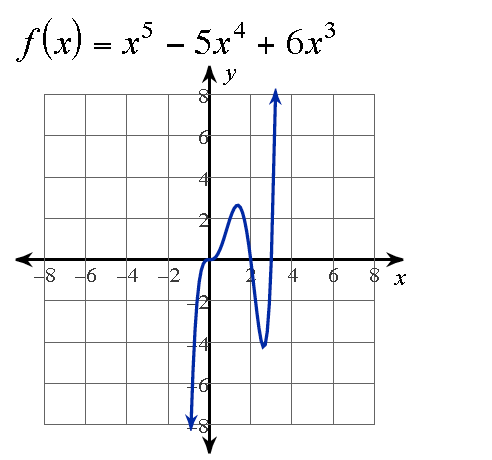
What is the degree of the function graphed here?
a)
2
b)
3
c)
4
d)
5
132.
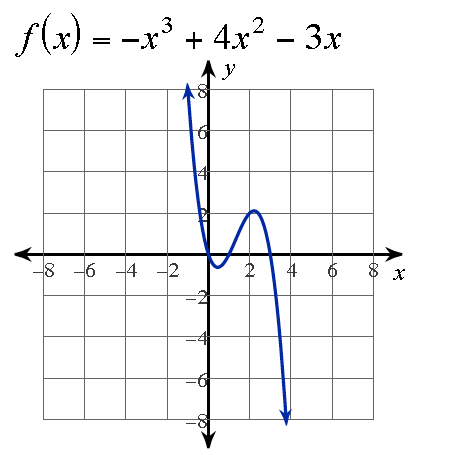
Is the leading coefficient positive or negative
a)
positive
b)
negative
133.
Is this expression in Standard Form?
6w2 - 9w3
a)
Yes
b)
No
134.
Put in Standard Form
6w2 - 9w3
a)
It is in Standard Form
b)
-9w3 + 6w2
135.
What is the Leading Coefficient?
-9w3 + 6w2
a)
-9
b)
6
c)
3
d)
2
136.
What are the coefficients?
-9w3 + 6w2
a)
-9, 3
b)
-9, 6
c)
6, 2
137.
What is the degree?
-9w3 + 6w2
a)
9
b)
3
c)
2
d)
6
138.
What type of expression is this?
-9w3 + 6w2
a)
Monomial
b)
Binomial
c)
Trinomial
d)
Polynomial
139.
Name this polynomial.
-9w3 + 6w2
a)
Linear
b)
Quadratic
c)
Cubic
d)
Quartic
140.

What is the name of the following function (5)

(a)  

141.

What is the name of the following function (x+4)

(a)  

142.

What is the name of the following function ( 4x24x^2 )

(a)  

143.

What is the name of the following function ( 4x32x2+x4x^3-2x^2+x )

(a)  

144.

What is the name of the following function ( 2x4+5x22x^4+5x^2 )

(a)  

145.

What is the name of the following function( x5+4x2+2x+1-x^5+4x^2+2x+1 )

(a)  

146.

Simplify:

(2x2)3

a)

8x5

b)

8x6

c)

6x6

147.
What value of p will make this equation true?
a)
-10
b)
-6
c)
2
d)
10
148.
a)
A
b)
B
c)
C
d)
D
149.
Simplify.
(3x2 - 2x) - (-2x2 + 3x)
a)
x2 + x
b)
5x2 + x
c)
5x2 - 5x
d)
x2 - 5x
150.
What are the zeros of the function?
a)
4,1
b)
3,1,-2,-5
c)
-3, -1, 2, 5
d)
-2,4
151.

How many roots are shown in the picture?

a)

0

b)

1

c)

2

d)

3

152.

How many zeroes are shown in the graph?

a)

1

b)

2

c)

3

d)

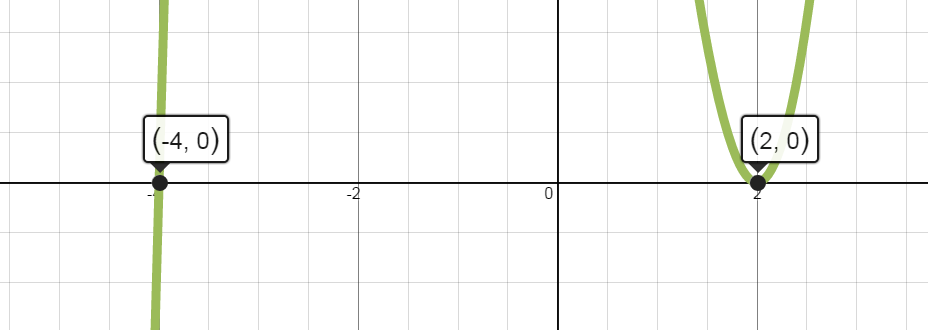
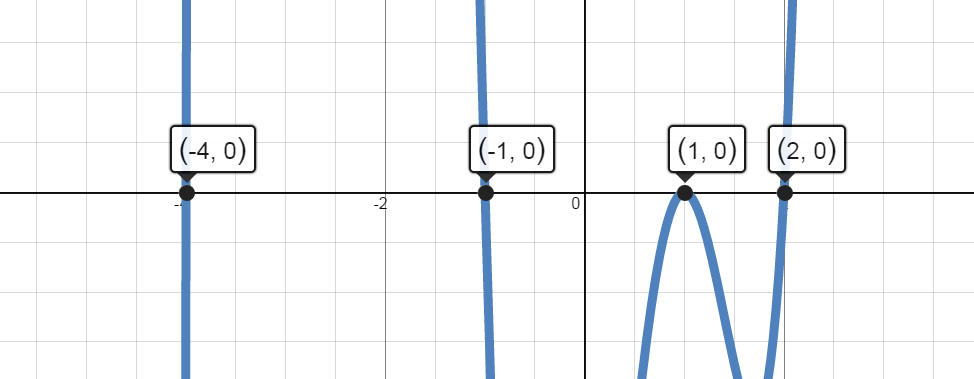
4

153.

Which root has a multiplicity of 2?

a)

-1

b)

2

c)

4

d)

-4

154.

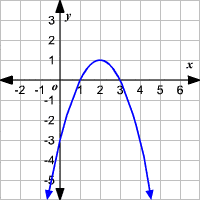
Use the graph to determine the solutions.

a)

x = -1 and x = -3

b)

x = 1 and x = -3

c)

x = 1 and x = 3

d)

x = -1 and x = 3

155.

What are the x- intercepts?

a)

(0,0) and (-4,0)

b)

(0,0) and ( 4,0)

c)

(0,0) and ( 2, -2)

d)

(0, 4) and (0, 0)

156.
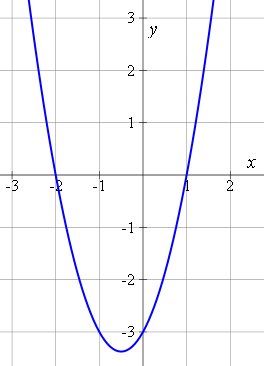
What is the equation for this parabola in factored form?
a)
y=(x+2)(x-1)
b)
y=(x-2)(x+1)
c)
y=(x-2)(x-1)
d)
y=(x+2)(x+1)
157.
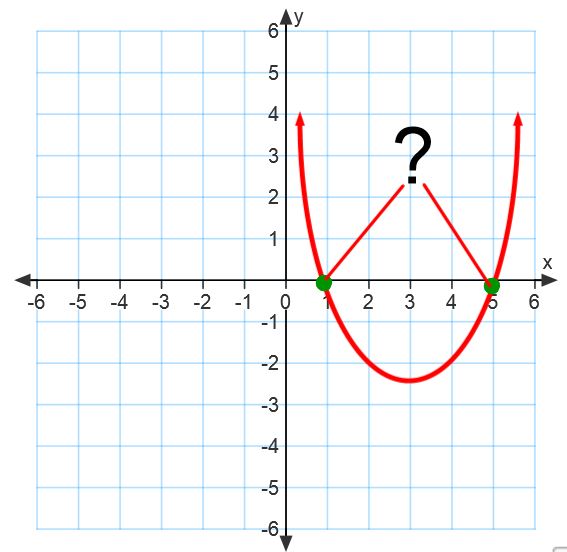
What are the green dots called?
a)
axis of symmetry
b)
vertex
c)
parabola
d)
roots or x-intercepts
158.
Find the root(s) of the function.
a)
x = 3
b)
x = {-3, -1, 2}
c)
x = {-3, 2}
d)
x = -1
159.

How many zeros does this equation have?

y=x(x2)(2x+1)(x4)(x+7)y=x\left(x-2\right)\left(2x+1\right)\left(x-4\right)\left(x+7\right)  

a)

4

b)

5

c)

3

d)

2

160.

What is the factor of the equation y= 3x36x2+3x3x^3-6x^2+3x

(a)